25 rubel 1916
Market Prices
6 salesAbout This Note
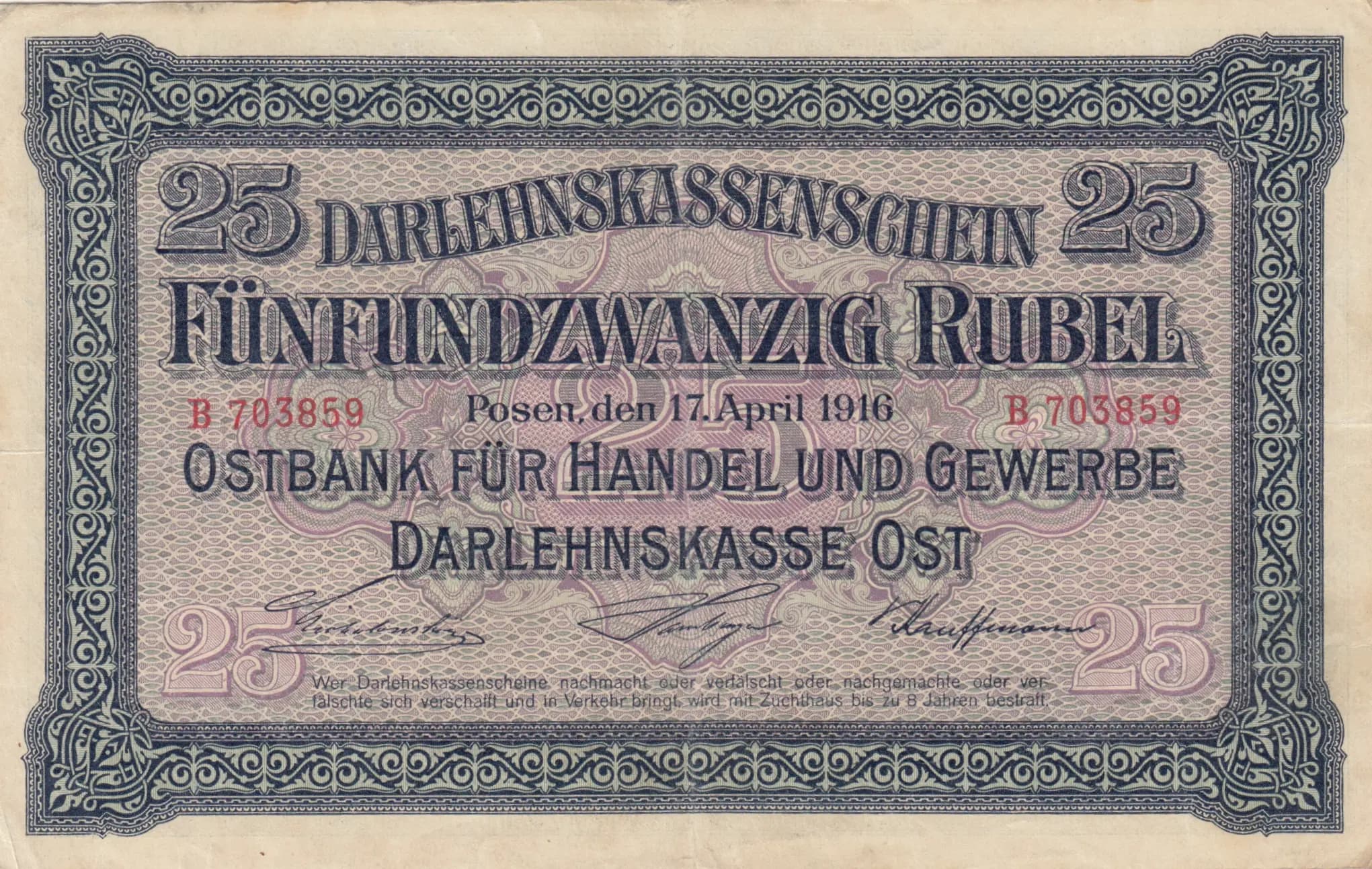
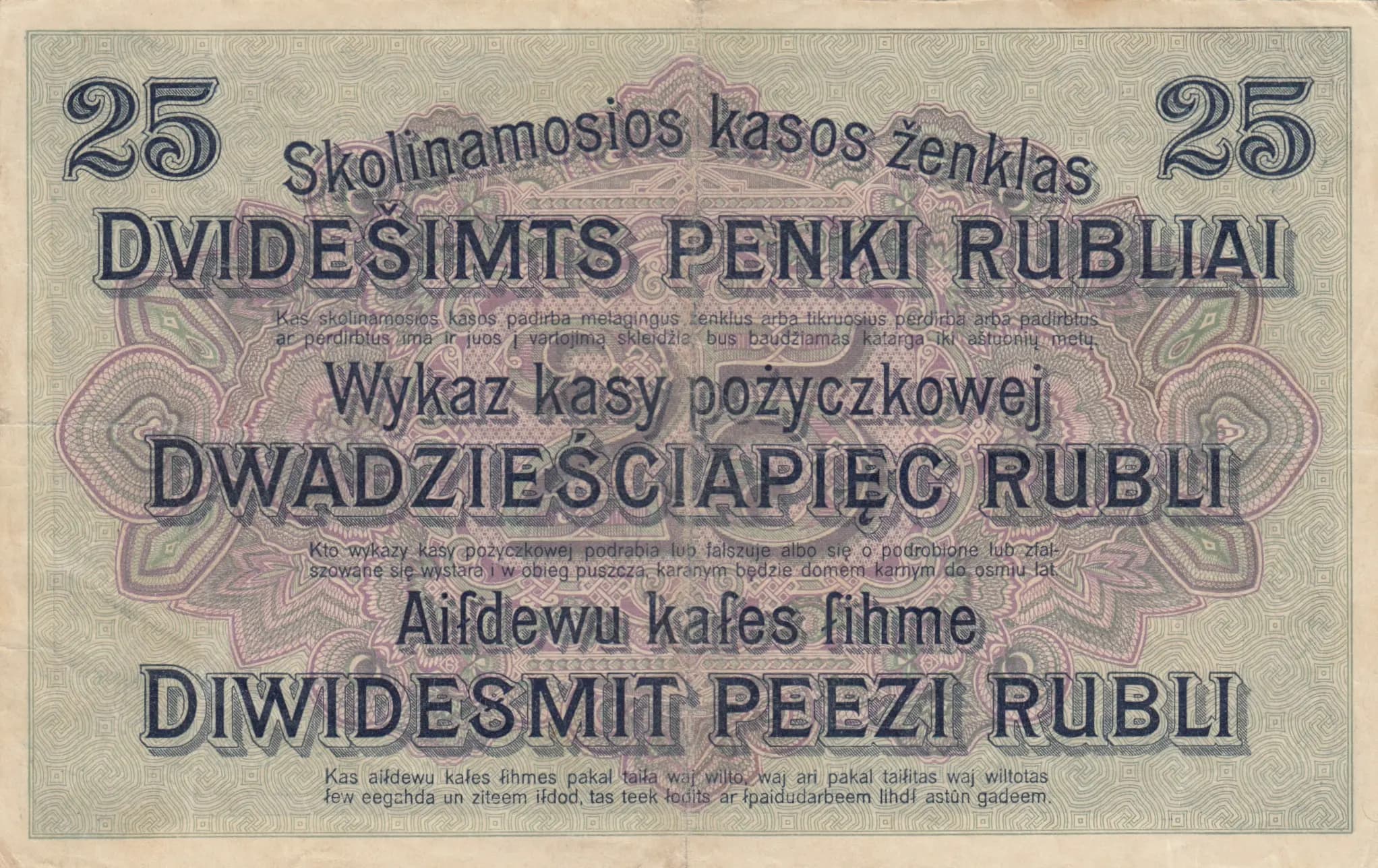
This is a 25 Rubel Darlehnskassenschein (loan certificate) issued by the Darlehnskasse Ost in Posen on April 17, 1916, during Germany's occupation of Eastern Europe in World War I. The note displays characteristic two-color printing in dark blue and red on a cream/lilac underprint, with an ornate decorative border featuring elaborate scrollwork. In VF condition, this example shows age-appropriate wear with visible foxing and creasing, yet maintains intact margins and good legibility of all inscriptions across three languages (German, Lithuanian, and Polish).
Common. The eBay price history provided shows this denomination consistently trading between $9–$63 in various condition grades over a six-year period, with most sales occurring in the $30–$50 range for VF examples. The 2008 catalog valuation of $250 VF appears significantly higher than realized market prices, suggesting market adjustment downward over the intervening decade. The relatively modest realized prices and consistent availability in the secondary market indicate this is a commonly encountered note among World War I German occupation currency collectors. Darlehnskasse Ost issues were produced in substantial quantities for occupation administration purposes, and examples survive in reasonable numbers. The specific denomination (25 Rubel) and issuing authority (Posen, 1916) do not represent a short print run or recalled issue.
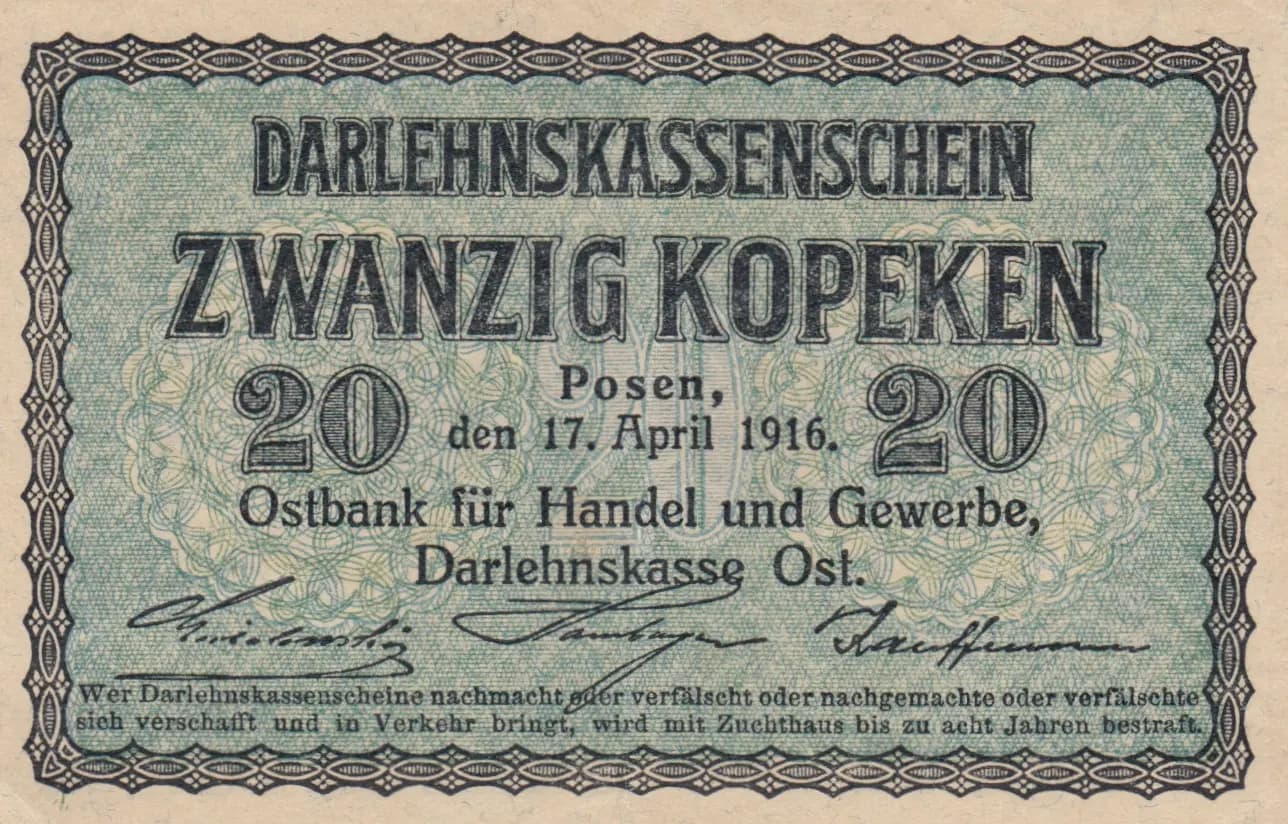
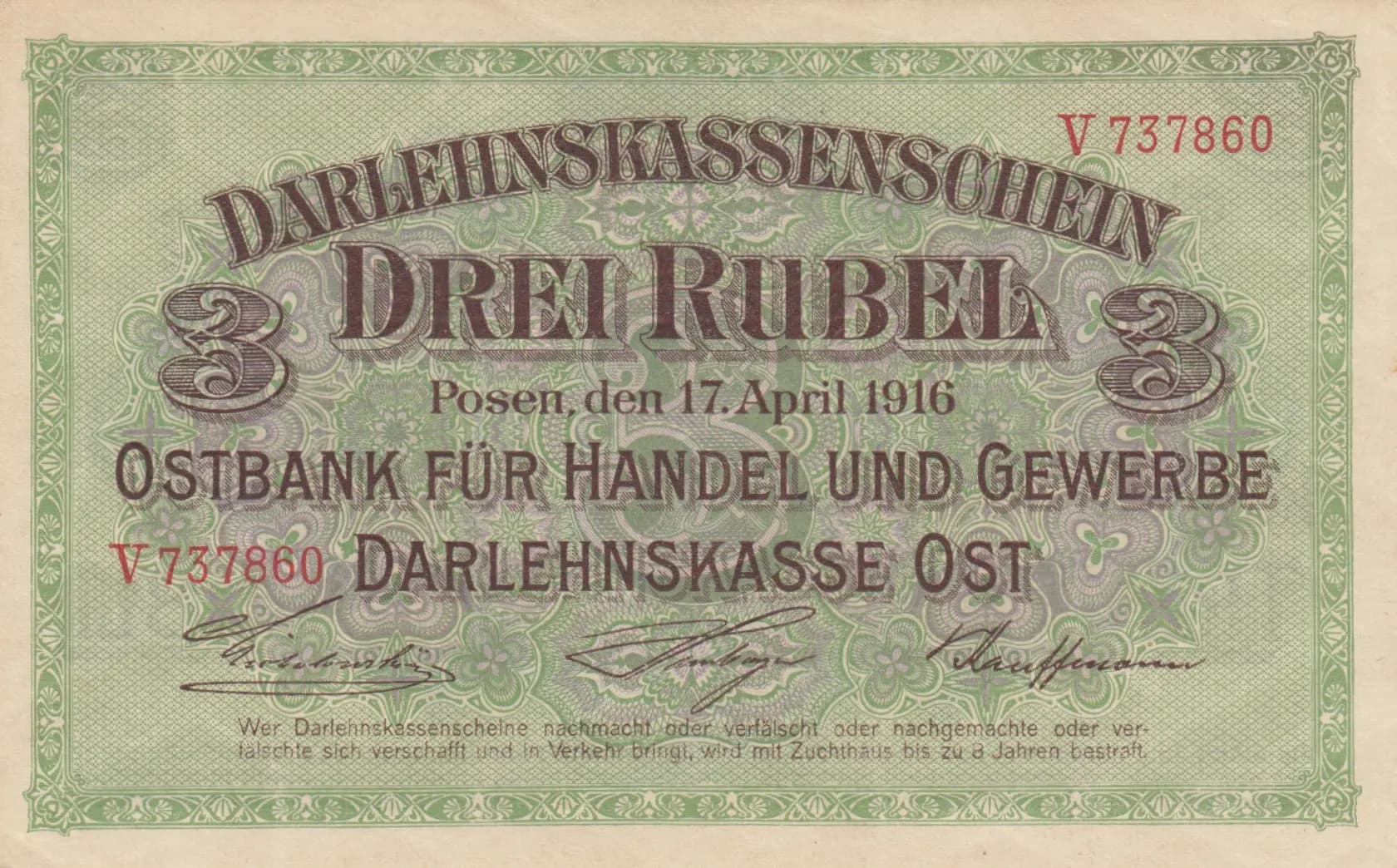
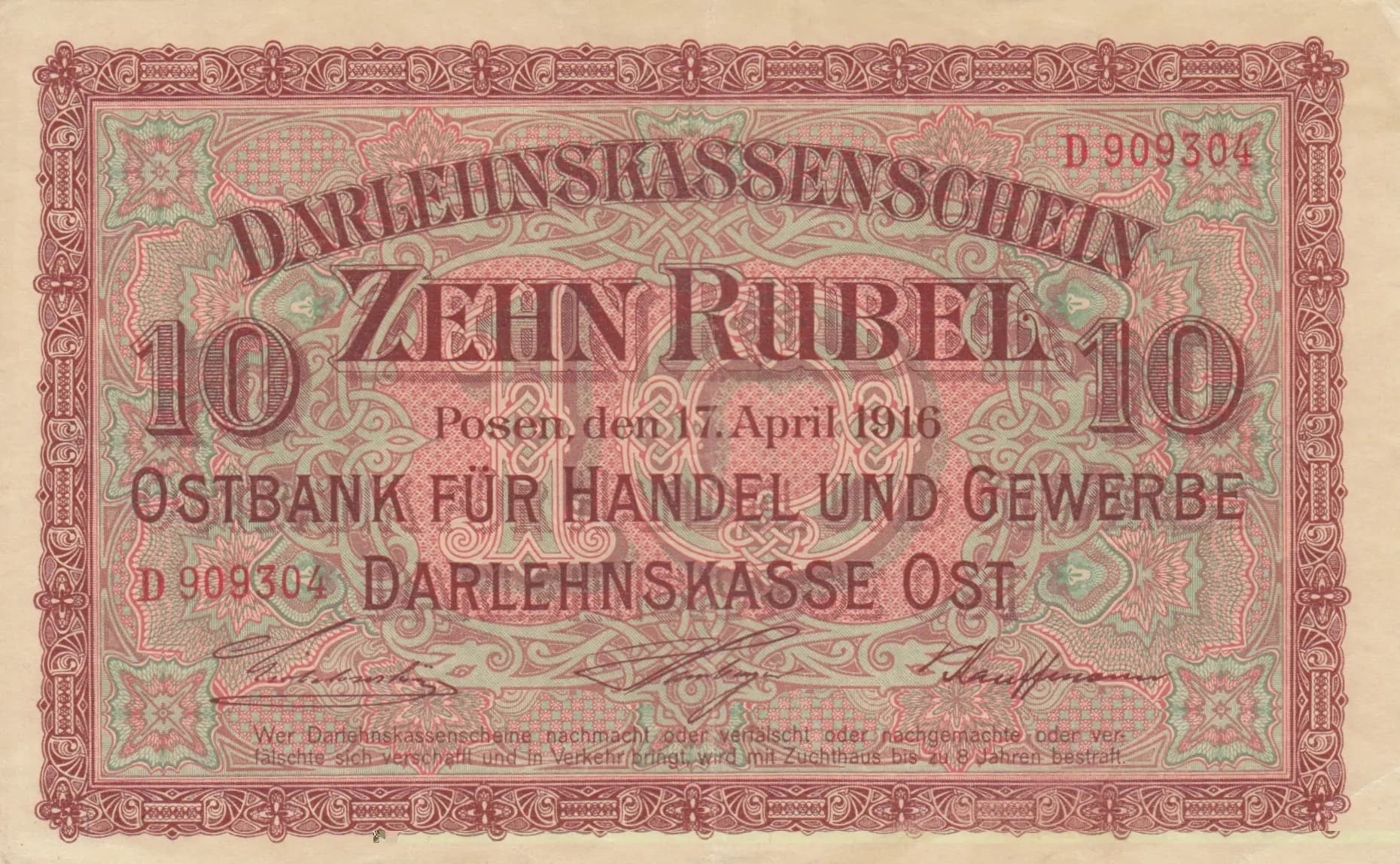
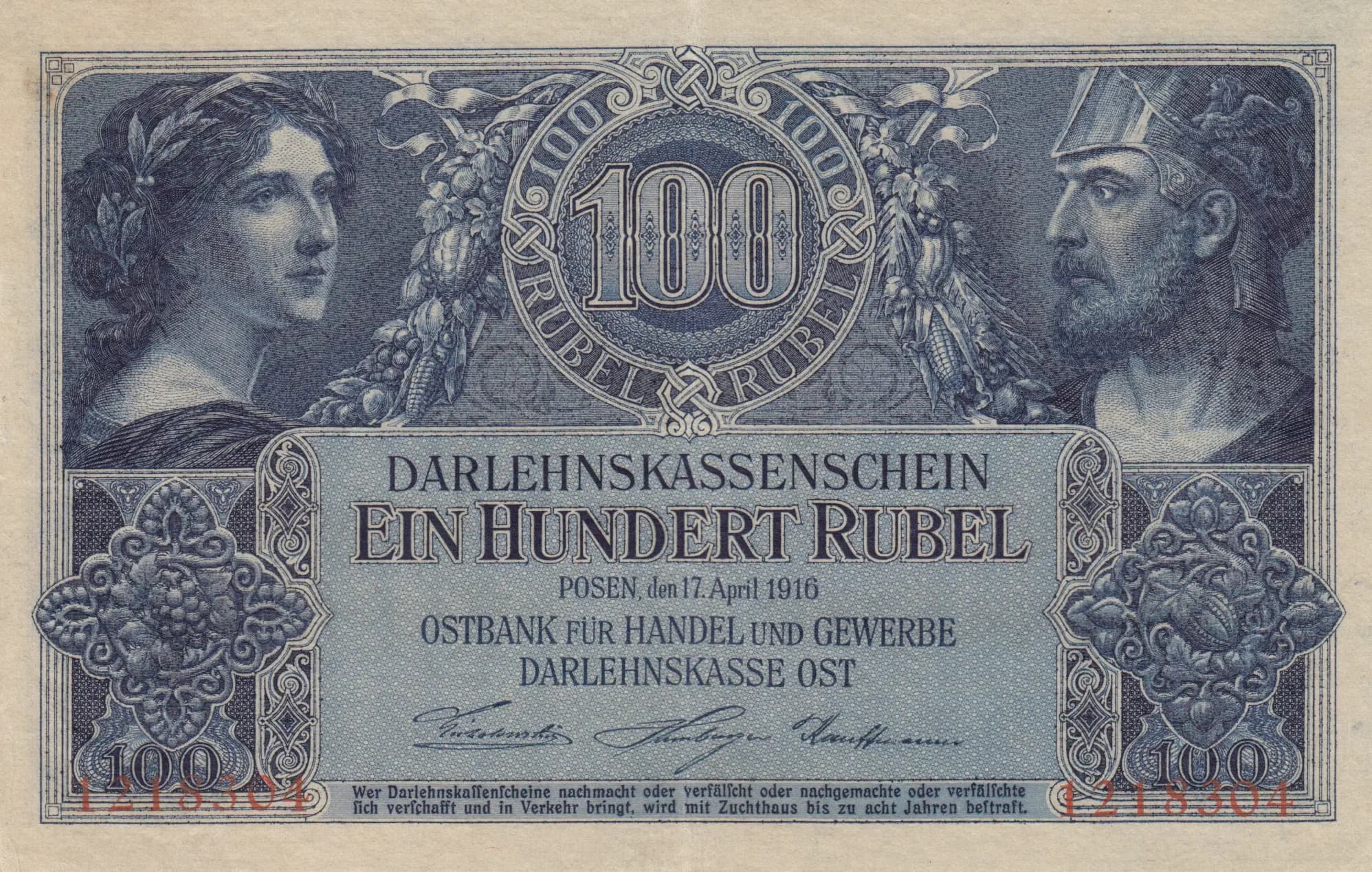
This banknote represents a fascinating artifact of World War I military occupation finance. The Darlehnskasse Ost (Eastern Loan Office) issued these certificates as emergency currency in occupied territories, specifically printed in Posen (modern-day Poznań) for circulation in Lithuania and other German-controlled Eastern European regions. The trilingual reverse—featuring German, Lithuanian, and Polish text—reflects the multinational character of the occupied territories and the German administration's attempt to facilitate commerce and control in these conquered lands through localized currency.
The note features a classical Germanic design aesthetic typical of early 20th-century German occupation currency. The obverse displays 'OSTBANK FÜR HANDEL UND GEWERBE' (East Bank for Trade and Commerce) as the primary issuer identification, with the denomination '25' prominently displayed. The design employs an ornate rectangular border with elaborate scrollwork and geometric patterns in the corners—characteristic Art Nouveau/Jugendstil influenced ornamentation common to Austro-Hungarian and German financial instruments of the period. No portraits or allegorical figures are present; instead, the design relies on typography and ornamental elements for visual authority and security. The two-color printing in dark blue/navy text with red serial numbers (visible as 'B 703859') creates visual contrast. The reverse maintains the identical border design but presents the text in three scripts (Latin/German, Cyrillic transliteration for Lithuanian, and Latin for Polish), indicating this was a multilingual occupation currency designed for circulation across diverse linguistic regions under German military administration. The cream/beige base paper with pale purple/pink underprint provides subtle color variation typical of the period.
FRONT SIDE: '25' (denomination); 'DARLEHNSKASSENSCHEIN' (Loan certificate); 'FÜNFUNDZWANZIG RUBEL' (Twenty-five Rubles); 'Posen, den 17. April 1916' (Posen, April 17, 1916); 'OSTBANK FÜR HANDEL UND GEWERBE' (East Bank for Trade and Commerce); 'DARLEHNSKASSE, OST' (Loan Office, East); Serial number 'B 703859'; Counterfeiting warning in German: 'Whoever counterfeits or forges loan certificates or obtains counterfeit or forged ones and puts them into circulation will be punished with imprisonment up to 9 years.' BACK SIDE: '25' (denomination repeated in corners); LITHUANIAN TEXT: 'skolinamosios kasos ženklas' (Loan office certificate); 'DVIDESIMTS PENKL RUBLIAI' (Twenty-five Rubles); Counterfeiting penalty clause in Lithuanian. POLISH TEXT: 'Wylkaz kasy pozyczkowej' (Loan office certificate); 'DWADZIEŚCIAPIEC RUBLII' (Twenty-five Rubles); Counterfeiting penalty in Polish: 'Whoever counterfeits or forges loan office certificates and puts them into circulation will be punished with imprisonment up to eight years.' NOTE: The visual analysis indicates some corrupted or unclear text in what may be a third language (possibly Latvian or Russian transliteration), suggesting either printing errors or damage to original printing blocks.
This banknote was produced using two-color letterpress or intaglio printing, a standard security printing method for the era. The dark blue/navy primary text and the contrasting red serial numbers indicate separate printing passes. The ornate border detail and fine line work in the scrollwork patterns suggest intaglio engraving, which was the premium security printing method employed by German state and occupation currency authorities. The printer for the Darlehnskasse Ost emission is not explicitly identified in the visible inscriptions, though such occupational currency was typically produced by established German security printers (such as Giesecke+Devrient or similar firms under military contract). The presence of printing irregularities or corrupted text noted on the reverse may indicate wear to engraved plates or production issues during wartime printing.
This example is identified as Pick catalog number P-R125 with serial number prefix 'B' and serial number '703859'. The series letter 'B' may indicate a specific printing series or signature combination, though the visual analysis does not reveal distinct signatures on this note. The April 17, 1916 date is consistent with early Darlehnskasse Ost emissions. Varieties of this Pick number may exist with different series letters (A, C, D, etc.), different date variants within 1916, or different printer marks, though the visual analysis does not provide sufficient detail to identify multiple printing variants. The multilingual reverse (German/Lithuanian/Polish/possible third language) appears to be the standard design for this issue rather than a variant, as it reflects the occupation authority's need to facilitate commerce across multilingual territories. No overprints or post-printing modifications are evident.