3 rubel 1916
Market Prices
11 salesAbout This Note
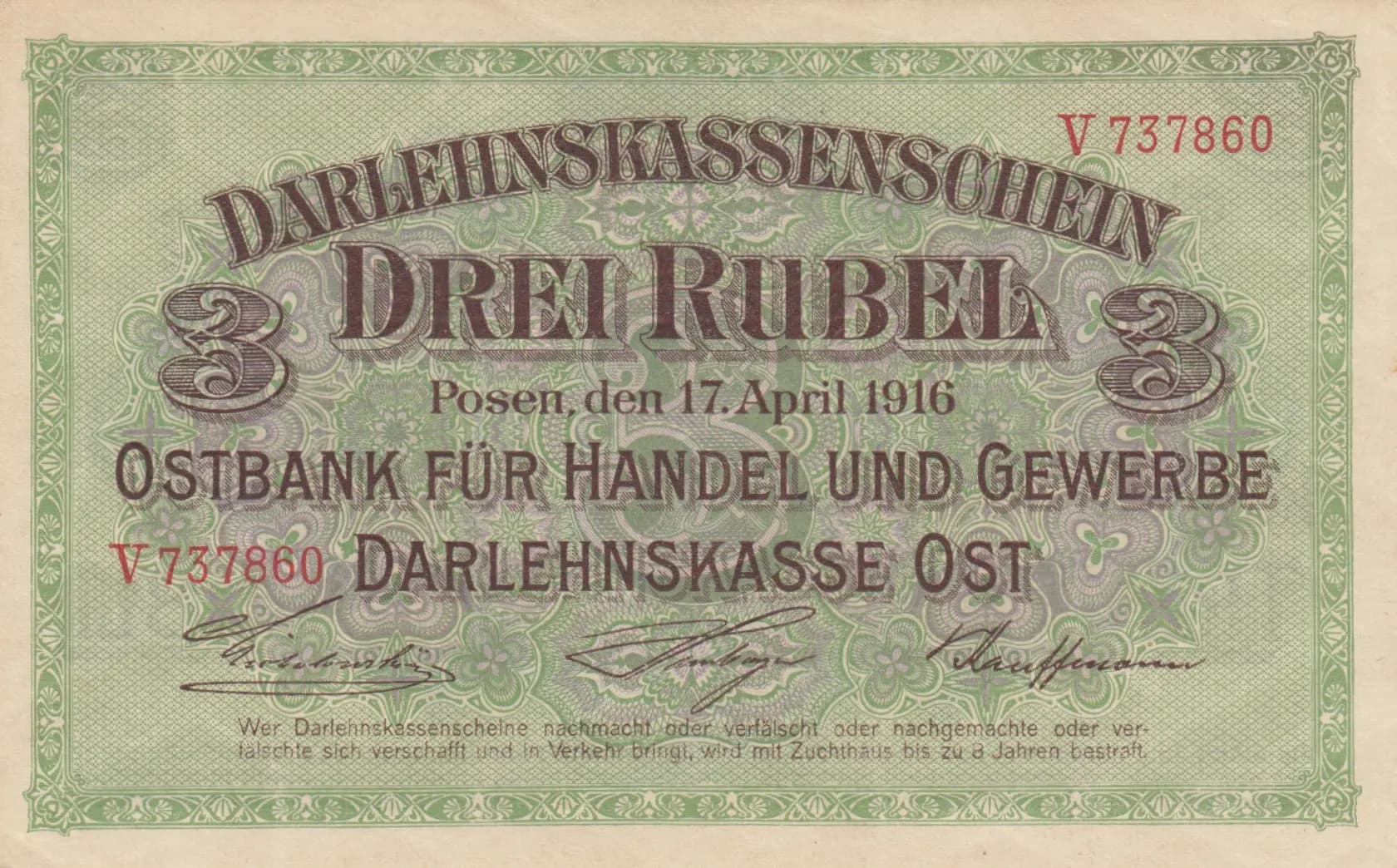
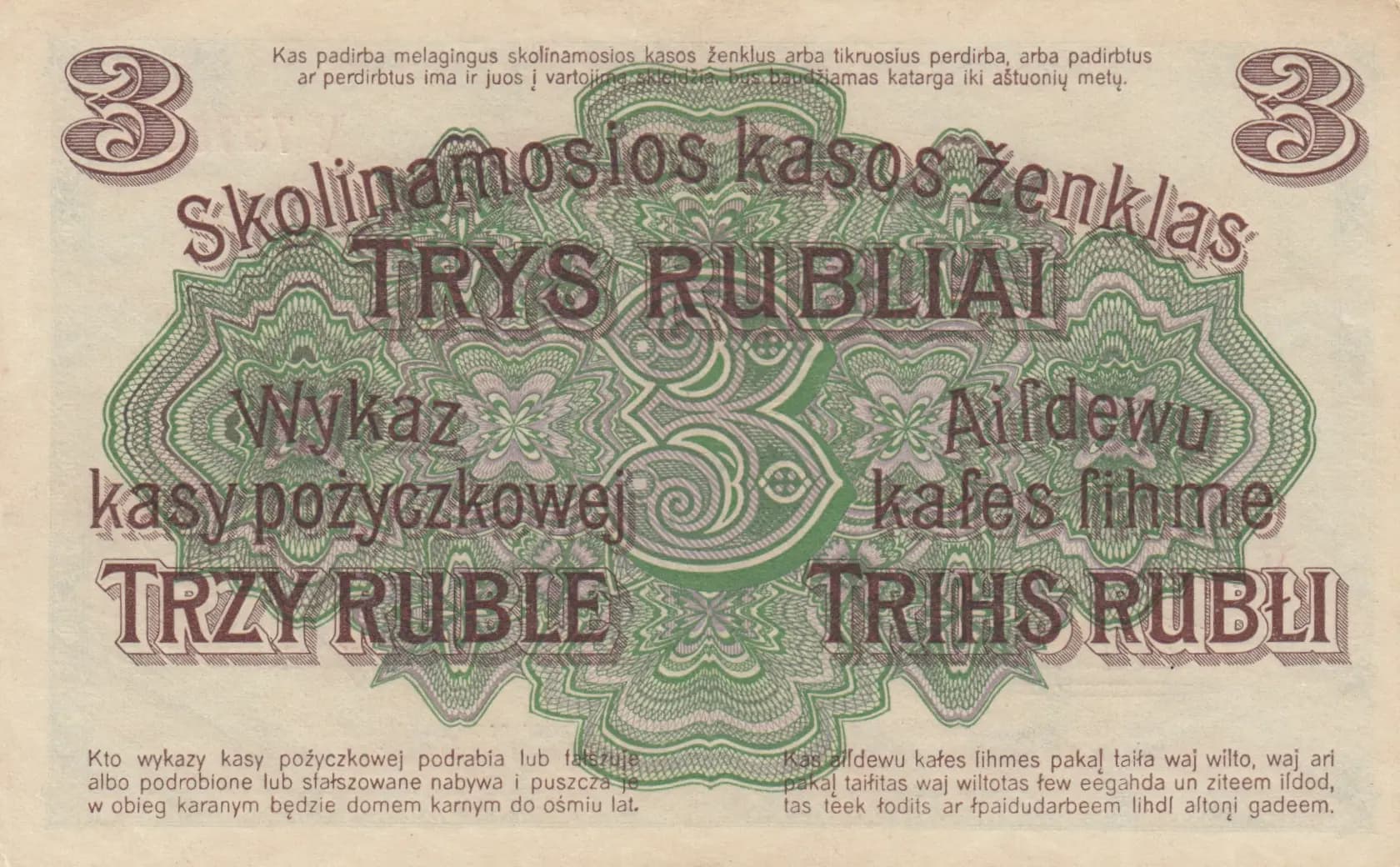
This is an AU-graded 3 Rubel note issued by the Darlehnskasse Ost in Posen on 17 April 1916, presenting an exceptional example of German occupation currency from World War I. The note displays crisp, sharp printing with ornate Art Nouveau borders in green, brown, and cream tones, and shows virtually no wear despite its age of over a century. The multilingual reverse (German, Lithuanian, and Polish/Yiddish) reflects the diverse population of the occupied eastern territories and makes this a historically significant regional banknote with strong collector appeal.
Common. Based on the eBay market data provided, which shows consistent sales in the $2-$33 range across multiple condition grades (F through VF) over an eight-year period, this note type remains readily available to collectors. Even in VF condition, recent sales (2023) reached only $33, and the 2008 catalog values ($50 for VF, $150 for UNC) now appear optimistic relative to actual realized prices. The Darlehnskasse Ost issued these notes in substantial quantities for regional circulation during 1916-1918, and survival rates remain good. Pick R123b in AU condition, while nice, is not scarce.
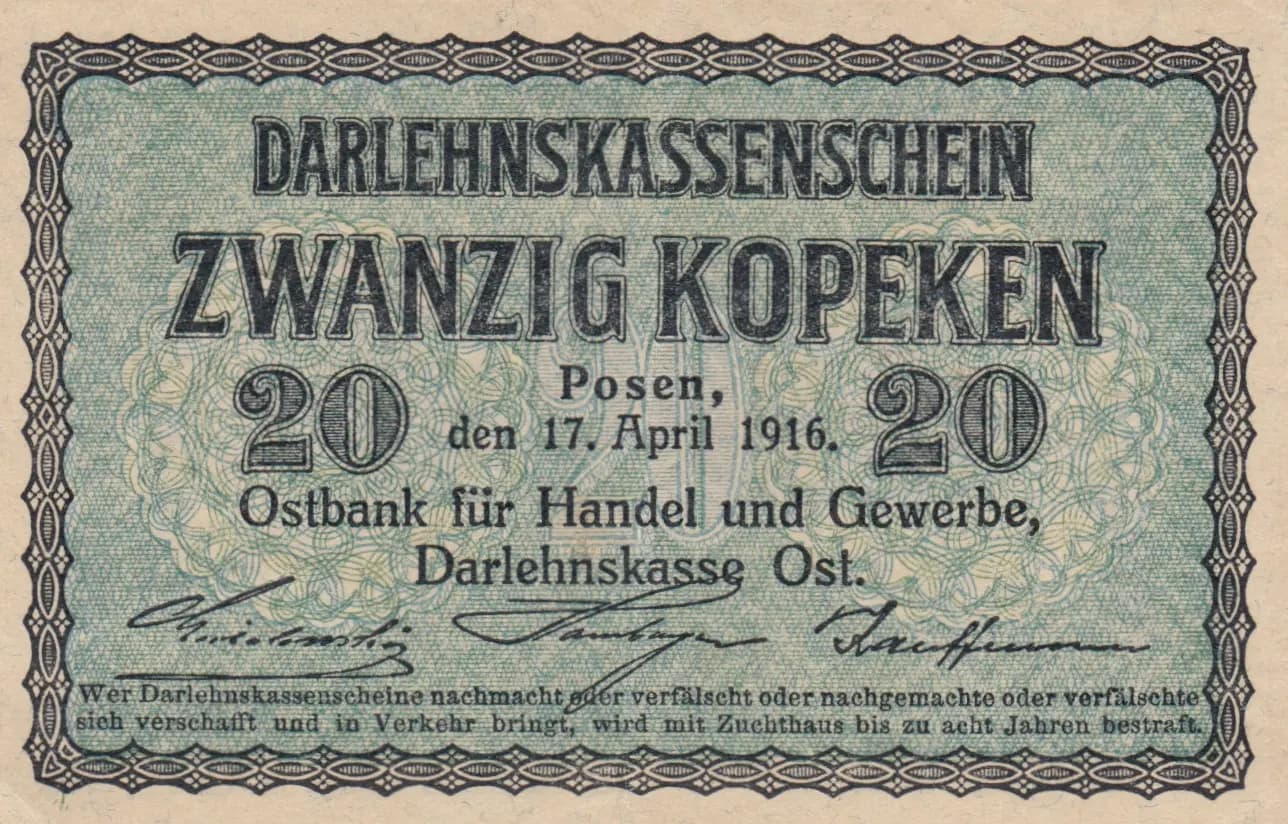
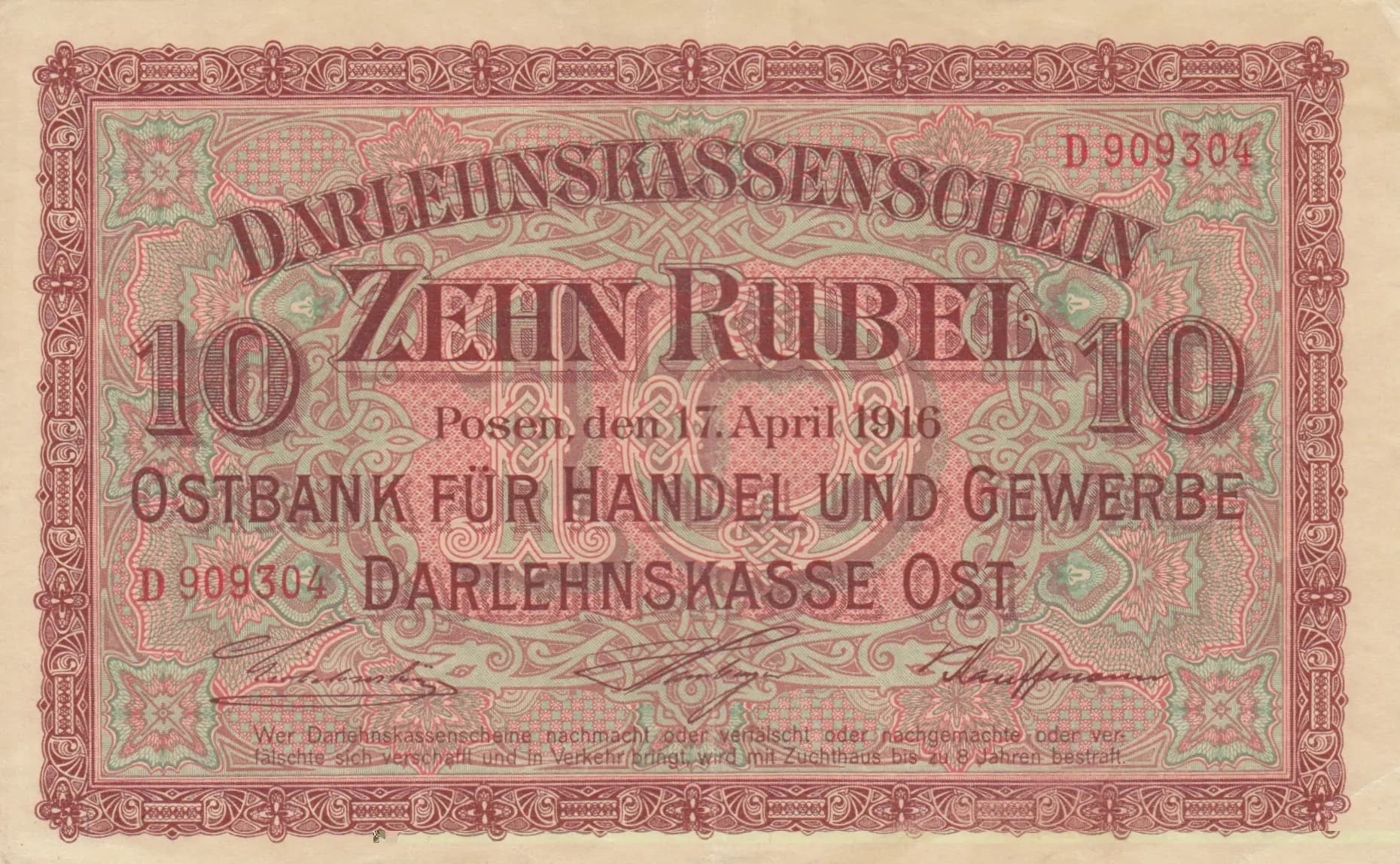
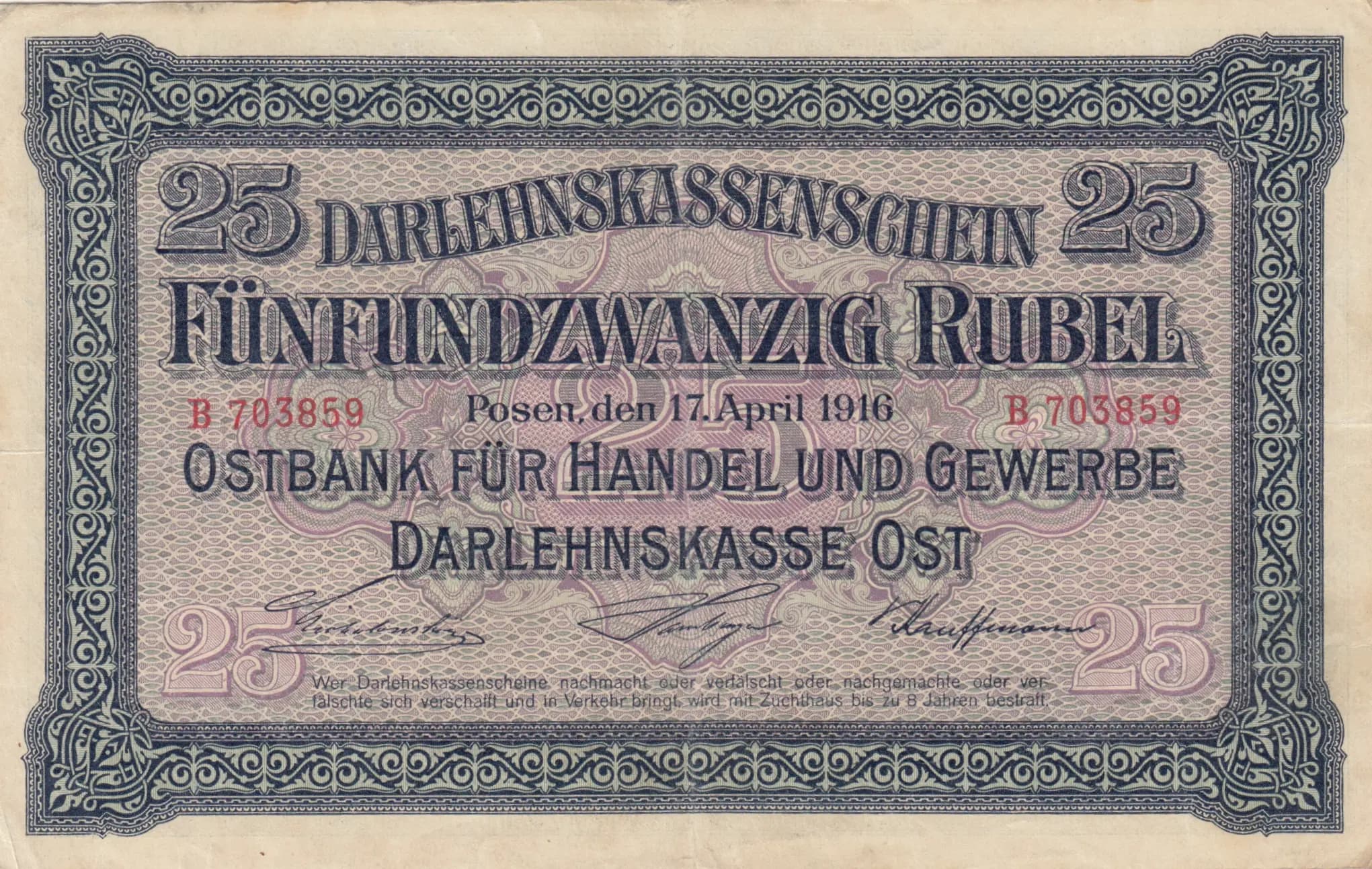
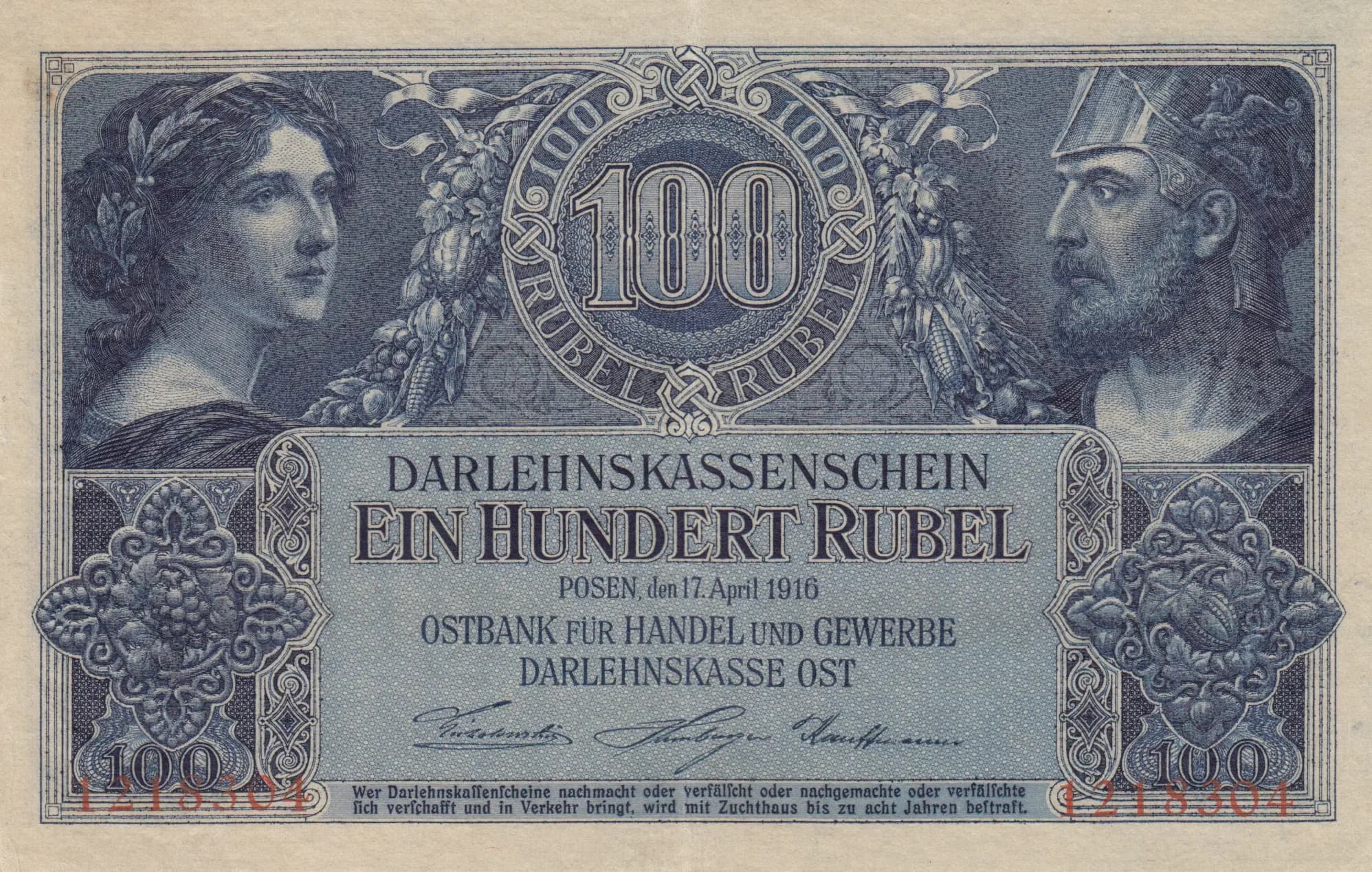
Issued during Germany's occupation of eastern territories in World War I, this Darlehnskassenschein (loan bank certificate) was specifically created to facilitate commerce and financial transactions in the annexed region centered on Posen (modern-day Poznań, Poland). The trilingual design demonstrates the occupying administration's pragmatic approach to managing a culturally and linguistically diverse population, with warnings against counterfeiting rendered in German, Lithuanian, and Polish to ensure comprehension across all communities. Such notes were circulated in Lithuania and surrounding areas until 1922, serving as a medium of exchange until political independence and currency reforms rendered them obsolete.
This banknote exemplifies the Art Nouveau aesthetic popular in early 20th-century German currency design, featuring elaborately engraved borders composed of repeating geometric and floral motifs executed in fine parallel lines. The obverse centers on the denomination '3' and text 'DREI RUBEL' in prominent placement, surrounded by ornamental scrollwork and flourishes typical of the period. The reverse features a central ornamental medallion with intricate geometric patterns and scrollwork, framed by matching decorative borders. No portraits or specific landmarks are depicted; instead, the design emphasizes institutional legitimacy through detailed typography and the repetition of institutional names (OSTBANK FÜR HANDEL UND GEWERBE, DARLEHNKASSE OST). The multilingual text blocks occupy the reverse, serving both a practical and security function. A red serial number (V 737860) appears in the upper right of the obverse. The color scheme—light green base with brown/maroon text and decorative elements on a cream background—provides strong visual distinction while maintaining the formal aesthetic appropriate to a financial instrument.
FRONT SIDE: 'DARLEHNNSKASSENSCHEIN' (Loan Institution Certificate); 'DREI RUBEL' (Three Rubles); 'Posen, den 17. April 1916' (Posen, 17 April 1916); 'OSTBANK FÜR HANDEL UND GEWERBE' (East Bank for Trade and Commerce); 'DARLEHNKASSE OST' (East Loan Bank); Serial number 'V 737860'; Counterfeiting warning: 'Wer Darlehnskassenscheine nachmacht oder verfälscht oder nachgemachte oder verfalschte sich verschafft und in Verkehr bringt wird mit Zuchthaus bis zu 8 Jahren bestraft' (Whoever counterfeits or forges loan certificates or procures and circulates counterfeited or forged ones will be punished with hard labor up to 8 years). REVERSE SIDE: 'TRYS RUBLIAI' and 'TRY'S RUBLIUAN' (Lithuanian: Three Rubles); 'Skolina motos kasos zenklai' (Lithuanian: Loan bank certificates); Lithuanian counterfeiting warning: 'Kas padirba melagingus skolinamosios kasos zenklus arba tikruosios perdiribai arba padirbtus ima ir juos i vartojimu isveda katarrga iki aštuoniy metu' (Whoever makes false loan certificates or counterfeits true ones and puts them into circulation will be punished with up to 8 years imprisonment); Polish/Yiddish denominations: 'TRZ'Y RUBLE' / 'TRZYSRUBLI' (Three Rubles) with corresponding counterfeiting warnings in those languages.
Intaglio (engraved line printing), as evidenced by the fine parallel line work visible in the ornamental borders, the sharp crisp quality of all text, and the precise registration of the multicolor design. The multiple security elements—fine line borders, intricate scrollwork, serial numbering in contrasting red ink, and the detailed counterfeiting warnings in fine print—are all characteristic of high-security intaglio production typical of German government security printers of the World War I era. The precise execution and absence of any printing defects visible in the AU condition specimen confirm professional security printing standards.
The specific variety observed is Pick R123b, characterized by the dark brown on green and lilac underprint as noted in the reference data. The serial number prefix 'V' is visible on this specimen (V 737860). This note was issued in Posen on 17 April 1916. Known varieties of this issue may include different signature combinations (three signature lines are visible but individual signatory identification would require specialized reference), different date printings within the 1916 issuance, and potentially different serial number prefixes, though these details require consultation of specialized German regional banknote catalogs for definitive classification.