50 mark 1918
Market Prices
24 salesAbout This Note
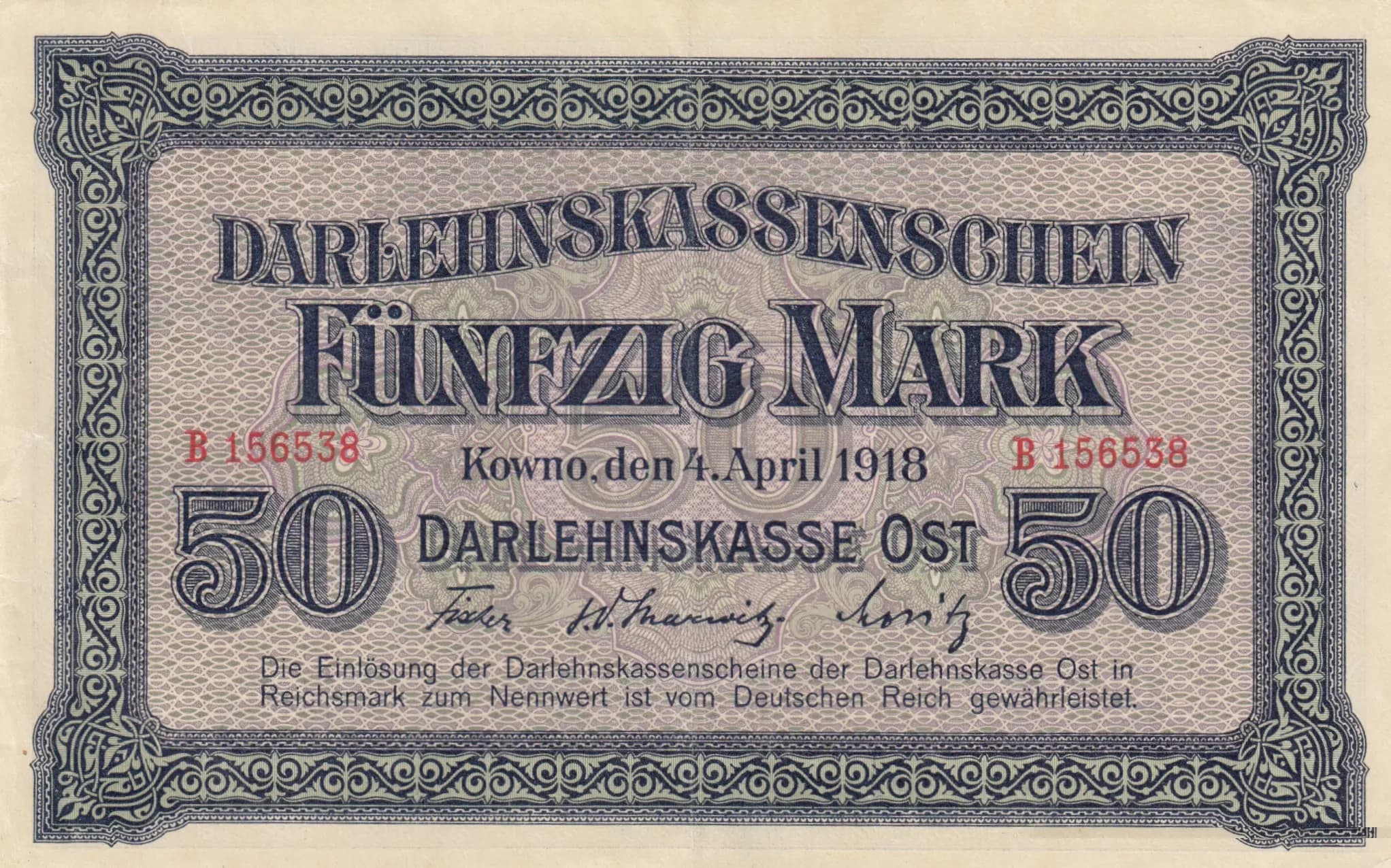
This is a German 50 Mark Darlehnskassenschein issued by the Darlehnskasse Ost (Eastern Loan Office) in Kovno on April 4, 1918, representing Pick-R132. The note features an elegant design with dark blue ink on a cream and light purple underprint, displaying intricate ornamental borders with scrollwork and fine cross-hatching throughout. The specimen appears to be in excellent condition with no visible wear, creases, or damage, making it a desirable example of this regional occupation currency that circulated in Lithuania until 1922.
Common. The eBay sales data provided shows consistent, modest pricing with VF examples regularly selling between $6-27, well below the 2008 catalog value of $60 for VF. The frequency of sales across multiple years (2010-2024) and varying conditions (VG through AUNC) indicates steady market availability. The Darlehnskasse Ost notes were issued in significant quantities across multiple denominations and dates during the 1918-1919 occupation period, and this 50 Mark denomination with the standard April 4, 1918 date does not exhibit characteristics of a scarce variety. Current market prices have trended downward from 2008 catalog values, which is typical of common, readily available notes.
This banknote was issued during Germany's occupation of the Baltic region in World War I, specifically by the Eastern Loan Office established in Kovno (now Kaunas, Lithuania). The multilingual inscriptions in German, Lithuanian, and other Baltic languages reflect the occupation administration's need to communicate with the local population while maintaining German monetary control. The guarantee of redemption in Reichsmark by the German Reich underscores the imperial authority backing this emergency currency during the final years of WWI.
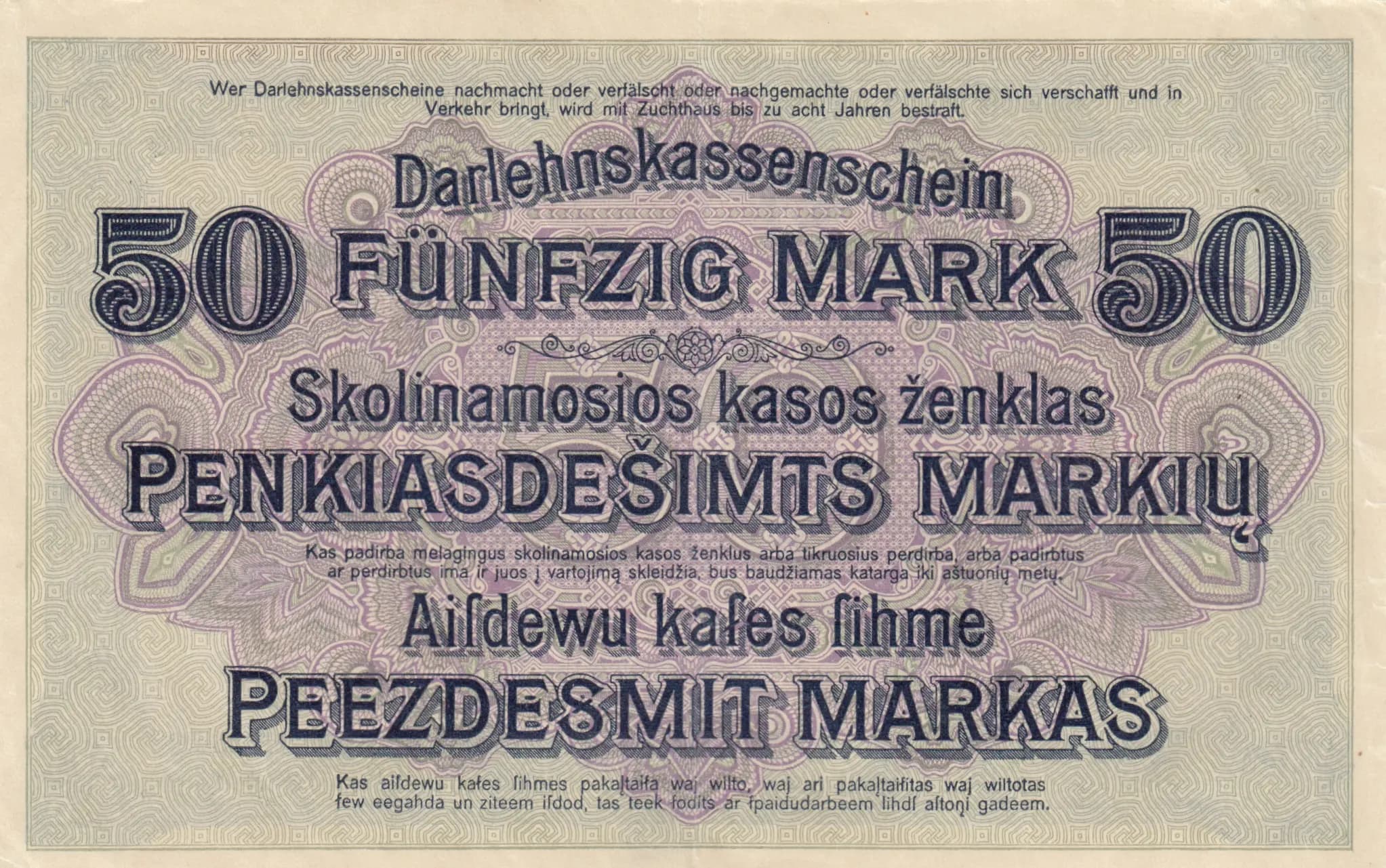
This regional banknote displays a classical German design aesthetic typical of the Darlehnskasse emergency currency series. The obverse features an elaborate ornamental border frame with repeating scrollwork motifs and floral patterns in the corners, surrounding the central denomination and issuer information. The reverse employs a complex geometric maze-like border pattern with circular ornamental elements in mauve and pink tints. Neither side features portrait imagery or landmark depictions; rather, the security design relies on fine cross-hatching patterns, intricate geometrical borders, and multilingual text. The color scheme of dark blue/navy on cream and light purple underprint with subtle pink tinting creates visual complexity intended to prevent counterfeiting. The serial numbers are printed in red, providing additional distinction from the primary blue printing.
FRONT SIDE: 'Darlehnskassenschein' (Loan Office Certificate) / 'Fünfzig Mark' (Fifty Mark) / Serial number 'B 166538' (appears twice) / 'Kowno, den 4. April 1918' (Kovno, April 4, 1918) / 'Darlehnkasse Ost' (Eastern Loan Office) / 'Die Einlösung der Darlehnkassenscheine der Darlehnkasse Ost in Reichsmark zum Nennwert ist vom Deutschen Reich gewährleistet.' (The redemption of the Loan Office certificates of the Eastern Loan Office in Reichsmark at face value is guaranteed by the German Reich.) / 'Jahr Unterschrift Kommit' (Year Signature Committee). BACK SIDE: 'Darlehnskassenschein' (Loan Office Certificate) / 'Fünfzig Mark' (Fifty Mark) / 'Skolinamosios kasos ženklas' (Lithuanian: Loan Office Token) / 'Penkiasdešimt Markių' (Lithuanian: Fifty Mark) / 'Peezdesimit Markas' (Fifty Mark in variant spelling) / German counterfeiting warning: 'Wer Darlehnskassenscheine nachmacht oder verfälscht, oder nachgemachte oder verfälschte sich verschafft und in Verkehr bringt, wird mit Zuchthaus bis zu acht Jahren bestraft.' (Whoever counterfeits or forges Loan Office certificates, or obtains counterfeit or forged ones for themselves and puts them into circulation, will be punished with hard labor for up to eight years.) / Lithuanian counterfeiting warning: 'Kas paderiba melagingas skolinamosios kasos ženklas arba tikruosios perdirba, arba padirbtus ią juos į vartojima skleidžia, bus baudziamas katarga iki aštuoniy metų' (Whoever makes a false loan office token or adulterates true ones, or circulates adulterated ones, will be punished with hard labor up to eight years.)
This note was produced using letterpress and intaglio printing techniques typical of German banknote production in the WWI era. The fine cross-hatching background patterns, ornamental borders, and the crisp impression of text suggest engraved steel plates for the primary design elements. The multilingual text on the reverse indicates multiple printing passes or careful plate work to accommodate German, Lithuanian, and other Baltic language inscriptions. The serial numbers in red suggest a separate printing run or supplementary printing pass. The precision of the geometric patterns and the fine detail visible in the ornamental work are characteristic of German security printing standards of the period, though the specific printer for the Darlehnskasse Ost series is not definitively identified in standard catalogs.
The observed specimen carries serial number B 166538 with the standard date of April 4, 1918 (Kowno, den 4. April 1918). The Darlehnskasse Ost 50 Mark notes exist with various serial number prefixes and ranges; the 'B' prefix appears to be standard for this denomination and date. No significant varieties or overprints are evident in this specimen. Known varieties of this Pick number would include different signature combinations and possibly variant serial number prefixes (A, C, etc.), but without access to comprehensive serial number range documentation, specific variety classification cannot be definitively assigned to this individual note beyond its 'B 166538' designation.