50 000 000 000 mark 1923
Market Prices
10 salesAbout This Note
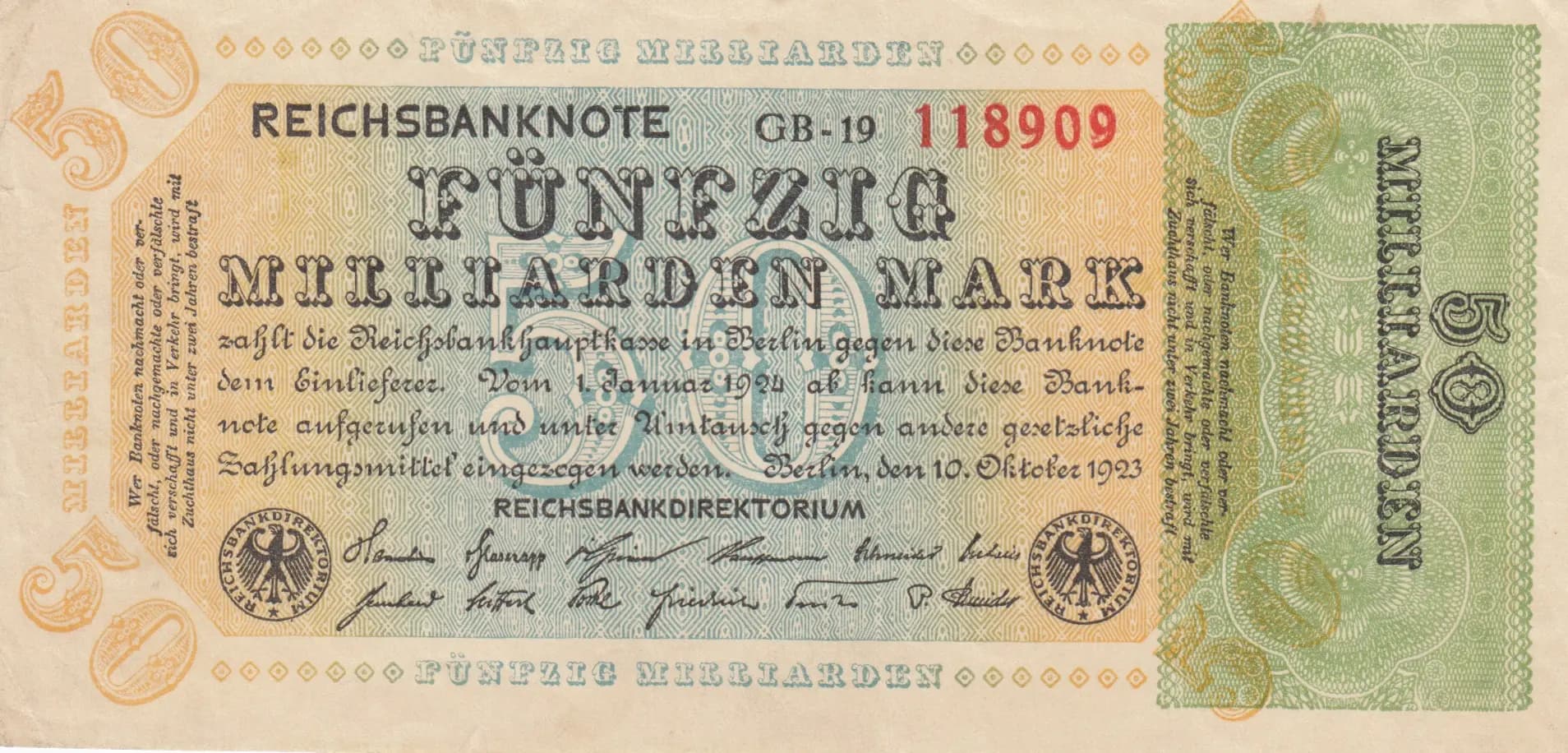
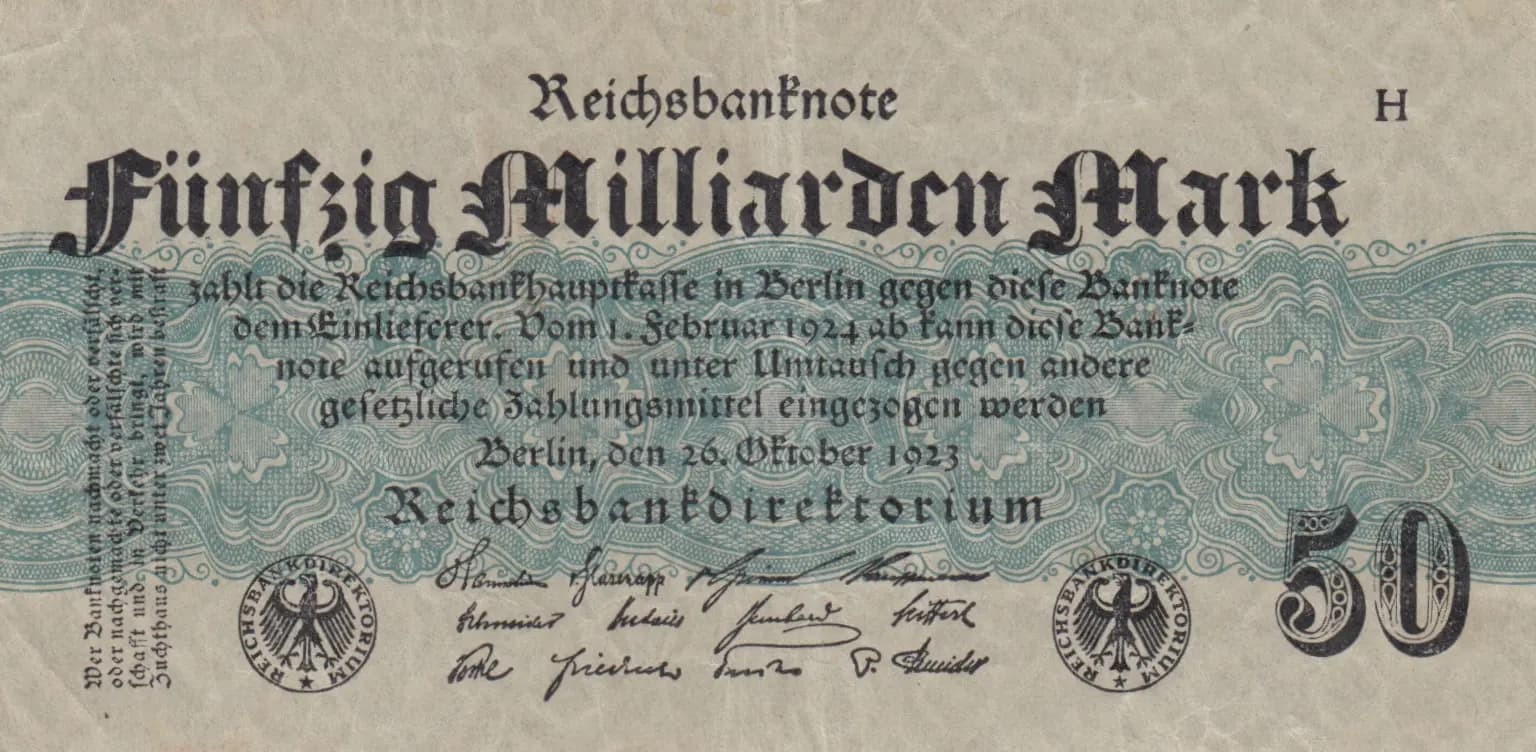
This is a German hyperinflation-era banknote denominated at 50 billion mark (Fünfzig Milliarden Mark), issued by the Reichsbank on October 26, 1923—during the peak of the Weimar hyperinflation crisis. The VF-graded example displays the characteristic elegant design of late-inflation currency with ornate teal and green borders, fine-line engraving, and official eagle seals. Despite significant age-related foxing and yellowing consistent with a century-old paper artifact, the note remains well-preserved with no major damage, making it a compelling historical document of one of the most economically turbulent periods of the 20th century.
Common. eBay market data shows recent sales ranging from $1.99 to $30 depending on condition, with VF examples selling for approximately $9-$10. The 2016 catalog valuation of $40 for VF demonstrates modest collector value. The relatively high print runs of hyperinflation-era currency, combined with these low market prices and frequent availability on auction platforms, clearly indicate this is a common issue. Millions of these notes were printed during the crisis.
Issued at the absolute peak of the German hyperinflation of 1923, this 50-billion-mark note represents the monetary collapse that followed World War I and the Treaty of Versailles. The note's inscription referencing its redemption validity through February 1, 1924, reflects the Reichsbank's attempt to control currency circulation during this period of economic crisis. The formal design with dual eagle seals and official signatures demonstrates the government's effort to maintain institutional credibility even as the currency's purchasing power evaporated—within weeks, notes of even higher denominations would be issued.
This uniface design features the denomination '50' prominently displayed in large Gothic-style numerals against a blue-green underprint. The obverse is framed by an elaborate ornamental border composed of fine interlocking scrollwork and classical flourishes rendered in teal and green, with black text and numerals. Two circular seals bearing the Reichsadler (Imperial Eagle of the German Reich) appear at the bottom corners, flanking multiple signature lines for Reichsbank officials. The central area contains the formal redemption text and issue date in regulated spacing. The paper is gray, and the overall aesthetic reflects the dignity and precision expected of official currency despite the economic chaos of the period. The reverse appears blank or minimally printed, typical of many inflation-period notes.
FRONT SIDE: 'Reichsbanknote' (Reichsbank note); 'Fünfzig Milliarden Mark' (Fifty billion mark); 'Zahlt die Reichsbankhauptstätte in Berlin gegen diese Banknote dem Einlieferer. Vom 1. Februar 1924 ab fann diese Banknote aufgerufen und unter Umtausch gegen jede (gesetzliche) Zahlungsmittel eingezogen werden' (The Reich Bank main office in Berlin pays against this banknote to the bearer. From February 1, 1924 this banknote can be called in and exchanged for any legal means of payment); 'Berlin, den 26. Oktober 1923' (Berlin, October 26, 1923); 'Reichsbankdirektorium' (Reich Bank Directorate); denomination numeral '50'. REVERSE SIDE: No clear inscriptions discernible—reverse appears largely blank or contains only faint watermark impressions.
Intaglio (engraved line) printing, characteristic of high-security banknote production. The fine-line engraving visible in the ornamental borders, numerals, and text, combined with the precise registration of the colored underprint (blue-green), indicates professional banknote engraving. The Reichsbank notes of this series were typically produced by the Reichsdruckerei (Imperial Printing Office) in Berlin, employing traditional steel-plate intaglio techniques to prevent counterfeiting.
Pick number P-125a indicates this is a recognized variety in the standard catalog. Hyperinflation-era German notes often exhibit varieties based on signature combinations of Reichsbank directorate members, printer marks, and serial number formats. The specific date (October 26, 1923) and uniface design with blue-green underprint are consistent with the cataloged P-125a variety. Without visible serial numbers in the images, the exact signature variety cannot be determined from the visual analysis alone, but the inscription dating and seal configuration match the designated Pick classification.