20 mark 1918
Market Prices
17 salesAbout This Note
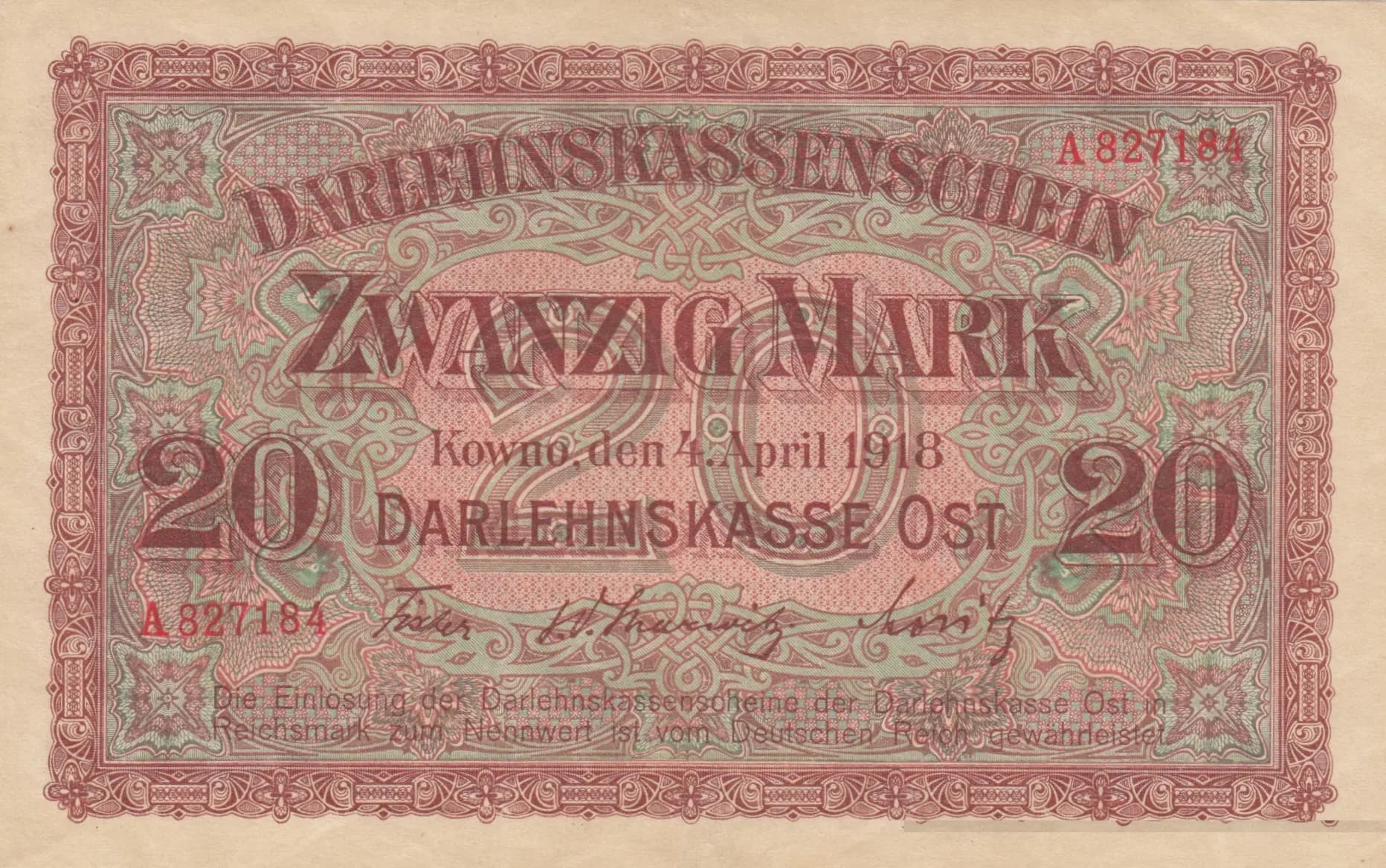
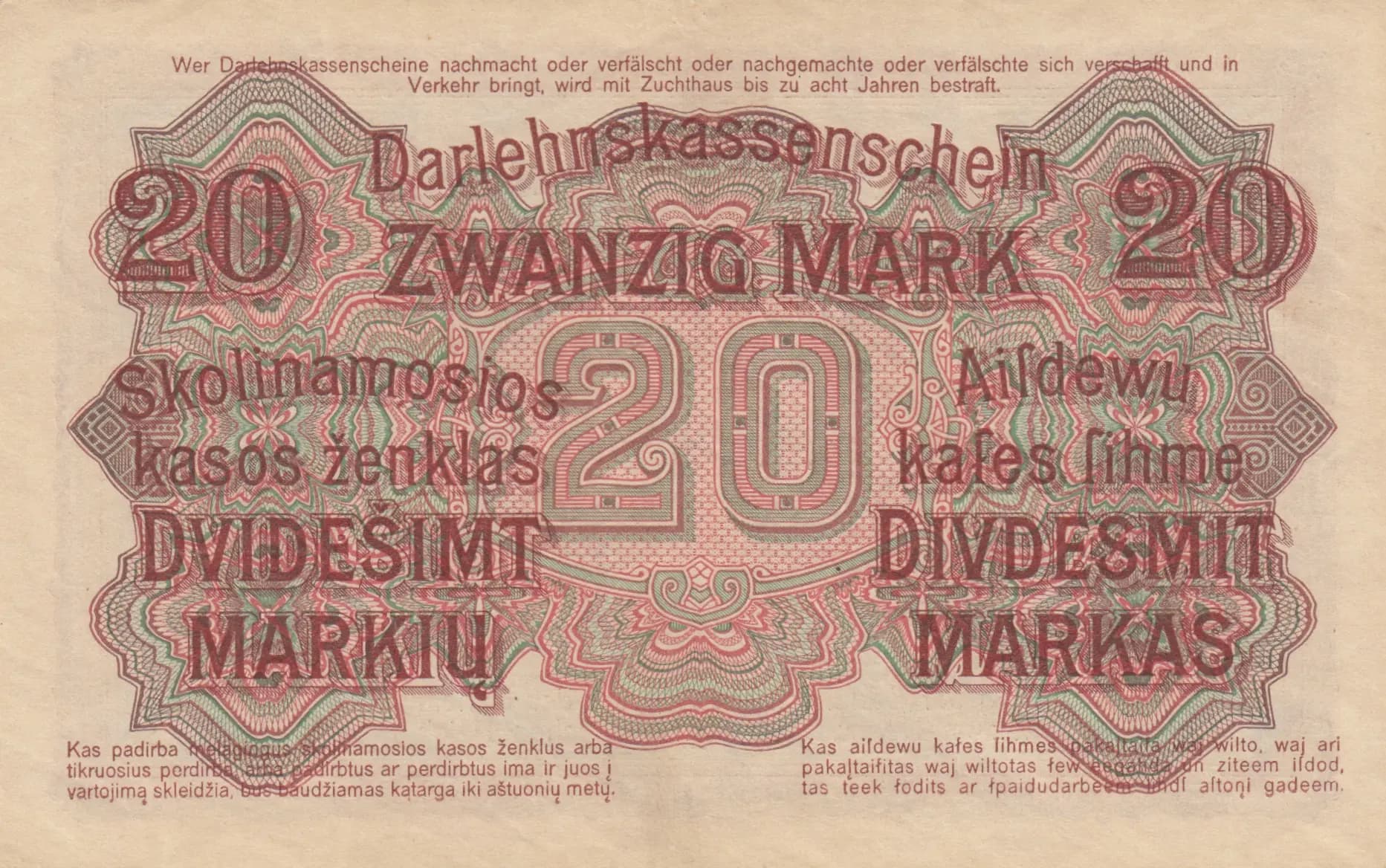
An exceptionally well-preserved 20 Mark banknote issued by the Darlehnskasse Ost in Kovno on 4 April 1918, graded AU with crisp, uncirculated appearance and no visible circulation wear. This regional German military occupation currency features striking Art Nouveau design elements with burgundy and green ornamental borders, demonstrating the high-quality engraving typical of German banknote production during World War I. The presence of both German and Lithuanian inscriptions reflects its historical role as occupation currency in Lithuania until the transition to independent Lithuanian currency in 1922.
Common. The eBay market data demonstrates consistent pricing in the $3-$32 range across multiple condition grades (F through EF/UNC) over a 10-year period, with most transactions occurring in the $6-$22 range. Despite the specialized nature of World War I German occupation currency, the volume of sales and the steady, moderate pricing indicate this is a commonly available note for collectors of German regional and occupation currency. The 2008 catalog valuation of $100 for UNC specimens appears somewhat optimistic compared to actual market realization; even AU specimens like this example would realistically trade in the $20-$40 range based on comparable recent sales patterns.
The Darlehnskasse Ost (Eastern Loan Office) issued this currency during Germany's military occupation of Lithuania in World War I, representing the financial apparatus of occupation administration in the Baltic territories. The dual-language design with German and Lithuanian text exemplifies the cultural overlay of the occupation period, while the official redemption guarantee from the German Reich printed on the obverse underscored the military authority's commitment to currency stability in occupied territories. This note circulated in Lithuania until 1922, marking the end of German occupation and Lithuania's transition to independence and its own national currency.
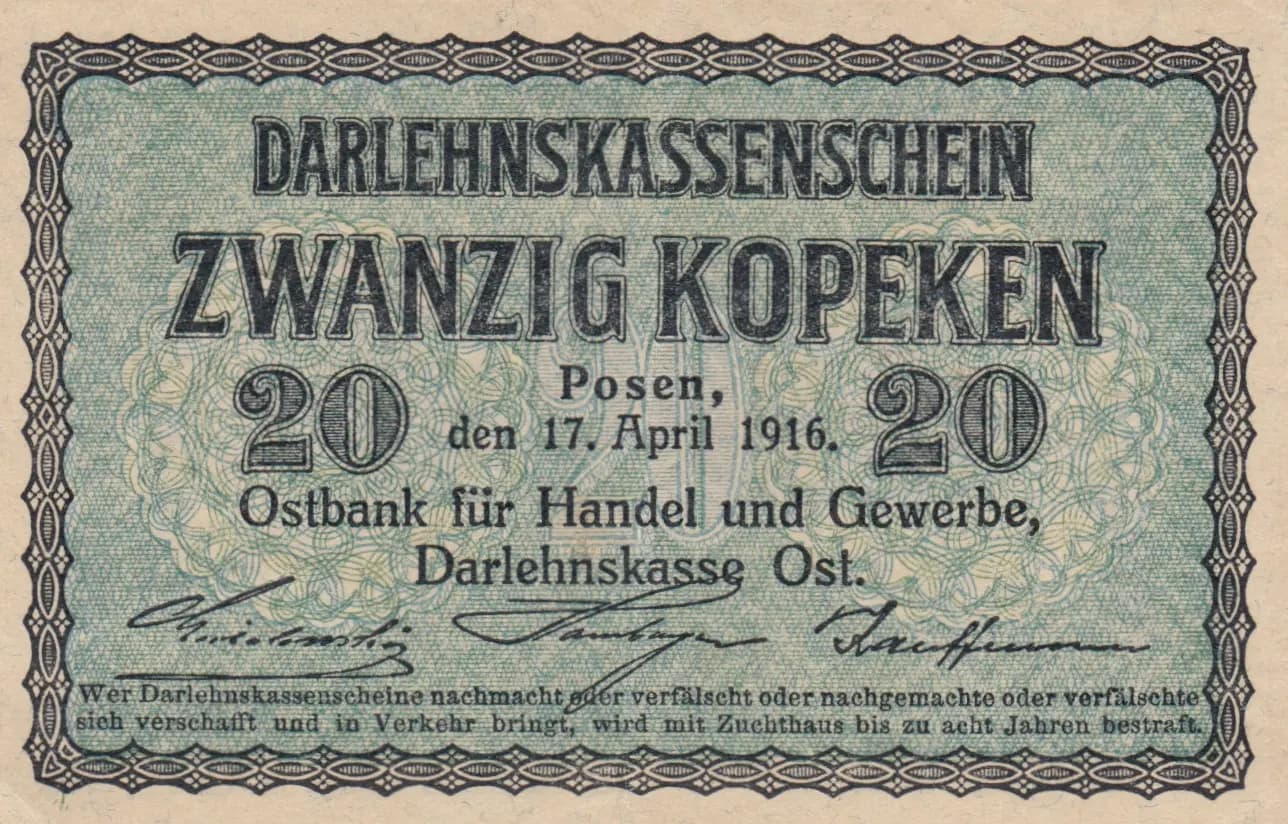
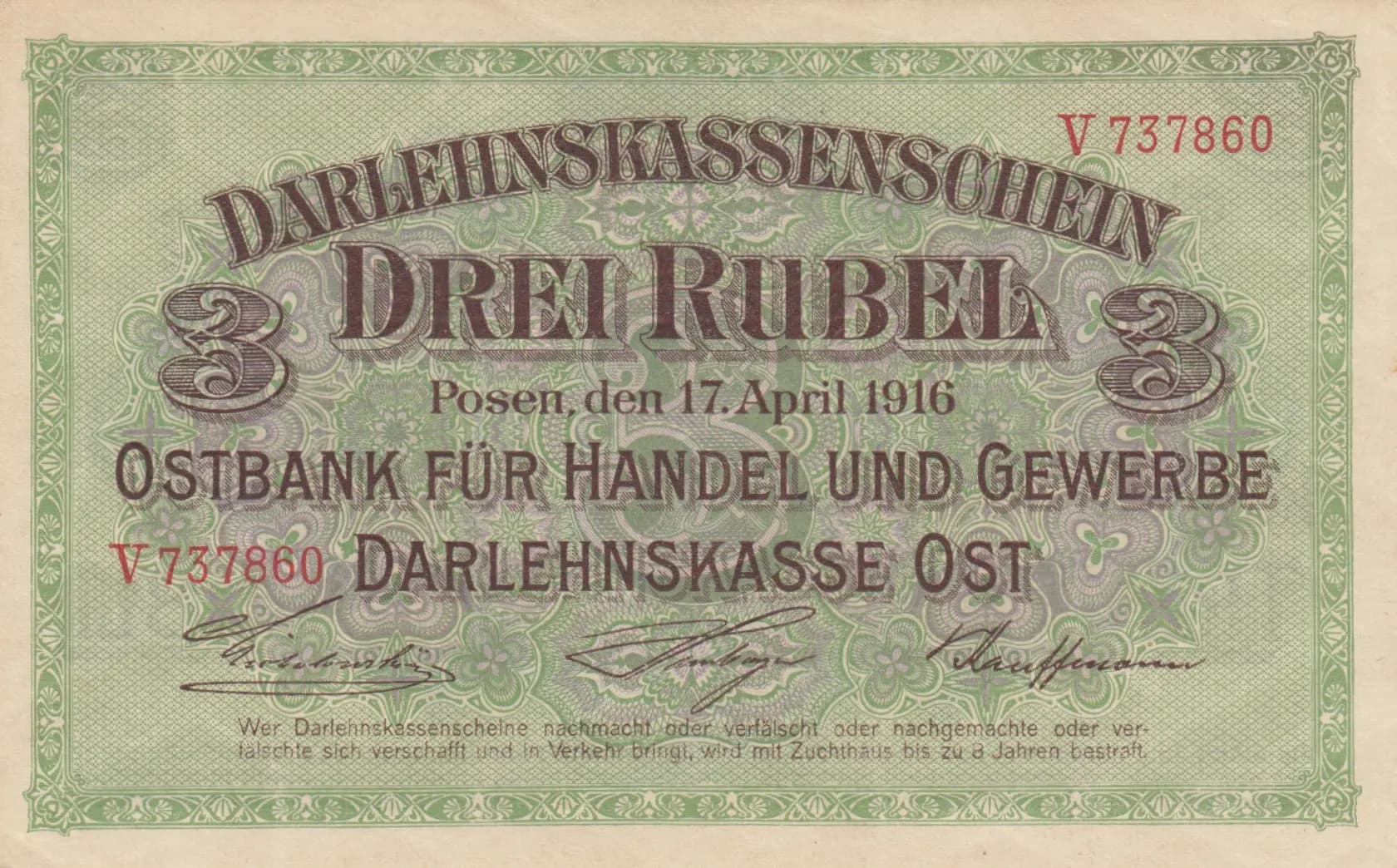
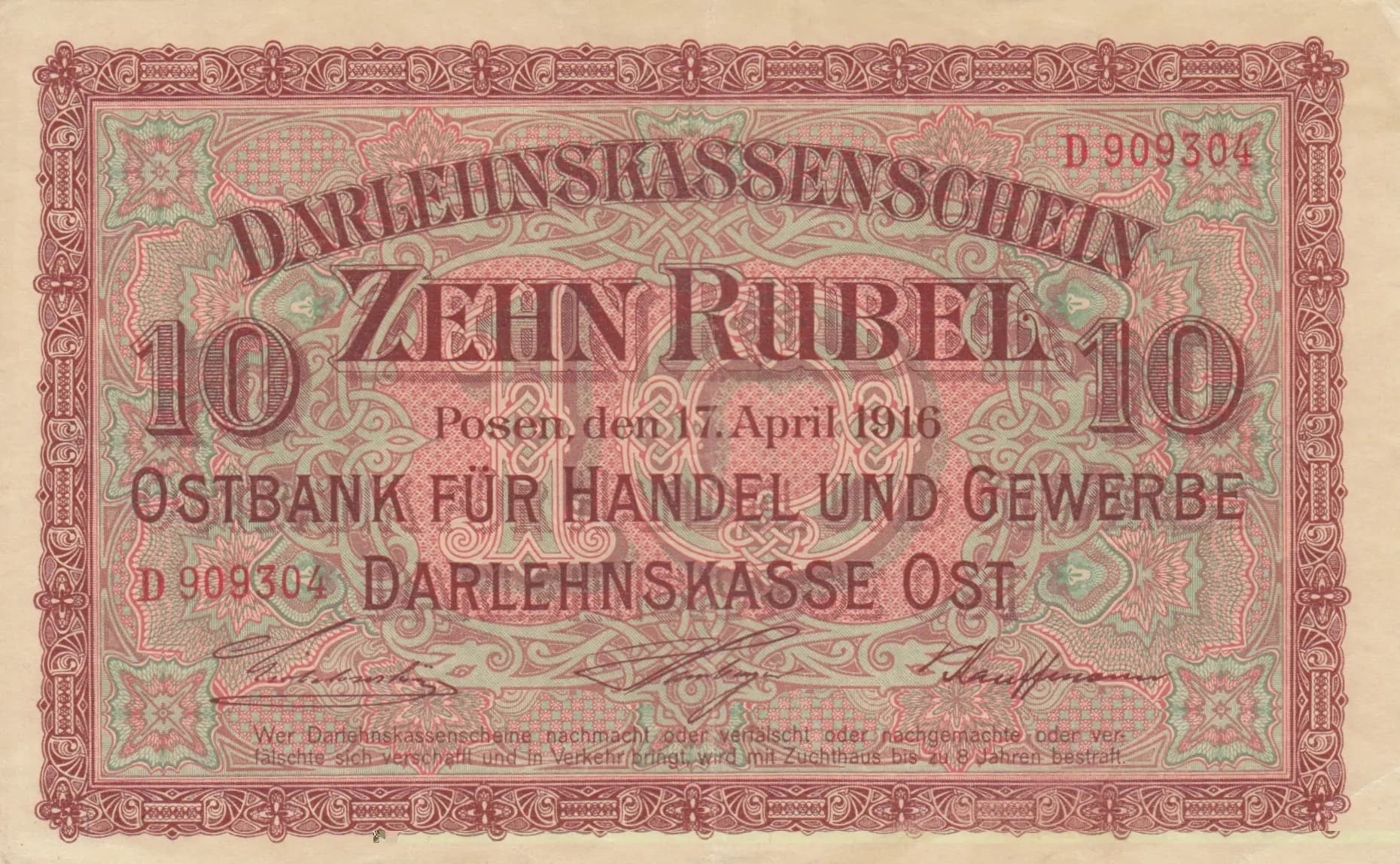
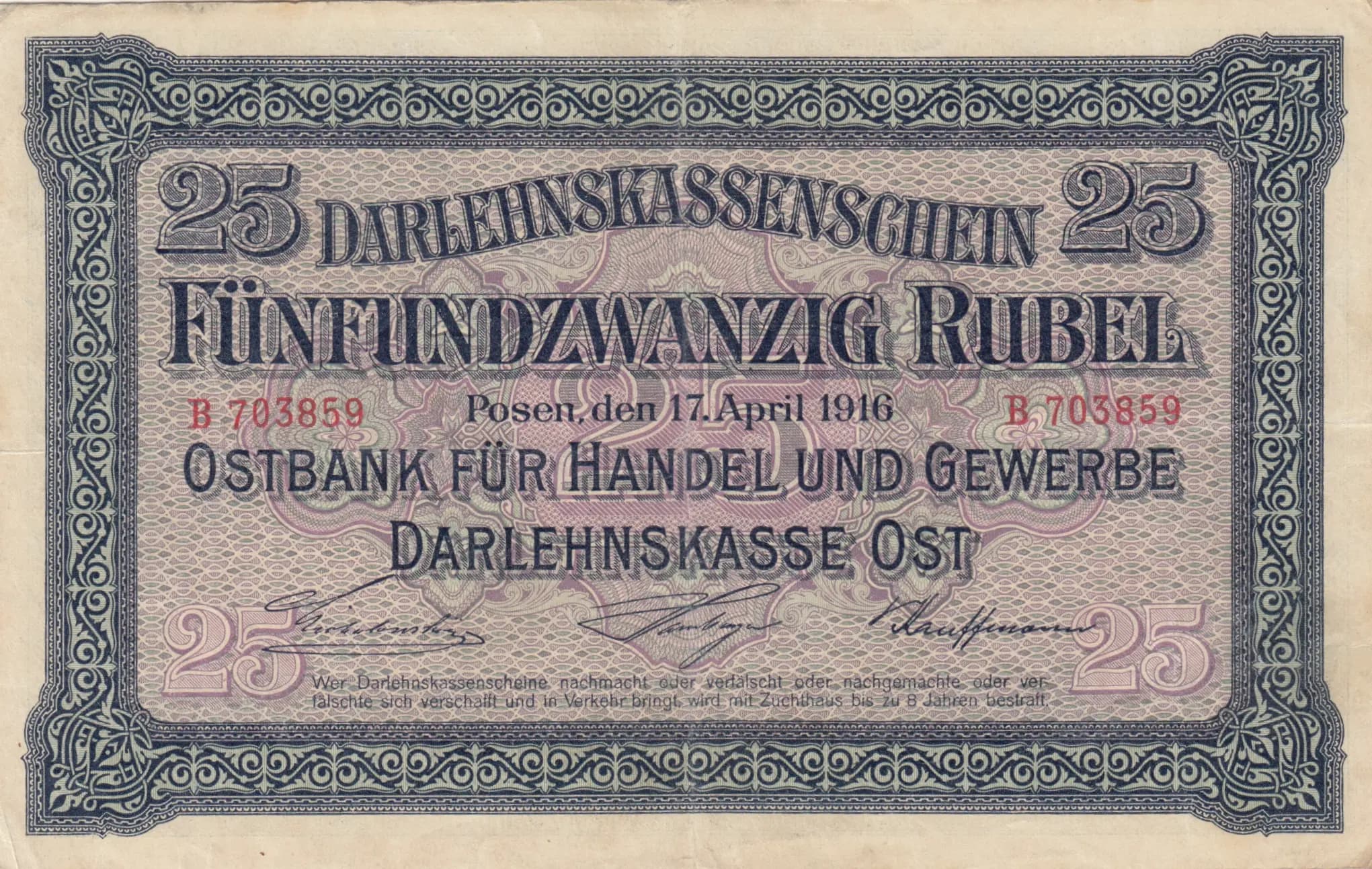
The 20 Mark note features a symmetrical Art Nouveau design with ornate geometric and floral border elements characteristic of German Imperial-era banknote artistry. The dominant visual elements include four-pointed star designs positioned at the corners, ornamental crosses framing the border, and interlocking Celtic-style geometric patterns throughout the frame. Large denomination numerals '20' appear prominently on both obverse and reverse, flanked by elaborate decorative cartouches. The color scheme employs burgundy/maroon printing on green and pink underprints with cream/tan background, creating a sophisticated palette typical of World War I era German occupation currencies. The design contains no portraits or specific landmarks, instead relying on abstract geometric and botanical ornamentation to convey authority and deter counterfeiting through complexity of execution.
FRONT SIDE: 'DARLEHNSKASSENSCHEIN' (Loan Office Certificate) / 'ZWANZIG MARK' (Twenty Mark) / 'Kownno den 4. April 1918' (Kovno on 4 April 1918) / 'DARLEHNSKASSE OST' (Eastern Loan Office) / Serial number: 'A 827184' (appears top right and bottom left in red) / 'Die Einlösung der Darlehnskassenscheine der Darlehnskasse Ost in Reichsmark zum Nennwert ist vom Deutschen Reich gewährleistet.' (The redemption of the Darlehnskasse Ost loan office certificates in Reichsmark at face value is guaranteed by the German Reich.) BACK SIDE: 'Wer Darlehnskassenscheine nachmacht oder verfälscht oder nachgemachte oder verfälschte sich verschafft und in Verkehr bringt, wird mit Zuchthaus bis zu acht Jahren bestraft.' (Whoever counterfeits or forges Darlehnskassenscheine or procures and puts into circulation counterfeited or forged ones will be punished with imprisonment up to eight years.) / Lithuanian counterpart text warning of similar penalties / 'Darlehnskassenschein' / 'ZWANZIG MARK' / Lithuanian equivalents including 'MARKAS' (Marks) and '20' denomination marking.
This banknote employs intaglio (engraved line) printing methodology, evidenced by the fine detailed line work, crisp impressions, and intricate engraved patterns visible throughout the design. The multi-color printing with distinct color zones (red-brown on green and pink underprints) indicates a sophisticated multi-plate printing process typical of German state banknote production during the World War I period. The sharp, clean appearance and precisely rendered geometric patterns demonstrate professional security printing techniques employed by established German security printers of the era, likely utilizing the traditional German banknote printing houses that produced occupation currency.
This specific specimen carries serial number A 827184, printed in red on both obverse (top right) and reverse (bottom left), which represents standard production for this Pick number. The 4 April 1918 date and Kovno (Kaunas) location are consistent with the primary issue of the Darlehnskasse Ost. No significant varieties have been documented for this series that would materially affect the specimen's classification or premium. The AU grade and uncirculated preservation with crisp appearance represent the optimal state for this common denomination, placing it at the upper end of typical market availability.