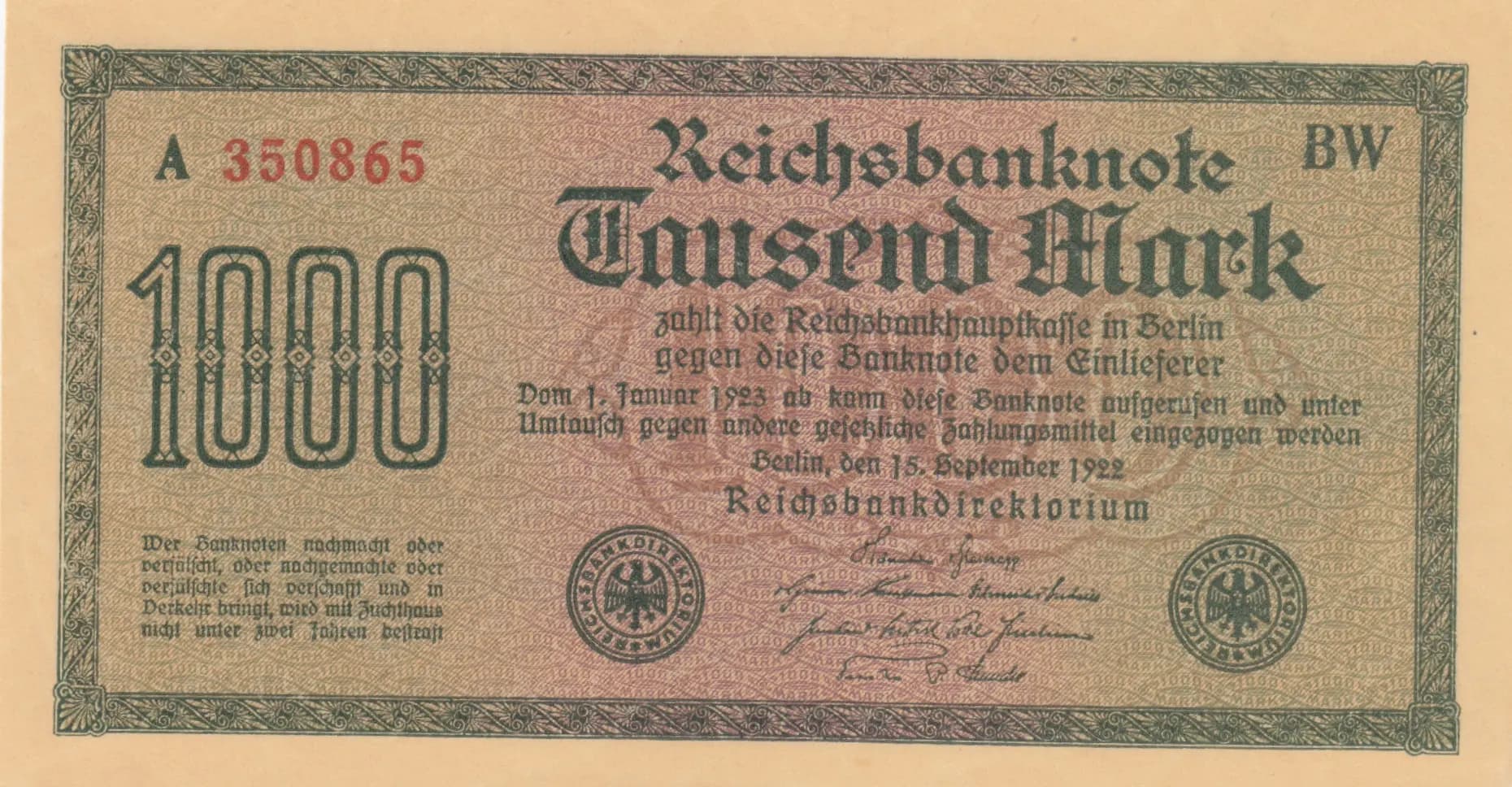
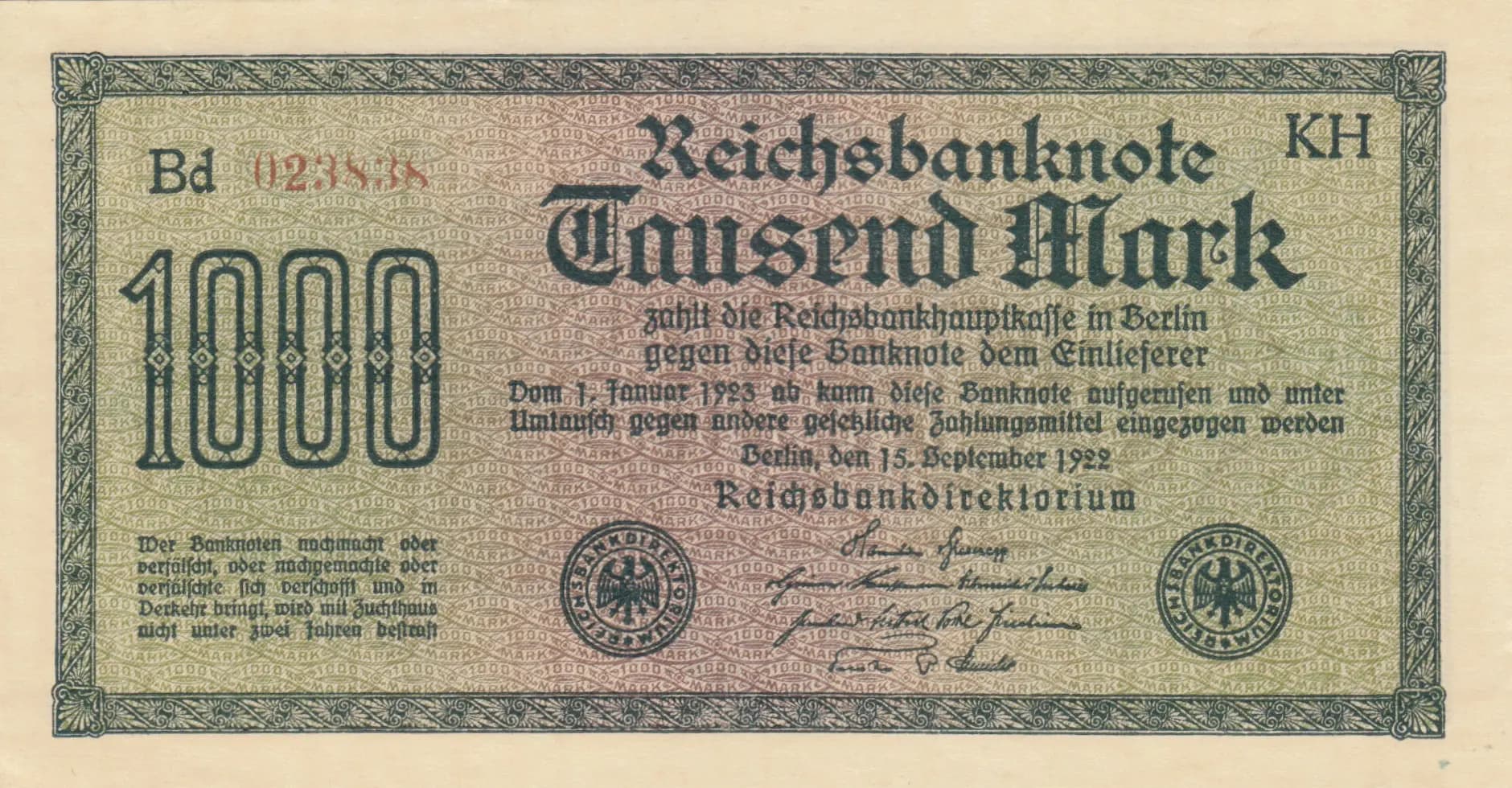
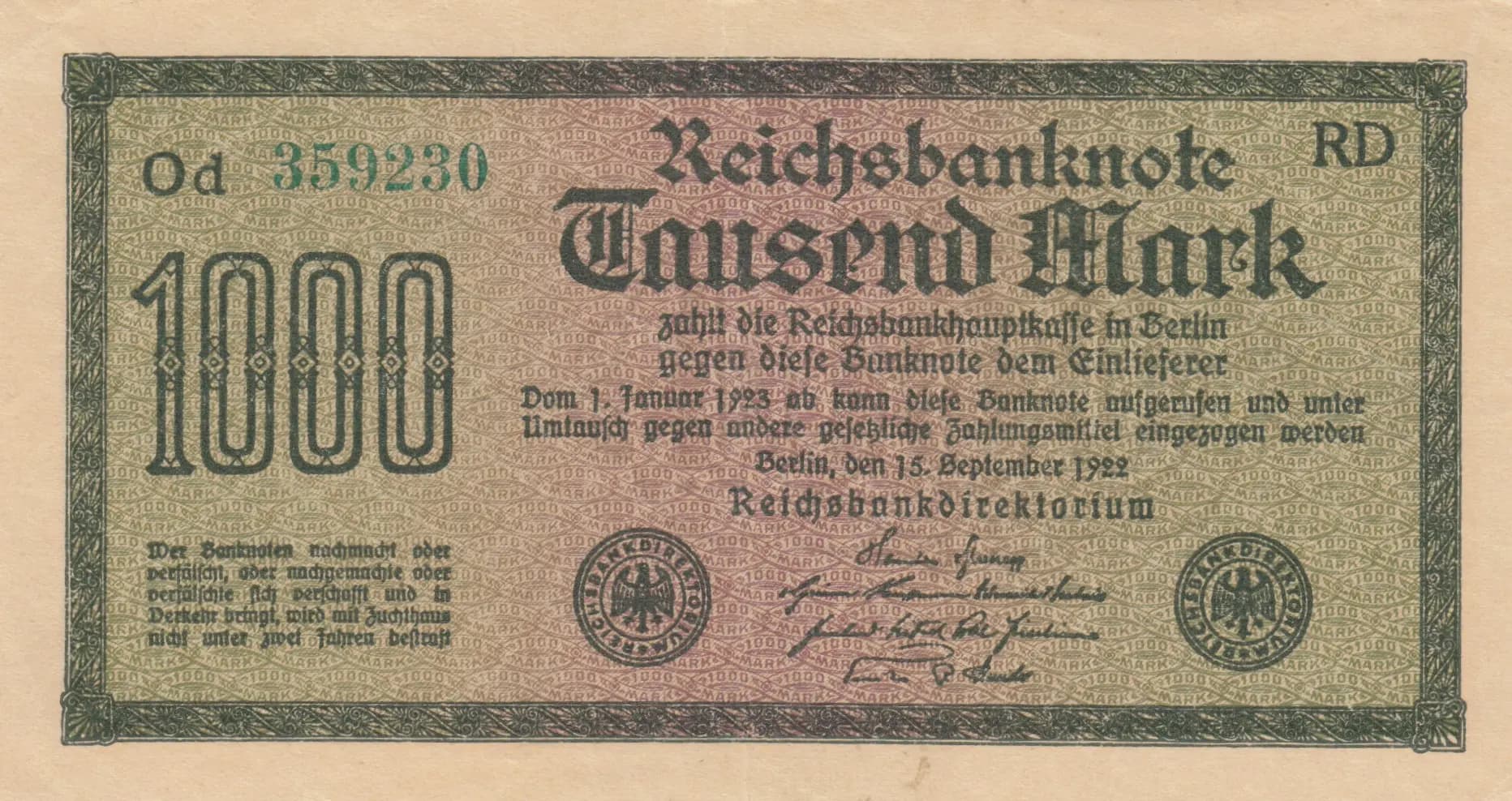
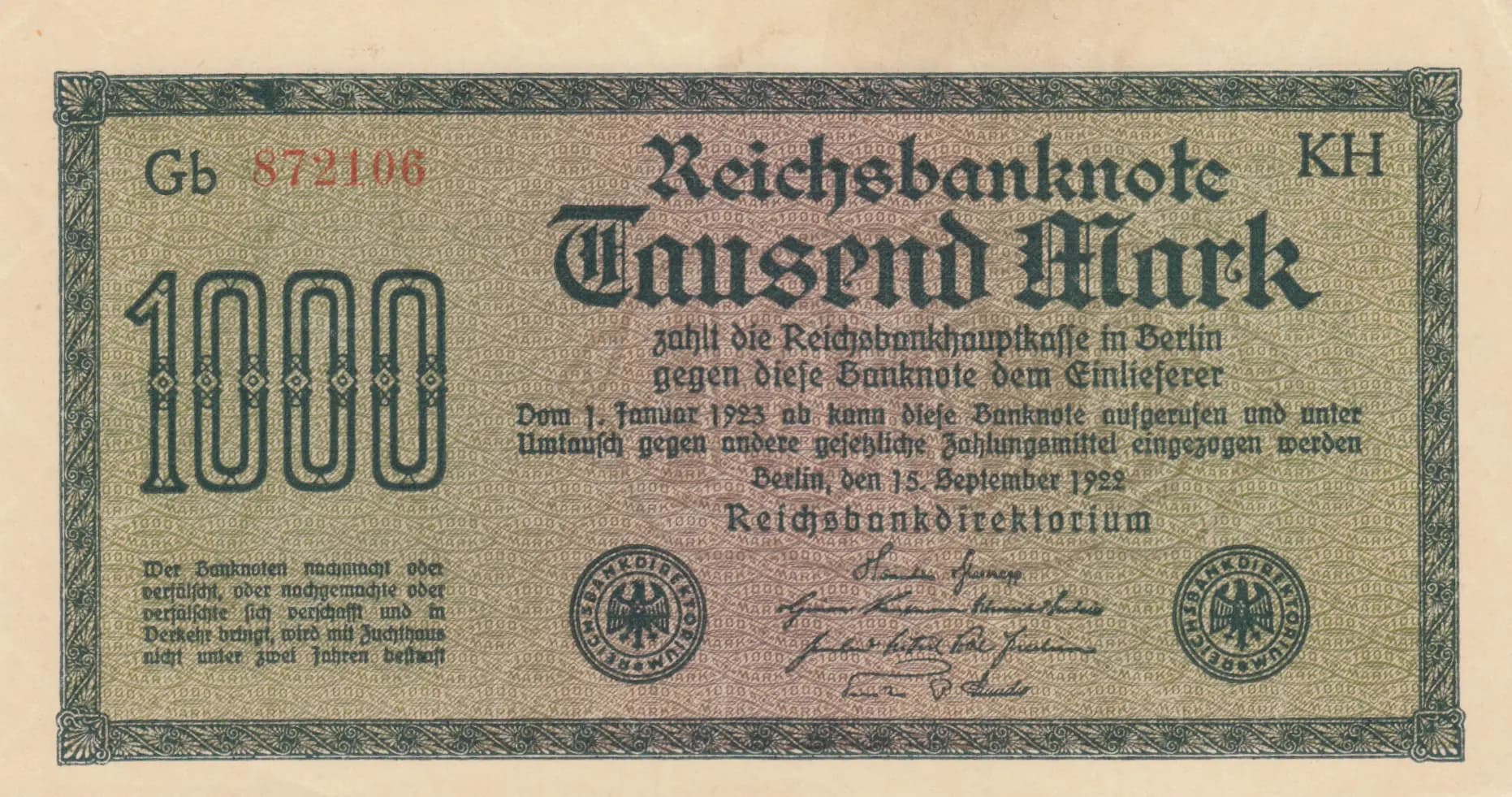
1000 mark 1922
Market Prices
16 salesAbout This Note
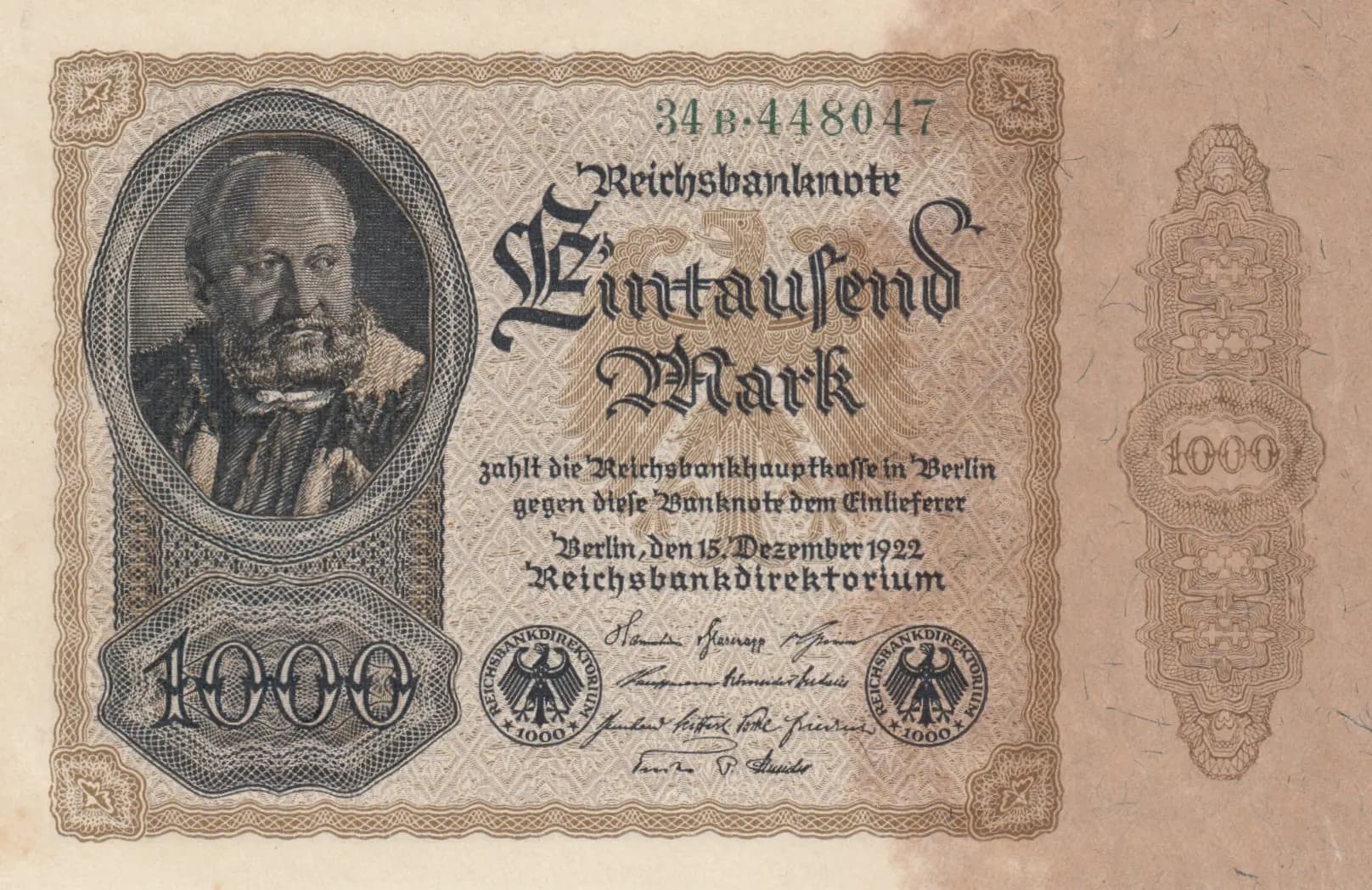
This German Reichsbanknote for 1000 Mark, issued December 15, 1922, features a portrait of Mintmaster Jörg Herz by renowned engraver Georg Penz on the obverse within an ornate oval frame. The note displays typical AU (About Uncirculated) condition with moderate age-related yellowing and foxing, intact structure, and no major tears or creases. This example represents a significant piece of Weimar-era currency issued during Germany's hyperinflationary period, with serial number 34 B 448047.
Common. eBay market data shows consistent sales activity ranging from $5 to $243, with most AU/AUNC examples selling between $16–$31 in recent years. The 2016 catalog value for UNC is listed at $100, yet actual market realizations rarely exceed $50 for this grade. The presence of multiple serial number style variants and the note's straightforward design indicate substantial production runs. This denomination from 1922 is readily available in the collector market.
Issued during the final months of 1922, this banknote represents the Reichsbank's response to severe inflation in post-World War I Germany. The Imperial German Eagle (Reichsadler) with shield, prominently displayed in circular seals on the obverse, symbolizes the continuity of German monetary authority under the Weimar Republic. The selection of Jörg Herz, a historical Renaissance-era mintmaster, reflects the note's design philosophy of invoking German cultural and numismatic heritage during a period of economic crisis.
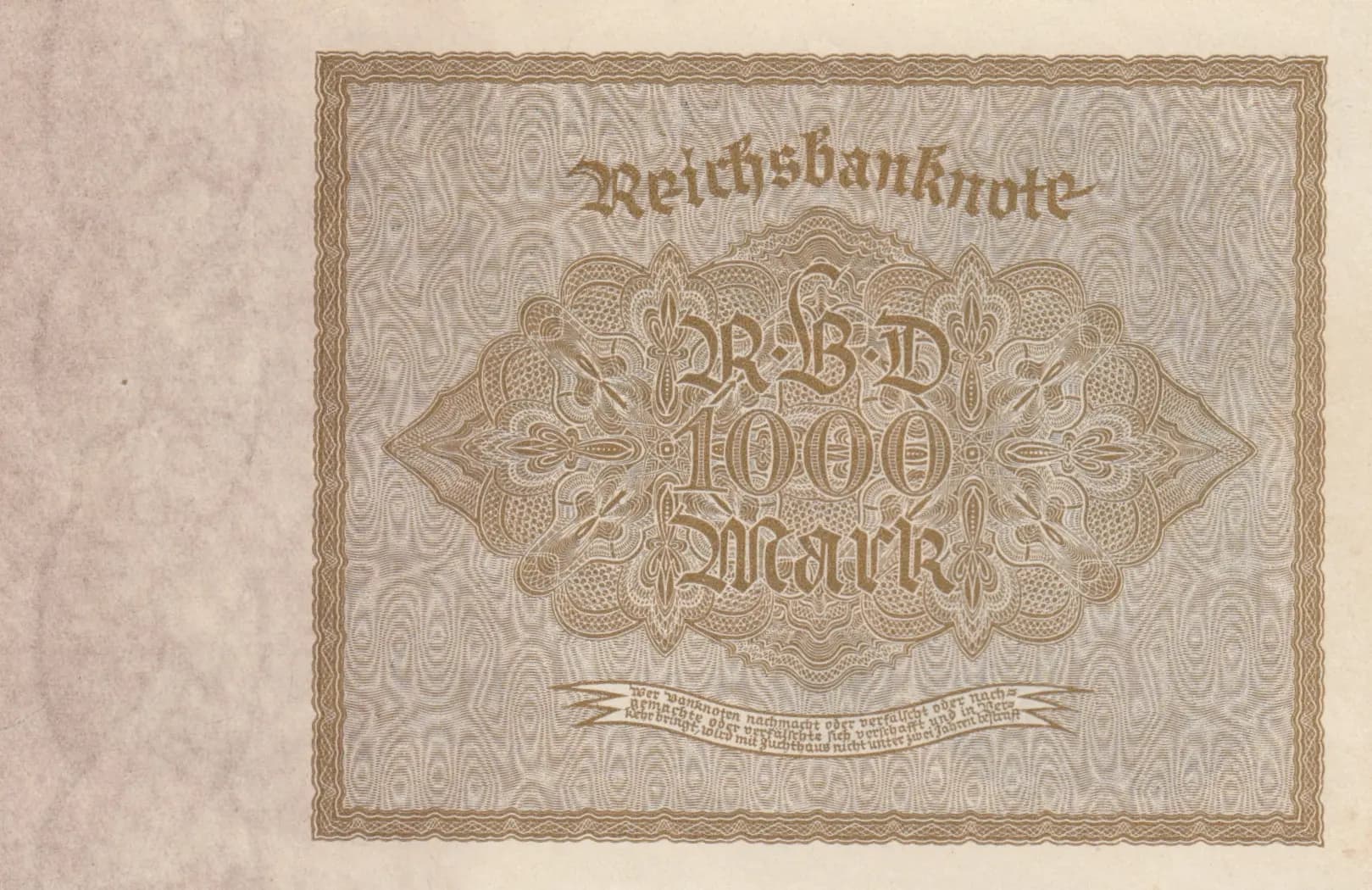
The obverse presents a left-facing portrait of Jörg Herz, a bearded historical figure in period dress, engraved by Georg Penz and contained within an elaborate oval frame. The design employs Gothic lettering and ornamental cartouches typical of Reichsbank notes. The reverse features an ornate decorative frame with floral and geometric patterns in Gothic style, dominating the center field with the denomination prominently displayed. Both sides utilize a tan and brown color palette with black text and detailing. Fine line engraving creates intricate geometric patterns and security borders throughout. The Reichsadler (Imperial Eagle) appears on both sides within circular seals, reinforcing the note's official authority. A wavy-line security pattern covers the reverse background.
FRONT: 'Reichsbanknote' (Reichsbank note); 'Eintausend Mark' (One Thousand Mark); 'zahlt die Reichsbankhauptkasse in Berlin gegen diese Banknote dem Einlieferer' (The Reichsbank main office in Berlin pays the presenter against this banknote); 'Berlin, den 15. Dezember 1922' (Berlin, December 15, 1922); 'Reichsbankdirektorium' (Reichsbank Directorate); Serial number '34 B 448047'. BACK: 'Reichsbanknote' (Reichsbank note); '1000 Mark' (1000 Mark); 'Wer Reichsbanknoten nachmacht oder verfälscht oder verfälschte oder nachgemachte Reichsbanknoten in den Verkehr bringt wird mit Zuchthaus bis zu fünf Jahren bestraft' (Whoever counterfeits Reichsbanknotes or forges them or puts counterfeit or forged Reichsbanknotes into circulation is punished with imprisonment for up to five years).
Intaglio (recess) printing, the standard security printing method for Reichsbank notes of this period. The fine line engraving evident throughout the note, the depth of the impressions visible in the ornamental details, and the intricate geometric patterns characteristic of anti-counterfeiting measures confirm this technique. The printer for Pick-82a was the Reichsbank's official security printer, though specific attribution requires archival research.
Pick-82a represents the standard variety of the 1000 Mark 1922 issue with watermark '1000'. Serial number variants documented include multiple styles with 4mm or less sizing. The serial number '34 B 448047' on this example represents one of the documented prefix varieties. The catalog notes an overprint variety exists (reference Germany P-113), but this example shows no overprint evidence. PMG population data indicates minimal variant subdivision for this Pick number within professional grading services.