1000 mark 1922
Market Prices
1 saleAbout This Note
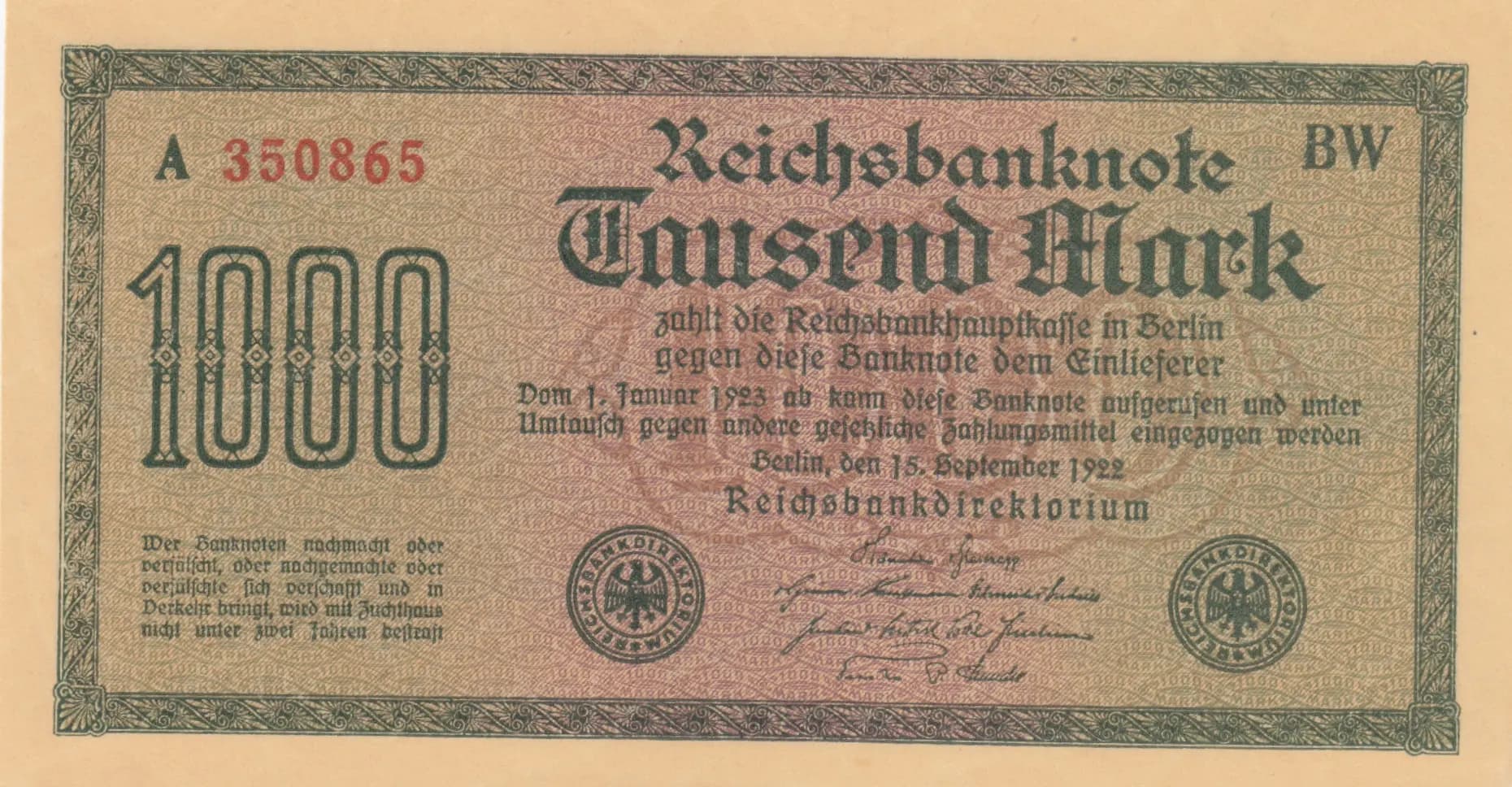
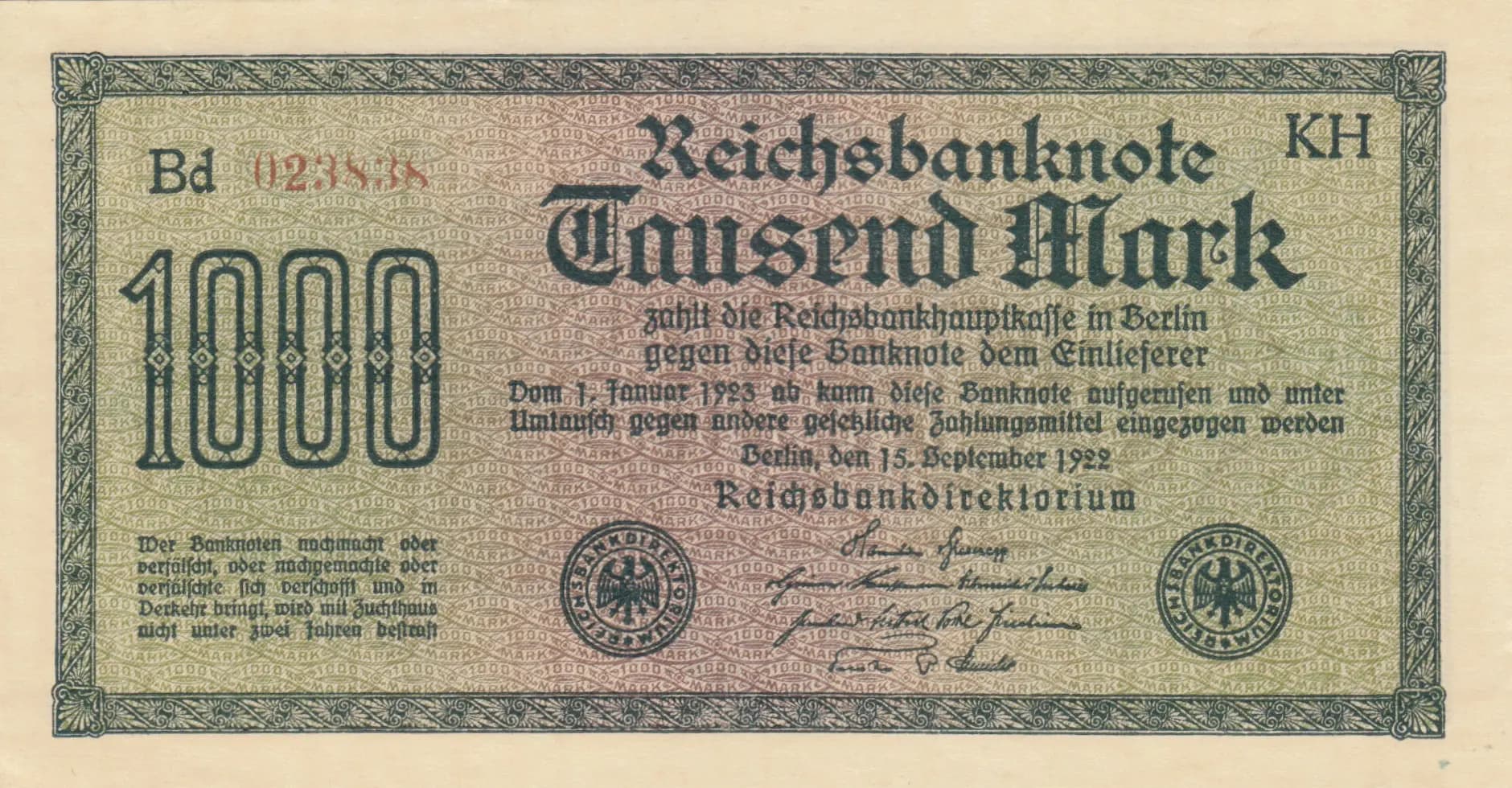
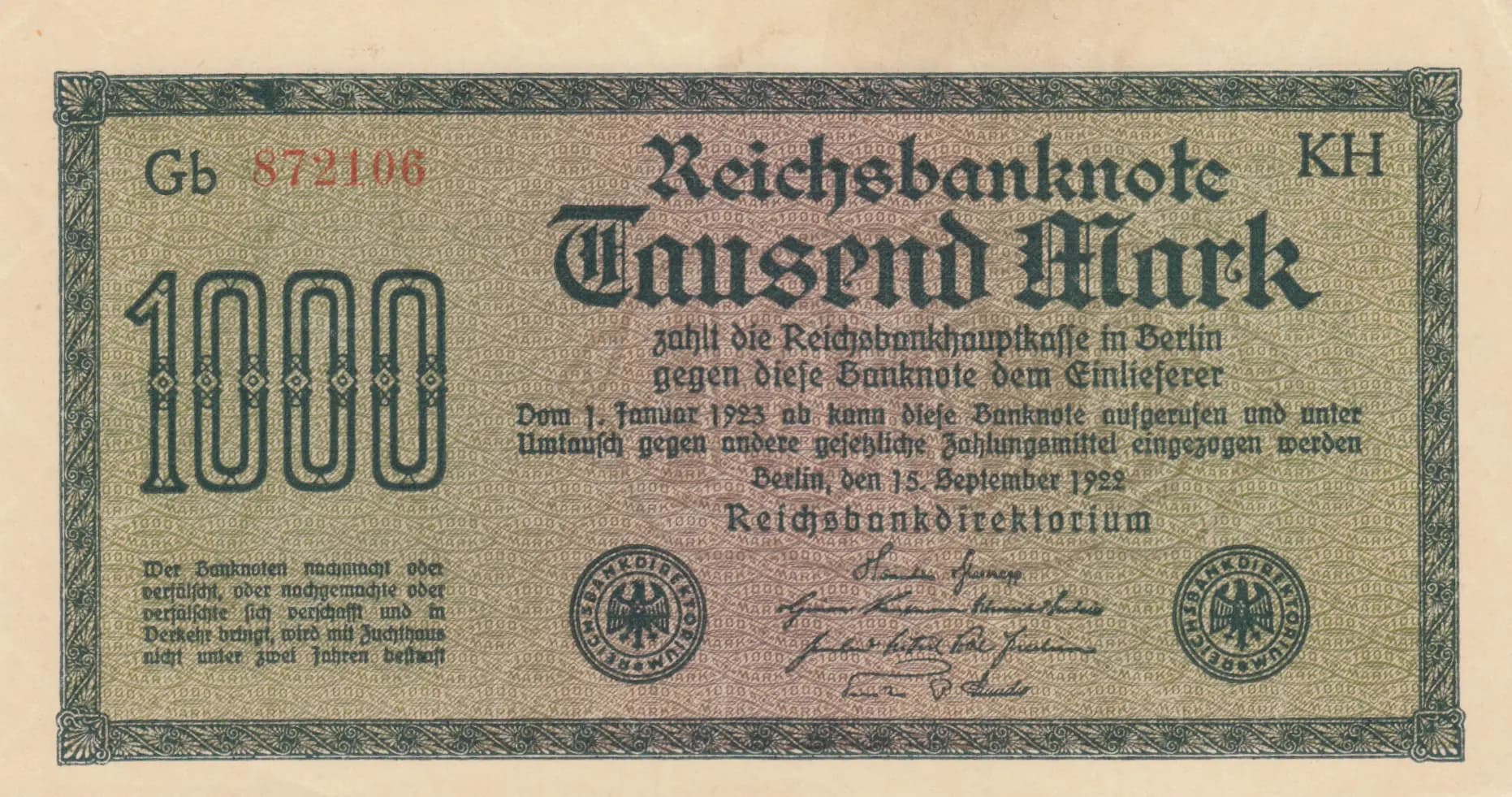
This is an attractive AU-grade example of the German Reichsbank 1000 Mark note from September 15, 1922, Pick-76f. The note displays crisp, well-preserved printing with excellent color retention in its green and beige palette, showing minimal wear consistent with its grade. The elaborate ornamental design and dual eagle seals are rendered with fine detail, making this a visually striking example of Weimar-era currency during the critical transition period before hyperinflation.
Common. The 1000 Mark denomination from 1922 was part of a regular issue by the Reichsbank with substantial print runs. Market data shows examples selling for $1-10 depending on condition, with a PMG-25 example fetching $12.99 in May 2024. The AU grade specimen described here would fall into the $5-10 catalog value range, reflecting typical market activity for this standard circulation note. While historically significant, these notes are readily available to collectors and command modest premiums.
Issued during the final months of relative monetary stability in the Weimar Republic, this 1000 Mark note represents the Reichsbank's last major denomination before the catastrophic hyperinflation of 1923. The note prominently features the dual Reichsadler (imperial eagles) in official seals, symbols of continued state authority, while the redemption text explicitly warns that the note could be called and exchanged after January 1, 1923—a prescient acknowledgment of the monetary crisis to come. This particular issue date of September 1922 places it at a critical juncture in German economic history, mere months before the Mark's complete collapse.
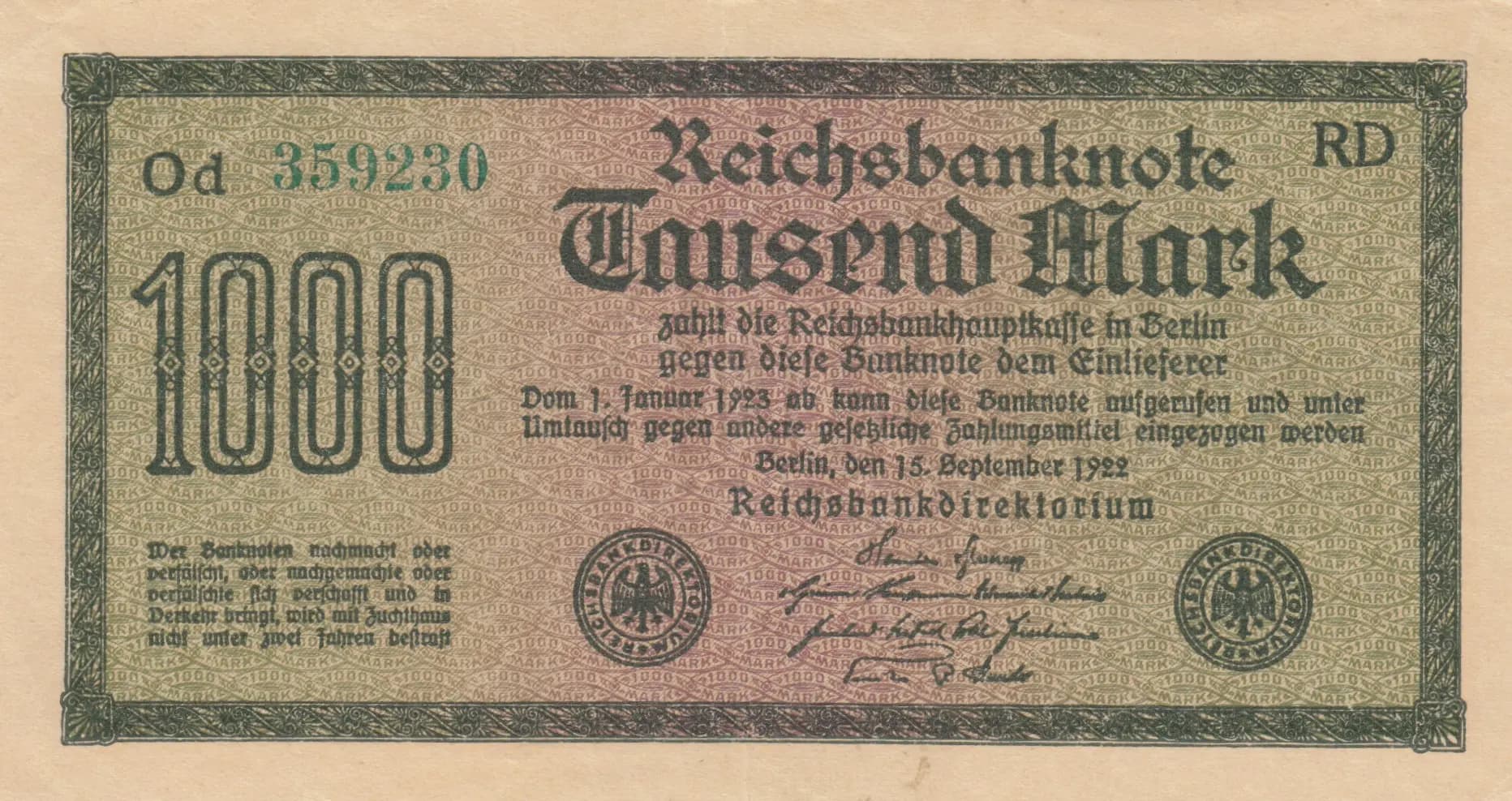
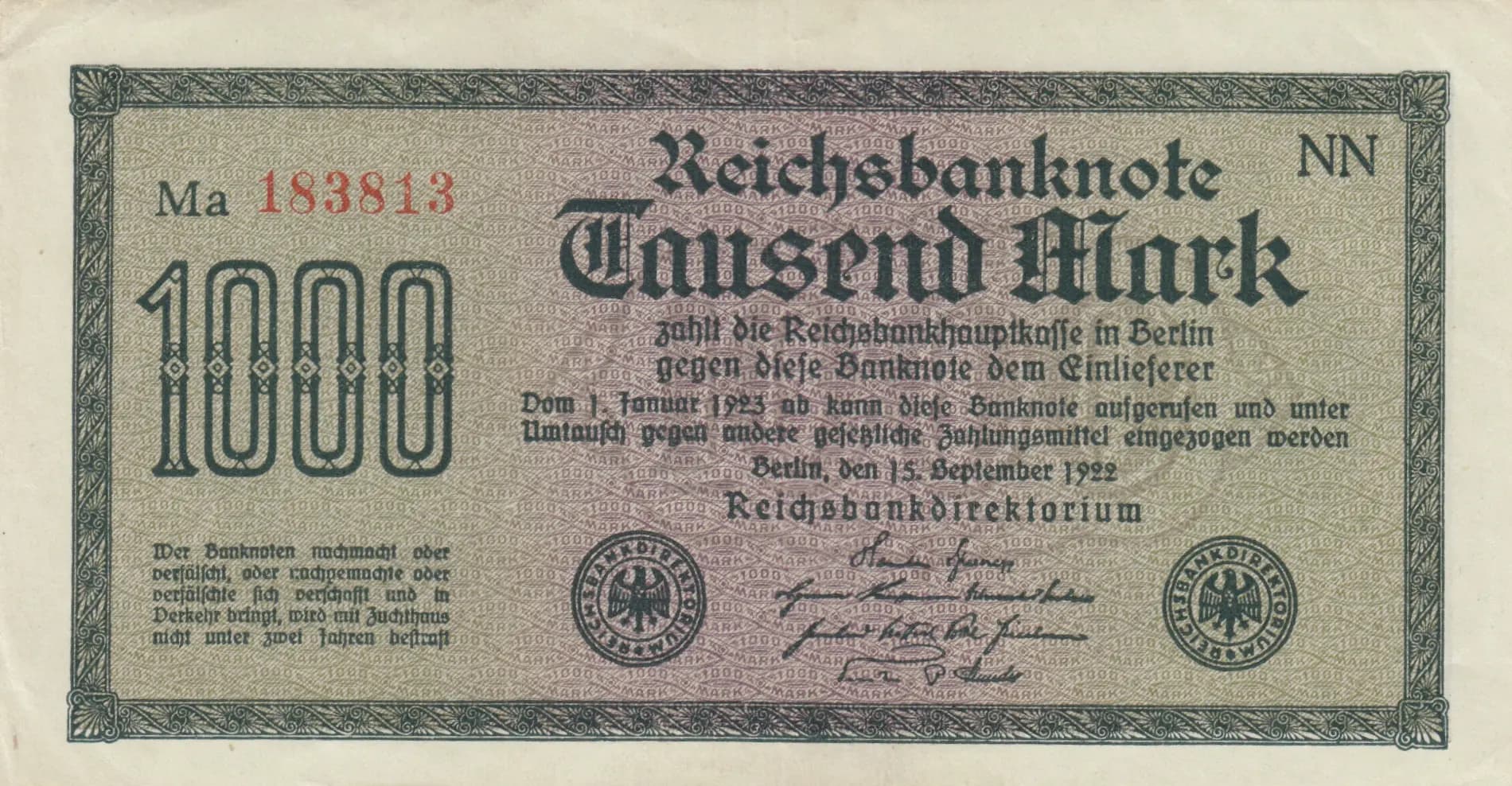
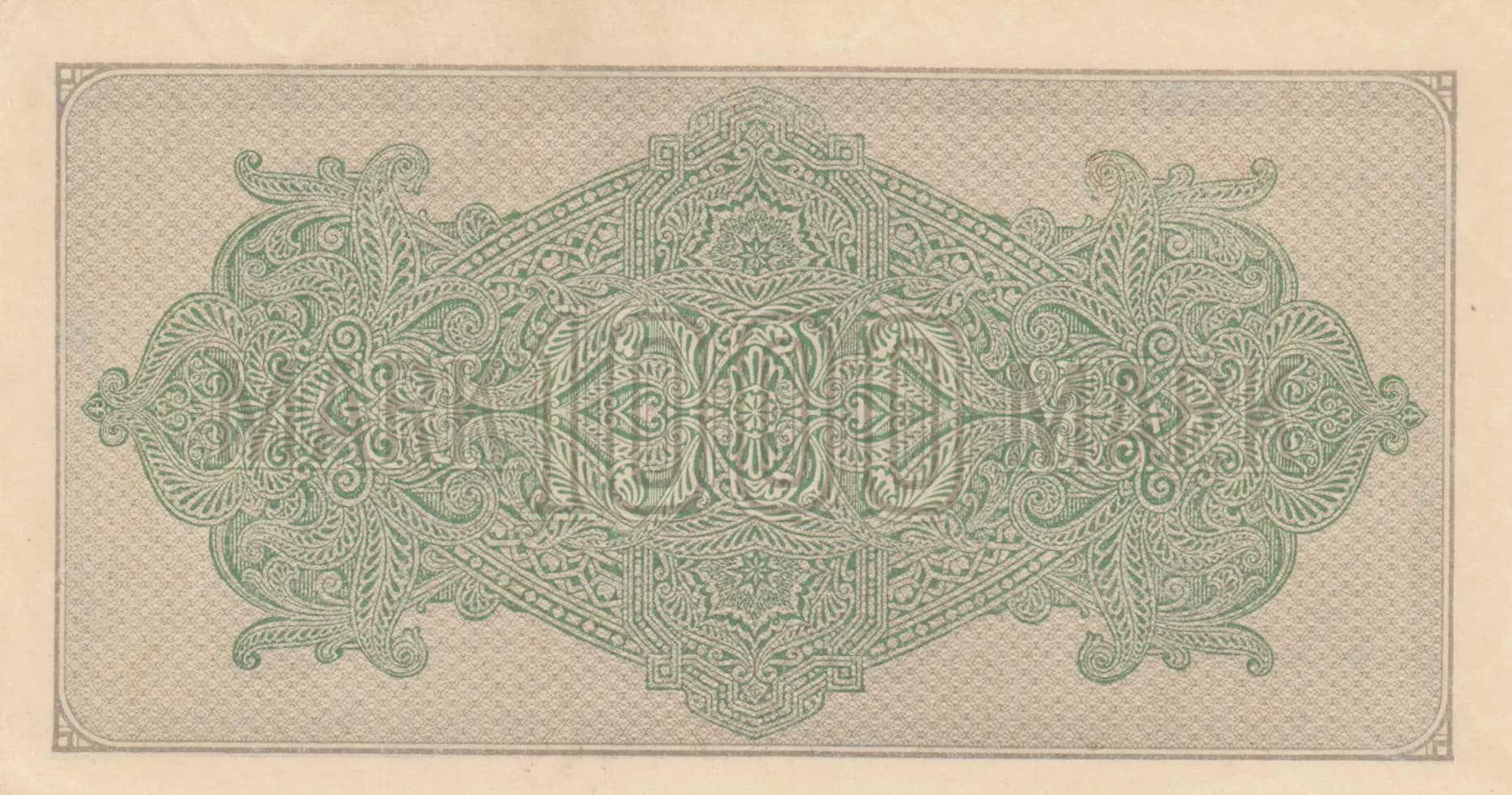
The obverse features a formal, classical design typical of Reichsbank currency of this period. The denomination '1000' appears in large, bold numerals on the left side, immediately drawing the eye to the note's value. The center showcases the title 'Reichsbanknote' and 'Eintausend Mark' in Gothic/Fraktur typeface, reflecting the formal German aesthetic of the era. Below this is a detailed redemption statement on behalf of the Reichsbank Directorate in Berlin. Two circular seals containing the Reichsadler (German imperial eagle) flank the lower portion, representing official state authority. Signatures of Reichsbank officials appear beneath these seals. The entire note is framed by an ornate guilloche border with floral and geometric elements in green. The reverse displays a striking baroque-style symmetrical ornamental design composed of elaborate scrollwork, interlocking curves, and flourishes in green against the beige background—a purely decorative element serving both aesthetic and security functions. The design demonstrates fine engraving work characteristic of German banknote production of this period.
FRONT SIDE: 'Reichsbanknote' (Reichsbank Note); 'Eintausend Mark' (One Thousand Mark); 'zahlt die Reichsbankhauptkaffe in Berlin gegen diese Banknote dem Einlieferer' (pays the Reichsbank main office in Berlin against this banknote to the depositor); 'Dem 1. Januar 1923 ab kann diese Banknote aufgerufen und unter Umstand gegen andere gejetzliche Zahlungsmittel eingezogen werden' (From 1 January 1923 this banknote can be called up and under circumstances exchanged for other legal tender); 'Berlin, den 15. September 1922' (Berlin, 15 September 1922); 'Reichsbankdirektorium' (Reichsbank Directorate); 'Der Banknoten nachahmt oder gefälscht, oder mangelhaft oder verschleissen und nicht unter zwei Jahren bestraft wird mit Zuchthaus nicht unter zwei Jahren bestraft' (Counterfeiting or falsifying banknotes, or producing defective or worn ones will be punished with hard labor not less than two years); Serial number: 'Gb 872106 KH'. BACK SIDE: No inscriptions; ornamental design only.
Intaglio (engraved) printing, the standard security printing method for Reichsbank currency of this era. The crisp detail visible in both the ornamental guilloche border on the obverse and the complex symmetrical baroque ornament on the reverse are characteristic of fine intaglio work. The multiple color printing (green and black on beige paper) employed separate plates for each color. The Reichsbank used established security printers including Giesecke+Devrient and other specialized facilities for high-denomination notes of this period.
This example is cataloged as Pick-76f, one of at least three documented varieties (PMG also catalogs P-76c, P-76g, and P-76h for this base denomination). Varieties within the same denomination typically reflect different signature combinations, serial number prefixes, or minor printing variations. The serial number prefix 'Gb' and the specific signature configuration visible on this example would place it within the P-76f variety. Collectors should verify the specific signature block and serial number prefix to confirm proper variety classification.