1000 mark 1922
Market Prices
5 salesAbout This Note
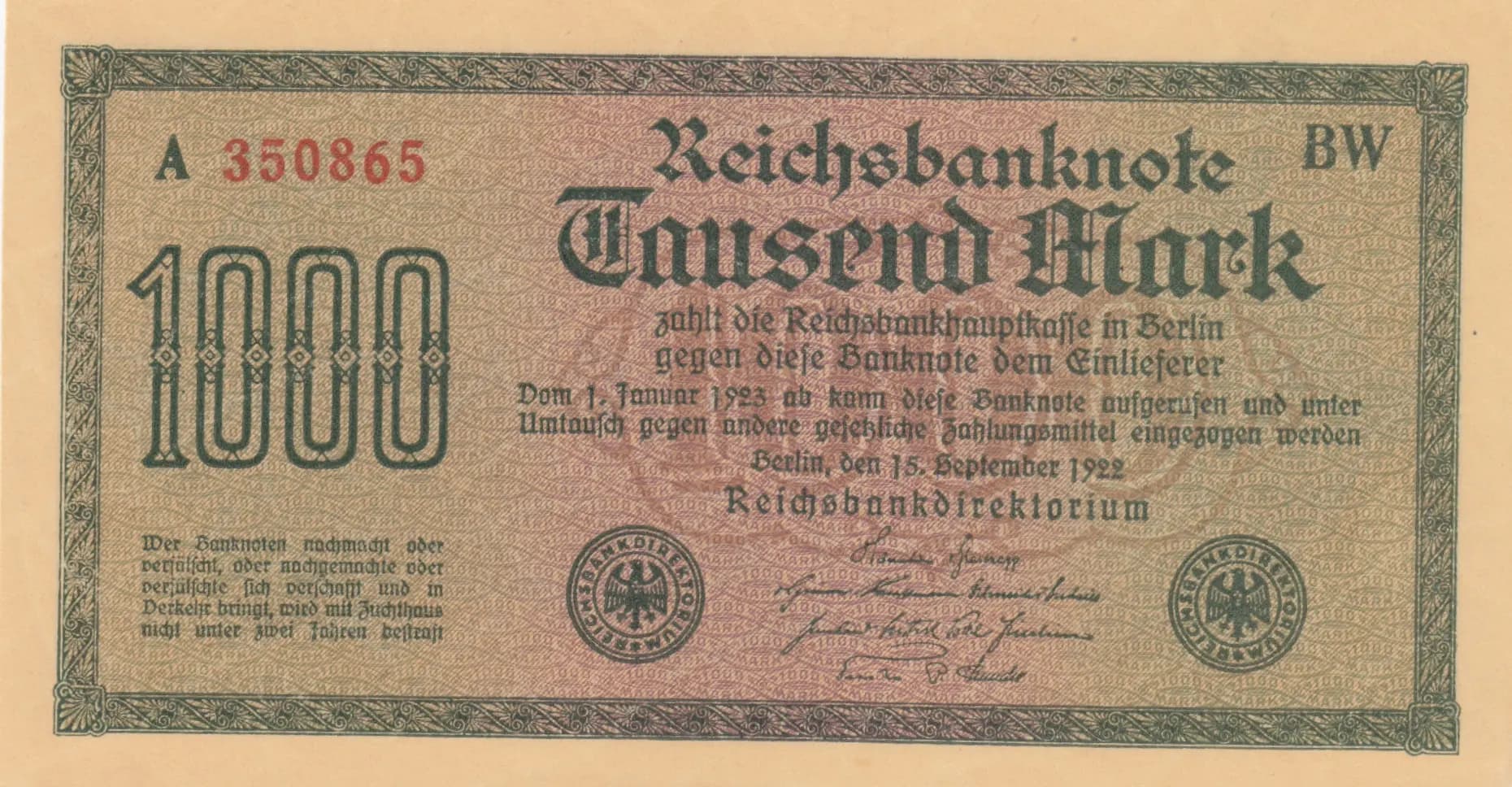
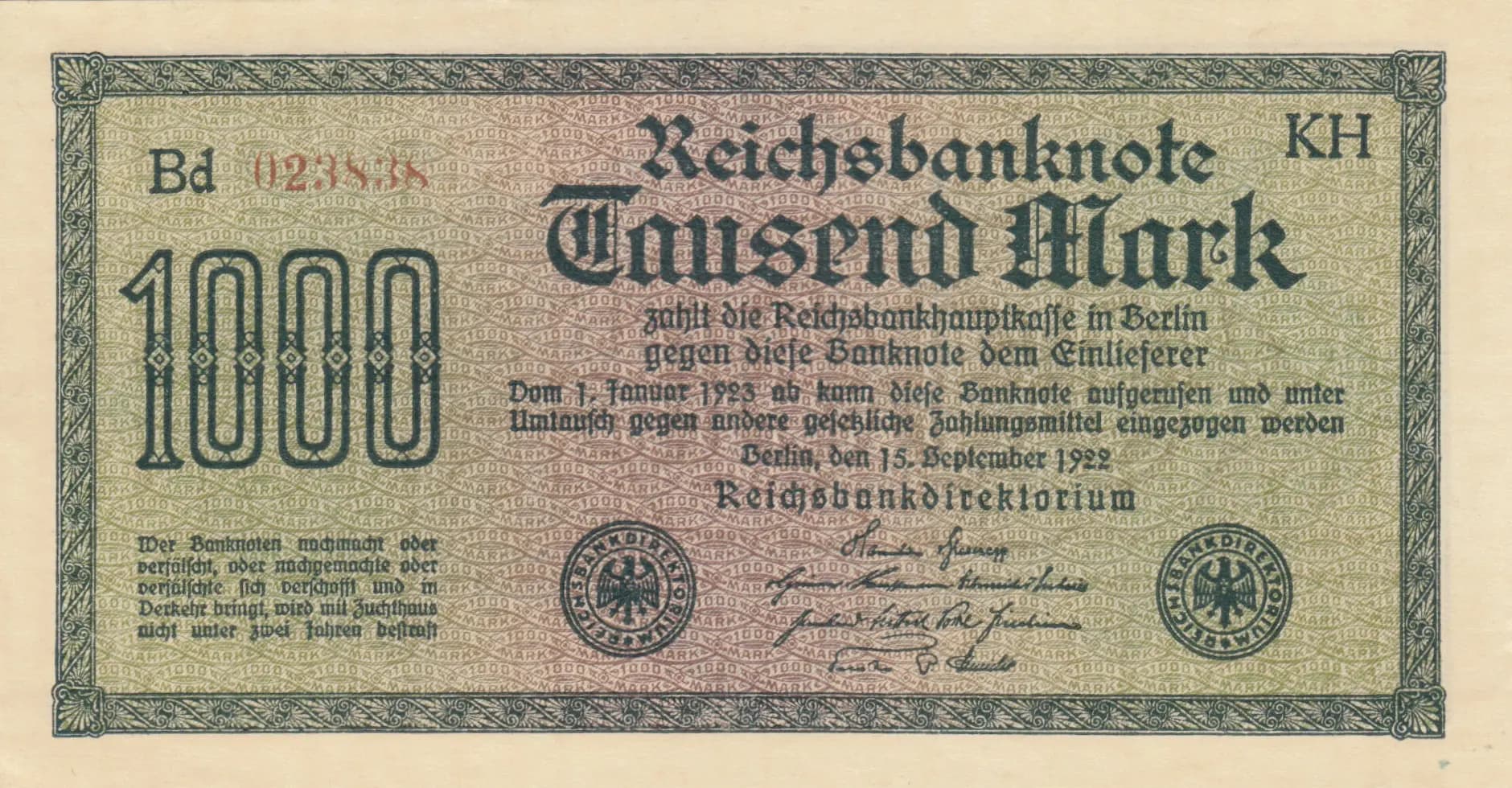
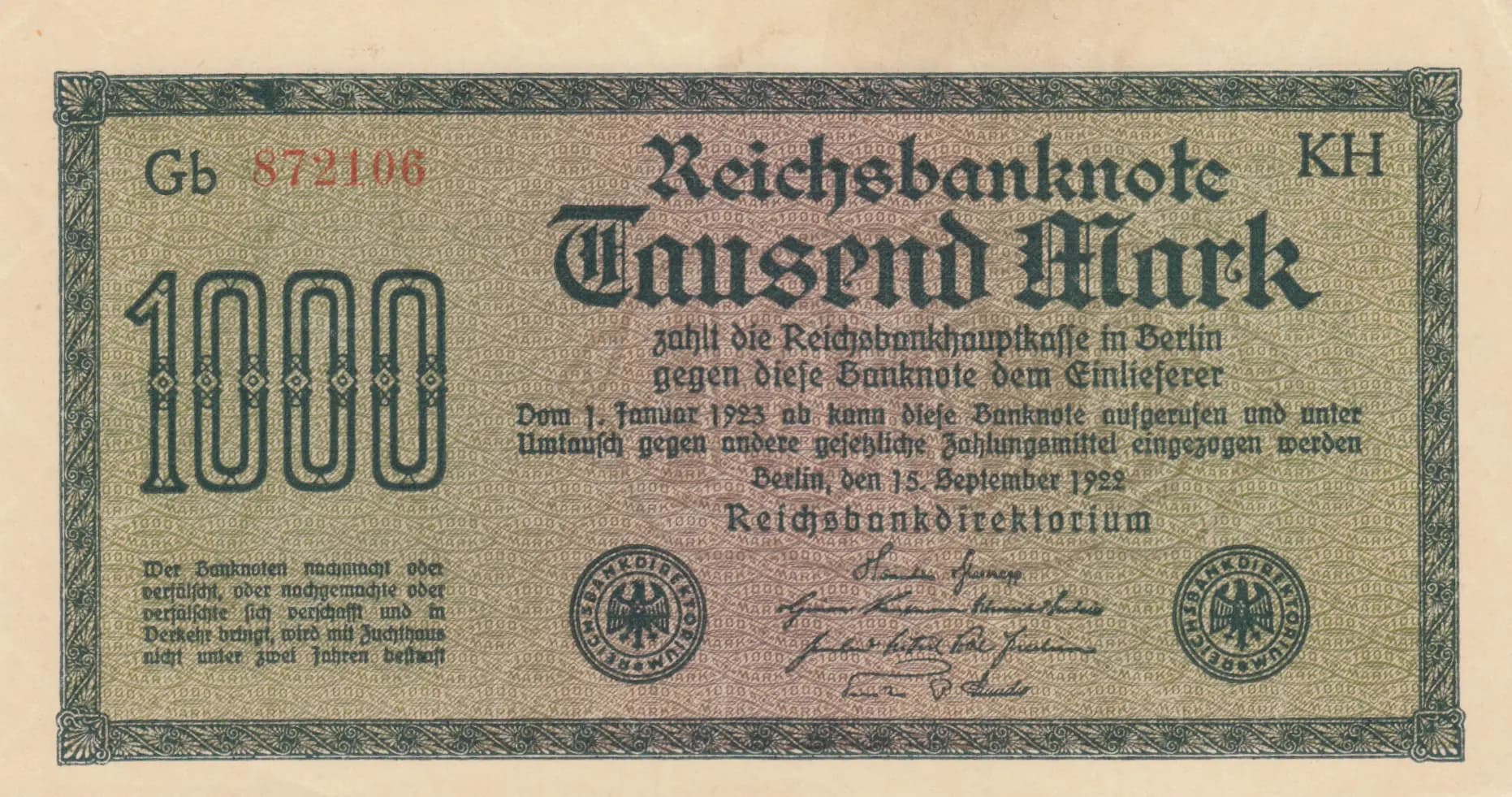
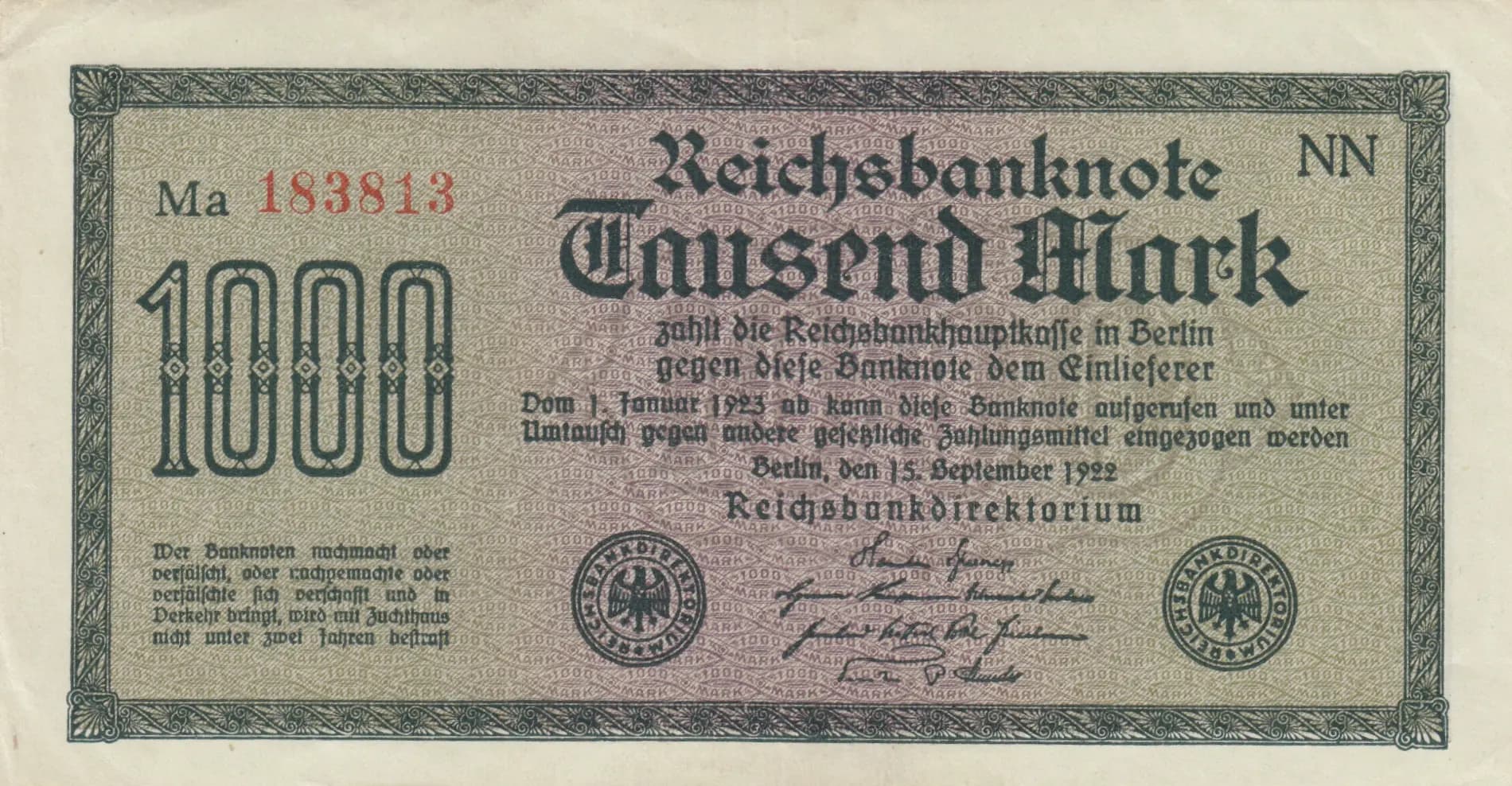
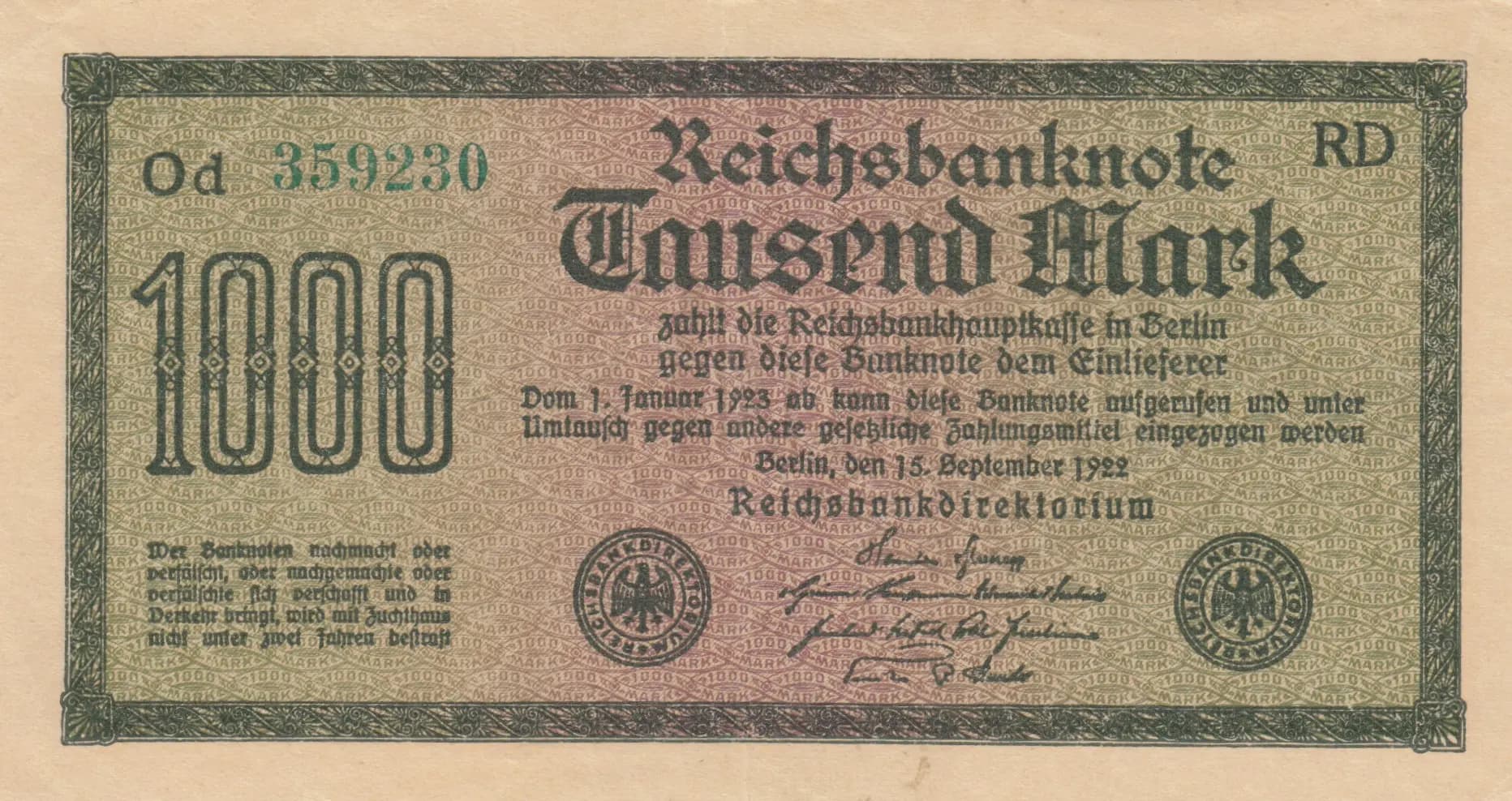
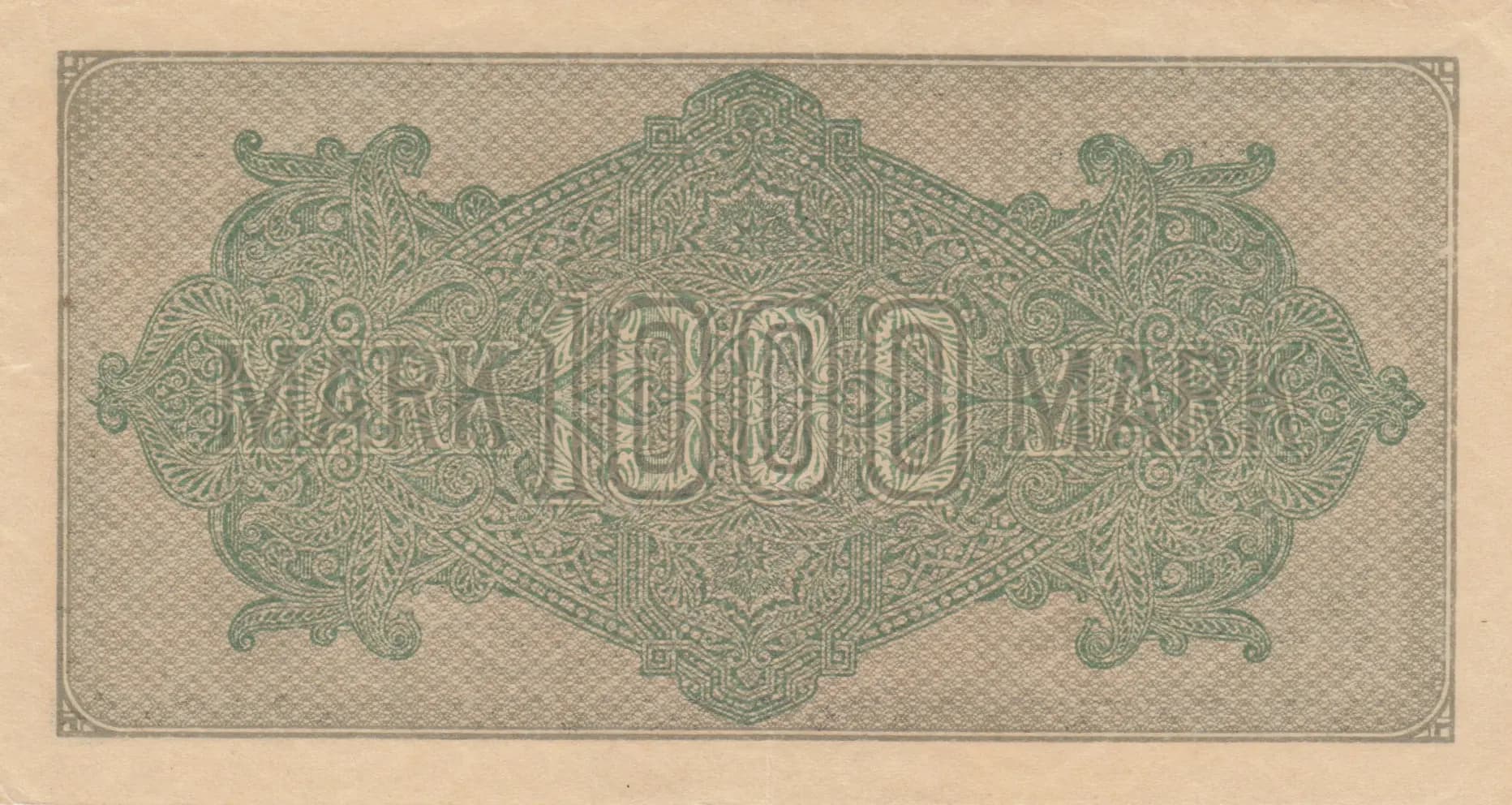
An attractive example of the German Reichsbank 1000 Mark note from September 15, 1922, graded AU. The note displays the characteristic two-color printing scheme with green and reddish-brown tones on cream paper, featuring ornate decorative borders and official seals with eagle emblems. Despite visible age-related toning, foxing, and creases consistent with circulation, the printing remains sharp and legible, with the elaborate reverse ornamental pattern particularly well-preserved—a testament to the high-quality intaglio workmanship of this hyperinflation-era issue.
Common. This is a regular issue of the Reichsbank from 1922 with no recorded small print run or collector rarity. The eBay market data shows these notes trading at low prices ($1–$2 in VF condition in the 2012–2020 period), with even PMG-graded examples (PMG 64 at $15.50, PMG 66 at $85.74) commanding modest premiums typical of common circulation notes rather than scarce pieces. Hyperinflation-era German notes exist in very large quantities, and while the 1000 Mark denomination is higher-value, it remains widely available to collectors.
This note was issued during the final months of the Weimar Republic's catastrophic hyperinflation crisis, specifically on September 15, 1922, when the German mark was collapsing in value. The inscription dated "1. Januar 1923" indicating the note's withdrawal date reflects the government's desperate attempt to manage currency stability during this economic emergency. The formal Reichsbankdirektorium (Reich Bank Directorate) signatures and Gothic German inscriptions emphasize the authority and legitimacy the bank sought to project even as the currency's real value evaporated.
This is a classically designed German banknote featuring the Reichsbank's standard security printing aesthetic of the early Weimar period. The obverse presents a formal layout with the denomination '1000' prominently displayed in large numerals on the left, the central text 'Reichsbanknote' and 'Tausend Mark' in Gothic script, two circular official seals featuring eagle emblems (representing German authority), and signatures of the Reichsbankdirektorium. The reverse consists entirely of an elaborate symmetrical ornamental pattern rendered in green ink—a baroque/rococo-style composition of scrollwork, geometric flourishes, and a central decorative cartouche. This ornamental reverse design served both aesthetic and security purposes, with the intricate fine-line engraving being difficult to counterfeit. The overall color scheme of dark green on green and lilac underprint with tan/cream paper provides visual distinction while maintaining the formal dignity expected of a central bank note.
FRONT SIDE: Serial number prefix: Od 359230 | 'Reichsbanknote' (Reich bank note) | 'Tausend Mark' (One thousand mark) | 'Zahlbar die Reichsbankhauptkasse in Berlin negeb diese Banknote dem Emitsierer' (Payable at the Reich Bank main office in Berlin according to this banknote to the issuer) | 'Dom 1. Januar 1923 ab kann diese Banknote aufgerufen und unter Umlasufer gegem andere gesetzliche Zahlungsmittel eingezogen werden' (From January 1, 1923 onwards, this banknote can be called in and withdrawn in exchange for other legal means of payment) | 'Berlin, den 15 September 1922' (Berlin, September 15, 1922) | 'Reichsbankdirektorium' (Reich Bank Directorate) | 'RD' (Initials) | 'Die Banknote nachahmlich oder verfälschlich, oder nachgemachte oder verfälschliche sich bestatift ist in Deutlich strafbar' (Counterfeiting or falsifying this banknote, or manufacturing counterfeit or falsified versions, is punishable under German law). BACK SIDE: '1000' (denomination indicator within ornamental design).
Intaglio (engraved) printing using multiple color plates. The visual evidence—particularly the sharp, finely-detailed ornamental patterns on both sides, the depth and crisp detail of the official seals and borders, and the precision of the line work—confirms the use of high-quality intaglio technology. German banknotes of this period were typically produced by specialized security printers such as Giesecke+Devrient or the Reichsdruckerei (Imperial Printing Office). The multi-color printing with green on lilac underprint suggests separate engraved plates with precise registration.
This note is identified as Pick P-76e. The PMG population report indicates that at least three variants exist within this base Pick number (P-76c, P-76g, P-76h), suggesting variations in signatures, dates, or series designations. The observed serial number prefix 'Od 359230' and the RD (Reichsbankdirektorium) signature block help distinguish this as the 'e' variety, though precise variety differentiation would require comparison with other documented variants. The issue date of September 15, 1922, is consistent with catalog records. Further examination of signature variations and serial number prefixes would be necessary to confirm this as a specific sub-variety.