1000 mark 1922
Market Prices
15 salesAbout This Note
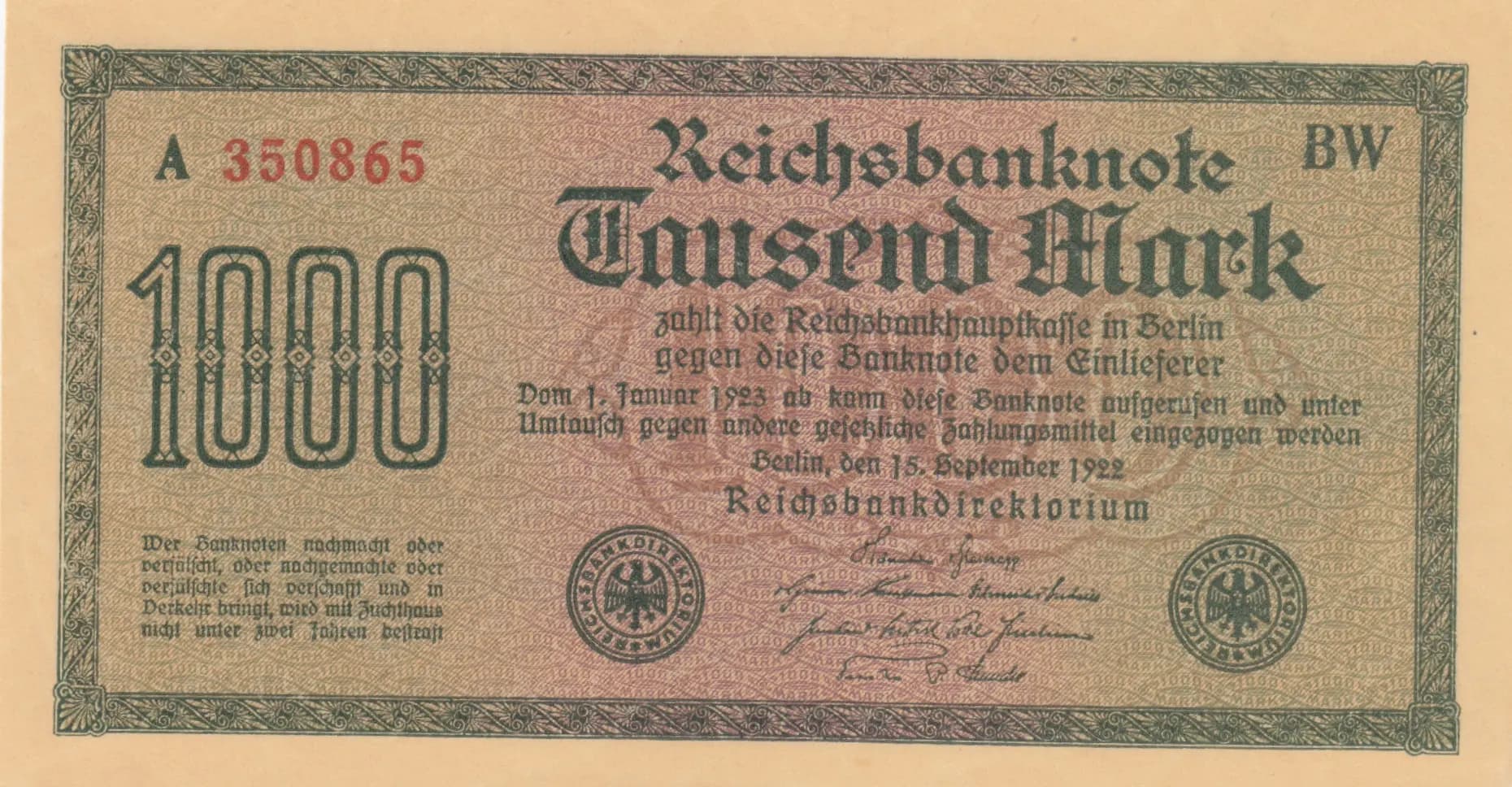
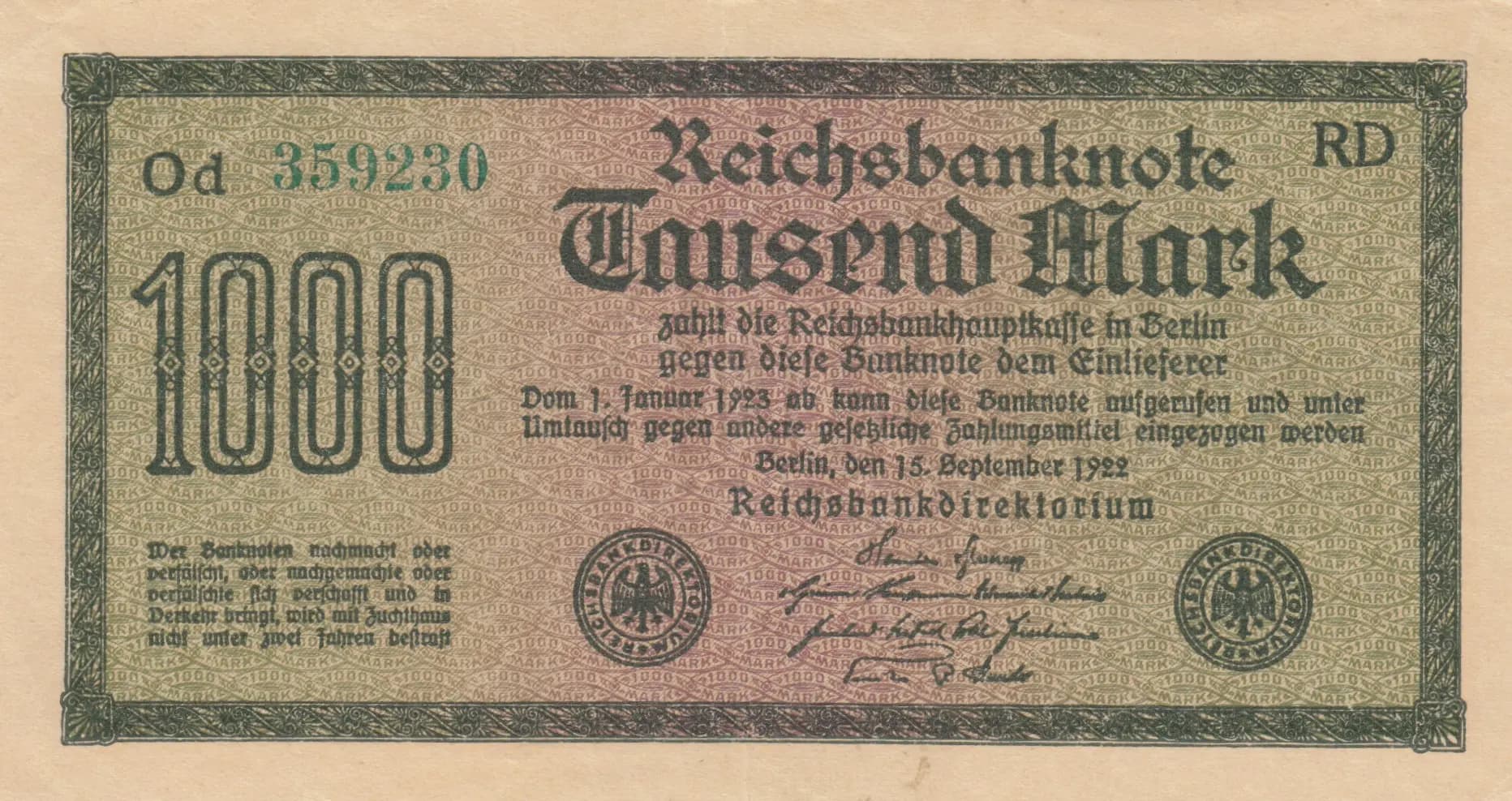
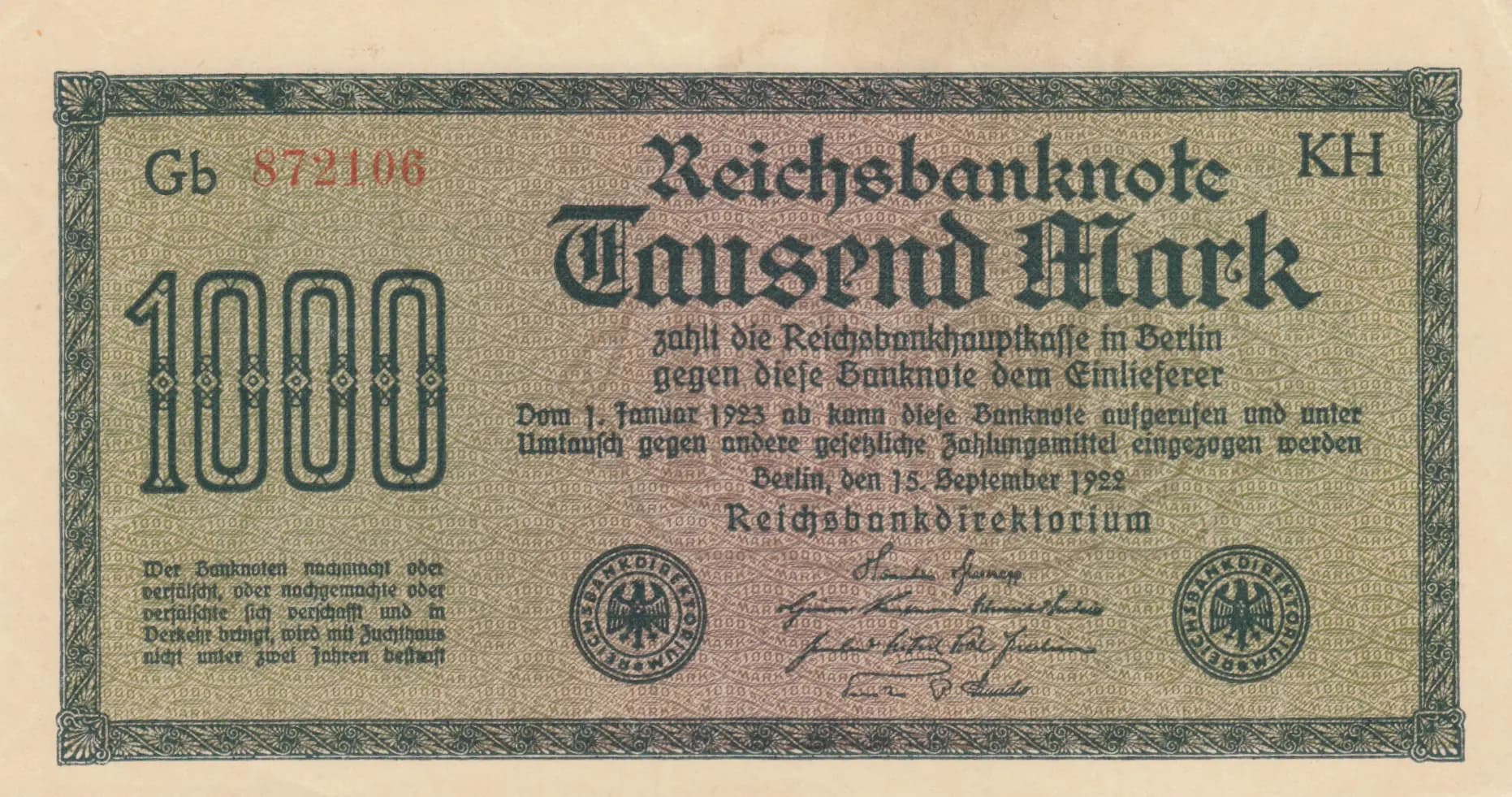
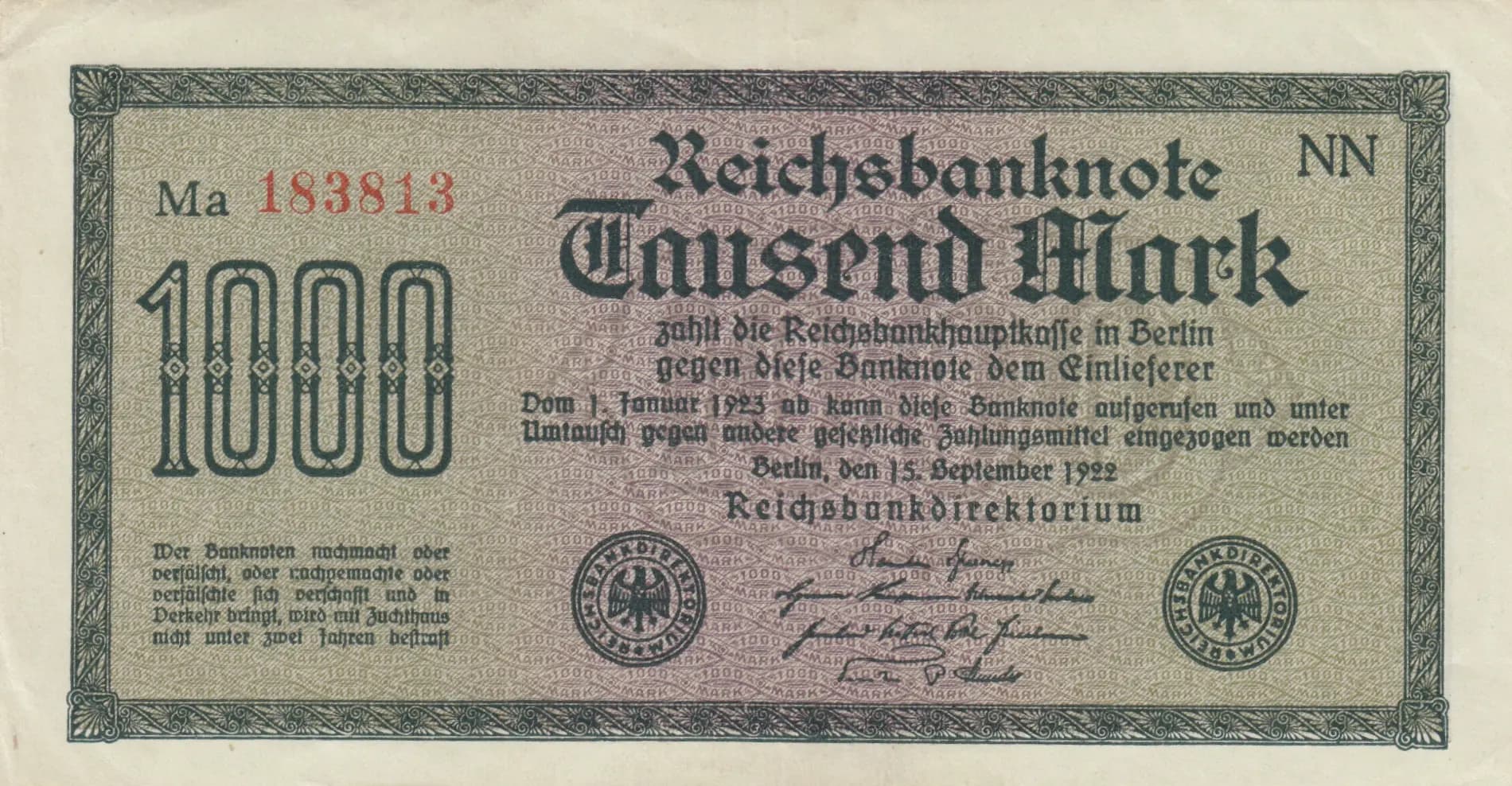
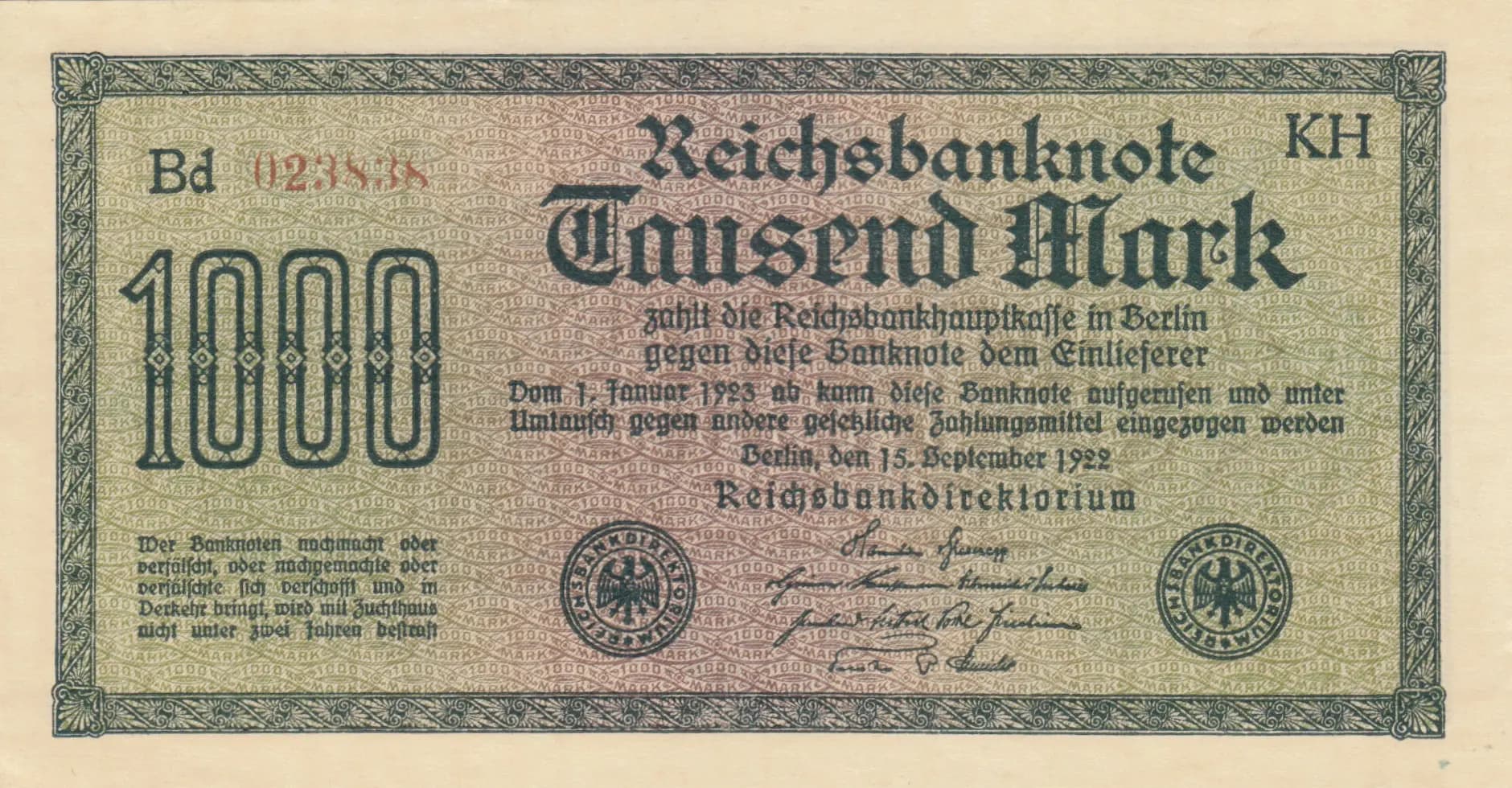
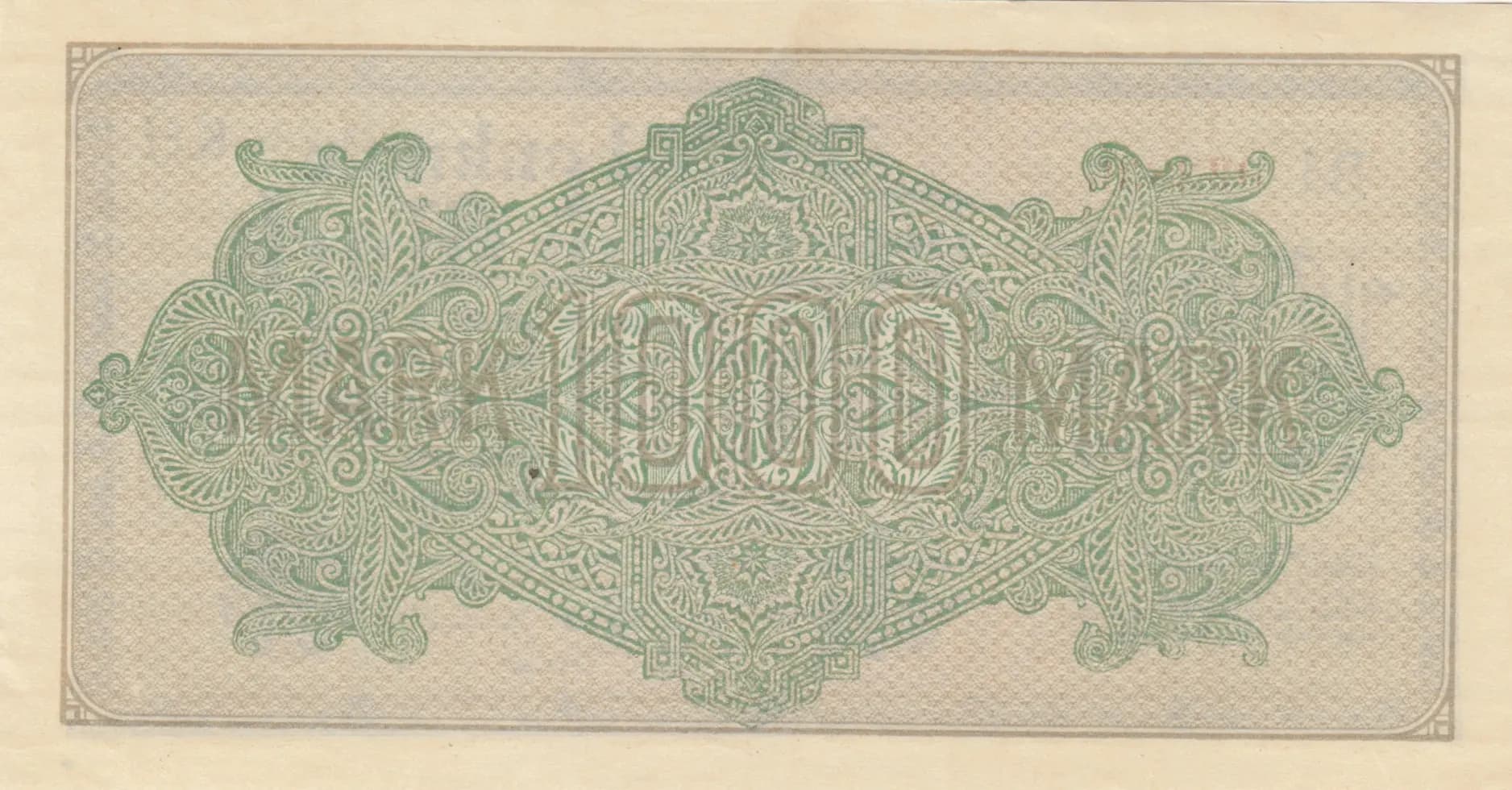
This is a 1000 Mark Reichsbank note from September 15, 1922, presented in AU (About Uncirculated) condition. The note features an ornate Germanic design with a cream/beige background accented by green and dark blue printing, displaying two official Reichsadler (eagle) seals and elaborate decorative borders with repeating geometric patterns. The obverse presents crisp, clearly-printed Gothic script and large denomination numerals, while the reverse showcases an intricate baroque/art nouveau ornamental medallion design, all indicating an uncirculated or barely-circulated specimen with no visible wear, creases, or deterioration.
Common. eBay market data shows consistent sales across multiple grades (VF, EF, AU, UNC) spanning from 2009 to 2024, with prices typically ranging from under $1 to approximately $20, indicating substantial circulation among collectors and dealers. The 1000 Mark denomination from September 1922 was part of a regular issue with no documented recall restrictions or limited print run. High-grade specimens (PMG 65+) command slightly elevated prices ($18-$19) but remain readily available, consistent with a common date and denomination.
Issued during the hyperinflation crisis of the Weimar Republic, this 1000 Mark note represents the Reichsbank's attempt to manage currency circulation in late 1922, just months before the catastrophic inflation of 1923. The note's inscription explicitly warns that it would be callable and exchangeable for other legal tender beginning January 1, 1923, reflecting the monetary instability of the period. The official seals, formal Gothic typography, and ornate design reflect the authority and tradition of the Reichsbank despite the economic turmoil surrounding its issuance.
The obverse features a formal, symmetrical layout characteristic of Reichsbank currency of the period. The denomination '1000' appears prominently in large Gothic numerals on the left side. Two circular official seals bearing the Reichsadler (Imperial German eagle) are positioned in the lower portion, representing the legal authority of the Reichsbank Directorate. An ornate decorative border frames the entire note with repeating geometric patterns. The reverse displays an elaborate baroque/art nouveau ornamental medallion at center with symmetrical floral scrollwork and geometric elements rendered in light green, flanked by corner vignettes. The design employs no portraits or specific landmarks, instead relying on classical ornamental motifs to convey governmental legitimacy and counterfeiting resistance.
FRONT: 'Reichsbanknote' (Reichsbank note) / 'Tausend Mark' (One Thousand Mark) / 'zahlbar die Reichsbankhapttkasse in Berlin' (Payable at the Reichsbank main office in Berlin) / 'gegen diese Banknote dem Einlieferer' (Against this banknote to the depositor) / 'Dom 1. Januar 1923 ab kann diese Banknote aufgerufen und unter Umtausch gegen andere gesetzliche Zahlungsmittel eingezogen werden' (From January 1, 1923 onwards, this banknote can be called in and withdrawn in exchange for other legal tender) / 'Berlin den 15. September 1922' (Berlin, September 15, 1922) / 'Reichsbankdirektorium' (Reichsbank Directorate) / '1000' (denomination) / 'Der Banknoten nachdrument oder verfaldehl, oder nachgemachte oder verfalschte ist strafbar, und in Deutsdt sind alle Zuwiderhandlungen nicht unter zwei jahren bestraft' (Counterfeiting or falsifying banknotes is punishable, and in Germany all violations are punished with at least two years). BACK: No text inscriptions; purely decorative design.
Intaglio (engraved) printing, the standard security printing method for Reichsbank notes of this period. The crisp, well-defined impressions visible on both obverse and reverse, the dimensional quality of the seals and borders, and the fine line-work of the ornamental designs are all characteristic of intaglio production. The color scheme of dark green and blue on cream/beige stock reflects the multi-color intaglio process employed by German government security printers of the early Weimar era.
This note is cataloged as Pick P-76c. The PMG Population Report indicates three documented varieties for the base Pick number (P-76c, P-76g, and P-76h), suggesting minor printing variations exist within the 1000 Mark 1922 issue. The specific variety designation would require examination of signatures, series letters, and serial number prefixes not fully detailed in the visual analysis. The 'Bd' and 'KH' markings visible on the obverse may represent printer identification codes or series indicators distinguishing this specific variety from other printings of the same denomination and date.