100 mark 1911
About This Note
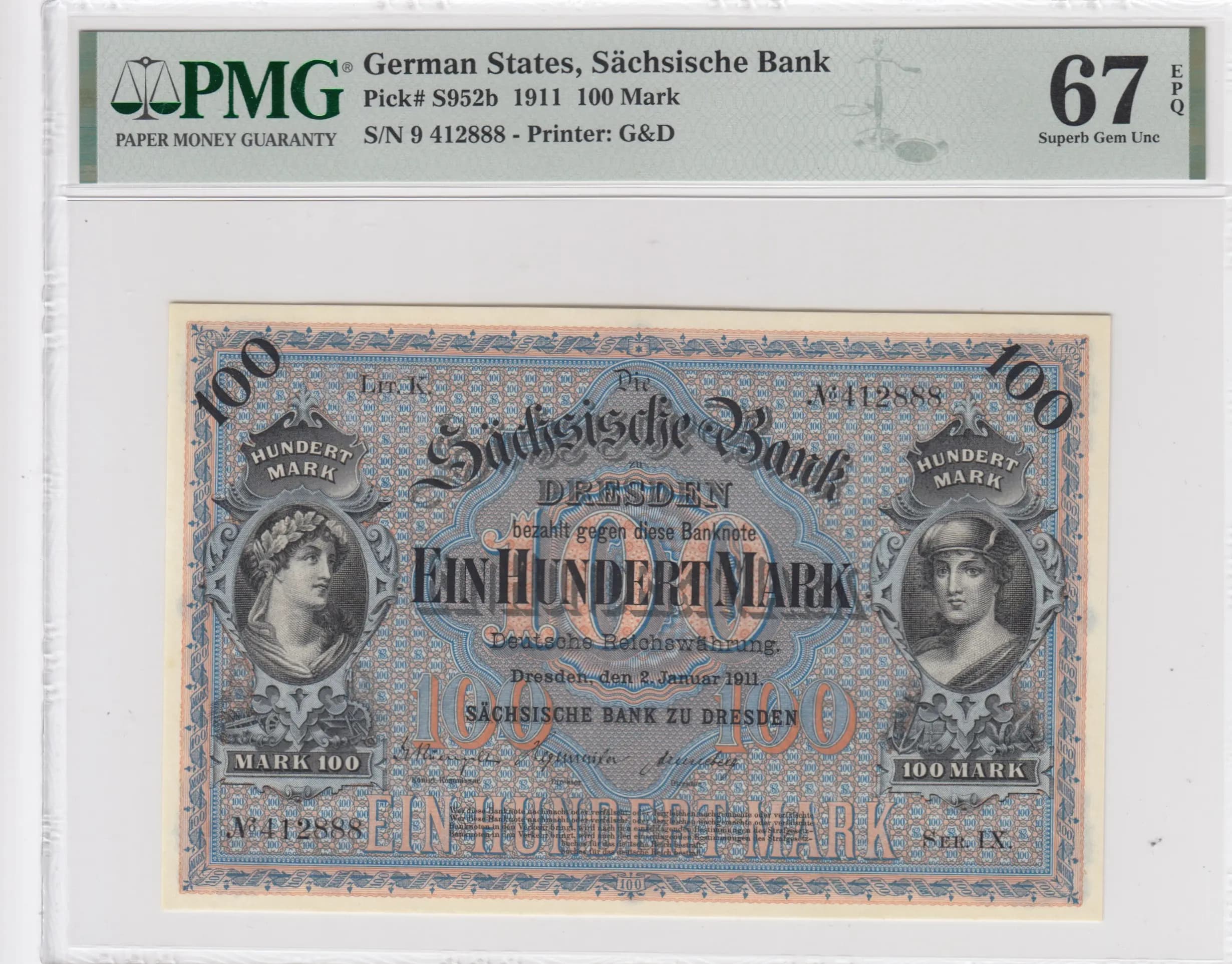
This is an exceptional example of a 100 Mark banknote issued by the Sächsische Bank zu Dresden on January 2, 1911, graded PMG 67 EPQ. The note displays a striking light blue and orange color scheme with ornate Art Nouveau-influenced design elements including two female portrait medallions and elaborate scrollwork. The PMG 67 grade reflects near-perfect uncirculated condition with exceptional paper quality and vibrant, sharp printing throughout, making this a desirable specimen of early 20th-century German regional currency.
Common. The Sächsische Bank zu Dresden was a major issuing authority with substantial print runs during the Imperial period, and 100 Mark denominations from 1911 appear with reasonable regularity in the collector market. While PMG 67 EPQ represents excellent condition, the note itself is not inherently scarce—the pick number P-S952b reflects a standard production variety. No historical evidence suggests limited circulation, recall, or extraordinary rarity for this specific issue.
The Sächsische Bank zu Dresden was one of Germany's major regional note-issuing banks during the Imperial era, operating under the decentralized banking system of the German Empire. This 1911 note was issued during a period of economic stability and imperial prosperity, predating World War I by only three years. The bank's authority to issue currency in German Reichsmarks (Deutsche Reichswährung) reflects the complex federalist monetary structure that characterized pre-Weimar Germany, where multiple banks held concurrent issuing privileges.
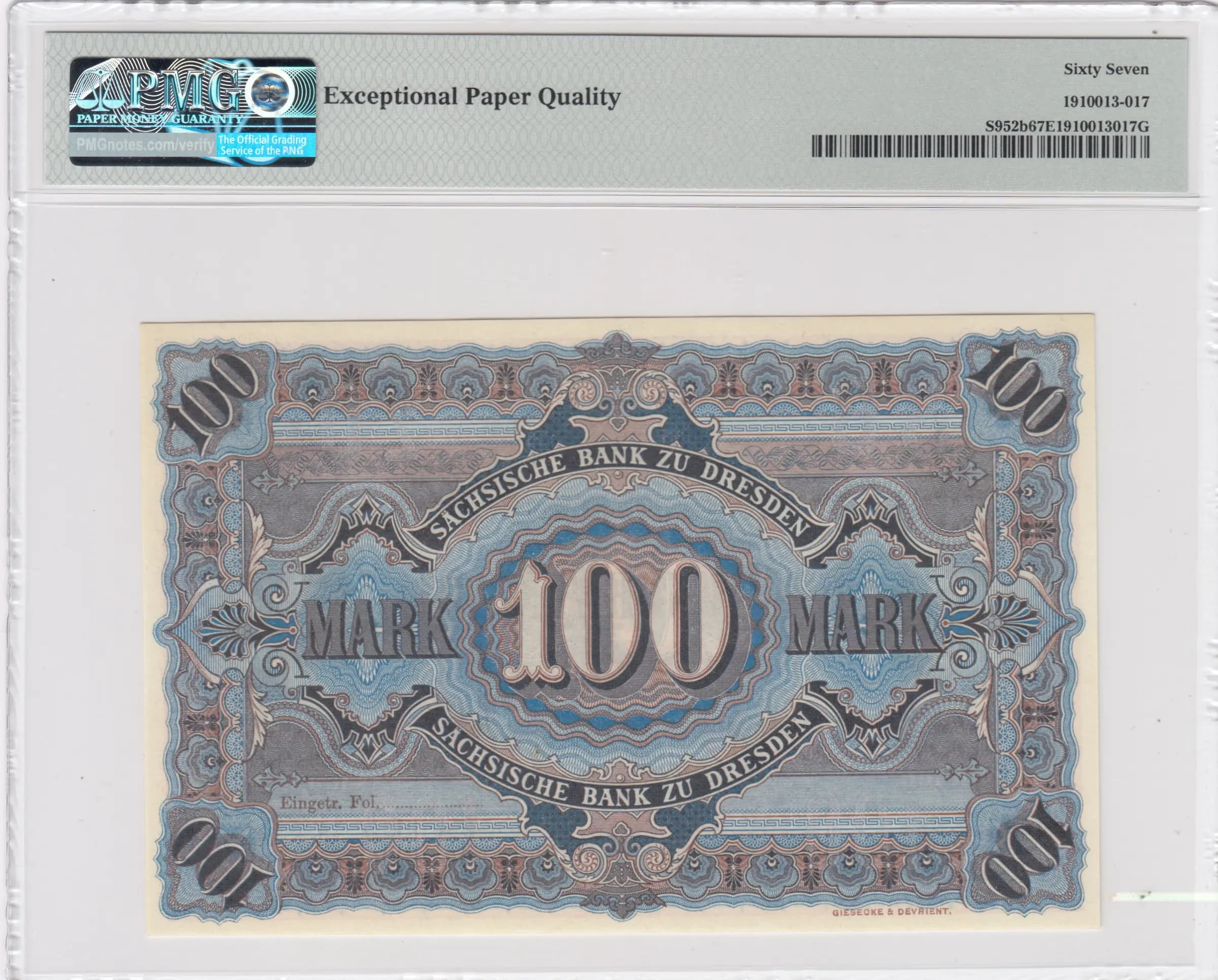
The obverse features a sophisticated symmetrical design centered on two allegorical female portrait medallions positioned on the left and right, housed within ornate circular frames labeled 'HUNDERT MARK.' These female personifications likely represent virtues or concepts associated with commerce and banking in the Belle Époque artistic tradition. The central text block carries the formal bank promise ('bezahlt gegen diese Banknote...') rendered as an overprint, while the date of issue is prominently displayed. The reverse presents a bold, large denomination numeral '100' as the focal point, surrounded by elaborate decorative frames, shell-motif corner ornaments, and the bank's name repeated in banners at top and bottom. The color palette of light blue and orange/tan, combined with black printing and cream background, creates a refined yet visually striking composition typical of high-denomination Imperial German currency. The geometric and floral pattern fills serve dual purposes of aesthetic appeal and security.
FRONT SIDE: '100' / 'HUNDERT MARK' (One Hundred Mark) / 'Die Sächsische Bank' (The Saxon Bank) / 'DRESDEN' / 'bezahlt gegen diese Banknote einhundert mark Deutsche Reichswährung' (pays against this banknote one hundred marks German currency) / 'Dresden, den 2. Januar 1911' (Dresden, 2nd January 1911) / 'SÄCHSISCHE BANK ZU DRESDEN' (Saxon Bank at Dresden) / 'MARK 100' / 'EINHUNDERT MARK' (One Hundred Mark) / Serial Number: 'М412888' / 'SER. IX' (Series IX). BACK SIDE: '100' / 'MARK' / 'SÄCHSISCHE BANK ZU DRESDEN' (Saxon Bank at Dresden) / 'Einzetz. Fol.' (Single leaf) / 'GIESECKE & DEVRIENT' (printer attribution).
This note was produced by Giesecke & Devrient, one of Europe's premier security printers, using a combination of intaglio (engraved) printing for the fine lines, portraits, and security background patterns, supplemented by letterpress overprinting for certain text elements. The sharp definition of the scrollwork, the subtle gradations in the portrait medallions, and the precise registration of multiple color layers indicate sophisticated multi-pass printing typical of Giesecke & Devrient's Imperial-era banknote production. The complex geometric and floral background patterns served as anti-counterfeiting measures standard to the period.
This specimen is identified as Pick P-S952b, representing the 1911 January 2 issue from Series IX (SER. IX), with serial number М412888. The 'b' designation in the Pick catalog typically indicates a specific variety within the 100 Mark 1911 issue, potentially relating to signature combinations, overprint variations, or serial numbering series. The Series IX designation suggests this note represents a later printing within the 1911 authorization. No other varieties or notable overprints are evident from the visual analysis beyond the standard bank promise overprint present on all notes of this type.