100 mark 1918
Market Prices
20 salesAbout This Note
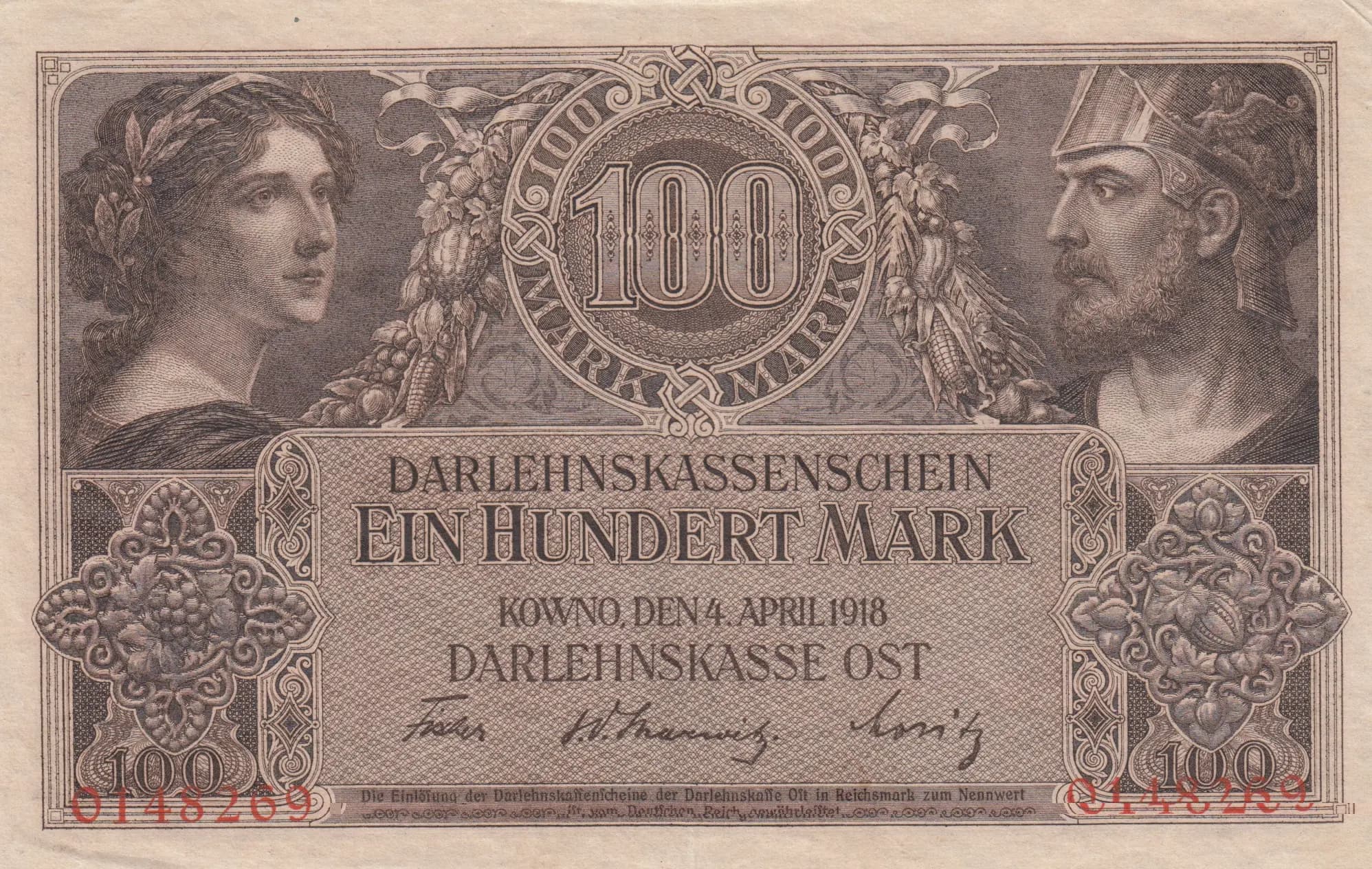
This is an EF-graded 100 Mark banknote issued by Darlehnskasse Ost in Kovno on April 4, 1918, featuring classical allegorical portraiture and exceptional ornamental engraving. The note displays light aging consistent with its age and demonstrates fine line work throughout with minimal handling wear. As a regional currency from the final year of World War I and the Central Powers' occupation of Lithuania, this note represents an important numismatic artifact from a brief and historically significant monetary period.
Common. While this is a regional occupational currency with a brief period of issue (April 1918 through the armistice in November 1918), the eBay price history shows consistent sales activity with notes regularly appearing on the market. Fine condition examples (F grade) have sold in the $10-$31 range over the past 15 years, while VF grades command $18-$33, and the single recorded EF sale in 2017 achieved $67.60. The 2008 catalog value for EF was $150, suggesting some price softening in the current market, but the regular auction activity indicates this is a collectible with steady demand rather than a scarce issue. Print runs for this temporary military occupation currency were substantial, and survival rates appear adequate for regular collector access.
This banknote was issued by the Darlehnskasse Ost (East Loan Bank), a financial institution established by the German military administration during their occupation of Lithuania (then called Kowno in German). The April 1918 date places this note in the final months of World War I, when the Central Powers controlled Eastern Europe following the Treaty of Brest-Litovsk. The classical female bust with laurel wreath and male figure with pointed helmet reflect Germanic allegorical imagery popular in wartime German currency, symbolizing prosperity and martial strength during this period of occupation.
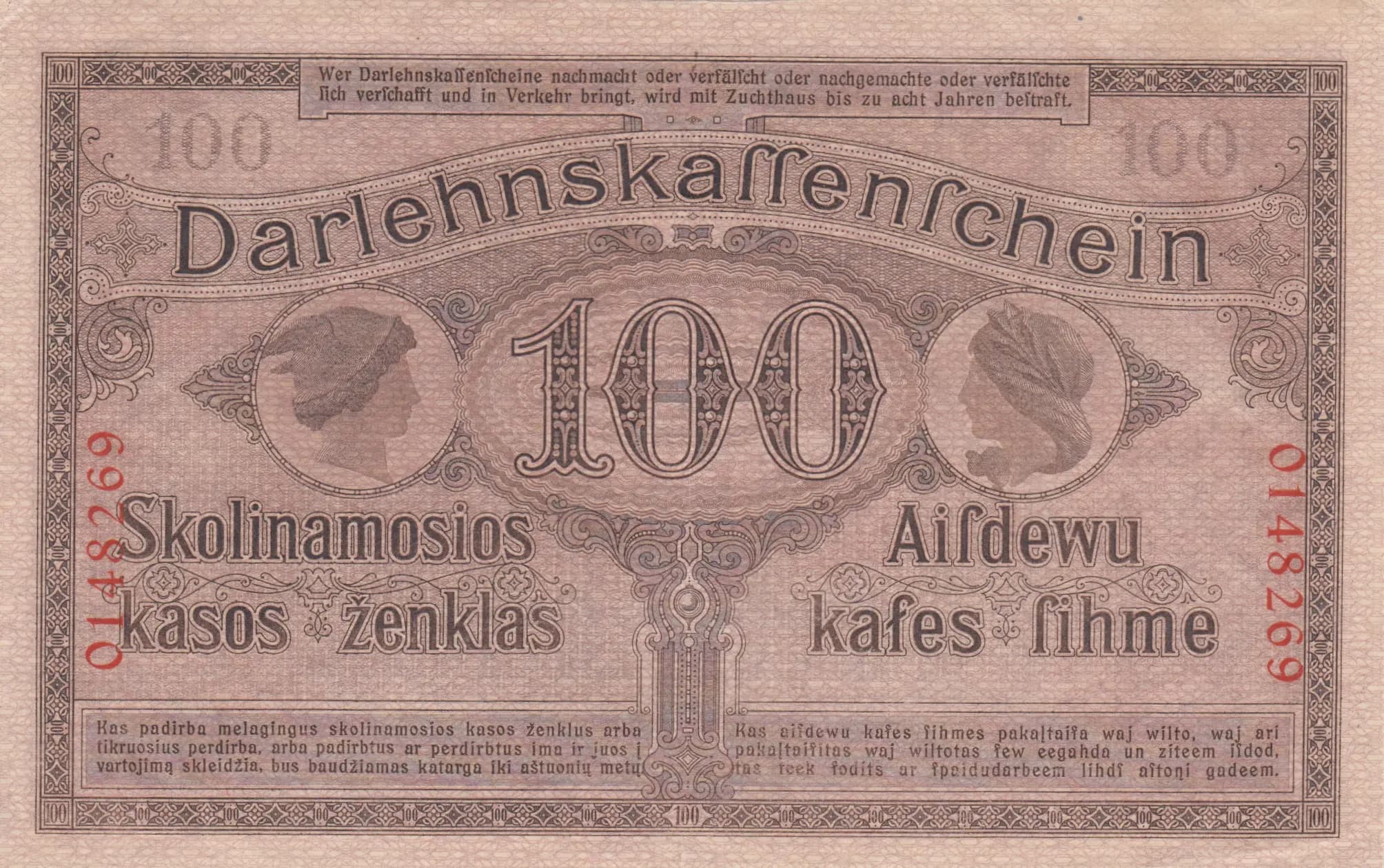
The front features two classical portrait busts in profile representing allegorical figures of prosperity and militarism—a female figure on the left wearing a laurel wreath and classical drapery (symbolizing peace and prosperity), and a male figure on the right wearing a spiked Prussian helmet (symbolizing military power). The central design showcases an ornamental circle containing the numeral '100' with elaborate Celtic and Germanic knotwork patterns characteristic of high-end financial engraving. The borders display intricate ornamental work featuring grape clusters and scrollwork, typical of security currency design. The reverse continues the ornamental theme with decorative medallions flanking the central '100' numeral, repeating geometric and floral border patterns, and additional allegorical portraiture within decorative cartouches. The red serial number overprint appears on both sides, serving as a security and tracking feature. The bilingual German-Lithuanian text reflects the occupation administration's need to address both the occupying power and the local population.
FRONT SIDE: 'DARLEHNSKASSENSCHEIN' (Loan Bank Note), 'EINHUNDERTMARK' (One Hundred Mark), 'KOWNO, DEN 4. APRIL 1918' (Kovno, April 4, 1918), 'DARLEHNSKASSE OST' (East Loan Bank), 'Die Einlösung der Darlehnsscheine der Darlehnskasse Ost in Reichsmark zum Nennwert' (The redemption of the loan notes of the East Loan Bank in Reichsmark at face value). BACK SIDE: 'Darlehnskaifenrchein' (Loan Bank Note), '100' (One Hundred), German counterfeiting penalty clause: 'Wer Darlehnskaitentcheine nachmacht oder verfälscht oder nachgemachte oder verfälschte lich verkauft und in Verkehr bringt, wird mit Zuchthaus bis zu acht Jahren beträft.' (Whoever counterfeits or forges loan bank notes or sells and distributes counterfeit or forged notes shall be punished with hard labor for up to eight years). Additional inscriptions appear in Lithuanian reflecting the bilingual administration of occupied Lithuania, with corresponding Lithuanian penalty clauses and denomination declarations.
Intaglio engraving (line engraving), characteristic of high-security banknote production. The fine line work throughout the note, the detailed portrait rendering, the intricate ornamental borders with grape cluster motifs, and the sharp denominational numerals all indicate master engraving plates. The crisp detail preservation in the EF example confirms professional security printing standards. The red serial number appears to be a separate overprint applied after the primary engraving, likely using letterpress or lithographic overlay techniques common to German banknote production of this period.
Pick catalog P-R133 with Rosettes watermark. This specific example displays the standard design with both German and Lithuanian inscriptions reflecting the bilingual occupation administration. The April 4, 1918 issue date is consistent with the earliest documented emissions from this institution. Serial number visible in red indicates this is from the standard production run. No signature varieties are apparent in the visual analysis, though German occupation banknotes of this period sometimes show variation in signatures or control numbers. The watermark specification (Rosettes) as noted in the PMG population report is the documented variant for this Pick number.