10 reichsmark 1929
Market Prices
11 salesAbout This Note
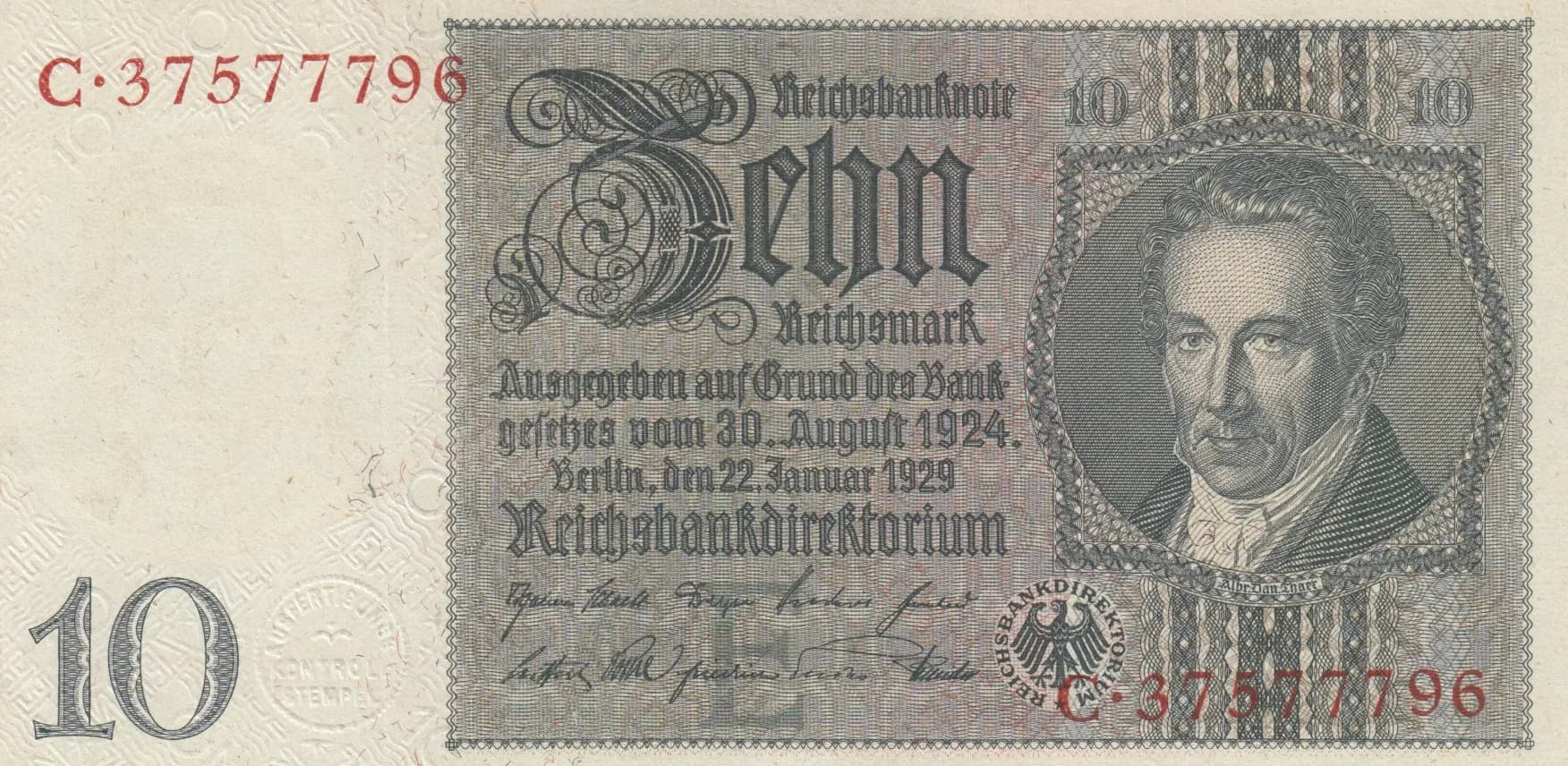
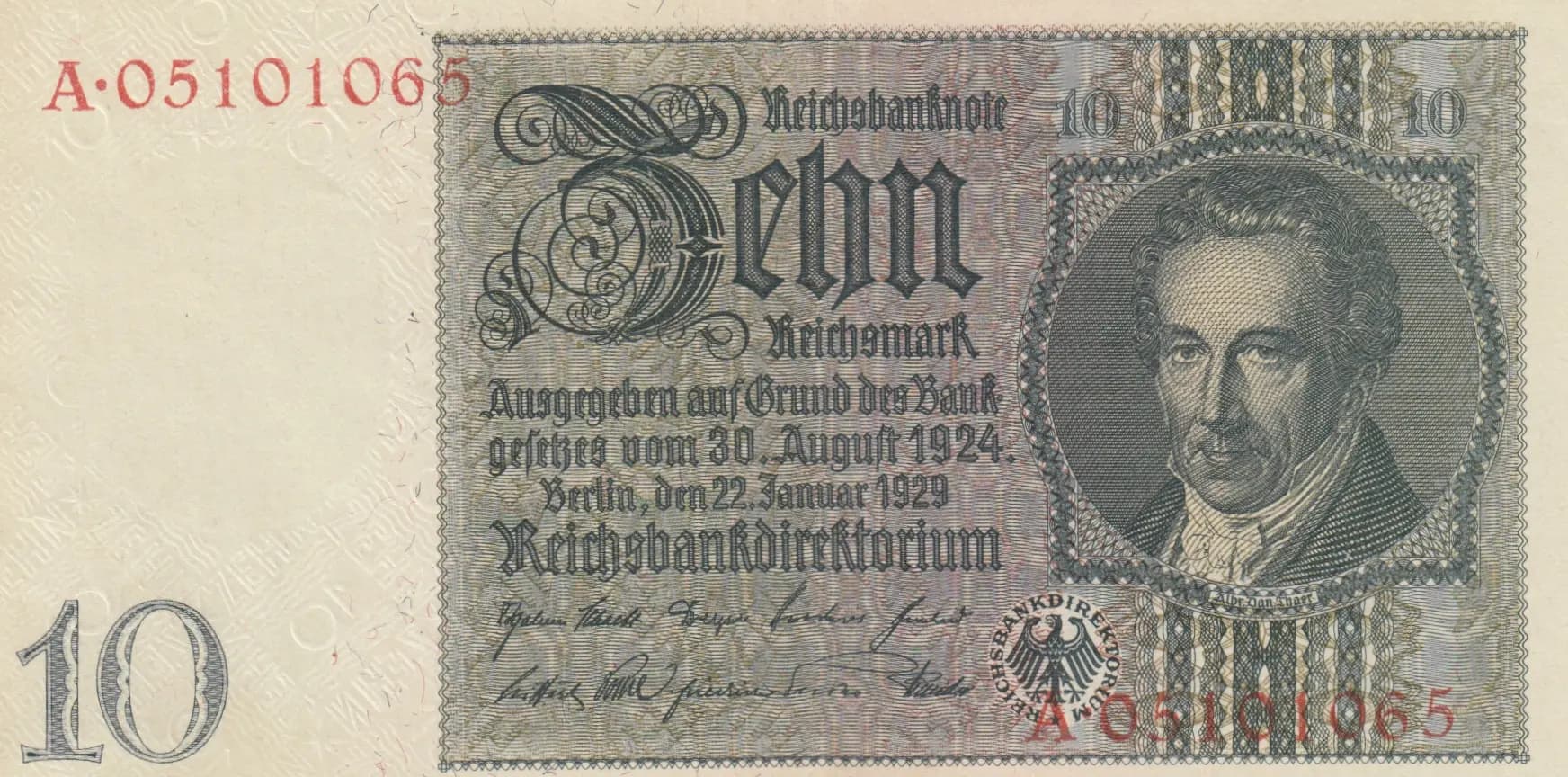
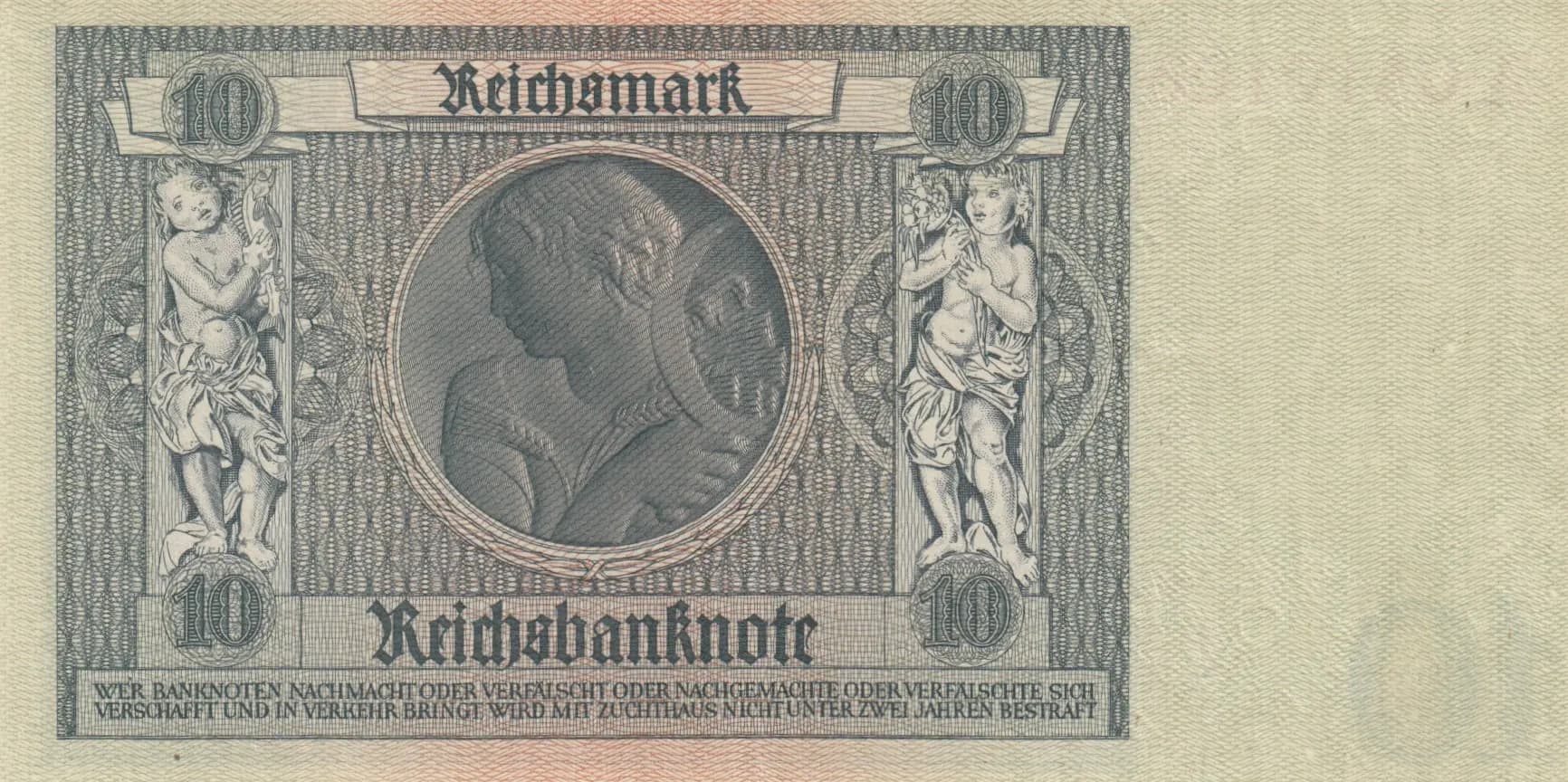
This 1929 German 10 Reichsmark note (Pick P-180b) is presented in exceptional EF condition with minimal wear and excellent preservation. The front features a portrait of Albrecht D. Thaer rendered in fine detail with green-gray and black coloring, while the reverse displays classical allegorical figures including cherubs flanking a neoclassical oval portrait, characteristic of Weimar-era currency design. The note exhibits crisp margins, well-defined engraving, and only light aging consistent with near-uncirculated preservation.
Common. The 1929 10 Reichsmark (Pick P-180b) is a regular issue with substantial print run typical of this denomination and period. eBay market data confirms common status: recent sales (2018-2024) consistently range from $22-$48 for graded examples in the VF-to-UNC range, with ungraded EF examples historically selling for $3-$5. Catalogue values from 2016 list EF at approximately $30, confirming this is a standard date and denomination without scarcity premium. No recall, overprint, or mintage restriction applies to this issue.
Issued on January 22, 1929 by the Reichsbank under the authority of the August 30, 1924 Dawes Plan legislation, this note represents the stabilized currency period of the late Weimar Republic. The selection of Albrecht D. Thaer, a pioneering German agricultural reformer, reflects the period's emphasis on rational economic modernization and productive achievement. The allegorical reverse imagery, featuring neoclassical cherubs and peasant-themed symbolism, connects the note to traditional Germanic values while maintaining a modern design aesthetic typical of late 1920s German currency.
The front side features a portrait of Albrecht D. Thaer (1752-1828), a prominent Prussian agronomist and agricultural reformer, positioned on the right within an ornate rectangular frame. The left side displays large denomination numerals and ornamental flourishes characteristic of classical engraving. The Reichsbank eagle emblem with shield appears in the lower right corner. The reverse presents a neoclassical design centered on an oval portrait medallion (likely representing an allegorical or historical figure symbolic of agricultural prosperity or national virtue) surrounded by decorative circular frames containing the denomination '10' in all four corners. Cherub or putti figures flank the central oval on both sides, representing classical allegory. The overall design employs fine line work, cross-hatching, and intricate scrollwork throughout, reflecting the high-quality intaglio engraving standards of German currency production during this period.
FRONT: 'Reichsbanknote' (Reichsbank Note); '10' and 'Zehn Reichsmark' (Ten Reichsmarks); 'Ausgegeben auf Grund des Gesetzes vom 30. August 1924' (Issued pursuant to the Law of August 30, 1924); 'Berlin, den 22. Januar 1929' (Berlin, January 22, 1929); 'Reichsbankdirektorium' (Reichsbank Directorate); Serial number 'A·05101065' (appears twice in red). BACK: 'Reichsmark' (Reichsmark); '10' (denomination, appears in all four corners); 'Reichsbanknote' (Reichsbank Note); 'WER BANKNOTEN NACHMACHT ODER VERFÄLSCHT ODER NACHGEMACHTE ODER VERFÄLSCHTE SICH VERSCHAFFT UND IN VERKEHR BRINGT WIRD MIT ZUCHTHHAUS NICHT UNTER ZWEI JAHREN BESTRAFT' (Whoever counterfeits banknotes or commits fraud, or obtains counterfeit or fraudulent notes and puts them into circulation will be punished with imprisonment for not less than two years).
Steel-plate intaglio engraving (Stahlstich), the standard printing method for German Reichsbank notes of this era. The visual analysis confirms the characteristic fine line work, precise cross-hatching, and depth of the engraved portrait and ornamental designs. According to the external reference, this note employs the 'Kreuz-Iris' (Cross-Iris) printing technique, a specialized transitional color printing method used by the Reichsbank until 1940/1941 for subtle color gradations in the underprint, though this particular characteristic is difficult to discern in reproduced images. The printer was the Reichsbank's primary engraving facility in Berlin.
This example carries the serial number prefix 'A', indicating the first series of this issue. The date of January 22, 1929 is consistent with the Pick P-180b catalogue designation. Two varieties are known for this issue: those with and without 'Kreuz-Iris' printing (a special transition color technique in the underprint), though both are common and difficult to distinguish in standard photographs. The visual analysis indicates this note is from the regular production series; no specific overprints, signatures variations, or limited-issue characteristics are evident. The note displays the standard Reichsbankdirektorium authorization block typical of this entire series.