1/2 mark 1918
Market Prices
14 salesAbout This Note
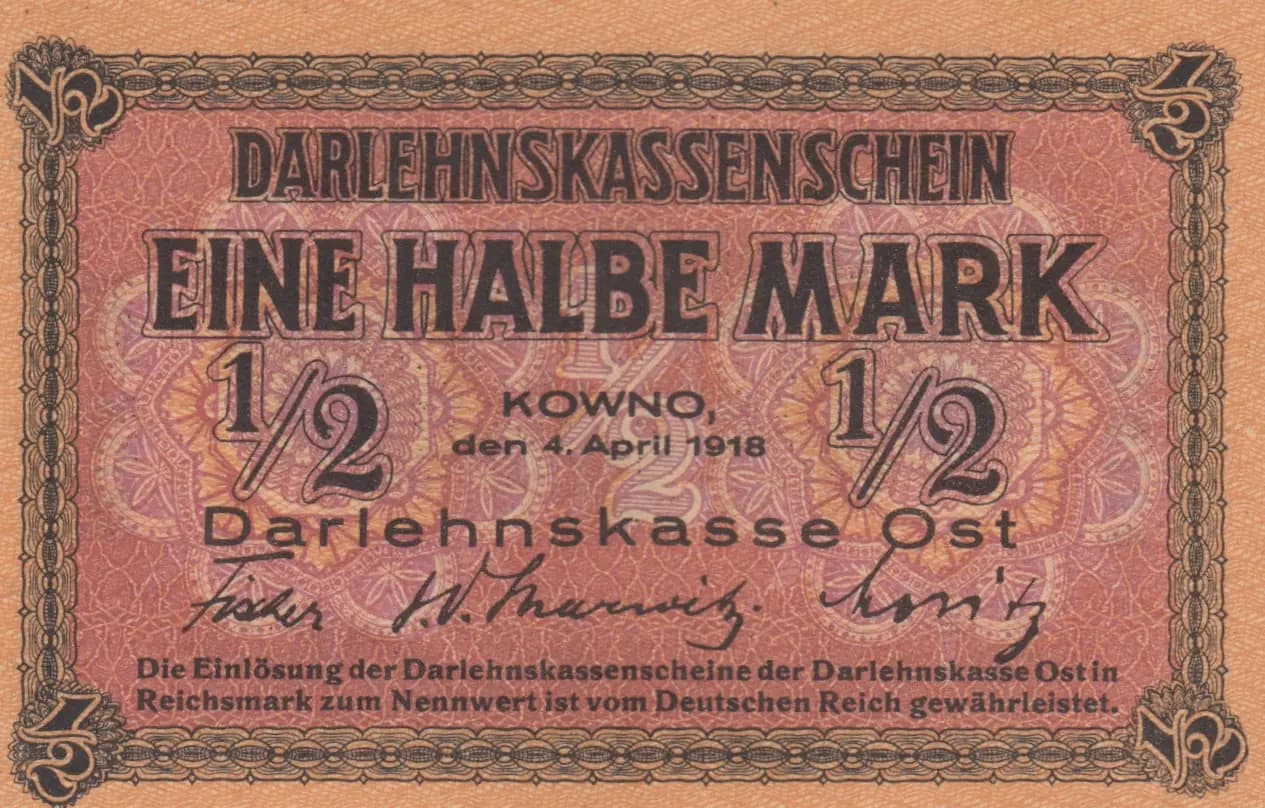
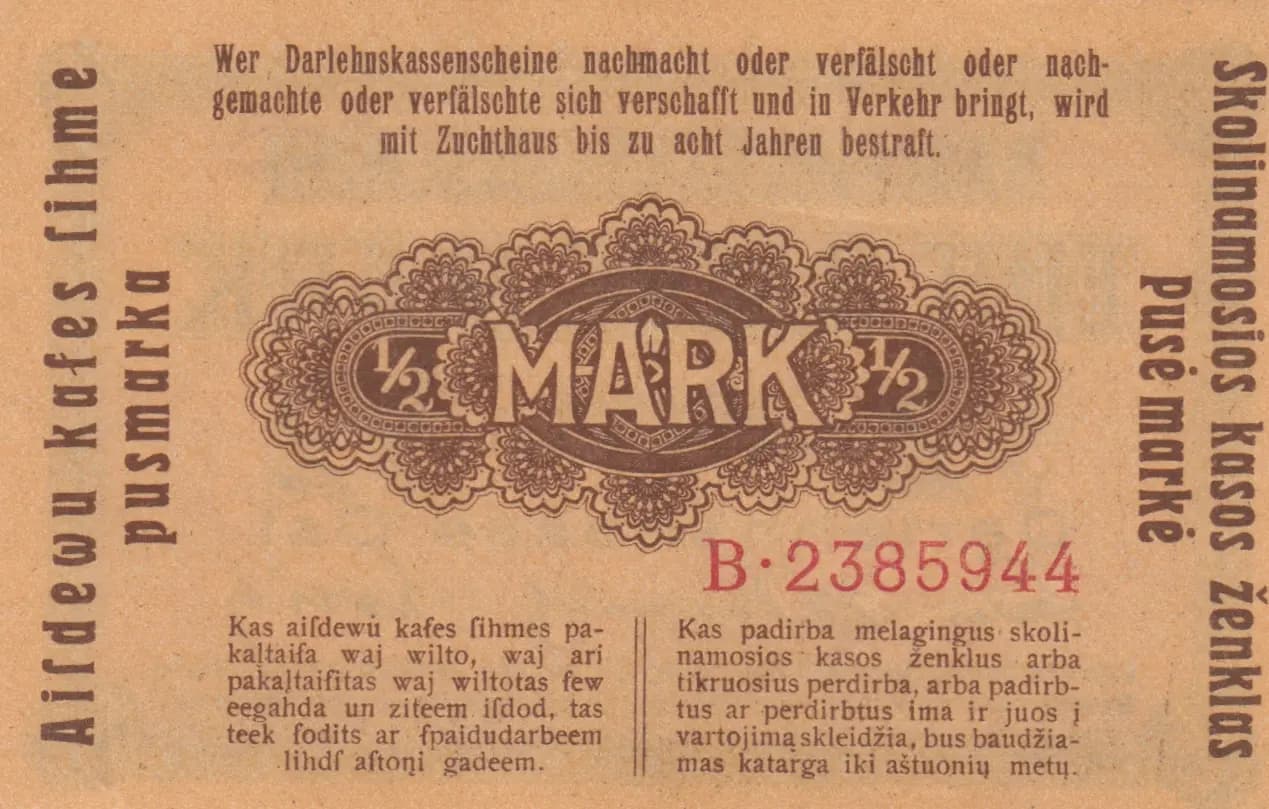
A 1/2 Mark Darlehnskasse Ost note from April 4, 1918, issued in Kovno (Kowno), Lithuania during German occupation. The note displays excellent preservation with minimal wear, featuring ornate Art Nouveau-style decorative borders in red/pink and brown tones, a central handwritten signature, and multilingual text reflecting the occupied territory's linguistic diversity. The serial number B·2385944 is clearly visible on the reverse, and the note exhibits the characteristic damask patterning and elaborate scrollwork typical of German Darlehnskasse emergency currency from this period.
Common. This note appears regularly on the secondary market with multiple eBay sales documented across various grades from 2010-2025, with prices ranging from under $1 (VG grade in 2014) to $70 (EF grade in 2023). The catalog 2008 valuations ($20 VG, $30 VF, $50 UNC) combined with recent market activity showing F-grade notes selling for $5-$12 and VF notes for $10-$13.50 indicate steady collector interest but no scarcity premium. The Darlehnskasse Ost issued substantial quantities of these notes across multiple denominations during 1918, and surviving examples remain accessible to collectors.
Issued by the Darlehnskasse Ost (Eastern Loan Bank) during Germany's World War I occupation of Lithuania, this note represents emergency wartime currency issued to facilitate commerce in occupied territories. The multilingual inscriptions in German, Lithuanian, and Maltese reflect the cosmopolitan nature of Kovno and the complex administrative structure of German occupation authorities. The guarantee statement referencing the German Reich's redemption obligation underscores the formal monetary authority backing these otherwise locally-issued emergency notes, which circulated in Lithuania until independence in 1922.
The note employs a classic Art Nouveau aesthetic with elaborate ornamental design elements on both obverse and reverse. The front features an ornate scrollwork border with corner ornaments and a repeating damask or floral background pattern in red/pink tones, with the denomination and issuer text prominently displayed in dark brown/black ink. A handwritten signature appears in the center, typical of Darlehnskasse notes requiring manual authorization. The reverse showcases an ornate oval frame with lace-like decorative borders containing the centered denomination '1/2 MARK' repeated. The multilingual text layout demonstrates the note's intended circulation across diverse linguistic communities within the occupation zone. No portraits or allegorical figures are depicted; instead, the design relies entirely on geometric and botanical ornamentation to convey legitimacy and security.
FRONT SIDE: 'DARLEHNSKASSENSCHEIN' (Loan Bank Note) | 'EINE HALBE MARK' (One Half Mark) | '1/2' (denomination) | 'KOWNO' (city of issue) | 'den 4. April 1918' (dated April 4, 1918) | 'Darlehnskasse Ost' (Eastern Loan Bank) | 'Die Einlösung der Darlehnskassenscheine der Darlehnskasse Ost in Reichsmark zum Nennwert ist vom Deutschen Reich gewährleistet.' (The redemption of the loan bank notes of the Eastern Loan Bank in Reichsmark at face value is guaranteed by the German Reich.) | BACK SIDE: '1/2 MARK 1/2' (denomination, repeated) | Serial number 'B·2385944' | 'Wer Darlehnskassenscheine nachmacht oder verfälscht oder nachgemachte oder verfälschte sich verschafft und in Verkehr bringt, wird mit Zuchthaus bis zu acht Jahren bestraft.' (German counterfeiting warning: Anyone who counterfeits or forges loan bank notes or obtains counterfeit or forged notes and puts them into circulation will be punished with imprisonment of up to eight years.) | Counterfeiting warnings in Lithuanian and Maltese providing equivalent legal warnings in those languages | 'Storinumosis kasos' (Lithuanian for Bank notes)
The note was produced using letterpress printing with colored underprinting. The dominant colors (red/pink damask pattern and tan/beige background on the obverse; brown and tan tones on the reverse) indicate separate color passes, with the black text elements applied in a final impression. The ornate decorative elements, fine line work in borders, and sharp reproduction of the detailed oval frame on the reverse are characteristic of high-quality letterpress work typical of Imperial German banknote production. The handwritten signatures were added post-printing, as was standard practice for Darlehnskasse notes requiring individual authorization.
This specific example carries serial number B·2385944 with the 'B' prefix. The date of April 4, 1918 places it among the earliest Darlehnskasse Ost emissions. PMG has catalogued one variant for Pick P-R127. Known varieties for this series typically include different serial number prefixes and date variations across the 1918 emission period. The presence of the handwritten signature in brown ink is consistent with standard authorization practices, though signature variations exist across individual notes in this series. No overprints or post-printing modifications are evident on this example.