1 000 000 000 mark 1923
Market Prices
16 salesAbout This Note
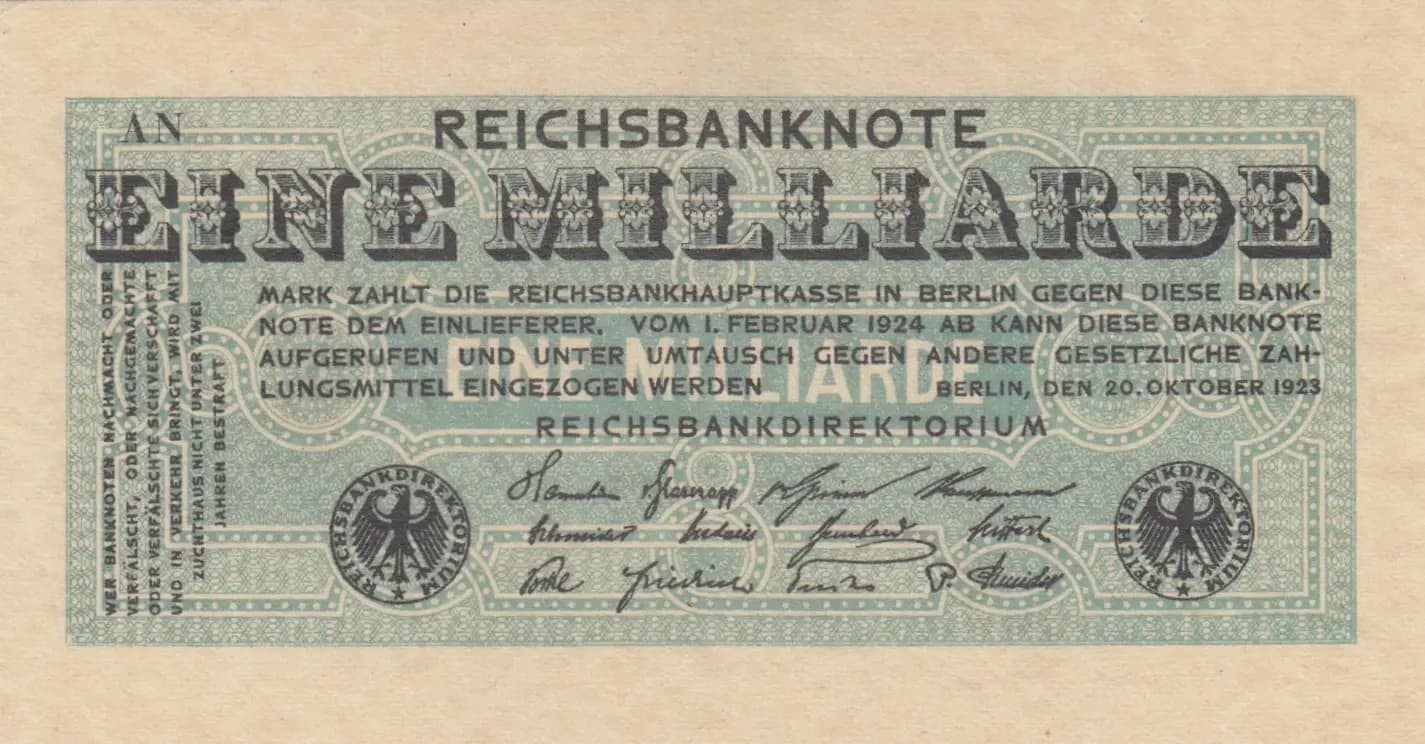
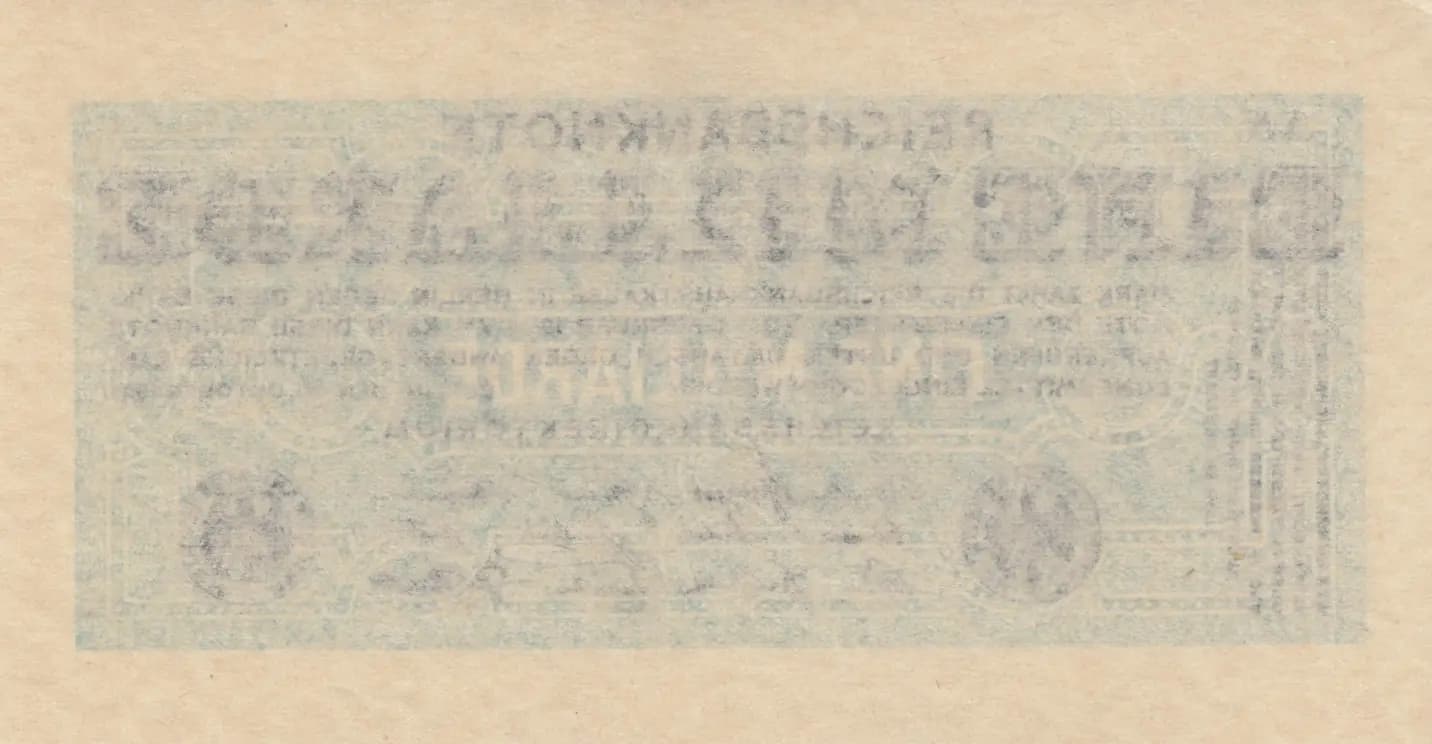
This is a German Reichsbank 1 Milliarde (1 billion) Mark note from October 20, 1923, representing a critical artifact of the hyperinflation period. The note displays the characteristic ornate design of late Weimar emergency currency, with intact official seals, legible inscriptions, and only moderate age-related wear on the obverse—consistent with the AU grade assigned. The reverse shows heavy fading typical of these heavily-circulated inflation notes, yet the front remains well-preserved with clear text and decorative elements intact.
Common. This note survives in significant quantities. The eBay price tracking data shows consistent sales in the $0.99–$21.50 range depending on condition, with prices typically under $20 even for higher grades (PMG 65 sold for $51 in 2017, but this is an outlier). The 2016 catalogue values of $5–$20 for VG–UNC conditions further confirm this is a commonly encountered note. The billion-mark denomination was printed in substantial volumes as an emergency issue, and examples are readily available to collectors. No significant rarity premium applies even in the AU condition shown here.
This note was issued at the peak of German hyperinflation in October 1923, just weeks before the introduction of the Rentenmark would stabilize the currency. The Reichsbankdirektorium (Reichsbank Directorate) signatures and the notation that the note could be called in and exchanged after February 1, 1924 reflect the temporary emergency nature of these denominations. The ornate classical design with Weimar Eagle seals represents the final gasps of confidence in the paper mark before currency reform.
The note features a classically ornate design befitting official Reichsbank currency. The obverse displays the denomination 'EINE MILLIARDE MARK' prominently in large Gothic-style lettering at the top. Two circular Weimar Eagle seals appear symmetrically on the left and right sides—the primary heraldic symbol of the Weimar Republic. The note employs an intricate geometric ornamental border framing the entire composition, with decorative circular medallions containing geometric patterns at the corners. The color scheme consists of black printed text and line work on a light greenish-gray underprint, creating a sophisticated if austere appearance. The central text block contains the formal declaration from the Reichsbankdirektorium dated October 20, 1923, accompanied by multiple handwritten signatures of authorized officials. The reverse (verso) originally contained additional text and design but has faded almost completely to illegibility, a characteristic common in these heavily circulated inflation notes.
FRONT: 'REICHSBANKNOTE' (Reichsbank Note); 'EINE MILLIARDE' (One Billion); 'MARK ZAHLT DIE REICHSBANKHAU PTKASSE IN BERLIN GEGEN DIESE BANKNOTE DEM EINLIEFERER' (The Reichsbank main cashier in Berlin pays this note to the bearer); 'VOM 1. FEBRUAR 1924 AB KANN DIESE BANKNOTE AUFGERUFEN UND UNTER UMTAUSCH GEGEN ANDERE GESETZLICHE ZAHLUNGSMITTEL EINGEZOGEN WERDEN' (From February 1, 1924 this banknote can be called in and withdrawn in exchange for other legal tender); 'BERLIN, DEN 20. OKTOBER 1923' (Berlin, October 20, 1923); 'REICHSBANKDIREKTORIUM' (Reichsbank Directorate); Multiple handwritten official signatures. REVERSE: Text present but illegible due to severe fading; design elements visible in outline only.
This note was produced using intaglio printing (engraving), the standard security printing technique for Reichsbank notes. The crisp line work evident in the ornamental borders, geometric patterns, and text, combined with the dimensional quality of the printed design, is characteristic of intaglio work. The precision of the decorative elements and the security features reflect the advanced printing capabilities of German security printers of the Weimar period. The extreme fading on the reverse suggests the reverse side may have employed a lighter ink application or different printing runs.
This specific note is dated October 20, 1923 (20.10.1923), placing it in the standard October 1923 issue of the 1 Milliarde Mark. Pick catalog P-122 encompasses the primary variety of this denomination. The note exhibits the standard Uniface design (printed on front only, or effectively front-only with faded reverse), which is the characteristic configuration for this issue. The handwritten signatures visible on the obverse are consistent with authorized Reichsbankdirektorium officials of the period, though individual signature varieties are difficult to distinguish at typical image resolution. No overprints or secondary variety markers are apparent. The note represents the standard main type for this Pick number with no known major varieties recorded for the October 20, 1923 date.