5 rupees 1915
About This Note
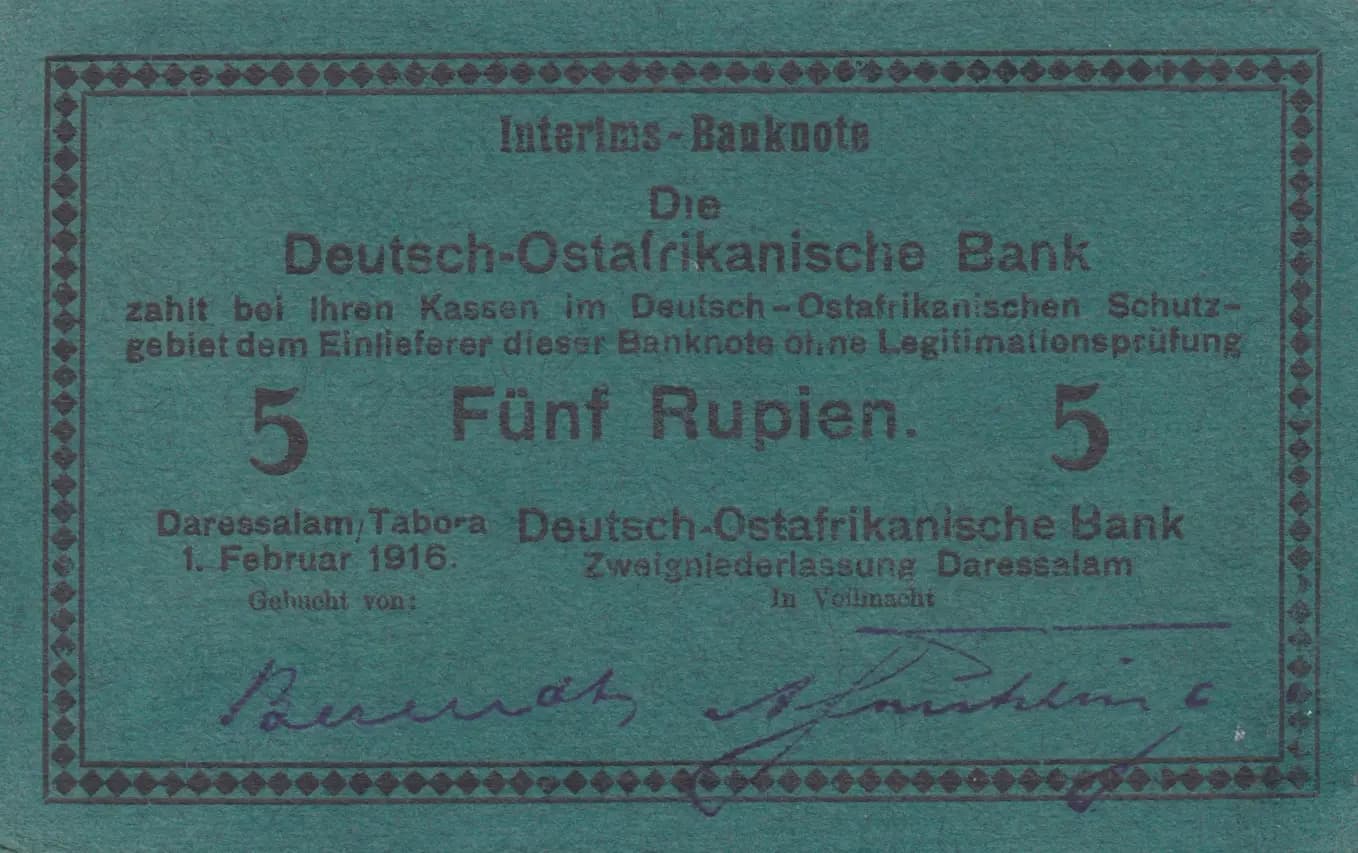
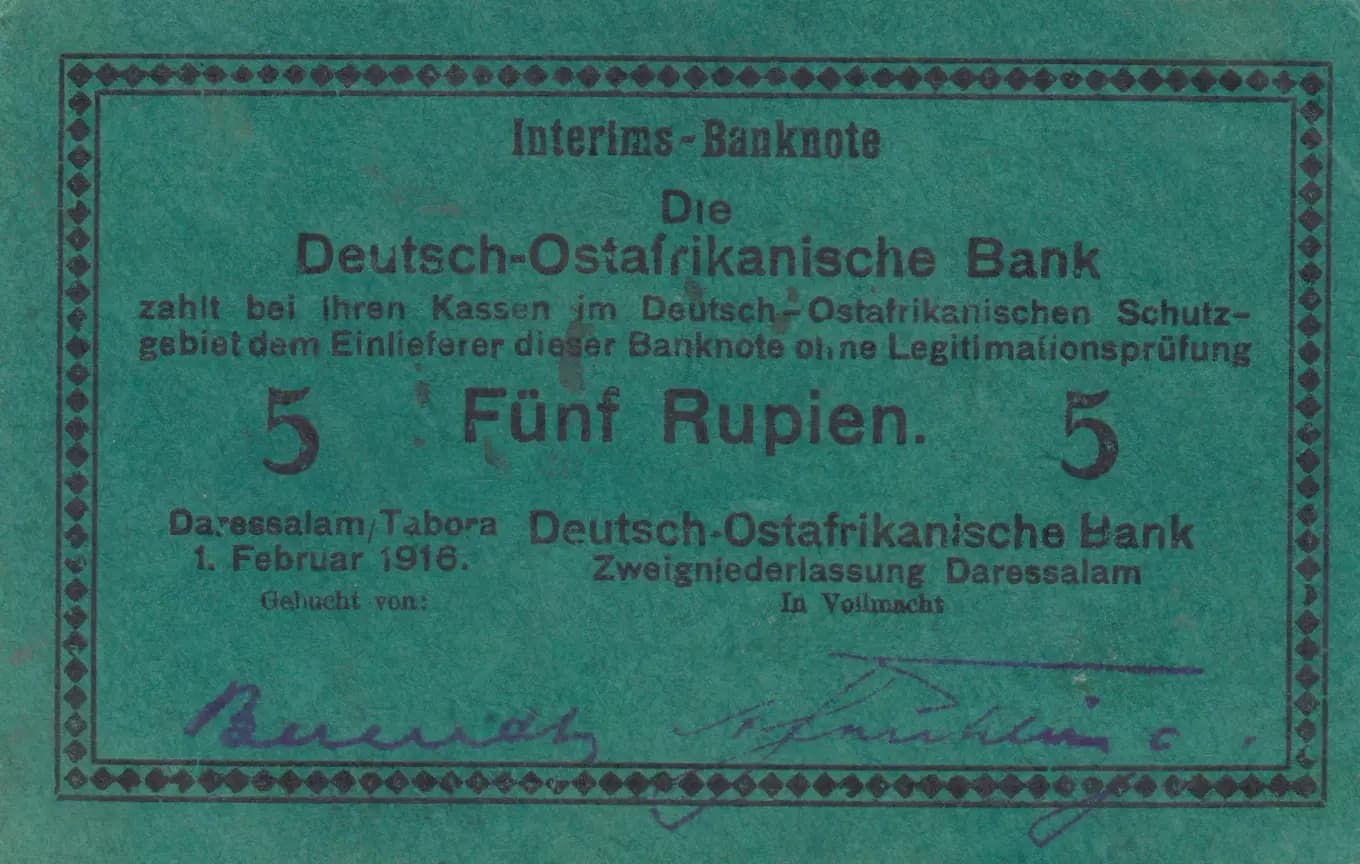
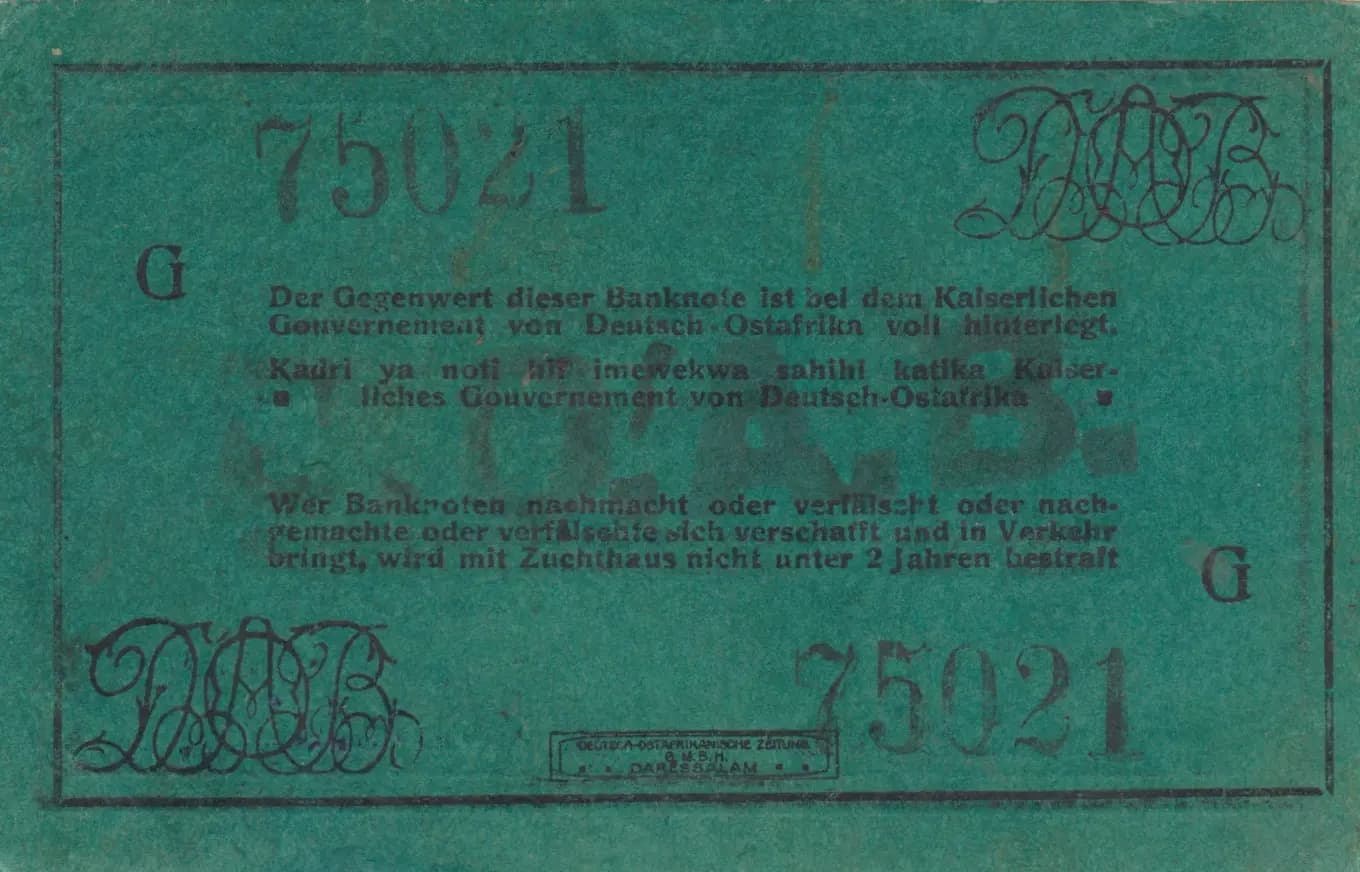
This is a German East African interim banknote (Interims-Banknote) for 5 Rupees issued by the Deutsch-Ostafrikanische Bank in February 1916, graded AU. The note features a distinctive green color with decorative diamond-pattern borders and bilingual German-Swahili text reflecting the colonial administration. Notable features include handwritten signatures of authorized officials, a serial number (750221-G), and official government seals, representing an emergency currency issued during the final years of German colonial rule in Africa.
common
This interim banknote was issued during World War I as German East Africa faced severe currency shortages and economic disruption. The dual-language inscriptions (German and Swahili) reflect the colonial administration's attempt to maintain legitimacy with both European officials and the local African population. The explicit statement that 'the value of this banknote is fully deposited with the Imperial Government of German East Africa' demonstrates the emergency nature of this currency, issued to maintain economic function in the protectorate during the final years before the territory's collapse in 1918.
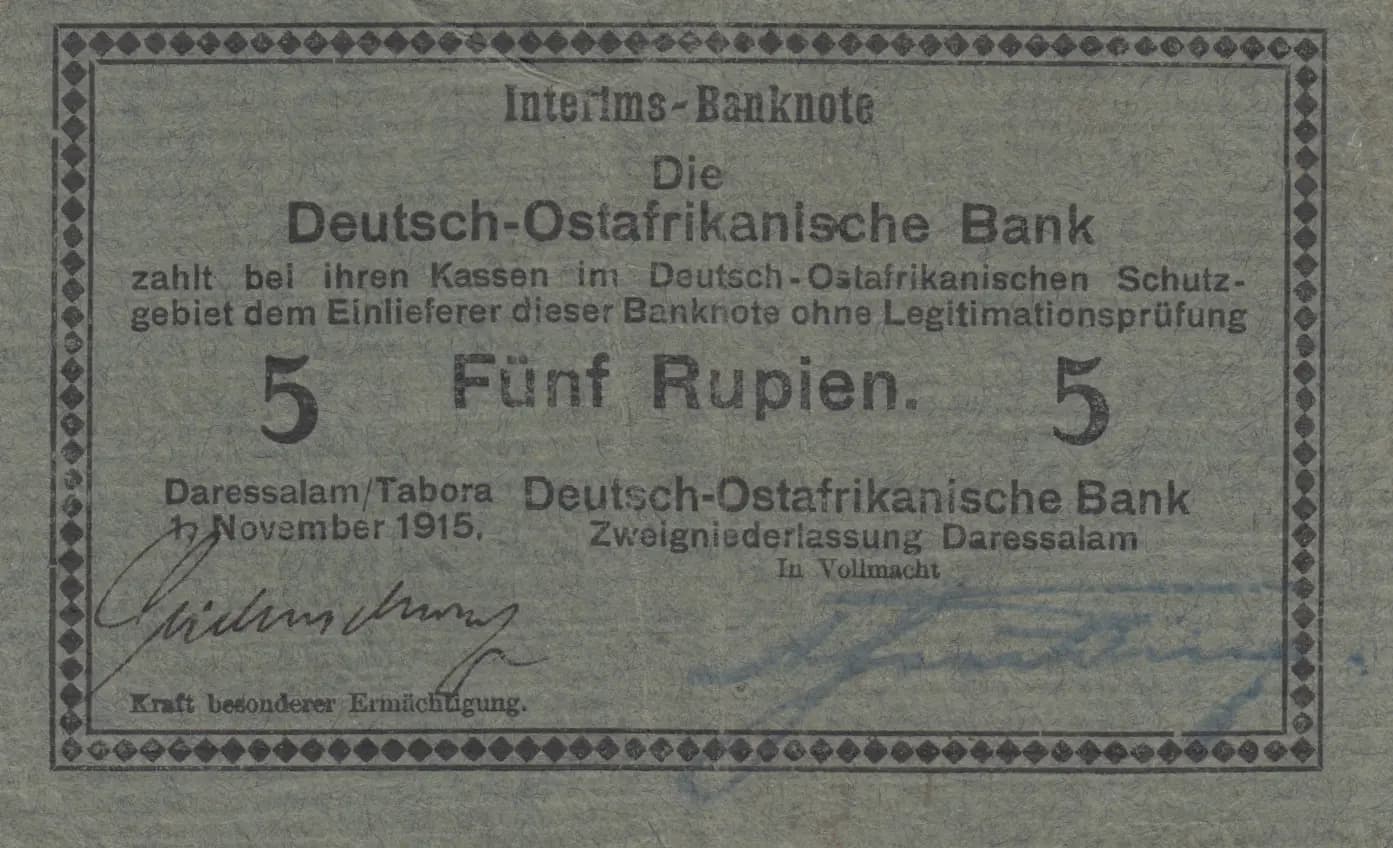
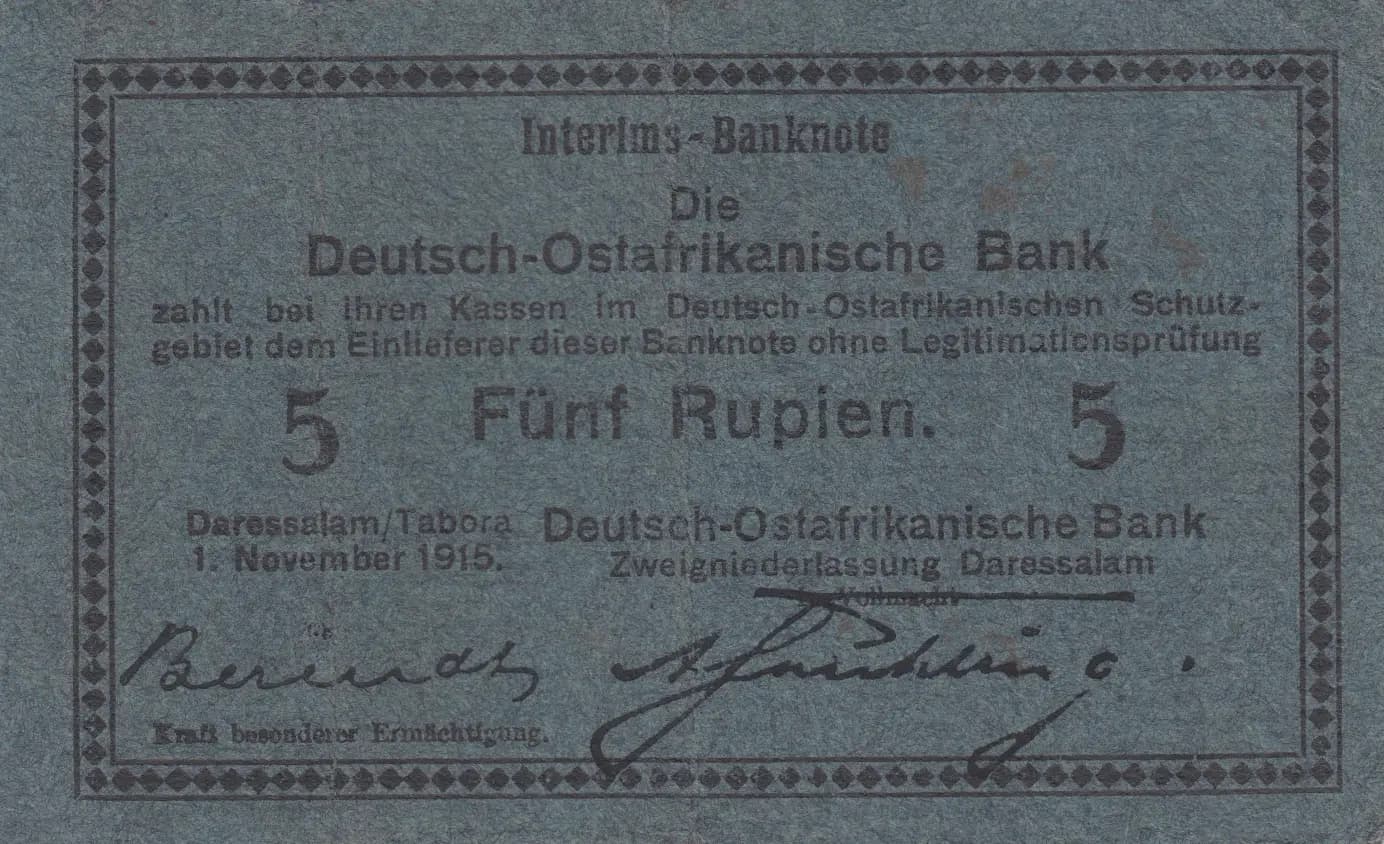
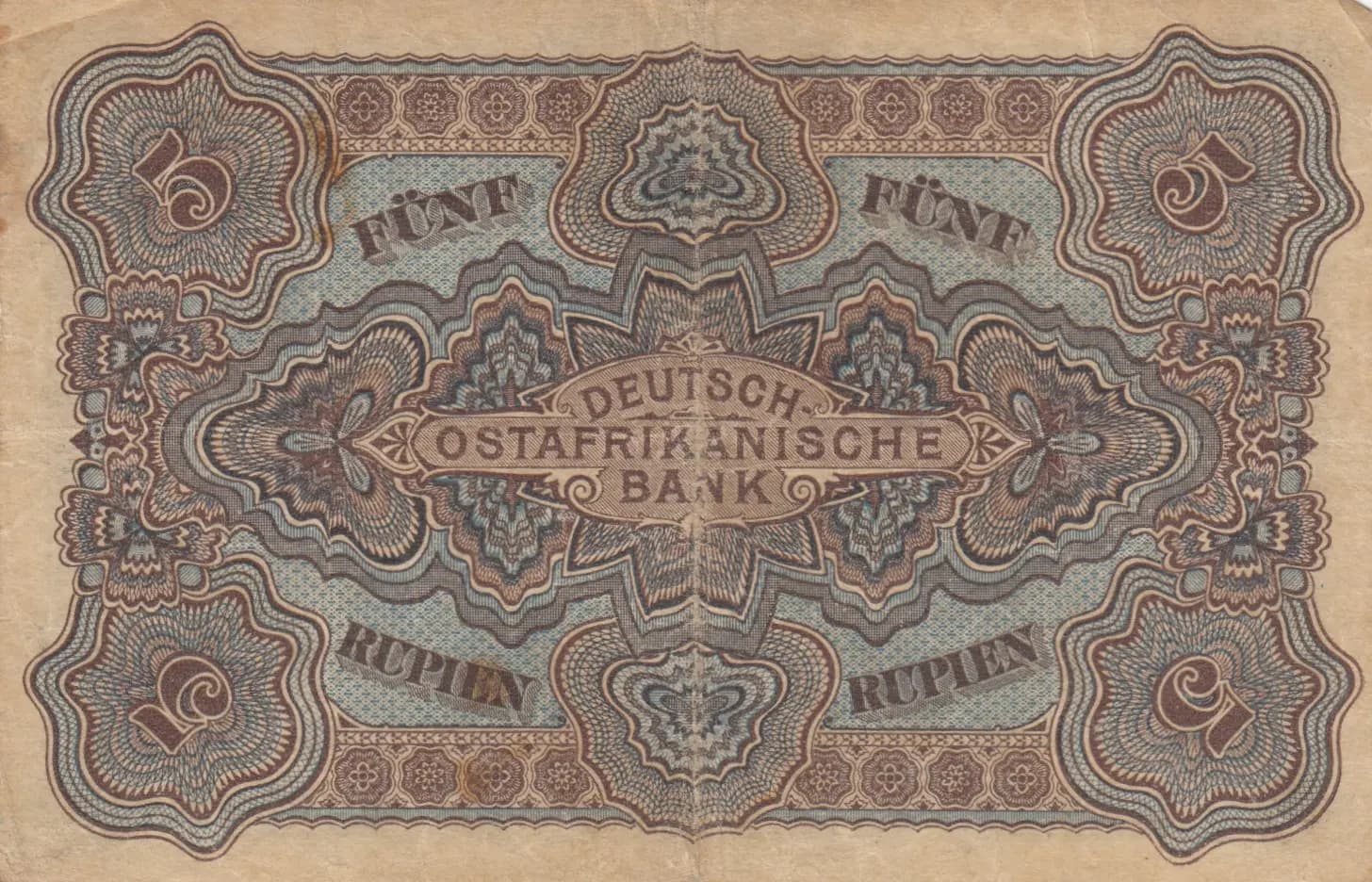
This interim banknote displays a utilitarian design reflecting emergency wartime currency. The obverse features a formal rectangular composition with green as the dominant color, surrounded by an ornamental diamond-pattern border frame. The central area is dominated by large, clearly legible German text declaring the issuer and payment guarantee, with the denomination '5 Fünf Rupien' prominently displayed at both left and right margins in large numerals. Two handwritten signatures appear at the bottom—authorized officials certifying and authorizing the issue. The reverse side maintains the green color scheme and presents official legal text regarding deposit backing and counterfeiting penalties. Notable design elements include an ornate monogram or coat of arms (top right), decorative monograms at bottom corners, and an official governmental seal/stamp from the Deutsch-Ostafrikanische Zeitung. Serial number 750221 with series letter 'G' provides identification. The bilingual presentation (German primary text with Swahili supporting text) reflects the colonial administrative structure.
FRONT SIDE: 'Interims-Banknote' (Interim Banknote) — 'Die Deutsch-Ostafrikanische Bank zahlt bei Ihren Kassen im Deutsch-Ostafrikanischen Schutzgebiet dem Einlieferer dieser Banknote ohne Legitimationsprüfung' (The German East African Bank pays at its counters in the German East African protectorate to the deliverer of this banknote without verification of legitimation) — '5 Fünf Rupien. 5' (5 Five Rupees 5) — 'Daressalam/Tabora Deutsch-Ostafrikanische Bank i. Februar 1916' (Daressalam/Tabora German East African Bank February 1916) — 'Zweigniederlassung Daressalam' (Branch Office Daressalam) — Signature lines marked 'Gebucht von:' (Certified by) and 'In Vollmacht' (With Power of Attorney). REVERSE SIDE: Serial designation '750221 G' — 'Der Gegenwert dieser Banknote ist bei dem Kaiserlichen Gouvernement von Deutsch-Ostafrika voll hinterlegt' (The value of this banknote is fully deposited with the Imperial Government of German East Africa) — 'Kaarü ya nofi für imewekwa sahihi Hadika Kaiserliches Gouvernement von Deutsch-Ostafrika' (Swahili-German mix acknowledging Imperial Government authority) — 'Wer Banknoten nachmacht oder verfälscht oder nachgemachte oder verfälschte sich verschafft und in Verkehr bringt, wird mit Zuchthaus nicht unter 2 jahren bestraft' (Whoever counterfeits or forges banknotes or procures counterfeit or forged ones and brings them into circulation will be punished with imprisonment of not less than 2 years) — 'DEUTSCH-OSTAFRIKANISCHE ZEITUNG DARESSALAM' (German East African Newspaper, Daressalam).
This interim banknote was produced using letterpress printing on paper, a standard technique for emergency currency of the World War I era. The text and decorative borders show the characteristic sharp impressions of relief printing. The handwritten signatures and notations were added post-printing by authorized bank officials, a common practice for interim notes. No elaborate engraving or security features typical of regular banknote production are present, reflecting the expedient nature of emergency wartime currency.
This specific note is identified as Pick P-36e, representing the 5 Rupees denomination from the 1915-1916 interim note series. The variety is distinguished by the handwritten signature authorization, the February 1916 date (rather than earlier 1915 dates), the series letter 'G', and the specific serial number 750221. The note indicates 'Zweigniederlassung Daressalam' (Daressalam branch), suggesting this was issued through the main branch office. The presence of both German and Swahili text and the specific government seal design are consistent with the final interim issues before the collapse of German East African administration in 1918. Variations within this issue type include different signature combinations, serial number ranges, and branch designations (Daressalam vs. Tabora).