1 rupien 1905
About This Note
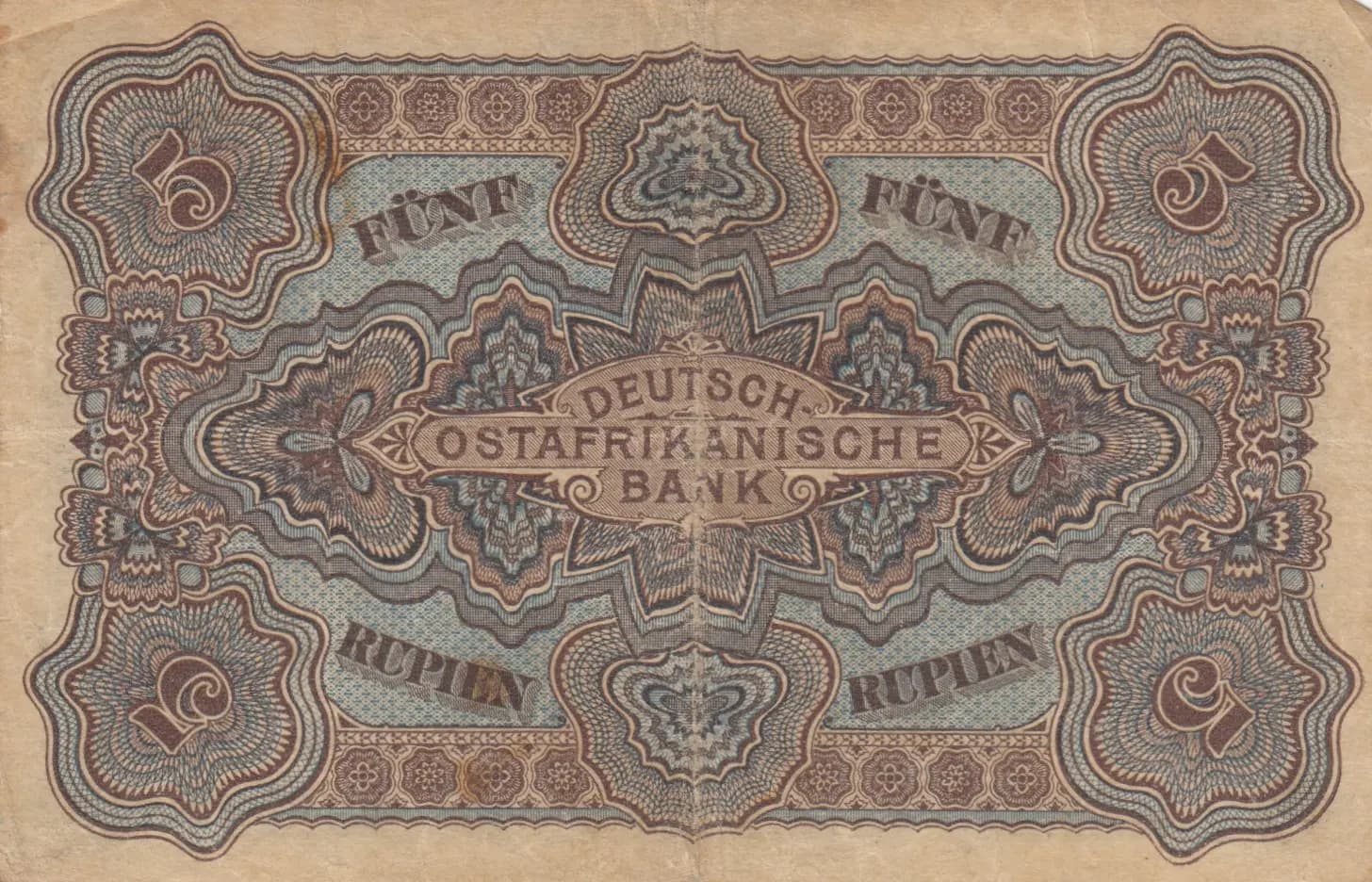
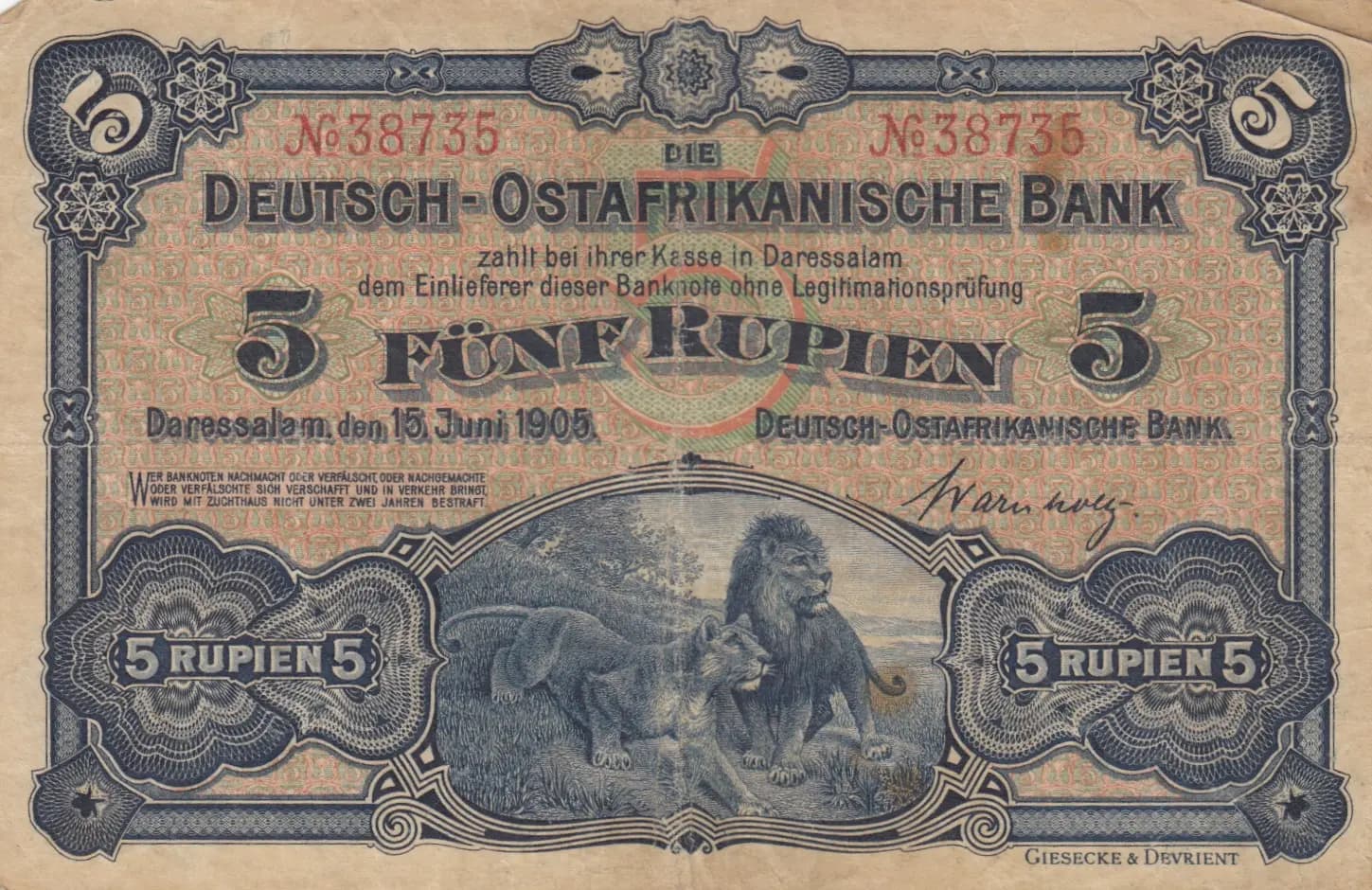
This is a 5 Rupien banknote from the Deutsch-Ostafrikanische Bank dated June 15, 1905, representing the first issue (Pick P-1) of German East Africa's currency. The front features an impressive engraved vignette of two lions in a naturalistic landscape, rendered in navy blue, red, and cream tones, with ornate geometric borders throughout. In VF condition, the note displays age-appropriate foxing and minor creasing consistent with early 20th-century circulation, but retains excellent clarity and color distinction, making it a visually striking example of this historically significant colonial African banknote.
Common. German East African rupien notes from the 1905 initial issues are readily available in the collector market. While they represent an interesting colonial note, the Deutsch-Ostafrikanische Bank issued these notes in substantial quantities during the early years of German East African colonial administration. The Pick P-1 denomination exists in multiple varieties and serial numbers, and examples in VF condition regularly appear at reasonable prices in numismatic venues, indicating no scarcity premium.
Issued by the Deutsch-Ostafrikanische Bank during the height of German colonial rule in East Africa, this note represents the monetary system of German East Africa (Deutsch-Ostafrikanisch) before World War I. The lion vignette symbolizes German imperial authority and the region's wildlife, while the inscription noting the bank's Dar es Salaam office anchors this note to German colonial commerce in the territory. The 1905 date places this within the period of German territorial consolidation in East Africa, before the colony's fall following Germany's defeat in the First World War.
The obverse features a central vignette depicting two African lions in a naturalistic savanna setting—one reclining and one standing in alert posture—symbolizing the fauna and imperial dominion of German East Africa. The vignette is framed by ornate geometric and floral borders with baroque-style flourishes characteristic of early 20th-century security banknote design. The dominant colors are dark navy blue, cream, red/pink, and black, with serial number 38735 printed in red. The reverse displays a highly symmetrical, ornamental design with a large baroque central motif, shell/fan corner elements, and hexagonal geometric patterns in the border bands, executed in brown/tan, light green/blue, and cream/beige. Both sides employ intricate engraving work with multiple layers of decorative patterning serving both aesthetic and anti-counterfeiting purposes.
FRONT: 'Die Deutsch-Ostafrikanische Bank zahlt bei ihrer Kasse in Daressalam dem Einlieferer dieser Banknote ohne Legitimationsprüfung' translates to 'The German East African Bank pays at its office in Dar es Salaam to the bearer of this banknote without proof of identity.' The denomination is shown as '5 FÜNF RUPIEN 5' (5 Five Rupees 5). The date reads 'Daressalam, den 15. Juni 1905' (Dar es Salaam, June 15, 1905). The printer credit states 'GIESECKE & DEVRIENT.' A counterfeiting warning appears: 'WER BANKNOTEN NACHMACHT ODER VERFÄLSCHT ODER NACHGEMACHTE ODER VERFÄLSCHTE SICH VERSCHAFFT UND IN VERKEHR BRINGT WIRD MIT ZUCHTHAUS NICHT UNTER ZWEI JAHREN BESTRAFT' (Anyone who counterfeits or forges banknotes or obtains counterfeit or forged notes and brings them into circulation will be punished with hard labor for not less than two years). Serial number shown: 'No 38735.' BACK: 'DEUTSCH-OSTAFRIKANISCHE BANK' and 'RUPIEN' appear at top and bottom with the denomination '5 FÜNF RUPIEN 5' repeated.
This banknote was produced by intaglio engraving (copperplate printing), as evidenced by the fine line patterns, detailed vignette work, and crisp border designs visible in the visual analysis. The printer is identified as Giesecke & Devrient, one of Europe's premier security printers of the era. The use of multiple color separations (blue, red, black, and green inks) indicates multicolor intaglio printing, a standard technique for high-security banknotes of this period. The intricate geometric patterns and fine engraved lines throughout both sides provided significant security features against counterfeiting.
This specific note is identified as the 5 Rupien denomination from the first issue dated June 15, 1905, with serial number 38735. The note bears the standard Giesecke & Devrient printing credit. Known varieties of the 1905 issue include different serial number ranges and signature variants. This example represents the standard first issue type with no apparent overprints or unusual printing variants noted in the visual analysis.