1 rupee 1915
“serie G”
About This Note
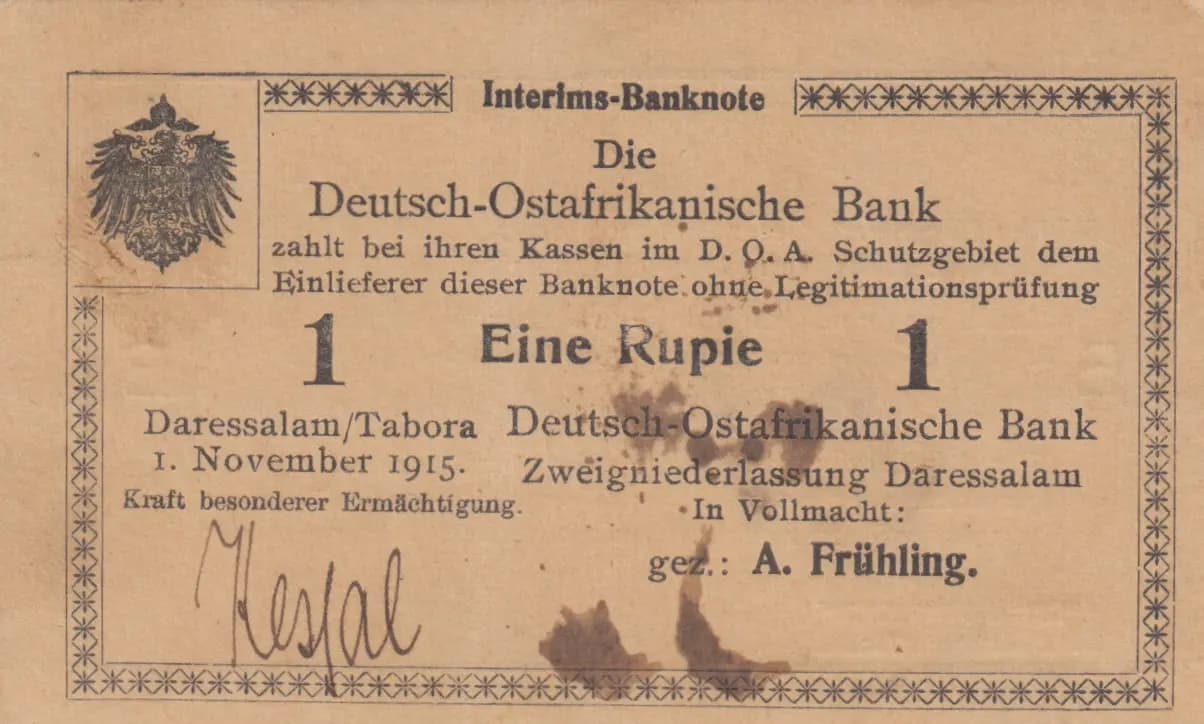
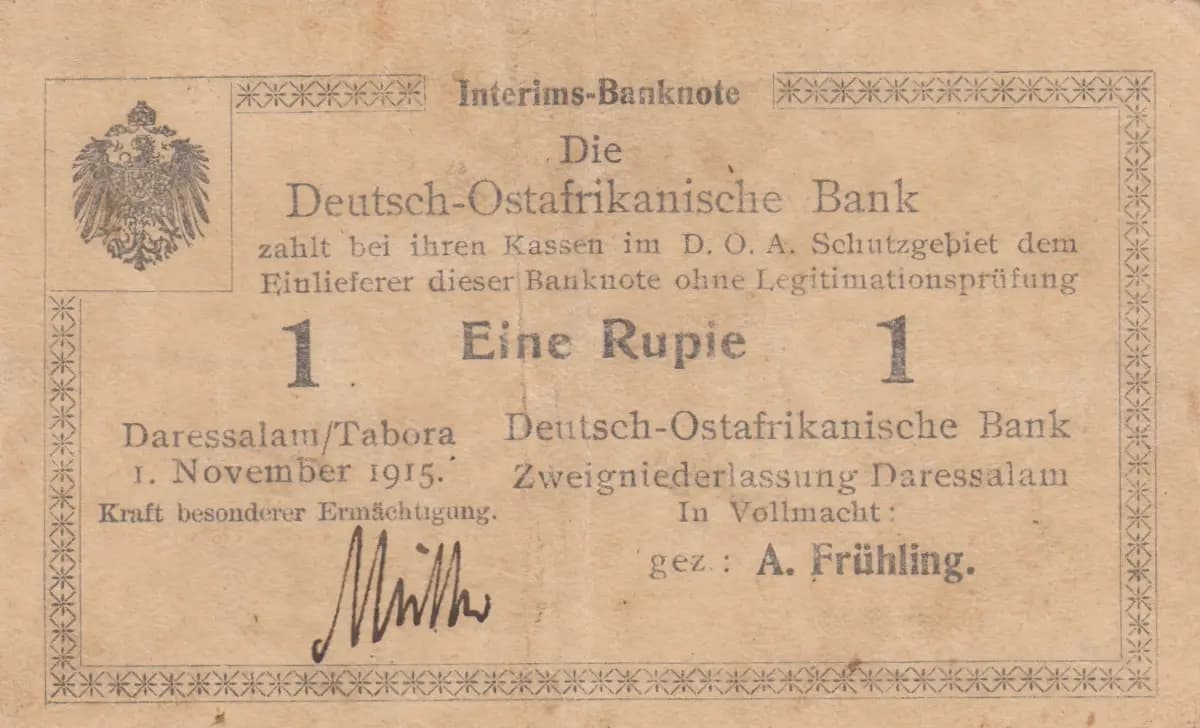
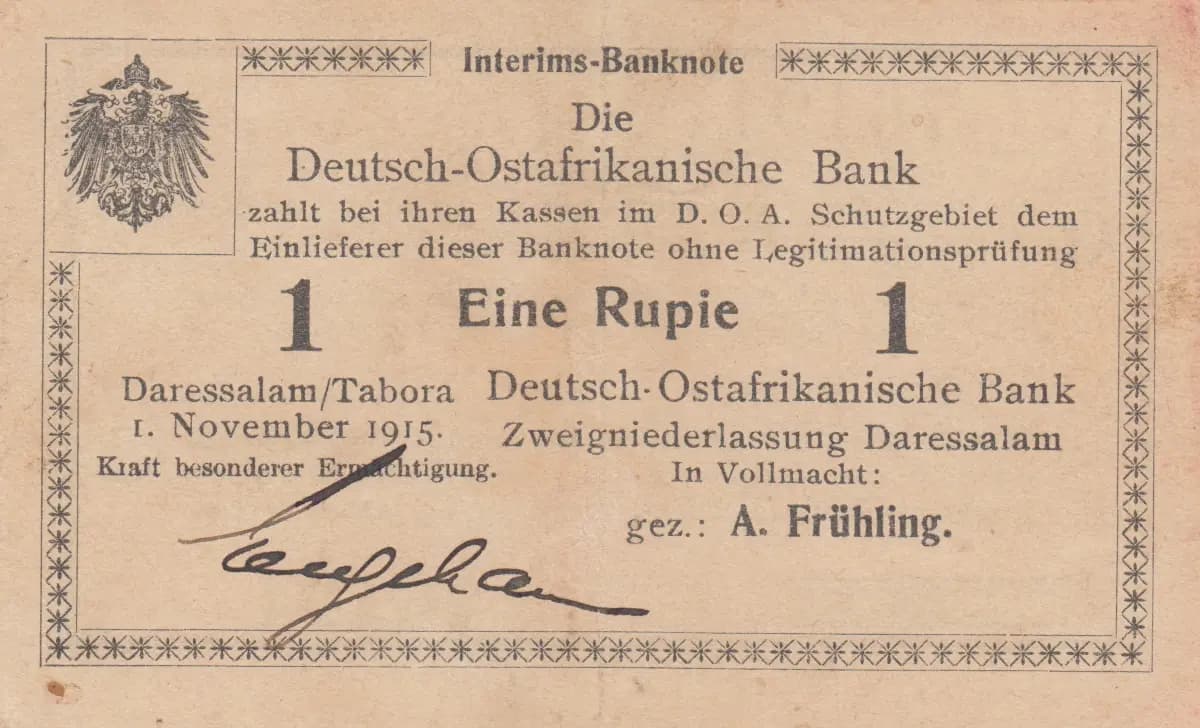
An exceptional example of the German East African Bank's 1 Rupee interim banknote from November 1, 1915, issued during the final year of German colonial rule in East Africa. The note displays the characteristic German Imperial Eagle emblem and bilingual German-Swahili text reflecting the colonial administration's practical approach to currency in the protectorate. Despite over a century of age, the note remains in EF condition with tan patina and minor foxing, preserving clear legibility of all inscriptions and the handwritten signature of A. Frühling.
common. This Pick 11b represents a standard interim banknote issue of the Deutsch-Ostafrikanische Bank with no indication of limited print runs, short-lived production, or significant recall. The note survives in relatively good condition with a clear collector provenance (Serie G). No specific information suggests scarcity; these notes, while historically important as early 20th-century African currency, were produced in sufficient quantities to sustain commerce in the protectorate during 1915-1916. EF condition examples command modest collector premiums for their historical interest rather than rarity value.
This interim banknote represents a critical moment in German East African financial history, issued as emergency currency during World War I when the German colonial administration faced severe monetary constraints in the D.O.A. (Deutsch-Ostafrikanische) protectorate. The German Imperial Eagle emblem and references to the Kaiser's government underscore Germany's sovereign presence in East Africa, while the inclusion of Swahili alongside German reflects the practical necessities of colonial commerce and administration. The note's declaration that equivalent value was 'fully deposited with the Imperial Government of German East Africa' was meant to assure holders of the currency's backing, even as the colonial administration faced military pressure and eventual loss of the territory to Allied forces by 1918.
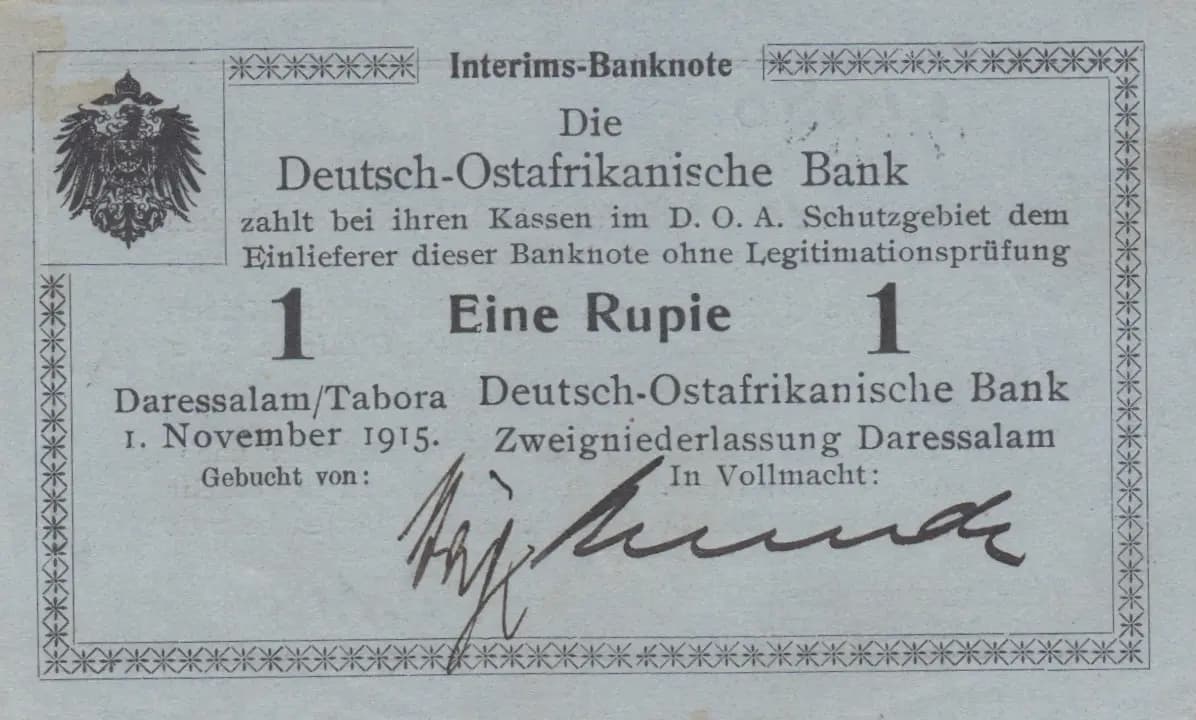
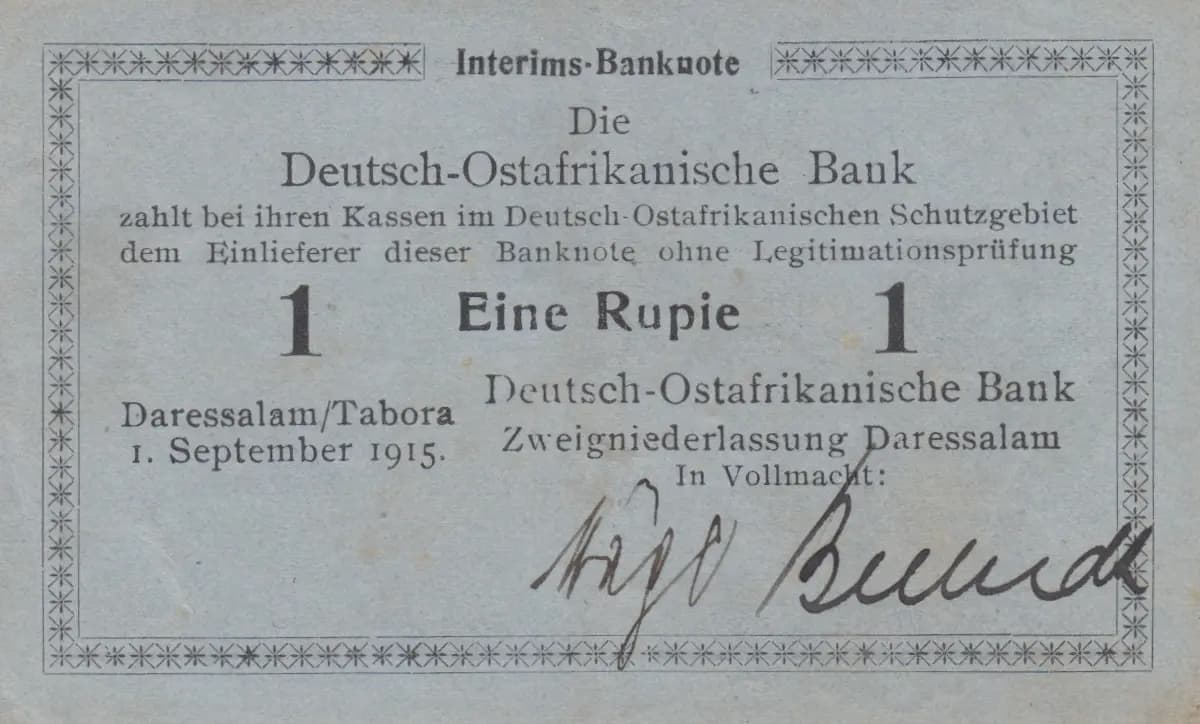
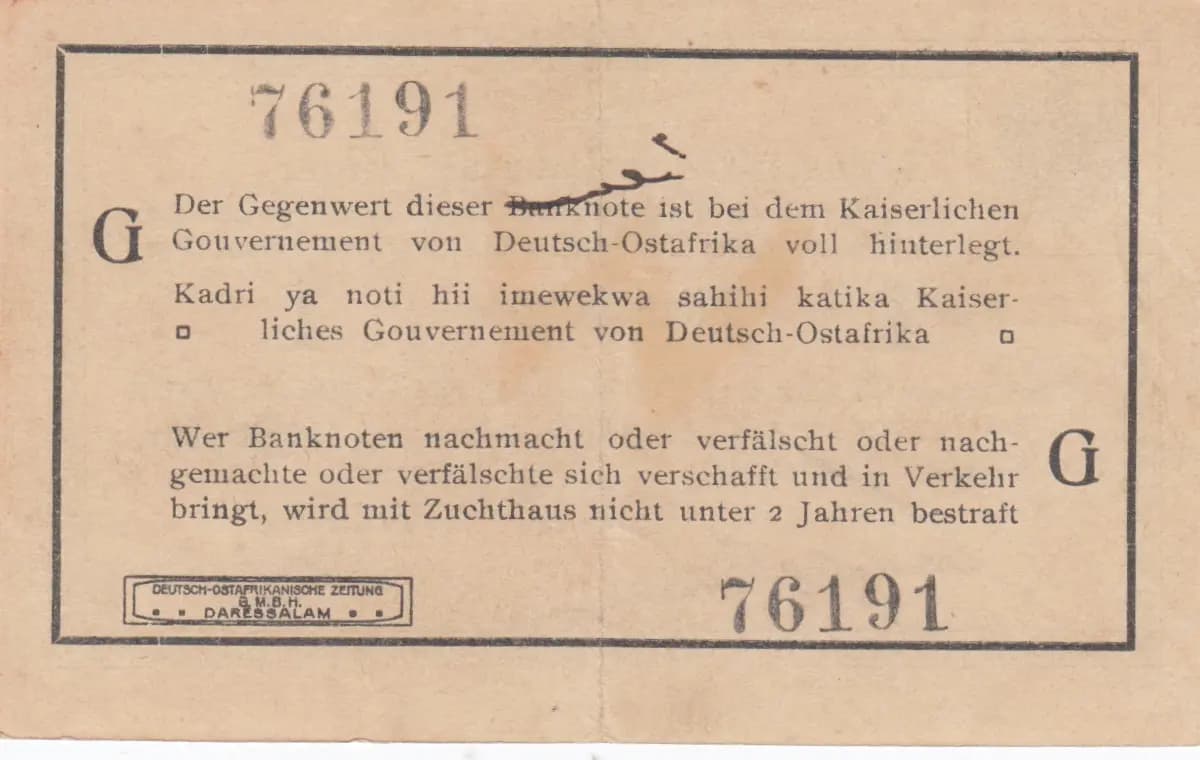
The front of this interim banknote features a formal, minimalist design centered on the German Imperial Eagle (Reichsadler) emblem positioned in the upper left corner, displaying the crown and spread wings characteristic of official German state seals. The denomination 'Eine Rupie' and issuer information are arranged in centered, formal typography typical of early 20th-century Austro-Hungarian and German colonial banking practice. An ornamental border pattern composed of repeated cross-like symbols frames the entire note, providing a security design element while maintaining the austere aesthetic appropriate to emergency wartime currency. The reverse side is dominated by legal and regulatory text in German and Swahili, including the serial number 76191 with prefix 'G', counterfeiting warnings, and declarations of value backing by the Imperial Government. The note bears a handwritten signature of A. Frühling, indicating authorization by a bank official, and carries a publisher mark for the Deutsch-Ostafrikanische Zeitung in Dar es Salaam, suggesting the newspaper may have been involved in the printing or distribution of this interim currency.
{"front":{"header":"Interims-Banknote (Interim Banknote)","issuer":"Die Deutsch-Ostafrikanische Bank (The German East African Bank)","paymentClause":"zahlt bei ihren Kassen im D. O. A. Schutzgebiet dem Einlieferer dieser Banknote ohne Legitimitationsprüfung (pays at its counters in the D.O.A. protectorate to the holder of this banknote without verification of legitimacy)","denomination":"Eine Rupie (One Rupee)","locations":"Daressalam/Tabora (Dar es Salaam/Tabora)","dateOfIssue":"1. November 1915 (1st November 1915)","authority":"Kraft besonderer Ermächtigung (By special authority)","branchInfo":"Deutsch-Ostafrikanische Bank Zweigniederlassung Daressalam (German East African Bank Branch Dar es Salaam)","signature":"In Vollmacht: gez.: A. Frühling (By proxy: signed: A. Frühling)"},"back":{"valueBackingGerman":"Der Gegenwert dieser Banknote ist bei dem Kaiserlichen Gouvernement von Deutsch-Ostafrika voll hinterlegt. (The equivalent value of this banknote is fully deposited with the Imperial Government of German East Africa.)","valueBackingSwahili":"Kadri ya noti hii imeweka sahilhi katika Kaiser-liches Gouvernement von Deutsch-Ostafrika (The value of this note is deposited with the Imperial Government of German East Africa)","counterfeiting":"Wer Banknoten nachmacht oder verfälscht oder nachgemachte oder verfälschte sich verschafft und in Verkehr bringt, wird mit Zuchthaus nicht unter 2 Jahren bestraft (Whoever counterfeits or forges banknotes or obtains counterfeited or forged ones and puts them into circulation will be punished with imprisonment of not less than 2 years)","printer":"DEUTSCH-OSTAFRIKANISCHE ZEITUNG DARESSALAM (German East African Newspaper Dar es Salaam)","serialNumber":"76191 (repeated top and bottom)"}}
This interim banknote was produced using letterpress printing, evidenced by the crisp, uniform impression of text and the characteristic appearance of the ornamental border pattern. The bilingual layout and clear legibility of both German and Swahili text, along with the handwritten signature, indicate a combination of mechanical letterpress printing for the standard text and imagery with manual signature application. While the external catalog reference incorrectly attributes printing to Thomas de la Rue (which applies to later East African Currency Board notes, not this 1915 German issue), the Deutsch-Ostafrikanische Zeitung credit on the reverse suggests the printing may have been accomplished locally in Dar es Salaam or by a German printer working under colonial administration authority.
This specimen is identified as Pick 11b with Series G and serial number 76191. The 'b' designation in Pick's catalog typically indicates a variant within the 1 Rupee type, possibly distinguishing printing or serial number series. The 'G' prefix on the serial number may represent a specific printing or control series. The signature of A. Frühling appears on this note; variants with different signatures or serial letter prefixes (A, B, C, D, E, F, H, etc.) would constitute distinct collectible varieties. The date November 1, 1915 is consistent with the early emergency currency phase of German East African wartime finance.