5 rupees 1915
About This Note
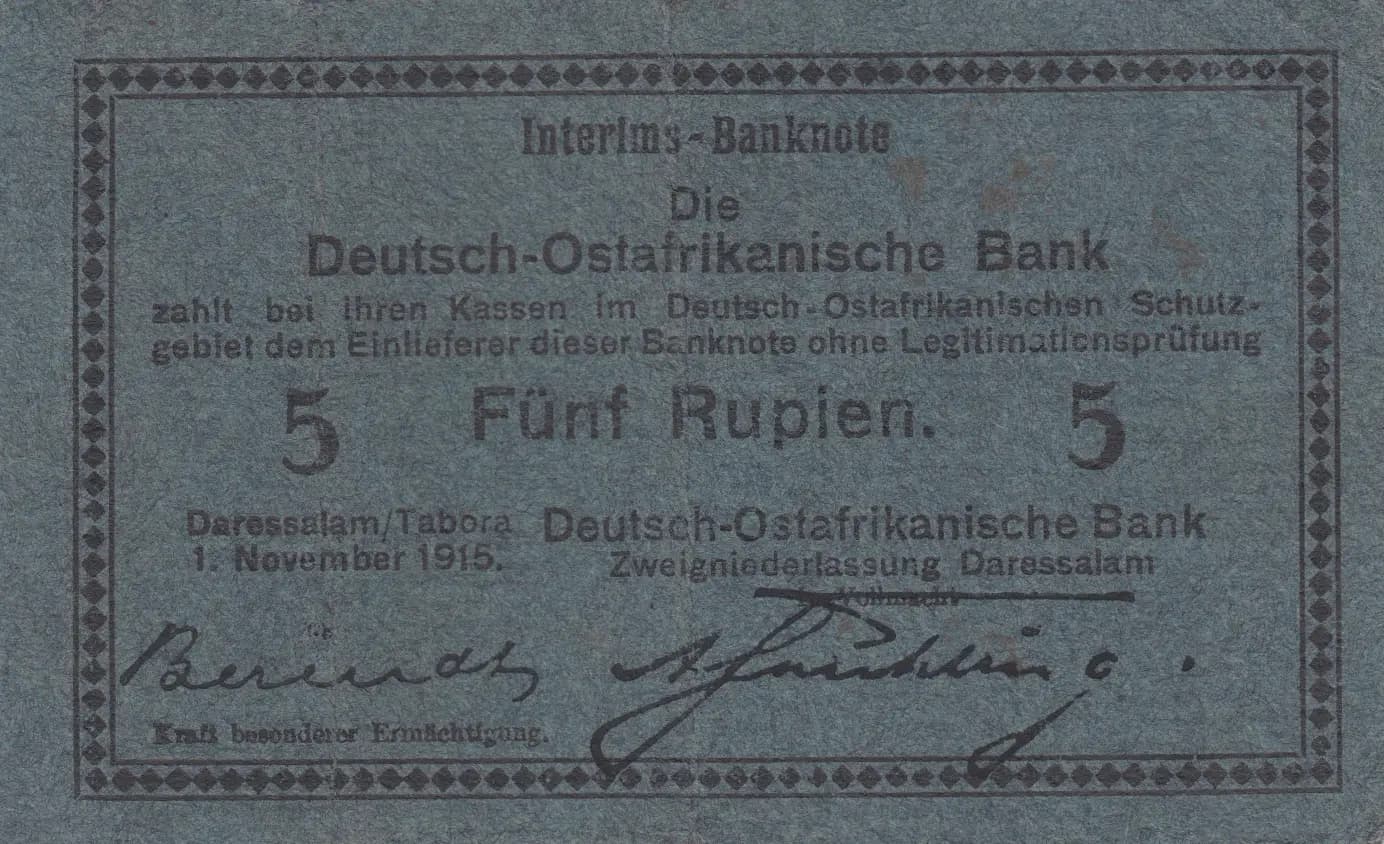
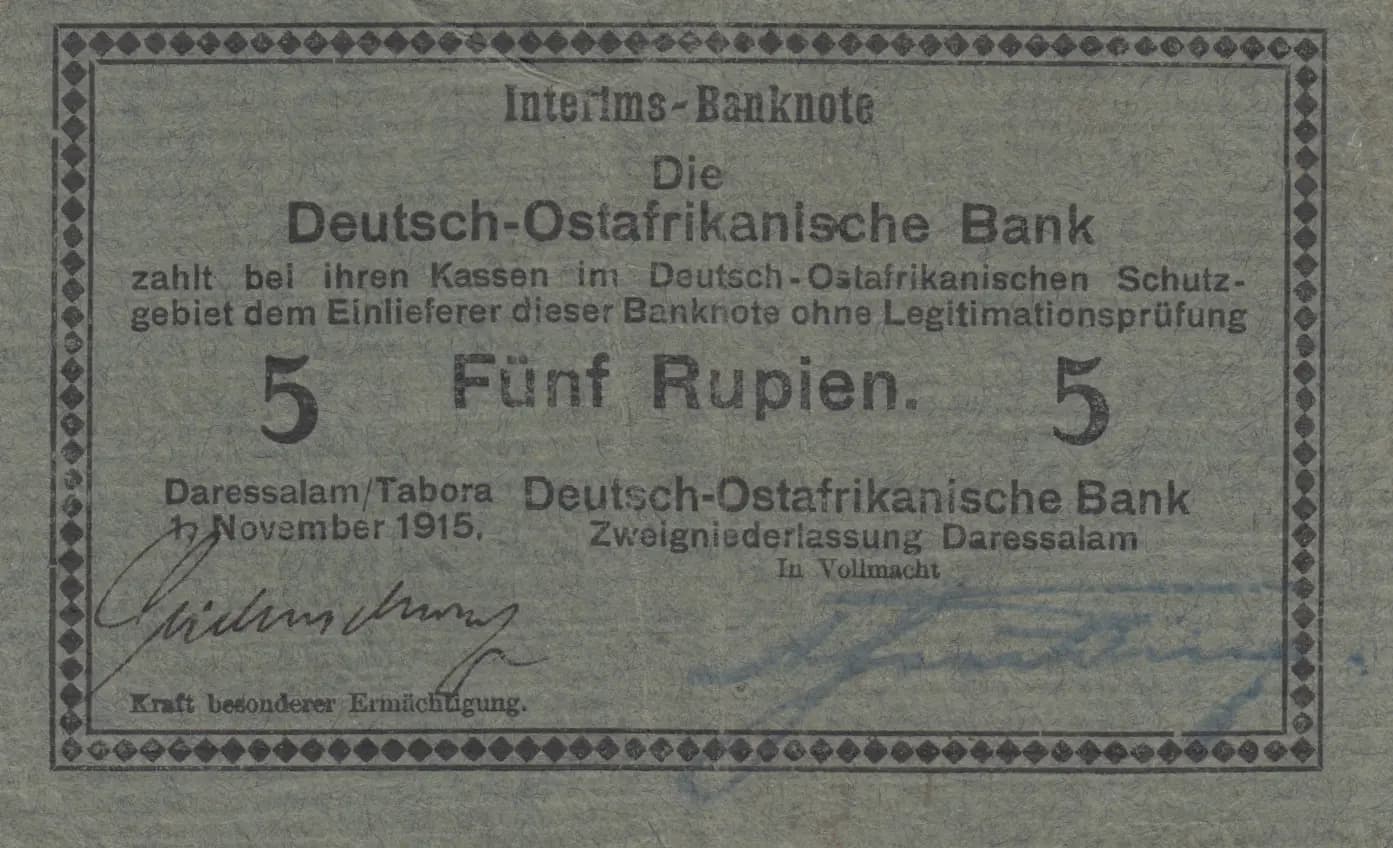
This is an Interims-Banknote (interim banknote) issued by the Deutsch-Ostafrikanische Bank in November 1915, denominated at 5 Rupees. The note displays a VF condition grade with visible aging, grayish-green patina, and a handwritten signature, reflecting its status as a historical artifact from German East Africa's final years of colonial rule. The presence of dual-language text (German and Swahili) and the emergency authorization language ('Kraft besonderer Ermächtigung') make this a significant example of wartime colonial currency.
Common. While this is a historical note from a defunct colonial issuer (German East Africa ceased as a colonial entity after WWI), Interims-Banknoten from 1915 appear with sufficient frequency in numismatic markets and collections to classify them as common within their category. The emergency nature of the issue likely resulted in substantial print runs, and many examples survive in collections. The VF condition grade is not exceptionally rare for this issue type.
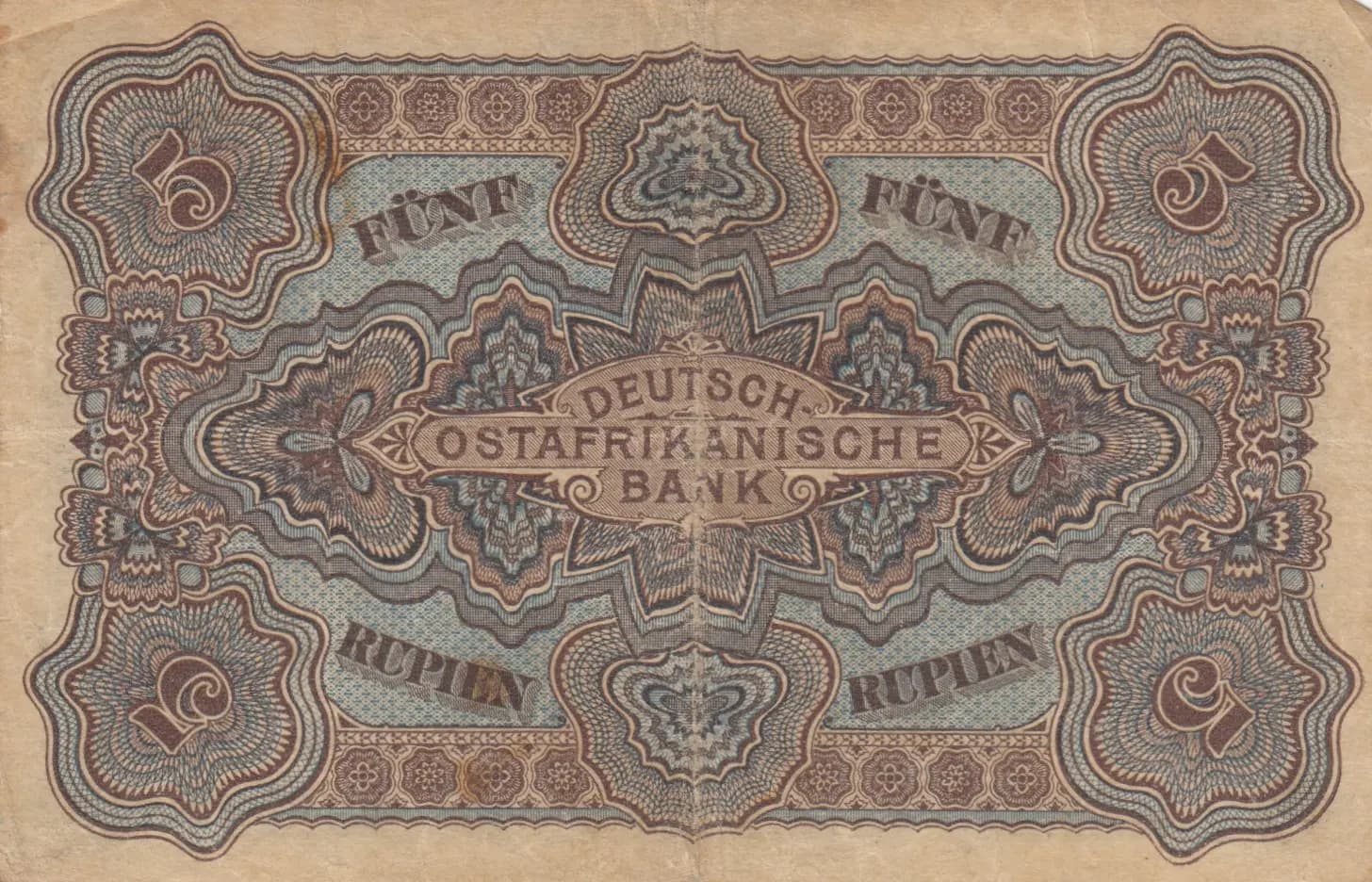
This interim banknote was issued during World War I, specifically in November 1915, when the German East African colony was under military pressure and facing currency supply disruptions. The 'Interims-Banknote' designation and the emphasis on 'special authorization' reflect the emergency monetary measures taken by the colonial administration. The dual German-Swahili inscriptions on the reverse demonstrate the colonial banking system's engagement with local populations while maintaining imperial control over currency circulation.
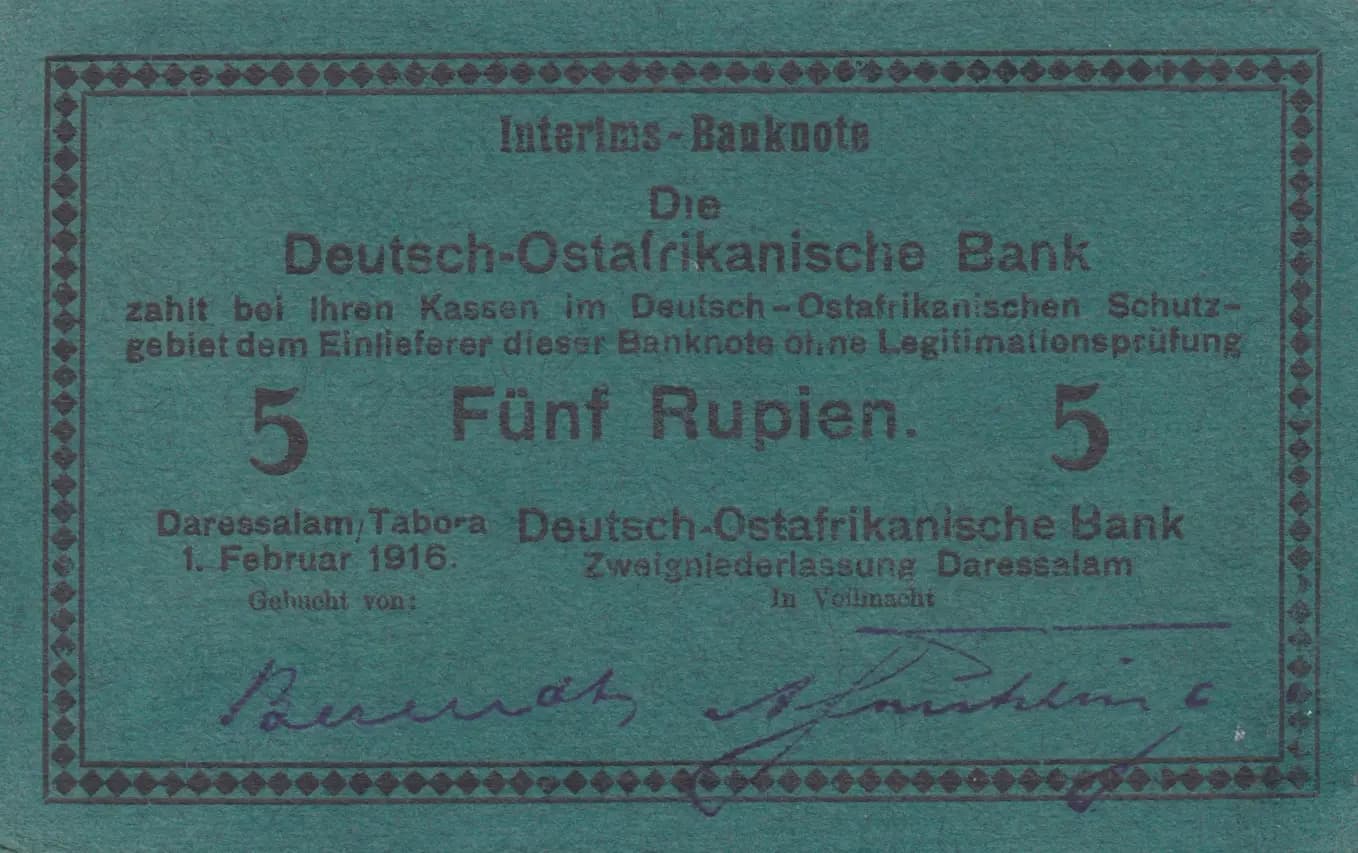
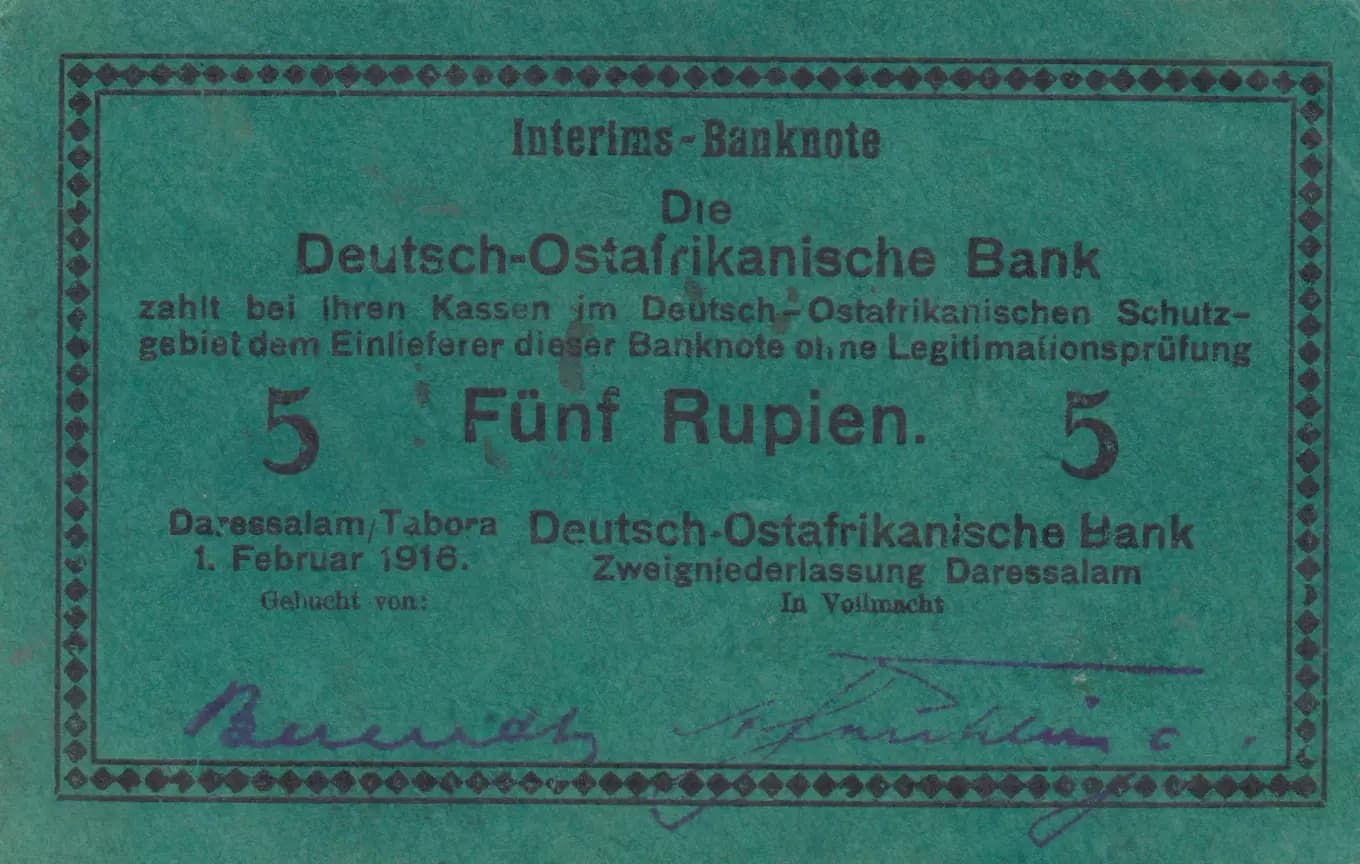
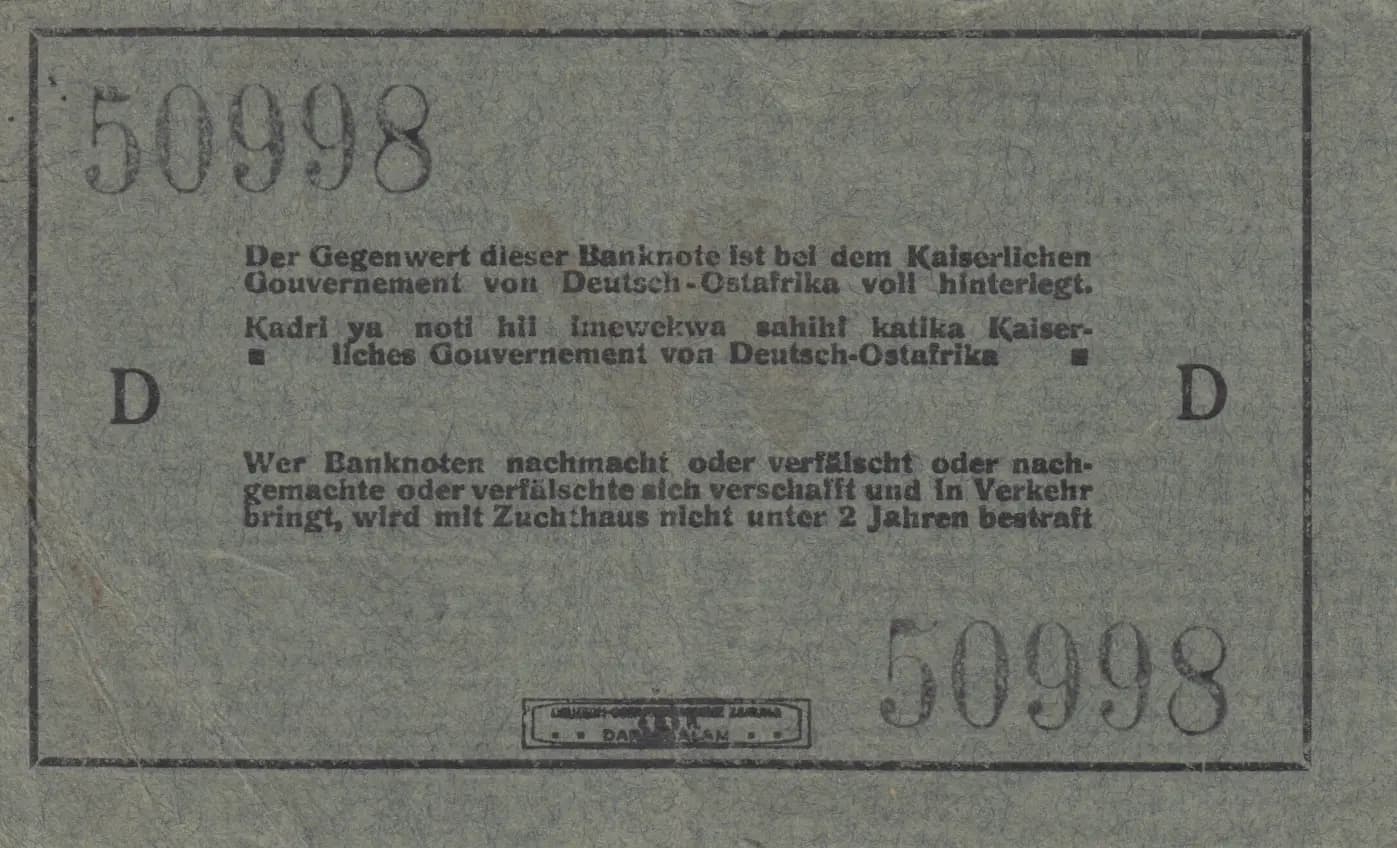
The 5 Rupees Interims-Banknote features a minimalist design without portraits or named landmarks, which was typical of emergency wartime currency. The layout is strictly typographic, organized in three vertical sections with the bank's name and authorization text dominating the front. The ornamental diamond-pattern borders frame all sides in grayish-green ink, providing visual structure to what is essentially a legal document converted into currency. The back contains the serial number (50998), a distinguishing letter 'D', and regulatory warnings. The dual-language elements (German and Swahili) on the reverse reflect the colonial administrative structure. A rectangular stamp or seal mark is visible near the bottom center of the reverse, likely representing official validation. The handwritten signature on the front indicates individual authorization by a bank official.
FRONT SIDE: 'Interims-Banknote' (Interim Banknote) / 'Die Deutsch-Ostafrikanische Bank' (The German East African Bank) / 'zahlt bei ihren Kassen im Deutsch-Ostafrikanischen Schutzgebiet dem Einlieferer dieser Banknote ohne Legitimationsprüfung' (pays at its tills in the German East African protectorate to the depositor of this banknote without verification of legitimacy) / '5 Fünf Rupien. 5' (5 Five Rupees. 5) / 'Daressalam/Tabora' (city locations) / '17. November 1915.' (date) / 'Deutsch-Ostafrikanische Bank' (German East African Bank) / 'Zweigniederlassung Daressalam' (Branch Daressalam) / 'In Vollmacht' (In authority) / 'Kraft besonderer Ermächtigung' (By special authorization). BACK SIDE: '50998' (Serial number, printed twice) / 'Der Gegenwert dieser Banknote ist bei dem Kaiserlichen Gouvernement von Deutsch-Ostafrika voll hinterlegt.' (The value of this banknote is fully deposited with the Imperial Government of German East Africa) / 'D' (Distinguishing letter, both sides) / 'Wer Banknoten nachmacht oder verfälscht oder nachgemachte oder verfälschte nicht verschafft und in Verkehr bringt, wird mit Zuchthaus nicht unter 2 Jahren bestraft' (Whoever counterfeits or forges banknotes or procures or puts into circulation counterfeit or forged notes will be punished with hard labor not less than 2 years).
The note employs letterpress printing, evidenced by the clean, sharp impression of the typographic text and the ornamental borders visible in the visual analysis. The uniform distribution of the grayish-green ink and the precision of the German and Swahili text suggest professional printing by an established colonial printer, though the specific printer is not identified in the available catalog data. The security features are minimal by modern standards, relying on the difficulty of reproducing the document format and the official seal rather than advanced anti-counterfeiting measures.
Serial number 50998 with distinguishing letter 'D' is recorded on this example. The specific date of 17. November 1915 and the dual branch designation (Daressalam/Tabora) are consistent with documented issues from this period. The handwritten signature represents individual authorization and may vary by note, though this is typical of interim notes rather than a distinct variety. No overprints or major printing varieties are evident from the visual analysis.