5 rupees 1915
About This Note
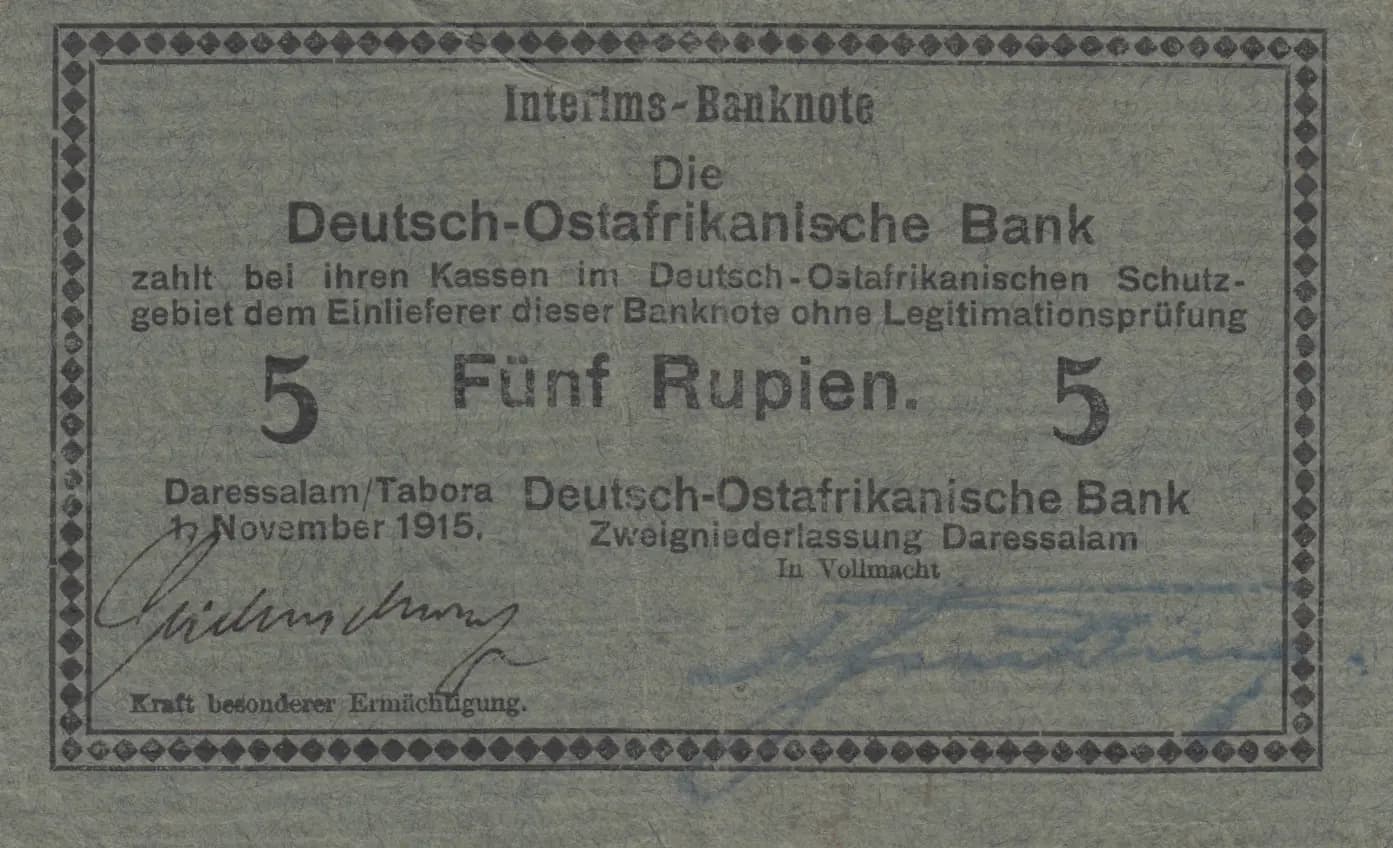
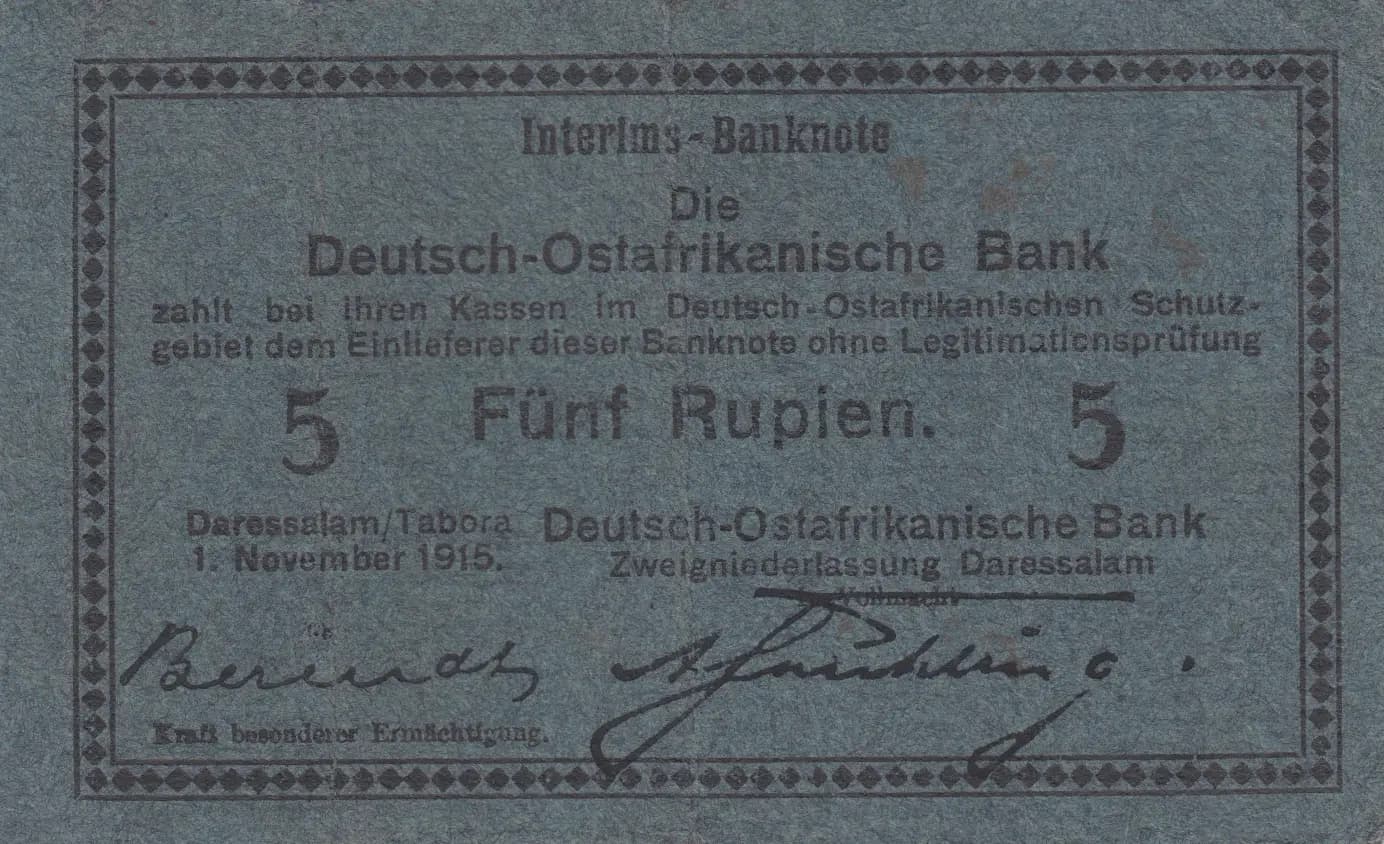
This is a German East African 5 Rupees interim banknote from November 1, 1915, issued by the Deutsch-Ostafrikanische Bank during World War I. The note features a clean, minimalist text-based design with an ornamental diamond-pattern border, printed in dark gray/black ink on light gray paper with a handwritten signature. In VF condition, the note displays moderate aging consistent with its 109-year age but shows no major tears or creases, with crisp text and well-defined borders that make it an attractive example of this transitional currency.
Common. German East African interim banknotes from 1915 were issued in substantial quantities to meet wartime currency demands and are not particularly difficult to locate in collector markets. While German East Africa itself is a popular collecting specialty, notes of this type remain relatively affordable and frequently available, particularly in VF condition. The lack of specific rarity notation in standard catalogs, combined with the straightforward design and functional nature of the issue, confirms this as common rather than scarce or rare currency.
This interim banknote was issued during a critical period in German East Africa's colonial history, specifically after Germany's military fortunes began to decline in World War I. The dual-language presentation (German and Swahili) reflects the colonial administrative structure, with German as the language of authority and Swahili as the lingua franca of the protectorate. The November 1915 date places this note in the final two years of German colonial rule in East Africa, before the territory was surrendered to Allied forces in 1918, making such notes important artifacts of this brief but historically significant period.
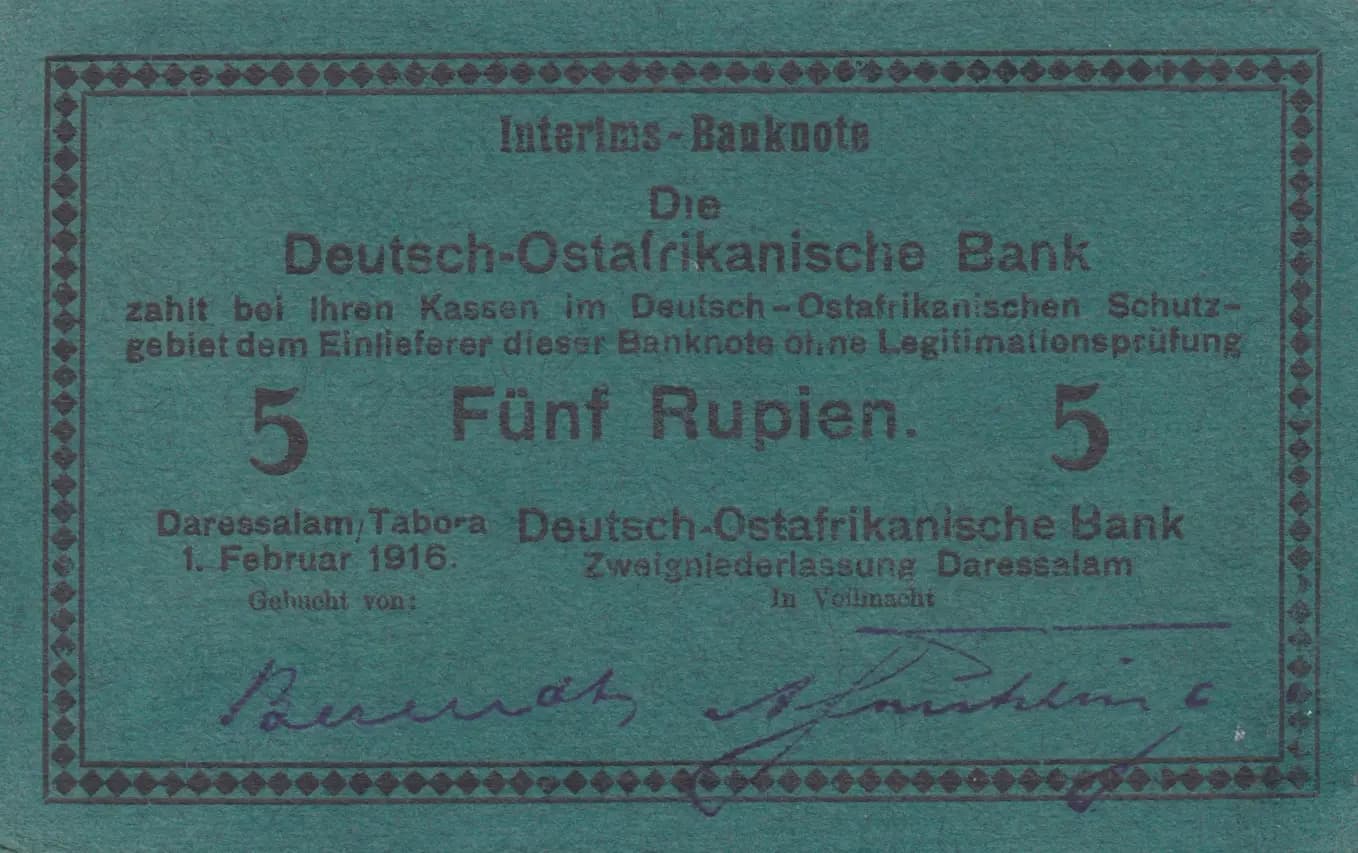
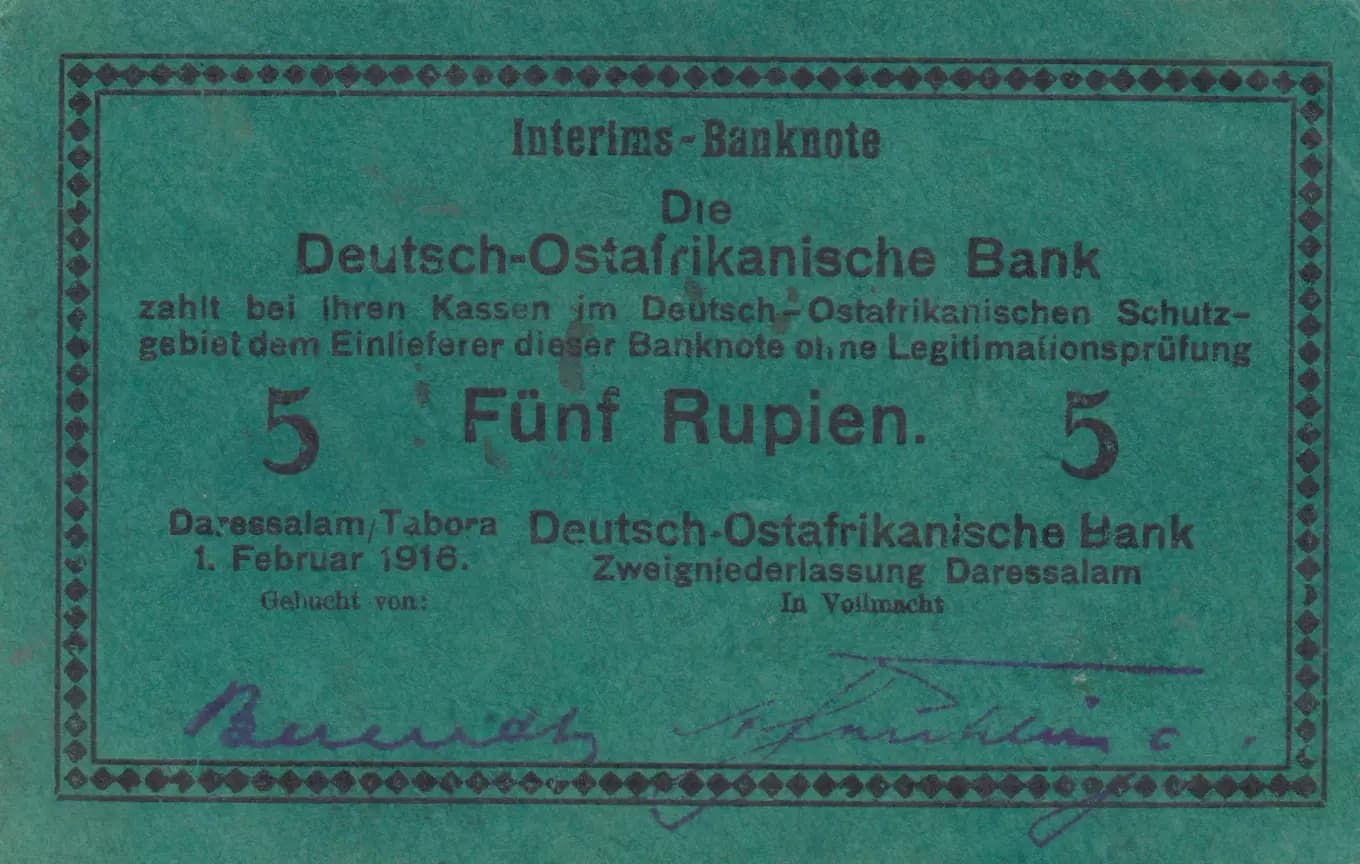
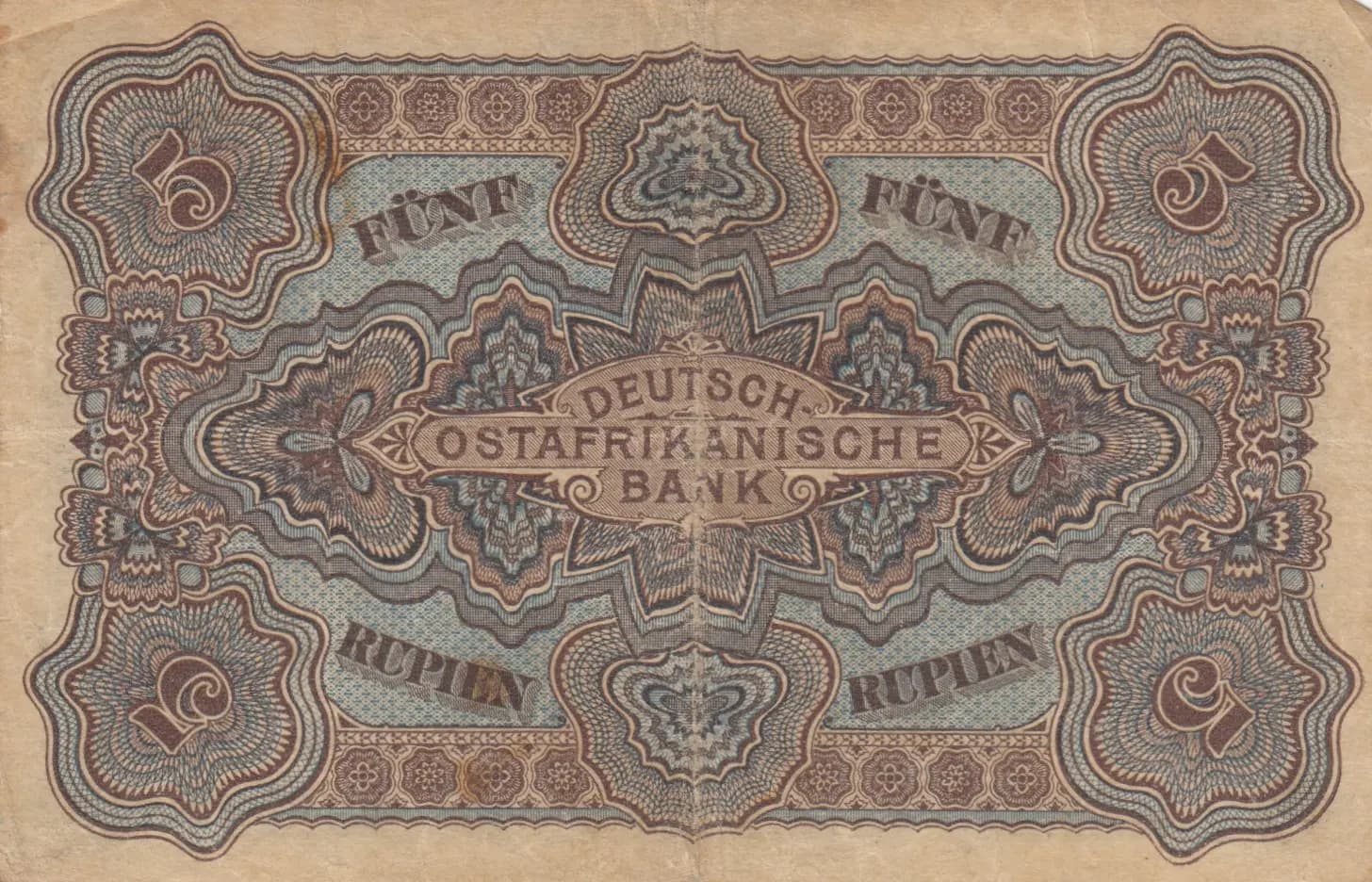
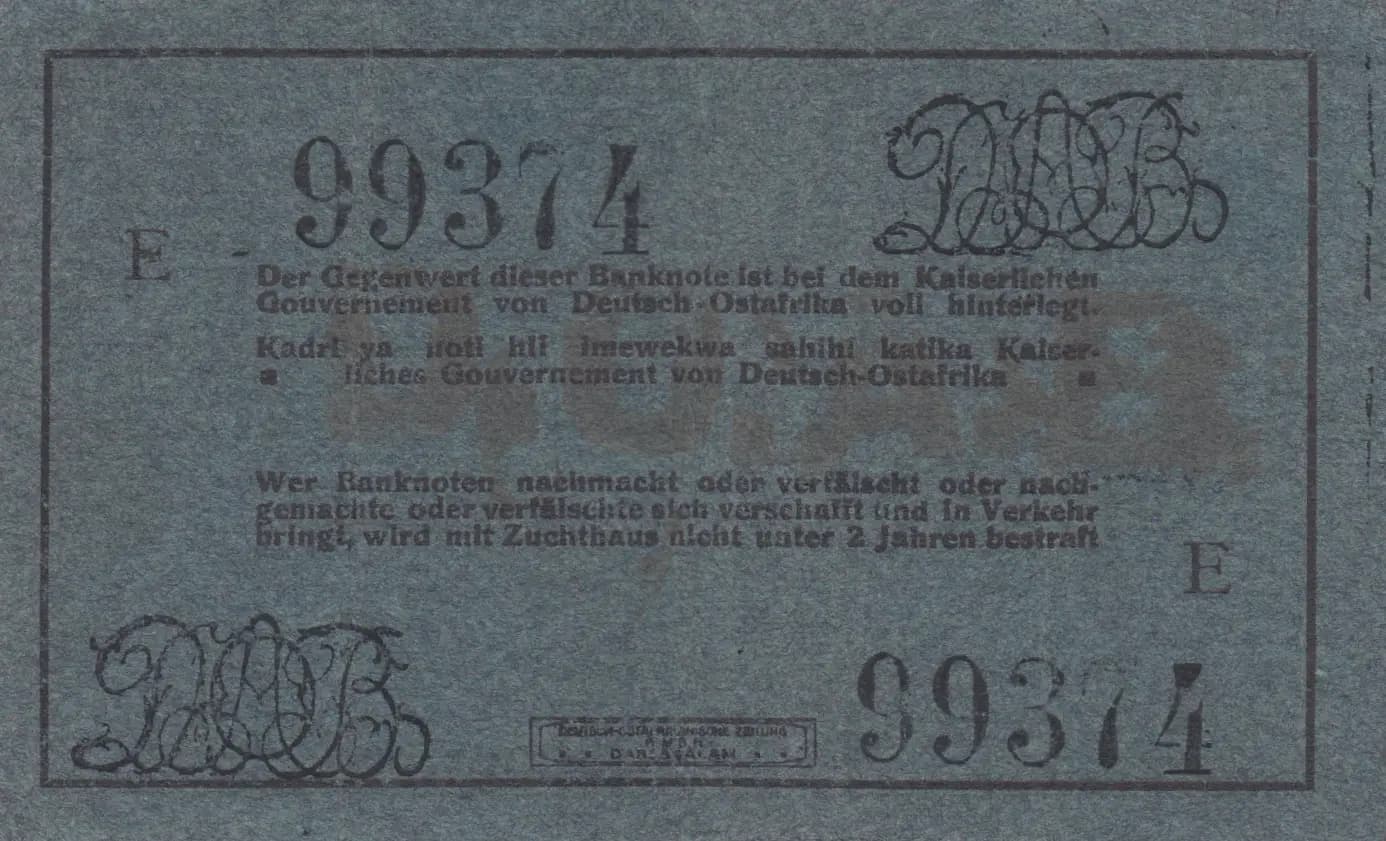
This is a text-only design typical of emergency or interim currency issued during wartime or periods of monetary instability. The front features a hierarchical arrangement of German text announcing the banknote's status as an 'Interims-Banknote' (interim note), with the issuing bank's promise of payment prominently displayed. The denomination is stated as '5 Fünf Rupien: 5' (5 Five Rupees), reflecting the rupee-based currency system used in German East Africa. An ornamental diamond-pattern border frames the content, providing decorative security elements typical of the period. The back side contains legal text warning against counterfeiting, with penalties specified, and dual-language text (German and Swahili) stating that the note's value is backed by deposits with the Imperial Government. Serial number 99374 appears in the top right and bottom center. Two handwritten signatures appear on the back, likely representing authorization by bank officials at the Daressalam branch. The overall design eschews portraiture or symbolic imagery in favor of text-based authority and legal assurance—appropriate for emergency currency requiring rapid public acceptance.
FRONT SIDE: 'Interims-Banknote' (Interim Banknote) / 'Die Deutsch-Ostafrikanische Bank zahlt bei ihren Kassen im Deutsch-Ostafrikanischen Schutzgebiet dem Einliejerer dieser Banknote ohne Legitimitätsprüfung' (The German East African Bank pays at its cashier in the German East African Protectorate to the presenter of this banknote without legitimacy verification) / '5 Fünf Rupien: 5' (5 Five Rupees: 5) / 'Daressalam/Tabora Deutsch-Ostafrikanische Bank' (Daressalam/Tabora German East African Bank) / '1. November 1915' (1. November 1915) / 'Zweigniederhassung Daressalam' (Branch Office Daressalam) / 'Eine besondere Erklärung' (A special declaration). BACK SIDE: Serial number '99374' (appears twice) / 'Der Gegenwert dieser Banknote ist bei dem Kaiserlichen Gouvernement von Deutsch-Ostafrika voll hinterlegt' (The equivalent value of this banknote is fully deposited with the Imperial Government of German East Africa) / 'Kadri va-noil hii imewekwa sahihi katika Kaiser-liche Gouvernement von Deutsch-Ostafrika' (Swahili/German: This has been properly deposited with the Imperial Government of German East Africa) / 'Wer Banknoten nachmacht oder verfälscht oder nachgemachte oder verfälschte sich verschafft und in Verkehr bringt, wird mit Zuchthaus nicht unter 2 Jahren bestraft' (Whoever counterfeits or forges banknotes or obtains counterfeit or forged notes and brings them into circulation will be punished with hard labor for not less than 2 years).
Letterpress printing on light gray paper, using dark gray/black ink. The crisp definition of text and ornamental borders, combined with the uniform paper tone and the presence of handwritten signatures, indicates traditional letterpress printing methods employed in the early 20th century. The printer for this Pick number is not definitively documented in the provided catalog data, but German East African banknotes from this period were typically produced by German printing houses or colonial administrative printing offices. The handwritten signatures suggest that authentication was performed manually after printing, a common practice for emergency currency.
This specific example is serial number 99374, from the Branch Office (Zweigniederhassung) in Daressalam. Known varieties for Pick 35 (5 Rupees 1915) include different signature combinations and potentially minor variations in the ornamental border design, though comprehensive variety documentation for German East African interim notes is limited. The handwritten signatures on this example may vary from other specimens. The presence of both German and Swahili text on the back is characteristic of the entire issue but represents an important documentation feature for variety identification.