10 rupien 1905
About This Note
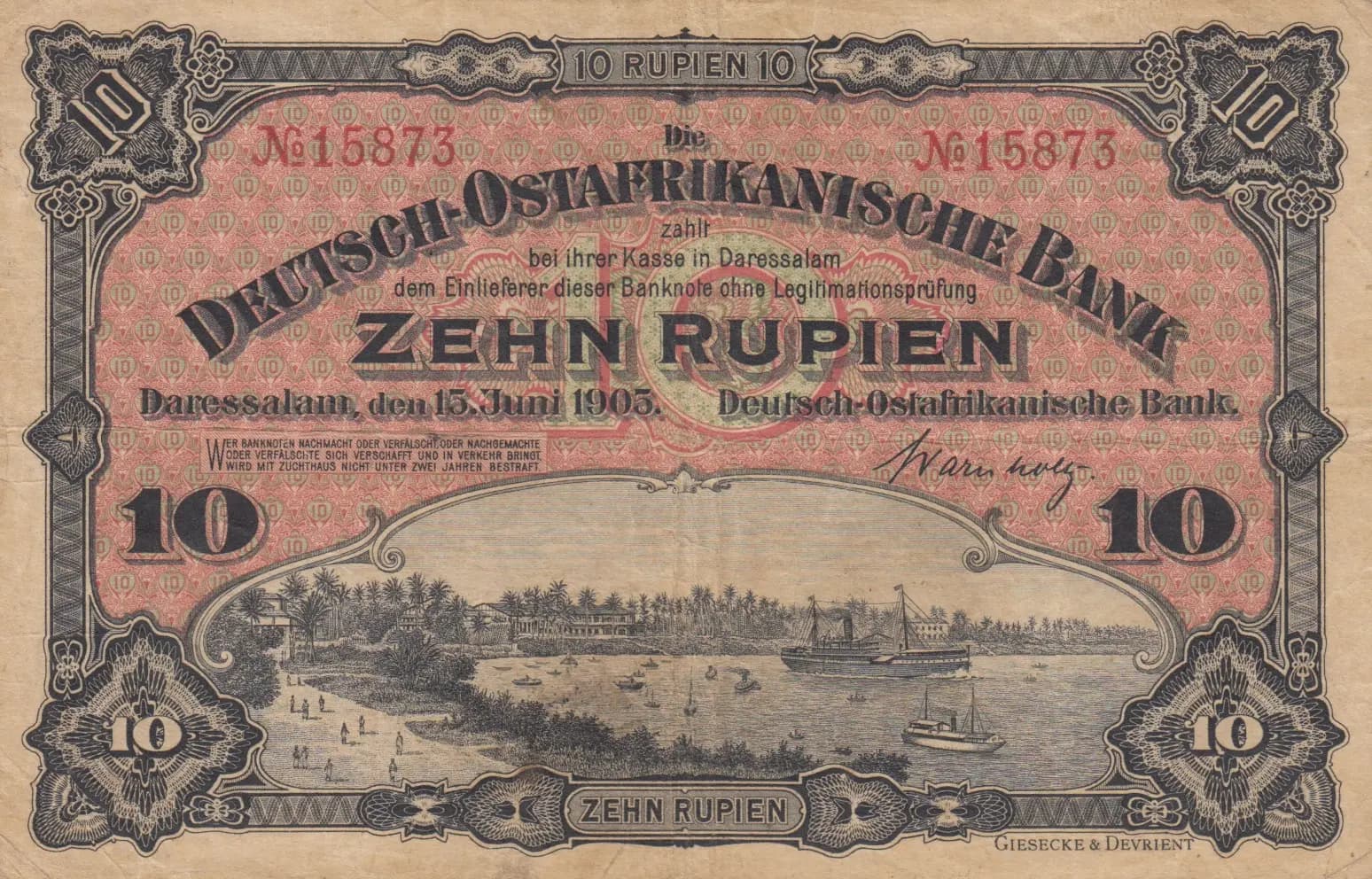
This is a handsome example of the 10 Rupien note issued by the Deutsch-Ostafrikanische Bank on June 15, 1905, in Dar es Salaam. The VF-graded note displays the characteristic ornate Art Nouveau design with a beautiful harbor vignette on the obverse featuring colonial architecture, palm trees, and sailing vessels—evocative imagery of Germany's East African colonial possession. Despite moderate aging with expected creasing and foxing from circulation, the note retains strong visual clarity with intact margins and all design elements clearly visible.
Common. While colonial banknotes from German East Africa possess historical interest, the 10 Rupien denomination from 1905 was issued in substantial quantities for commercial circulation in the protectorate. The Pick catalog designation (P-2) indicates this as a standard, regularly-issued note rather than a special or limited issue. No historical evidence suggests small print runs or recall of this denomination. The VF condition grade is typical for surviving examples that were handled in circulation but preserved without major damage—not exceptional enough to command premium pricing.
This note represents German colonial monetary authority in East Africa during the height of the German colonial period, issued just a decade before the German East African territory would be lost following World War I. The prominent harbor scene with palm trees and colonial buildings reflects the economic importance of Dar es Salaam as the colonial capital and primary trading port. The 1905 date places this note during a period of German economic expansion in Africa, when the Deutsch-Ostafrikanische Bank facilitated commerce in the protectorate.
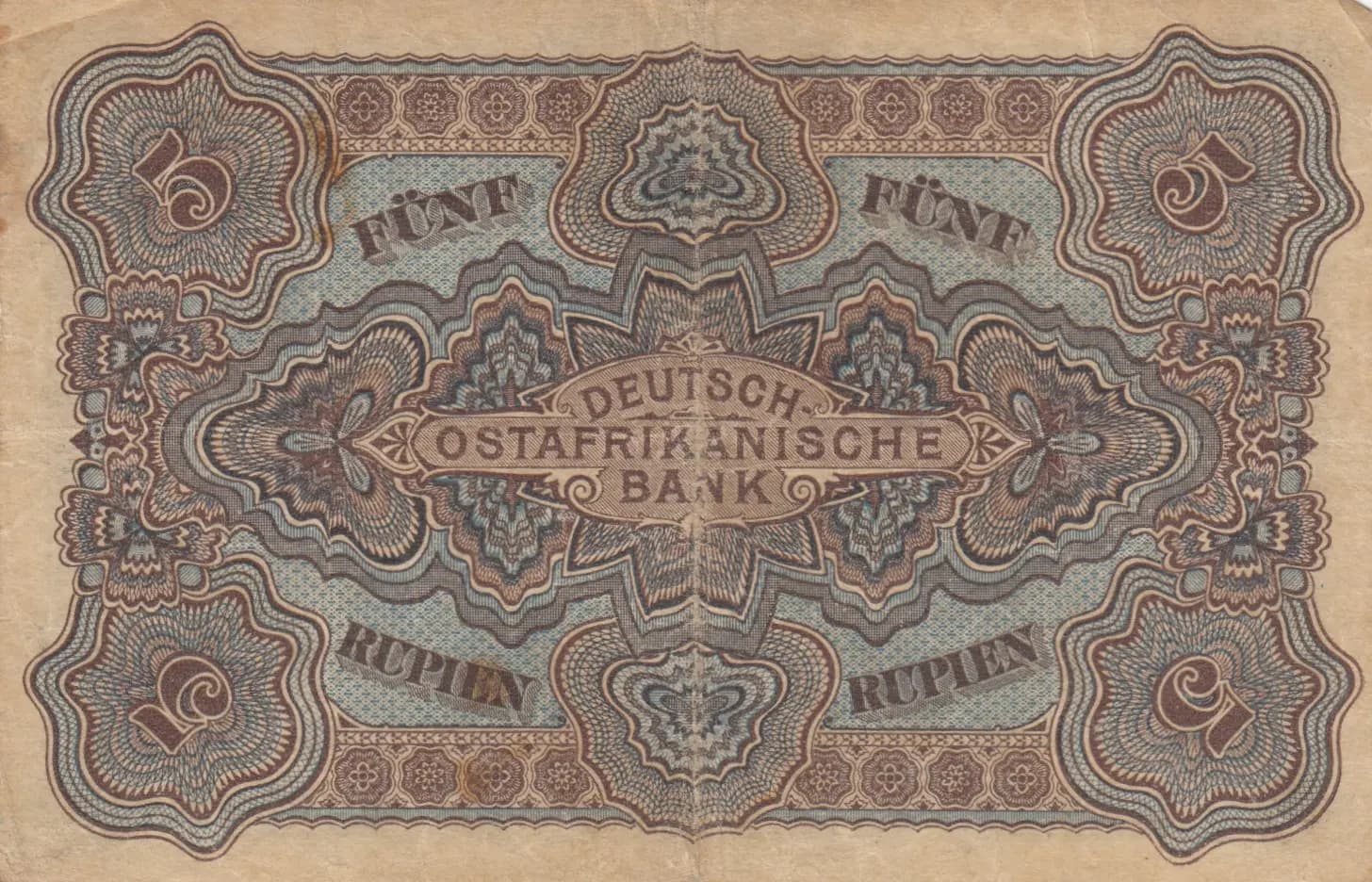
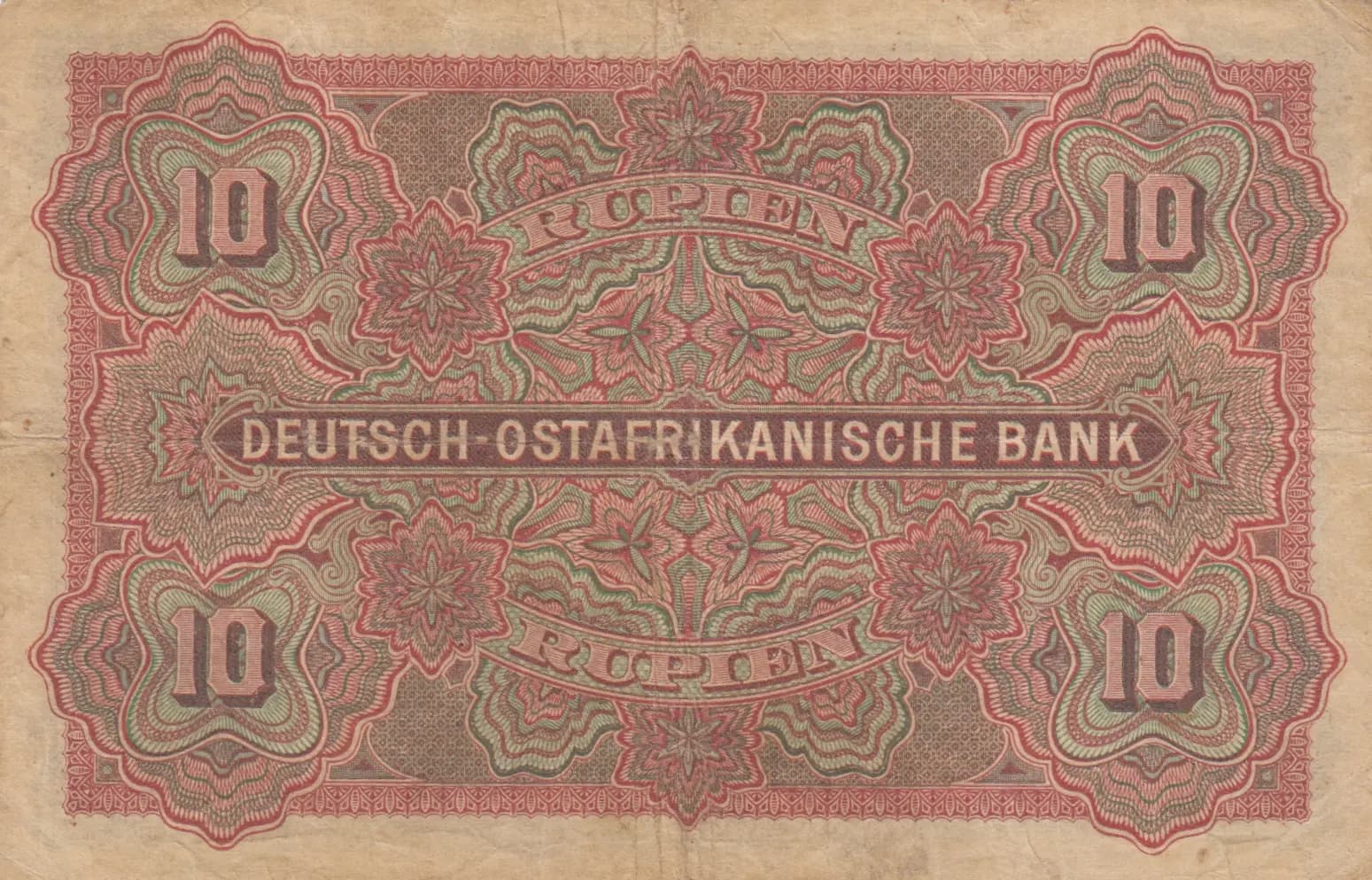
The obverse features a horizontally-oriented composition with an elaborate ornamental border containing decorative corner medallions displaying the numeral 10 in radiating sunburst designs. The central vignette, rendered in an oval cartouche in the lower portion, depicts a colonial harbor scene of Dar es Salaam with palm-lined coastline, colonial-style administrative buildings, a large steamship at anchor, smaller rowing vessels and sailing boats on the water. The reverse is entirely decorative, employing symmetrical ornamental patterns with elaborate scrollwork and floral motifs in Art Nouveau style, featuring corner medallions with numerals 10 and a central oval cartouche containing the bank name. The design employs multiple colors—predominantly pink/rose, green, tan/cream, and brown/gray—typical of high-quality turn-of-the-century banknote production.
FRONT: '10 RUPIEN 10' (Ten Rupees); 'DIE DEUTSCH-OSTAFRIKANISCHE BANK' (The German East African Bank); 'zählt bei ihrer Kasse in Daressalam dem Einlieferer dieser Banknote ohne Legitimationsprüfung' (pays at its office in Dar es Salaam to the bearer of this banknote without verification of legitimation); 'ZEHN RUPIEN' (Ten Rupees); 'Daressalam, den 15. Juni 1905' (Dar es Salaam, June 15, 1905); 'No 158 p3' and 'No 15873' (serial numbers); 'GIESECKE & DEVRIENT' (printer); 'WIER BANKNOTEN NACHMACHT DER VERFALSCH ODER NACHMACHTE SICH VERSCHAFFT UND IM VERKEHR BRINGT WIRD MIT ZUCHTHAUS NICHT UNTER ZWEI JAHREN BESTRAFT' (Whoever counterfeits these banknotes or procures counterfeit or forged ones and brings them into circulation will be punished with imprisonment for not less than two years). BACK: '10' (repeated in corner medallions); 'DEUTSCH-OSTAFRIKANISCHE BANK' (German East African Bank); 'RUPIEN' (Rupees).
Intaglio engraving with multicolor printing. The visual characteristics—fine line work, intricate geometric patterns, repeating numeral backgrounds, and complex engraved details throughout—are consistent with traditional intaglio techniques. The note was printed by Giesecke & Devrient, a leading European security printer, as confirmed by the imprint visible on the obverse. The multicolor design required multiple printing passes using separate engraved plates.
The observed note bears the date of June 15, 1905, which is the official issue date for the Deutsch-Ostafrikanische Bank's first series. Serial numbers visible include 'No 158 p3' and 'No 15873,' indicating this is part of the regular circulation printing. No known overprints or special varieties are visible. The printer attribution to Giesecke & Devrient is consistent with the first 1905 issue by this bank. No signatures are present, as these bank-issued notes did not require individual authorization signatures.