1 rupee 1916
“serie Q3”
About This Note
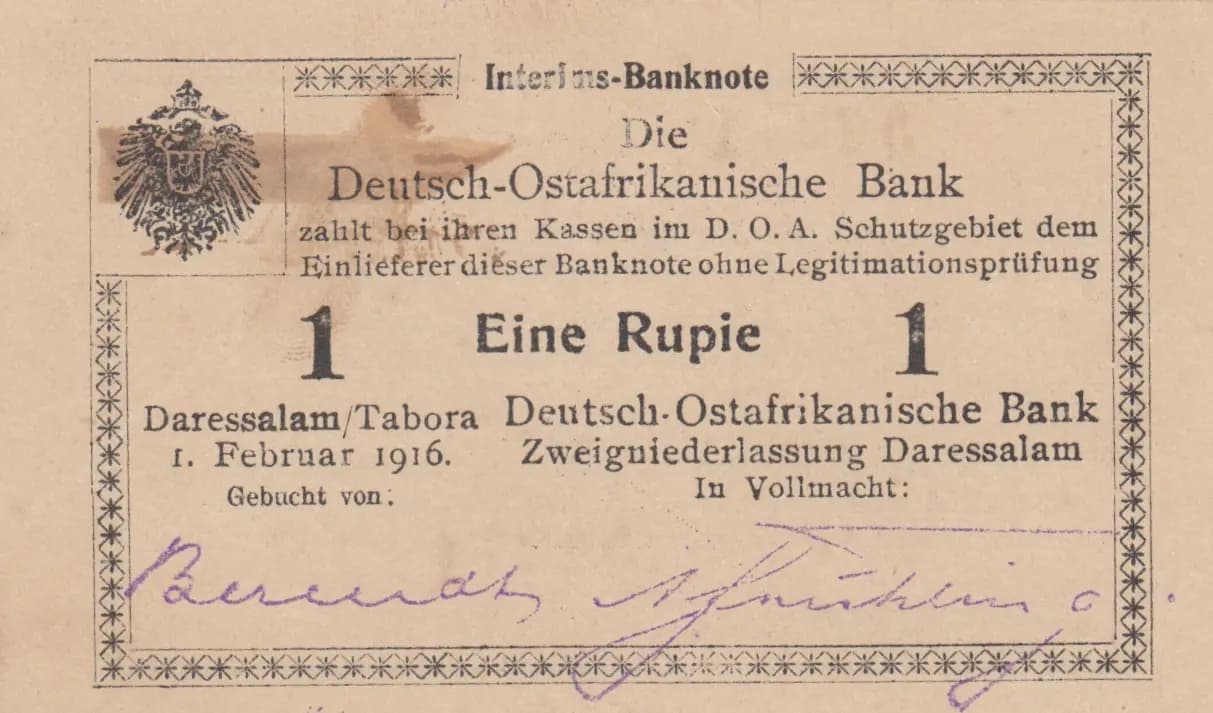
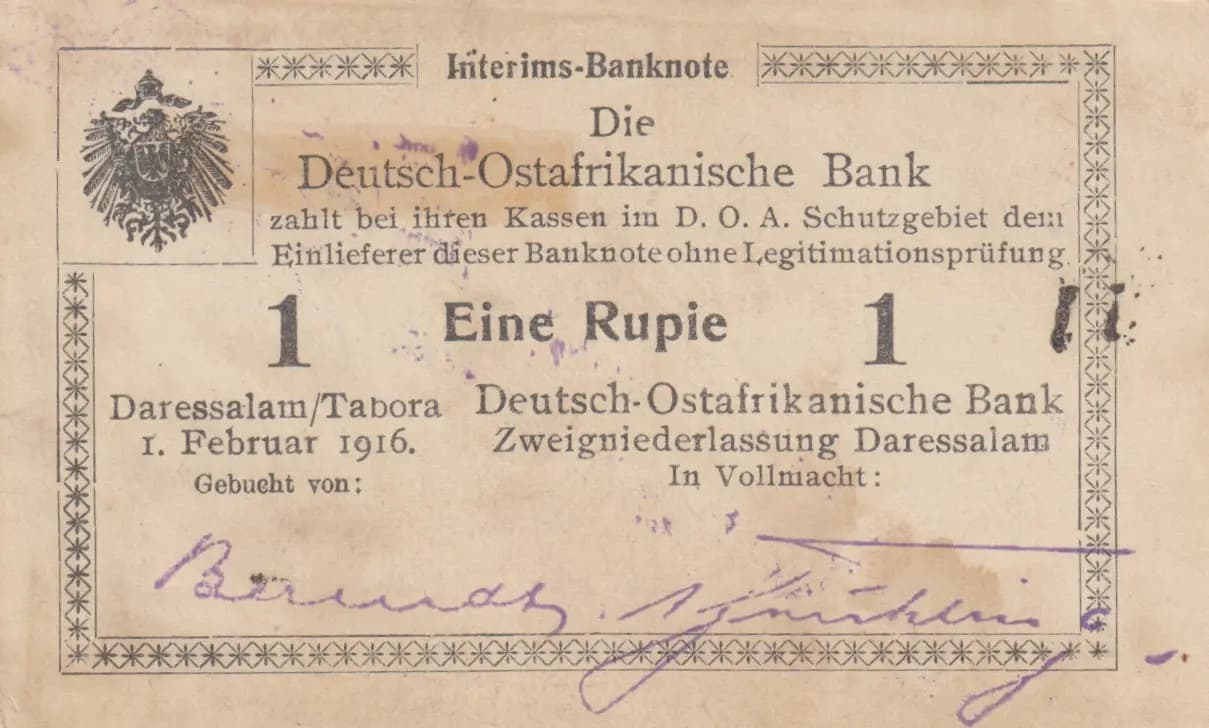
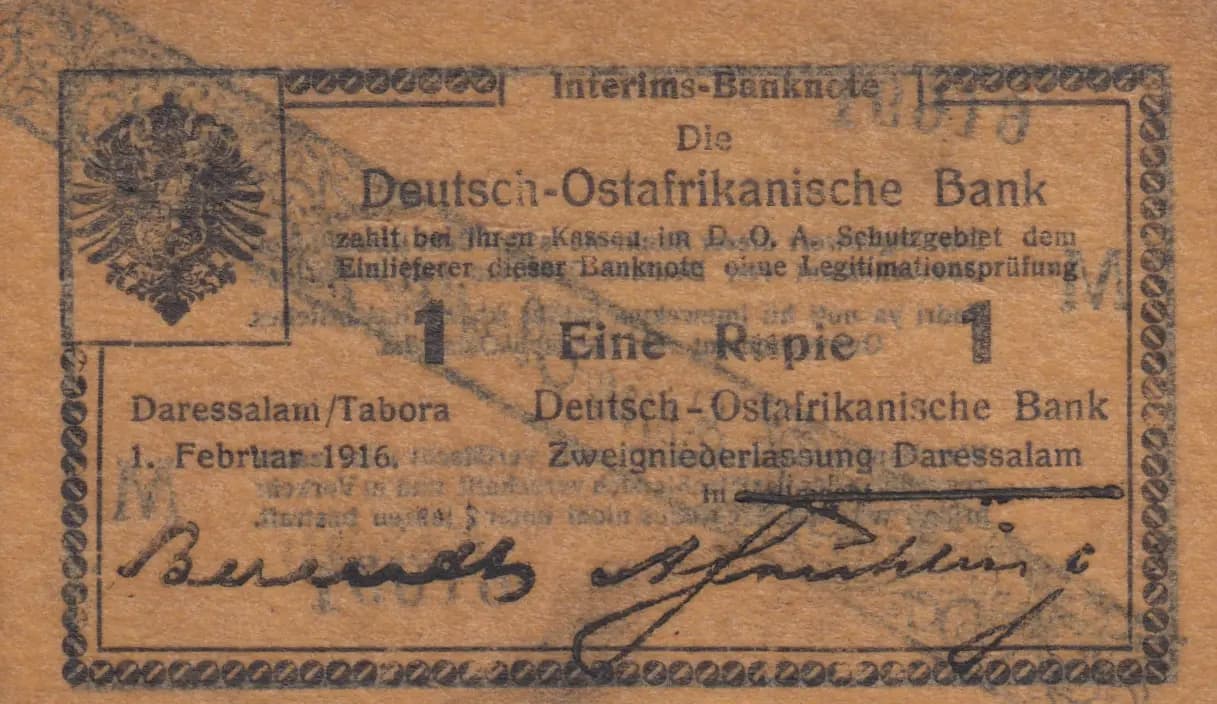
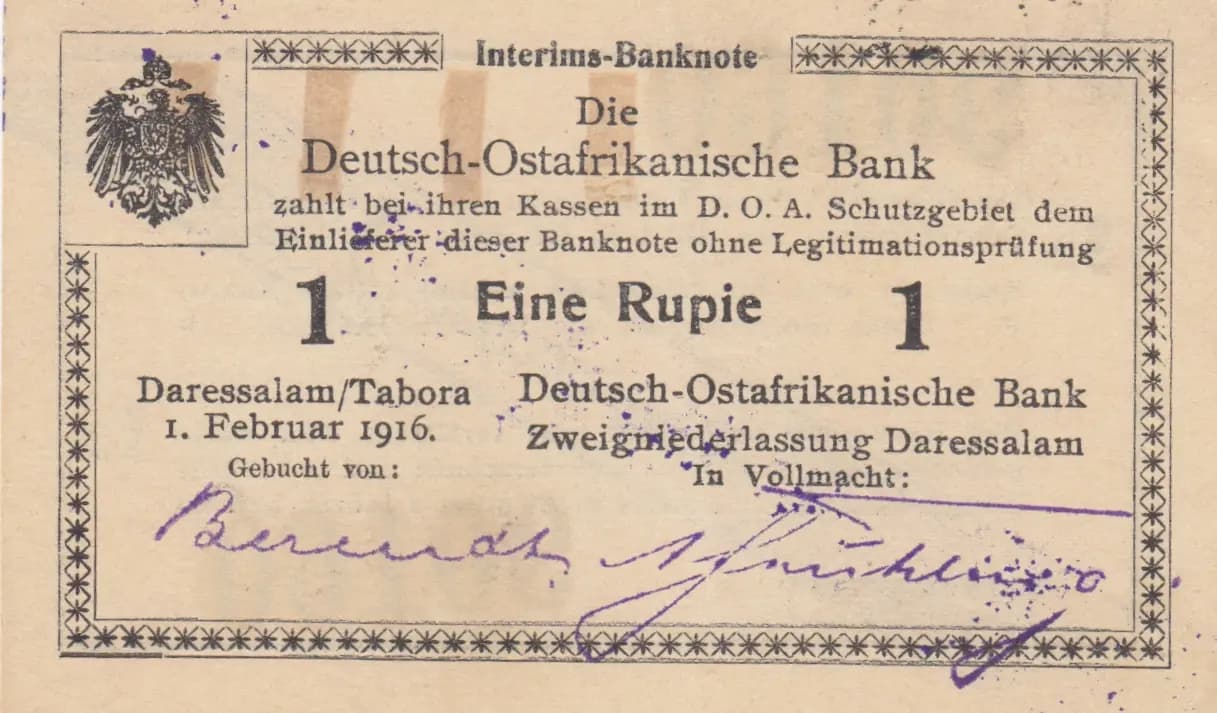
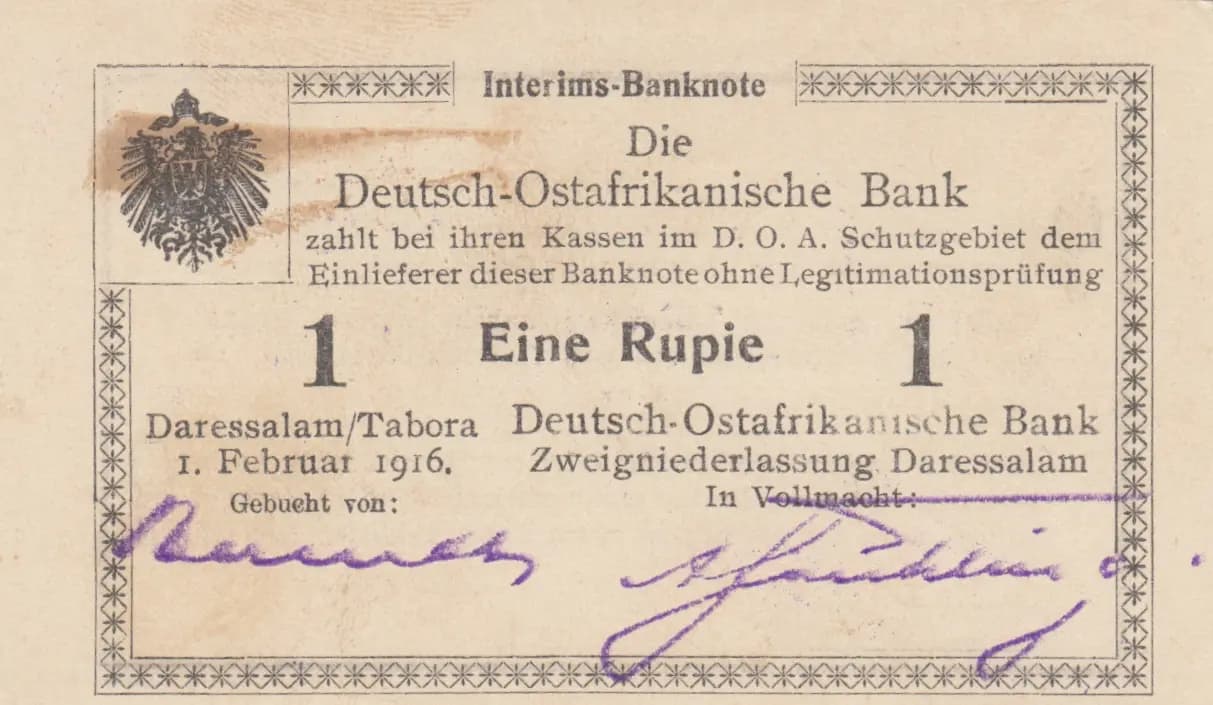
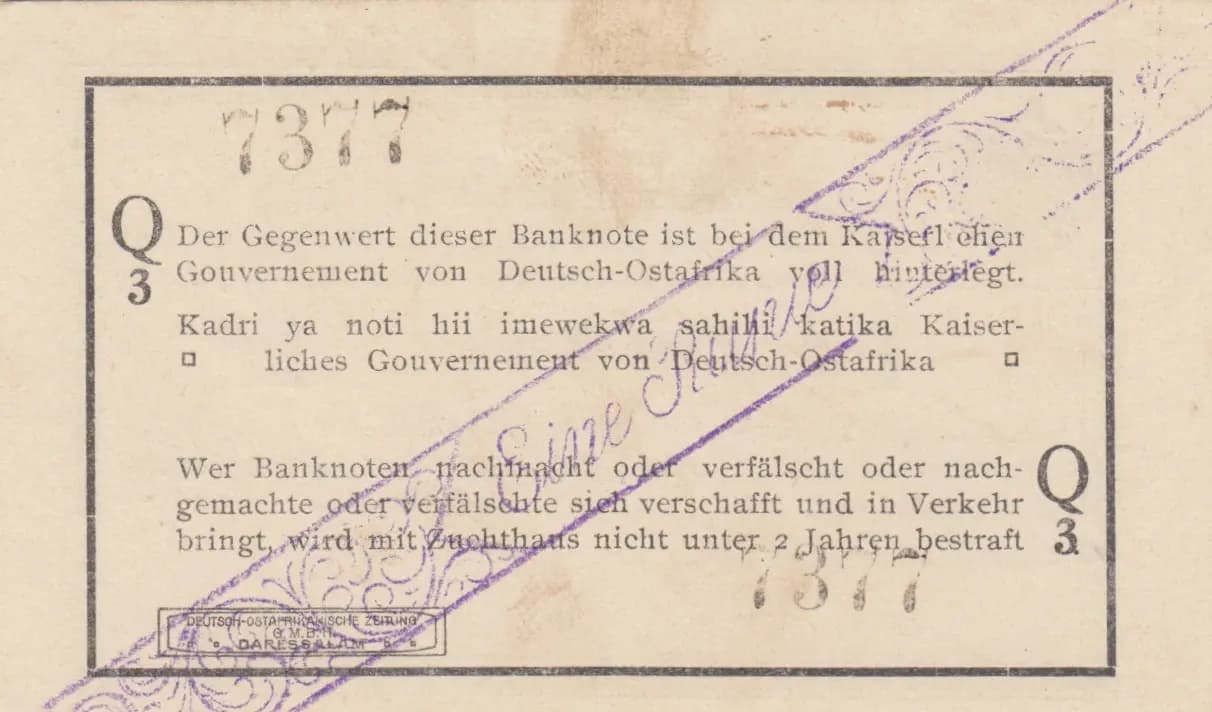
This is a German East Africa 1 Rupee interim banknote from February 1, 1916, issued by the Deutsch-Ostafrikanische Bank during World War I. The note displays the characteristic cream-colored paper stock with visible aging, foxing, and period handwritten signatures in purple/blue ink typical of emergency currency. In AU condition, this example shows significant but honest age-related wear, with the reverse bearing archival notations (series Q3) and a stamp impression, making it an interesting artifact of colonial German banking and WWI-era emergency finance.
Common. German East Africa interim banknotes from 1916 were issued in substantial quantities as emergency currency to facilitate trade during World War I. The Pick catalog lists this denomination and variety (P-20a) without notation of scarcity, and these notes survive in considerable numbers in collections. The series Q3 and AU condition are standard variations that do not command premium pricing. While historically significant as colonial German wartime currency, they remain widely available to collectors at modest valuations.
This interim banknote represents an emergency currency measure taken by the German colonial administration in German East Africa during World War I, when normal monetary channels were disrupted. The note features the German Imperial Eagle coat of arms and is dated February 1, 1916, reflecting the mobilization of colonial resources during wartime. The bilingual German-Swahili inscriptions on the reverse acknowledge the multinational character of the protectorate, while the backing statement asserting deposit with the Imperial Government represents an attempt to maintain confidence in this emergency currency during a period of military and economic strain.
The obverse features a formal layout centered on the issuer's authority and denomination, with the German Imperial Eagle coat of arms (Reichsadler) positioned on the left side—a symbol of imperial sovereignty rendered with the characteristic crowned eagle and shield design. The denomination '1' is displayed prominently in the upper corners in Arabic numerals, with 'Eine Rupie' (One Rupee) stated in German text. The design employs an ornate geometric border with repeating cross patterns, characteristic of early 20th-century German banking practice. The note bears handwritten signatures in purple/blue ink below the main text, representing authorized bank officials or government representatives. The reverse presents a more austere legal and informational layout, featuring the series identifier 'Q 3' in opposite corners and dense German-language text asserting the backing of the currency by the Imperial Government. A stamp or seal impression appears at the bottom left. The overall design reflects the utilitarian nature of interim/emergency currency—functional rather than elaborate, with emphasis on legal declarations of value backing and counterfeiting penalties.
FRONT: 'Interims-Banknote' (Interim Banknote); 'Die Deutsch-Ostafrikanische Bank' (The German East African Bank); 'zahlt bei ihren Kassen im D. O. A. Schutzgebiet dem Einlieferer dieser Banknote ohne Legitimationsprüfung' (pays at its cashiers in the D.O.A. Protectorate to the deliverer of this banknote without legitimacy examination); '1' and 'Eine Rupie' (One Rupee); 'Daressalam/Tabora'; '1. Februar 1916' (1st February 1916); 'Zweigniederlassung Daressalam' (Branch office Dar es Salaam); 'In Vollmacht' (By proxy); 'Gebucht von' (Booked by). REVERSE: 'Q 3' (reference/series number); 'Der Gegenwert dieser Banknote ist bei dem Kaiserlichen Government von Deutsch-Ostafrika voll hinterlegt' (The value of this banknote is fully deposited with the Imperial Government of German East Africa); Swahili-German mixed text affirming the same backing; 'Wer Banknoten nachmacht oder verfälscht oder nachgemachte oder verfälschte sich verschafft und in Verkehr bringt, wird mit Zuchthaus nicht unter 2 Jahren bestraft' (Whoever counterfeits or forges banknotes, or procures counterfeit or forged notes and brings them into circulation, will be punished with hard labor for not less than 2 years); 'DEUTSCH-OSTAFRIKANISCHE ZEITUNG DARESSALAM' (German East African Newspaper Dar es Salaam).
The note employs letterpress printing for the main typographic elements and borders, evidenced by the crisp, uniform impression of text and geometric patterns. The handwritten signatures and notations were executed in manuscript using pen and purple/blue ink, applied after the primary printing. The stamp or seal impression on the reverse appears to be an applied rubber or hand stamp, likely an archival or institutional marking added during handling and storage. No evidence of engraving, photogravure, or color printing is visible; the entire note relies on monochromatic black printing on cream-colored security or bond paper stock. This production method was economical and appropriate for emergency wartime currency.
This note is identified as Pick 20a and bears series designation 'Q 3', visible in opposite corners of the reverse. The series letter 'Q' with number '3' represents a specific print batch within the 1916 issue. The handwritten signatures and the presence of an institutional stamp on the reverse suggest this example passed through official banking or archival channels. No overprints or date variants are evident on the observed surfaces. The Pick designation P-20a typically distinguishes this from other 1916 rupee issues by its specific design layout and issuer designation.