1 rupee 1916
“serie F2”
About This Note
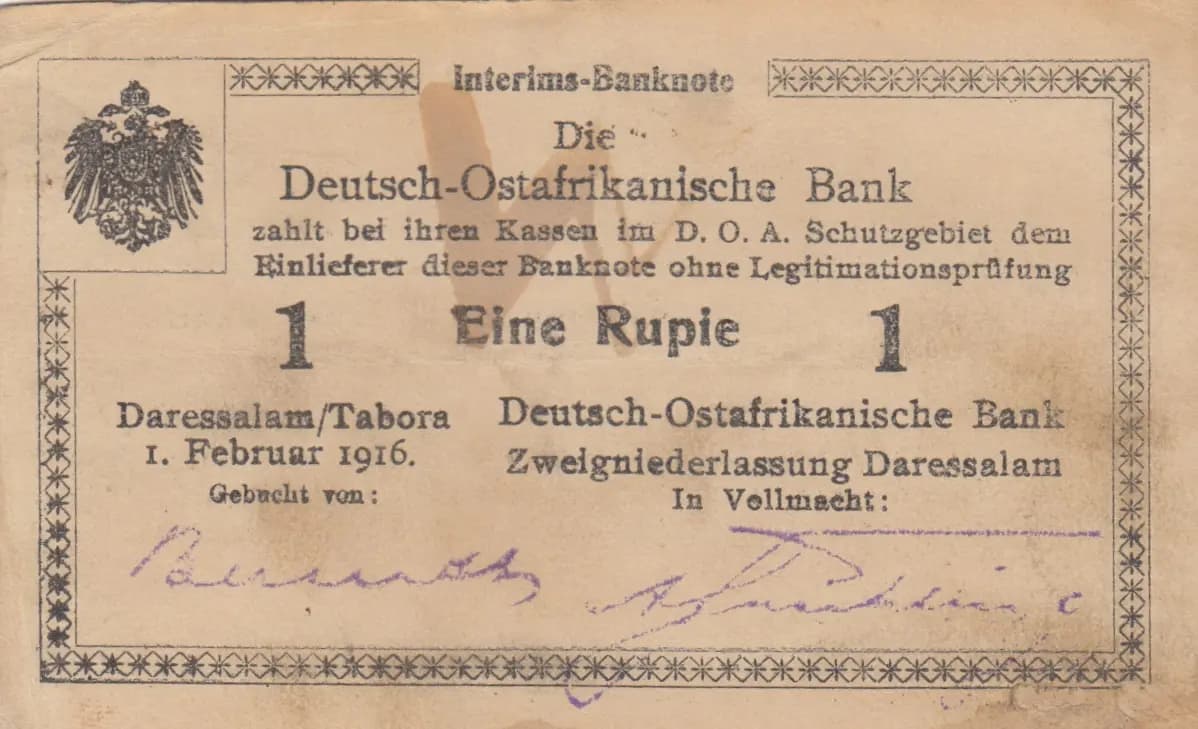
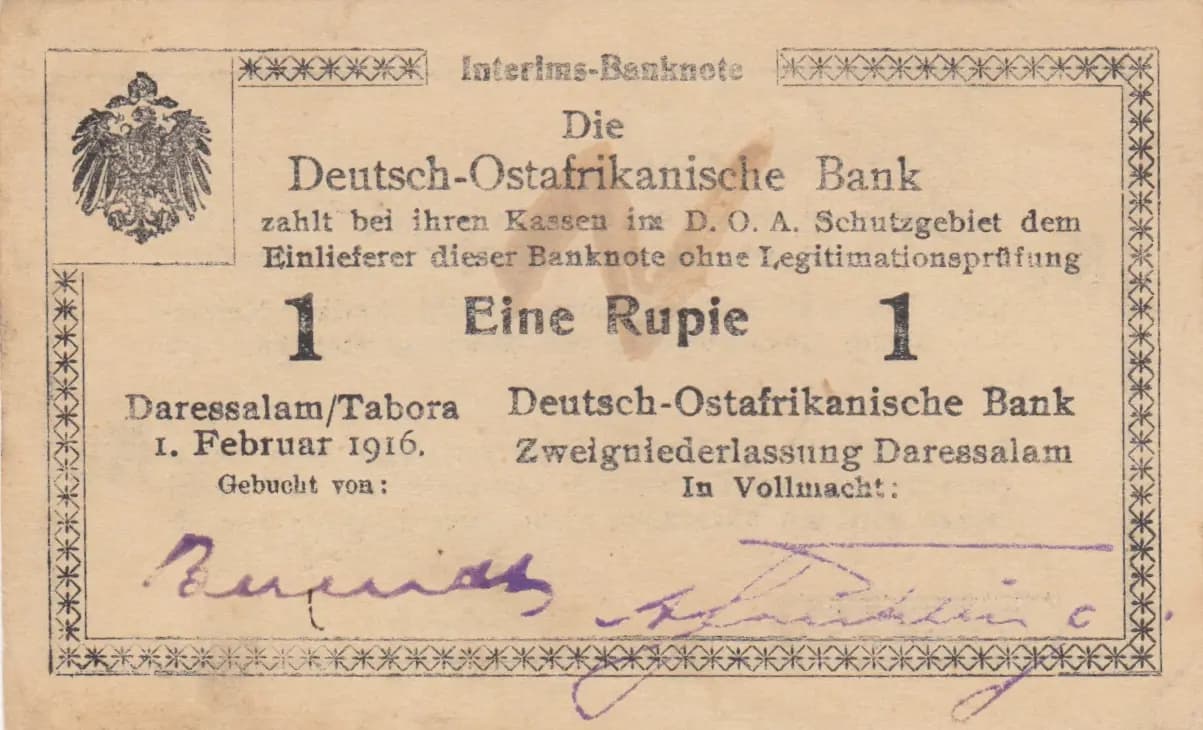
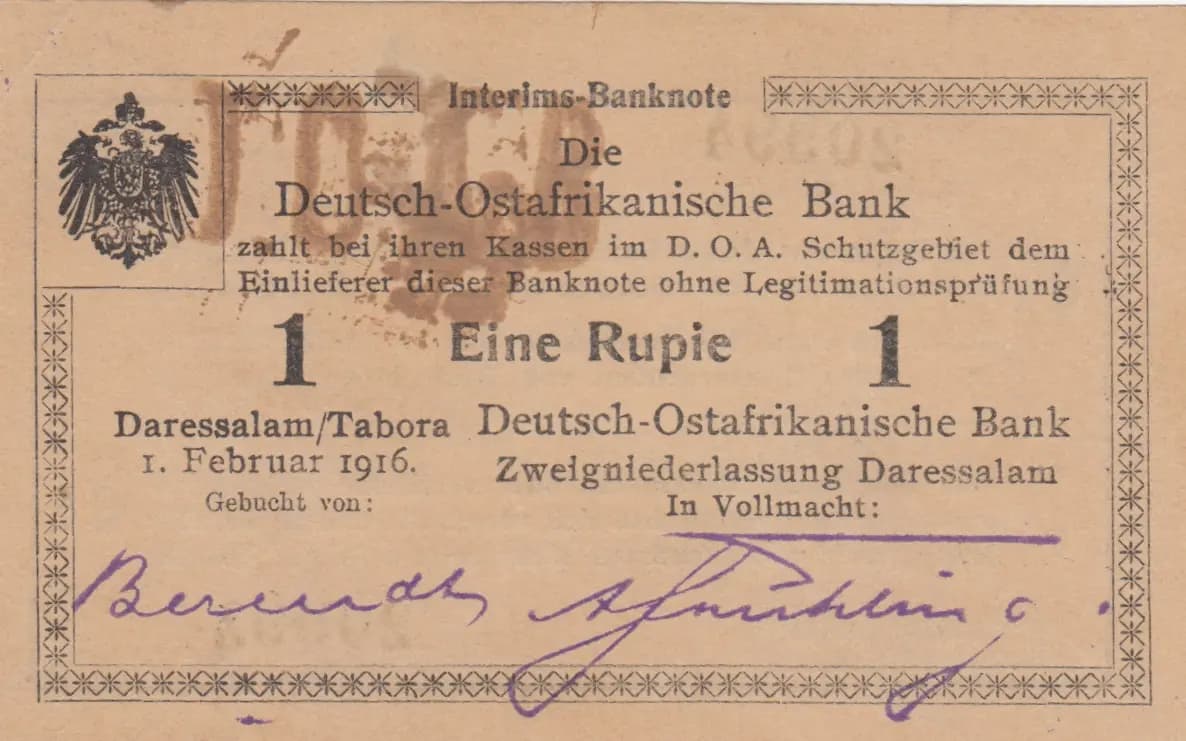
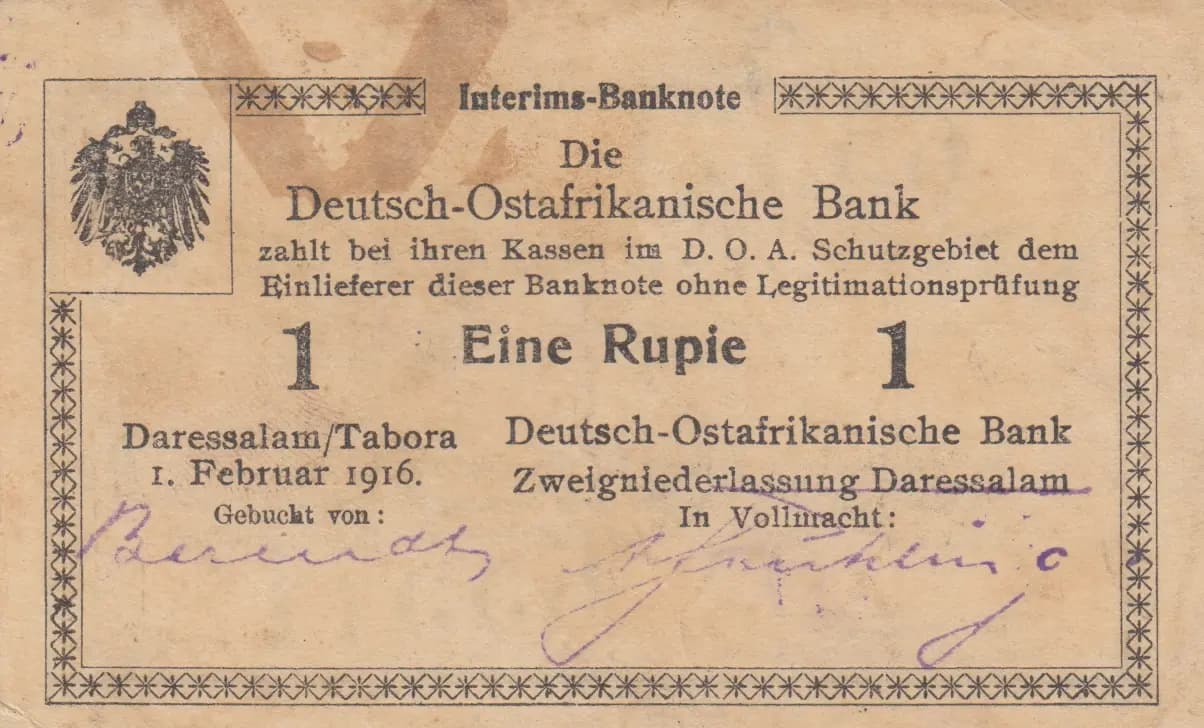
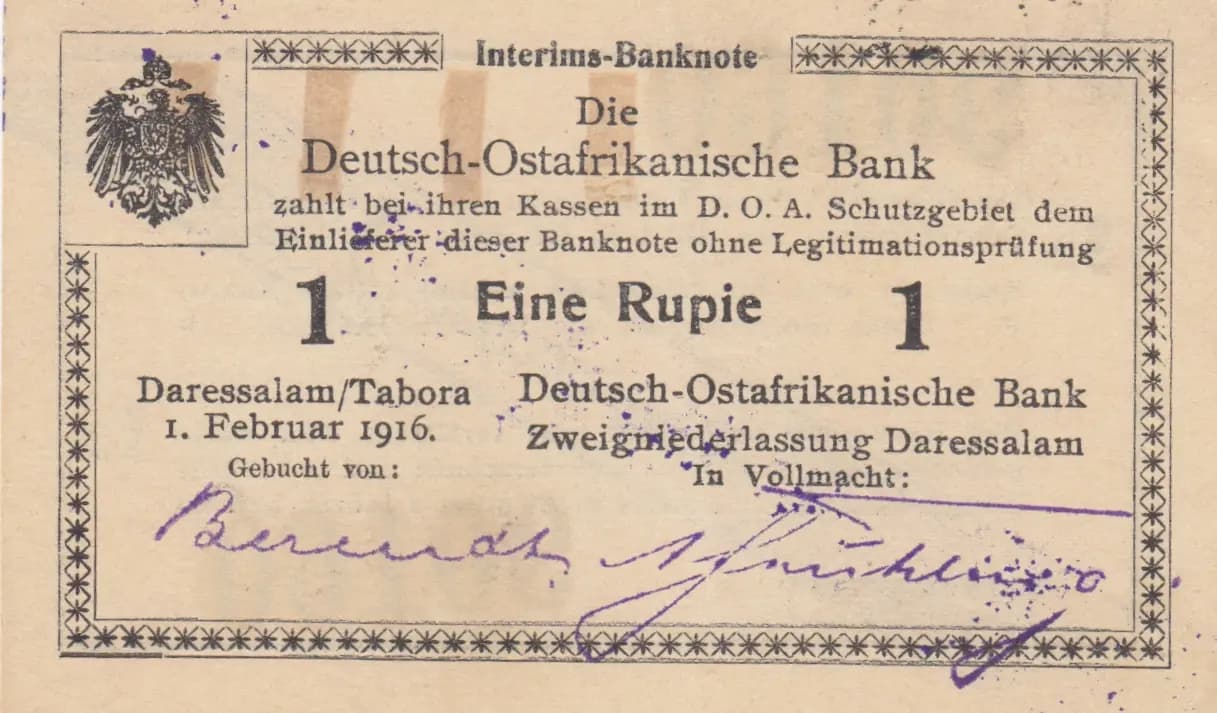
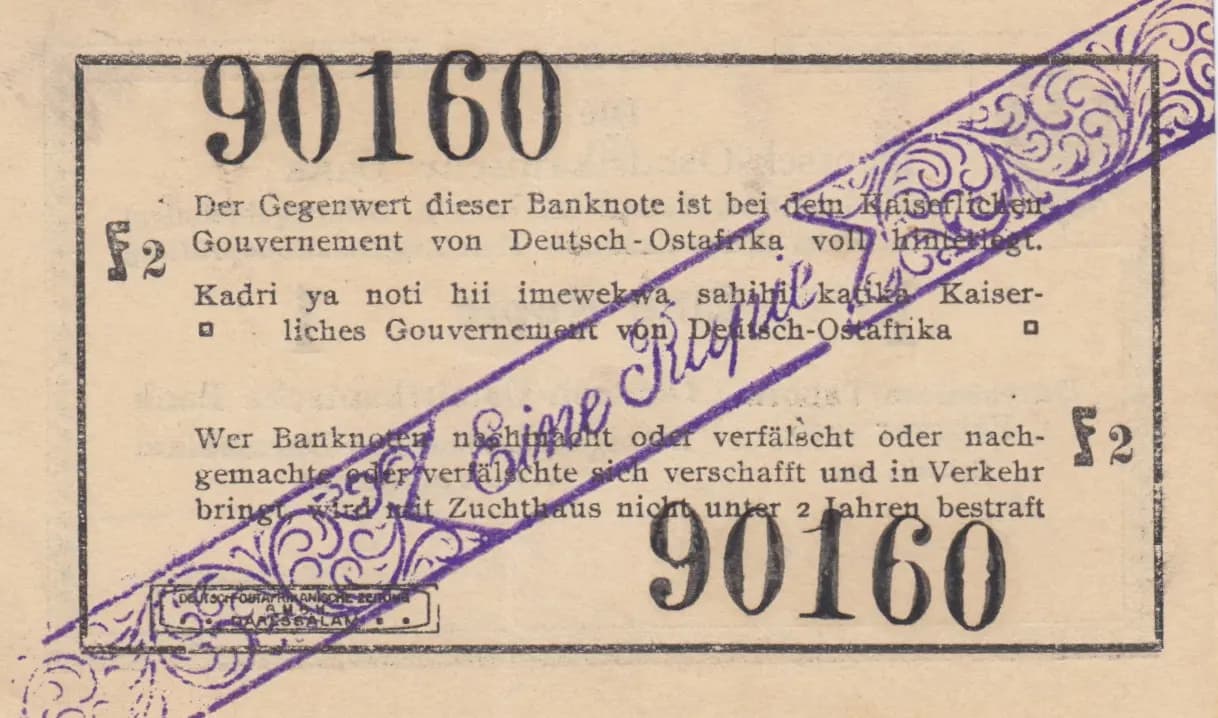
This is an Interims-Banknote (interim banknote) issued by the Deutsch-Ostafrikanische Bank on 1 February 1916, denominated in 1 Rupee. The note exhibits an AU condition grade with visible aging including foxing and yellowing consistent with its 108-year age, featuring the German imperial double-headed eagle (Reichsadler) and a distinctive purple/blue diagonal ornamental security stripe on the reverse. The presence of handwritten signatures and the scarce series F2 marking make this a notable example of German East African currency from the final years of German colonial rule in Africa.
Uncommon. The 1 Rupee notes of the Deutsch-Ostafrikanische Bank from 1916 are not scarce in absolute terms, as multiple series were issued throughout 1916. However, the specific series F2 variety in AU condition represents a minority of surviving examples, as most specimens encountered show heavier circulation wear or greater deterioration. The AU grade and the complete bilateral inscription make this a desirable collector's example. These notes have moderate collector demand given their historical significance as the final German East African currency, but they are not rare enough to command premium valuations typical of scarce colonial issues.
This banknote was issued during World War I by the Deutsch-Ostafrikanische Bank, the colonial currency authority for German East Africa (Deutsch-Ostafrika). The 'Interims-Banknote' designation and the bilateral inscription in German and Swahili reflect the colonial administrative structure, while the Imperial German eagle symbolizes the Kaiser's authority over the protectorate. By 1916, German East Africa was under military pressure and would soon fall under British control, making these interim notes the final expression of German monetary sovereignty in the region.
The obverse features the Imperial German coat of arms—the Reichsadler (double-headed imperial eagle with crown and shield)—positioned prominently in the upper left corner, symbolizing Kaiser Wilhelm II's authority over the protectorate. The denomination '1' is displayed in large numerals at both left and right margins, with 'Eine Rupie' (One Rupee) printed centrally. The note is bordered by a geometric star-pattern decorative frame with ornamental flourishes. The reverse displays the serial number 90160 in large numerals at upper left and lower right, with a striking diagonal security feature consisting of an ornamental floral scroll-work watermark or stripe in purple/blue ink. The series marking F2 appears on both sides. The entire note is printed on aged, cream-colored paper with natural yellowing and foxing consistent with the note's 108-year age. Handwritten signatures and marks in blue/purple ink indicate official authorization at the Dar es Salaam branch.
FRONT: 'Interims-Banknote' (Interim Banknote) | 'Die Deutsch-Ostafrikanische Bank' (The German East African Bank) | 'zahlt bei ihren Kassen im D.O.A. Schutzgebiet dem Einlieferer dieser Banknote ohne Legitimationsprüfung' (pays at its offices in the D.O.A. protectorate to the bearer of this banknote without verification of legitimation) | 'Eine Rupie' (One Rupee) | 'Daressalam/Tabora' (Dar es Salaam/Tabora) | '1. Februar 1916' (1st February 1916) | 'Gebucht von:' (Issued by:) | 'Deutsch-Ostafrikanische Bank Zweigniederlassung Daressalam' (German East African Bank Branch Dar es Salaam) | 'In Vollmacht:' (By authority:). BACK: '90160' (serial number) | 'F2' (series marking) | 'Der Gegenwert dieser Banknote ist bei dem Kaiserlichen Gouvernement von Deutsch-Ostafrika vollständig hinterlegt' (The equivalent of this banknote is fully deposited with the Imperial Government of German East Africa) | 'Wer Banknoten verfälscht oder verfälschte sich verschafft und in Verkehr bringt, wird mit Zuchthaus nicht unter 2 Jahren bestraft' (Whoever counterfeits banknotes or procures counterfeit banknotes and brings them into circulation shall be punished with imprisonment of not less than 2 years) | Bilingual inscription mixing German with Swahili elements regarding currency backing.
This interim banknote was produced using letterpress printing combined with handwritten and hand-applied security elements. The base design, text, and serial numbers were printed via relief printing (likely at a colonial printing facility in German East Africa or Germany), while the distinctive diagonal ornamental watermark/security stripe appears to have been applied separately, possibly via lithography or as an overlay security feature. The handwritten signatures and manuscript marks visible on the note indicate manual authentication. The production quality reflects the exigencies of World War I-era colonial administration, with practical interim measures rather than the sophisticated security printing typical of metropolitan German currency.
This note is identified as series F2, as noted both in the collector notes and visible on the reverse of the specimen. The serial number is 90160. The bilateral text (German and Swahili) and the specific date of 1. Februar 1916 place this within the standard 1 Rupee interim issue. Variations within the F2 series may exist regarding signature variations and minor printing details, though the fundamental design remained consistent across the 1916 interim issue. The presence of handwritten authorization marks suggests this particular note underwent manual verification, which may indicate a specific treasury office release or batch processing variation typical of interim wartime currency.