1 rupee 1916
“serie M2”
About This Note
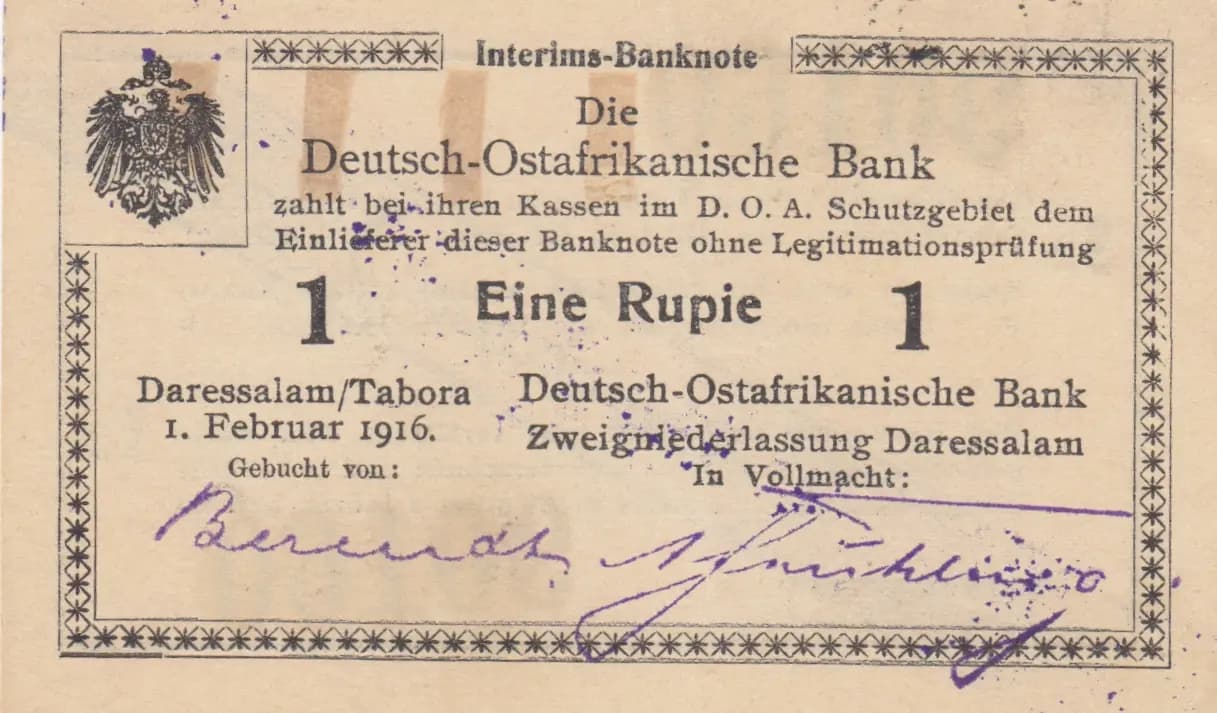
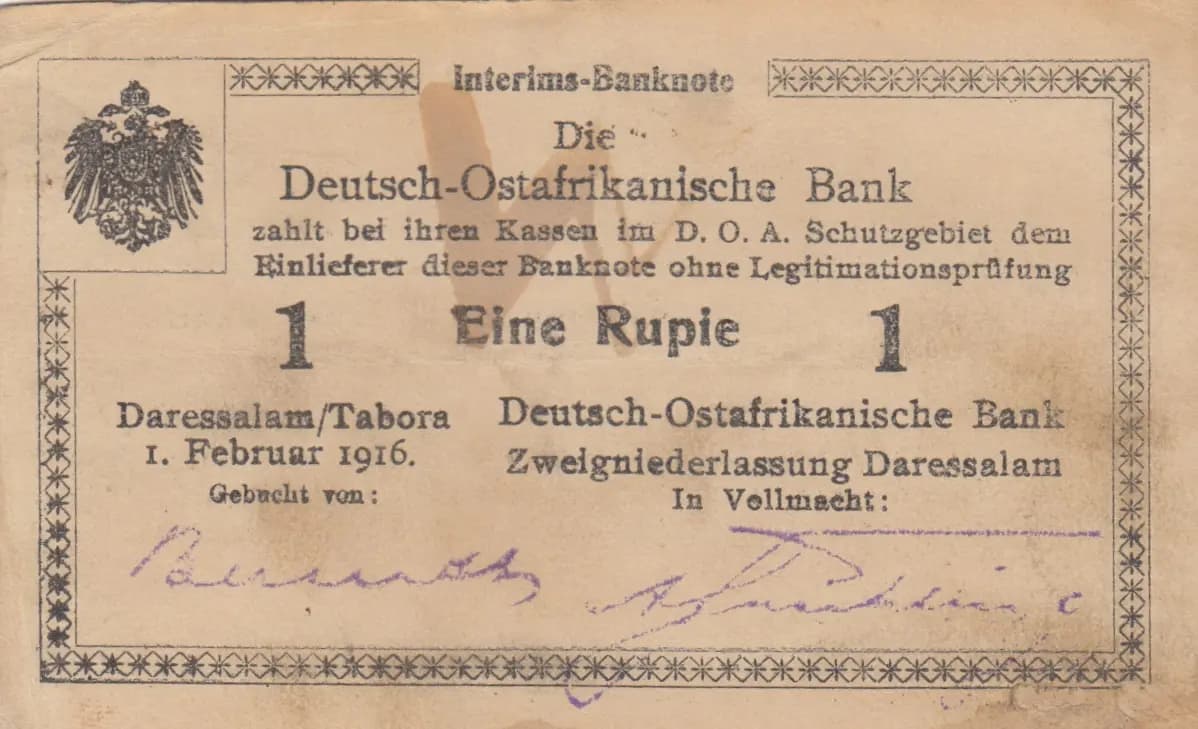
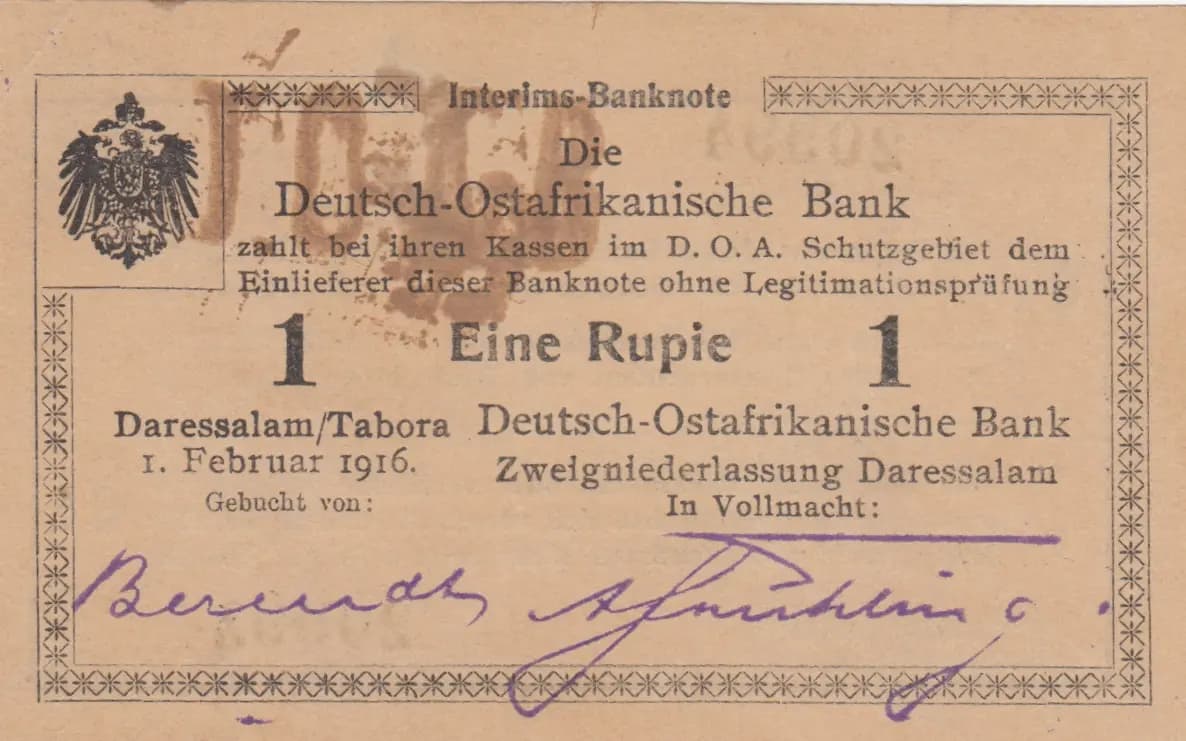
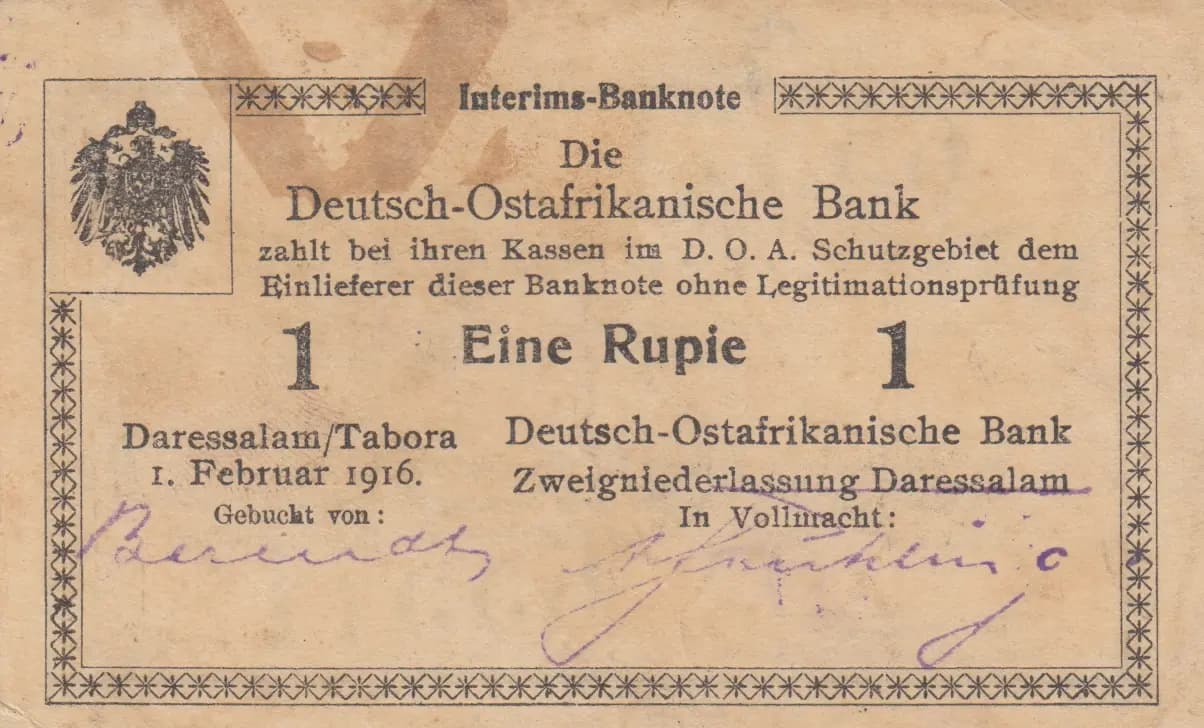
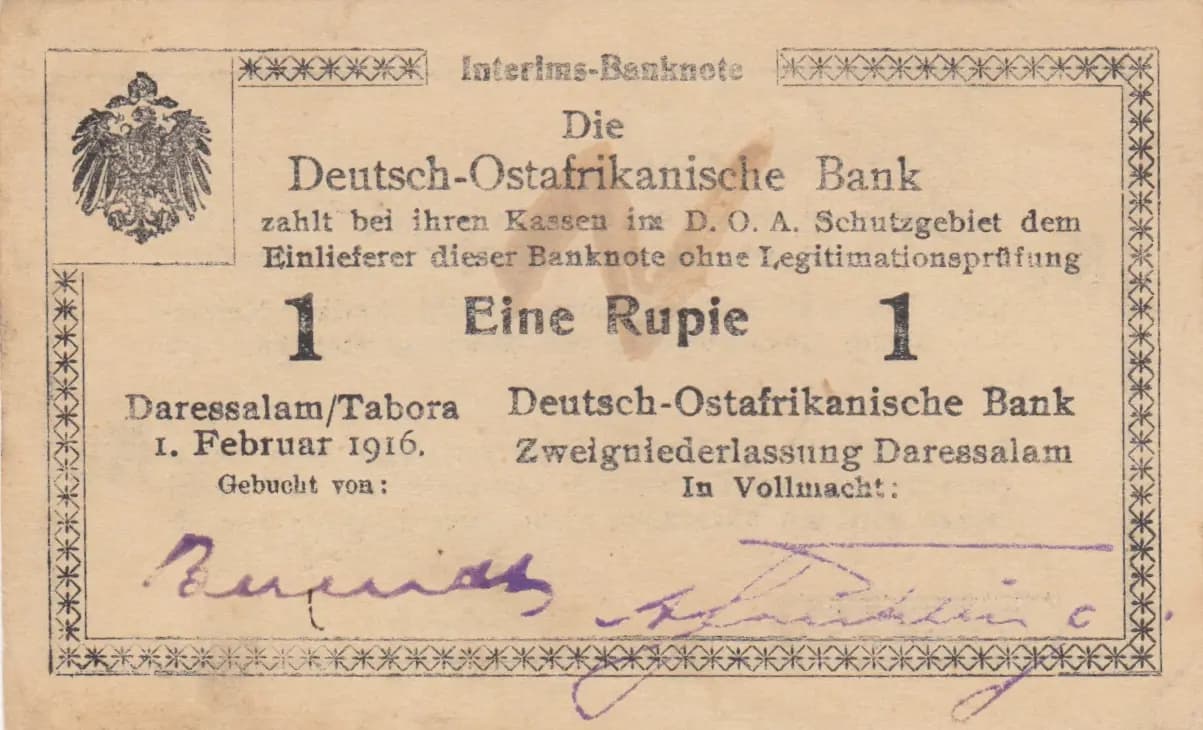
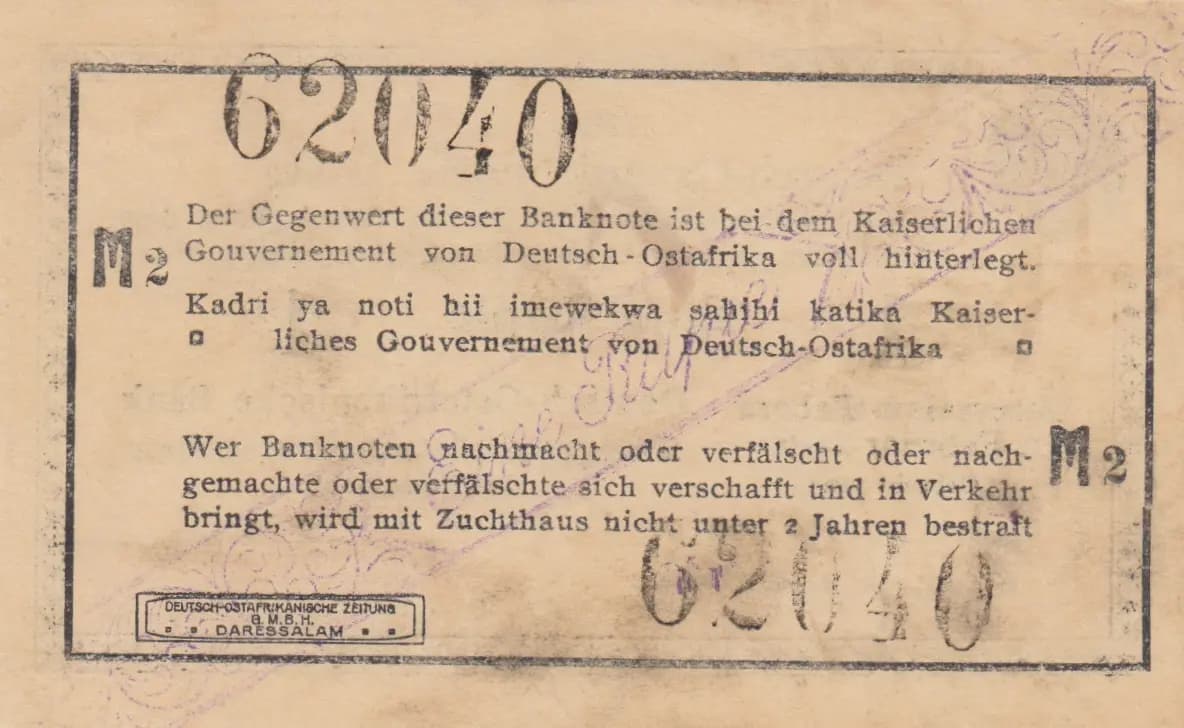
This is an exceptional example of the Deutsch-Ostafrikanische Bank's 1 Rupee interim banknote from February 1, 1916 (Pick P-19), graded AU with excellent eye appeal. The note displays the characteristic tan/beige coloration typical of early 20th-century German colonial currency, with the Imperial German eagle prominently featured and two handwritten signatures in purple ink authenticating the issue. The bilingual German-Swahili reverse and reference number 02040 mark this as a genuine example from Germany's East African colonial administration during World War I.
Common. The Deutsch-Ostafrikanische Bank's 1 Rupee interim notes from 1916 (Pick P-19) were issued in substantial quantities during the colonial period and appear regularly in collections of German colonial currency. Multiple examples with various series designations (like the M2 noted here) are readily available in the numismatic market. The AU condition grade is noteworthy but does not significantly elevate rarity status, as these notes were printed on durable paper and many survive in similar condition. No evidence of restricted print runs or special circumstances affecting availability.
This interim banknote was issued by the Deutsch-Ostafrikanische Bank during Germany's colonial period in East Africa, specifically during World War I when traditional currency supplies were disrupted. The reference to the Imperial German eagle (Reichsadler) and the official seal of the Kaiser's government reflect the formal colonial administration structure. The bilingual German-Swahili inscriptions and dual location references (Dar es Salaam and Tabora) demonstrate the bank's regional operational centers serving the D.O.A. (Deutsch-Ostafrika) protectorate.
The obverse features a bearer bond format typical of interim emergency currency, with the Imperial German eagle coat of arms (Reichsadler) positioned in the upper left corner as the primary heraldic symbol of German authority. The denomination '1' and textual reference 'Eine Rupie' are centrally positioned. The note incorporates decorative border patterns with asterisk/star motifs for security purposes. Two handwritten signatures in purple/violet ink appear in the lower portion, representing dual authorization by bank officials. The reverse contains extensive legal text in both German and Swahili, reflecting the bilingual administration of the German East African colony, along with the printer's identification and counterfeiting warnings. The reference number 02040 appears at the top of the reverse, with series designation M2 visible. The overall layout is characteristic of Austro-Hungarian and German colonial interim banknotes of the 1916 period.
FRONT SIDE: 'Interims-Banknote' (Interim Banknote) — 'Die Deutsch-Ostafrikanische Bank zahlt bei ihren Kassen im D.O.A. Schutzgebiet dem Einlieferer dieser Banknote ohne Legitimationsprüfung' (The German East African Bank pays at its counters in the D.O.A. protectorate to the bearer of this banknote without verification of legitimation) — '1 / Eine Rupie' (1 / One Rupee) — 'Daressalam/Tabora' (locations) — 'i. Februar 1916' (1st February 1916) — 'Gebucht von: Deutsch-Ostafrikanische Bank Zweigniederslassung Daressalam' (Issued by: German East African Bank Branch Office Dar es Salaam) — 'In Vollmacht:' (By authority:). REVERSE SIDE: '02040' (reference number) — 'Der Gegenwert dieser Banknote ist bei dem Kaiserlichen Gouvernement von Deutsch-Ostafrika voll hinterlegt' (The value of this banknote is fully deposited with the Imperial Government of German East Africa) — Swahili equivalent text — 'Wer Banknoten nachmacht oder verfälscht oder nachgemachte oder verfälschte sich verschafft und in Verkehr bringt, wird mit Zuchthaus nicht unter 2 Jahren bestratt' (Whoever counterfeits or forges banknotes or acquires counterfeit or forged notes and puts them into circulation will be punished with imprisonment of not less than 2 years) — 'M2' (series designation) — 'DEUTSCH-OSTAFRIKANISCHE ZEITUNG GMBH DARESSALAM' (German East African Newspaper GmbH Dar es Salaam — printer's mark).
Letterpress printing with handwritten signature authentication. The printer's mark 'DEUTSCH-OSTAFRIKANISCHE ZEITUNG GMBH DARESSALAM' indicates production by the German East African Newspaper printing house in Dar es Salaam. The note combines typeset text with handwritten signatures in purple ink applied post-printing as authorization marks. This hybrid approach was common for interim emergency currency where speed of production was essential and security features were primarily dependent on signature verification rather than advanced printing techniques.
This example is identified as Series M2, as noted on the reverse. The reference number 02040 and the dual signatures (visible in purple ink) represent specific issuing characteristics of this batch. For Pick P-19, varieties are primarily distinguished by series letters (M, N, etc.) and signature combinations. The February 1, 1916 date is consistent with the primary issue. No overprints or other significant varieties are apparent on this specimen. Collectors should note that the bilingual format and printer identification (Zeitungs GMBH) are standard for this Pick number rather than indicating a special variety.