1 rupee 1916
“serie L2”
About This Note
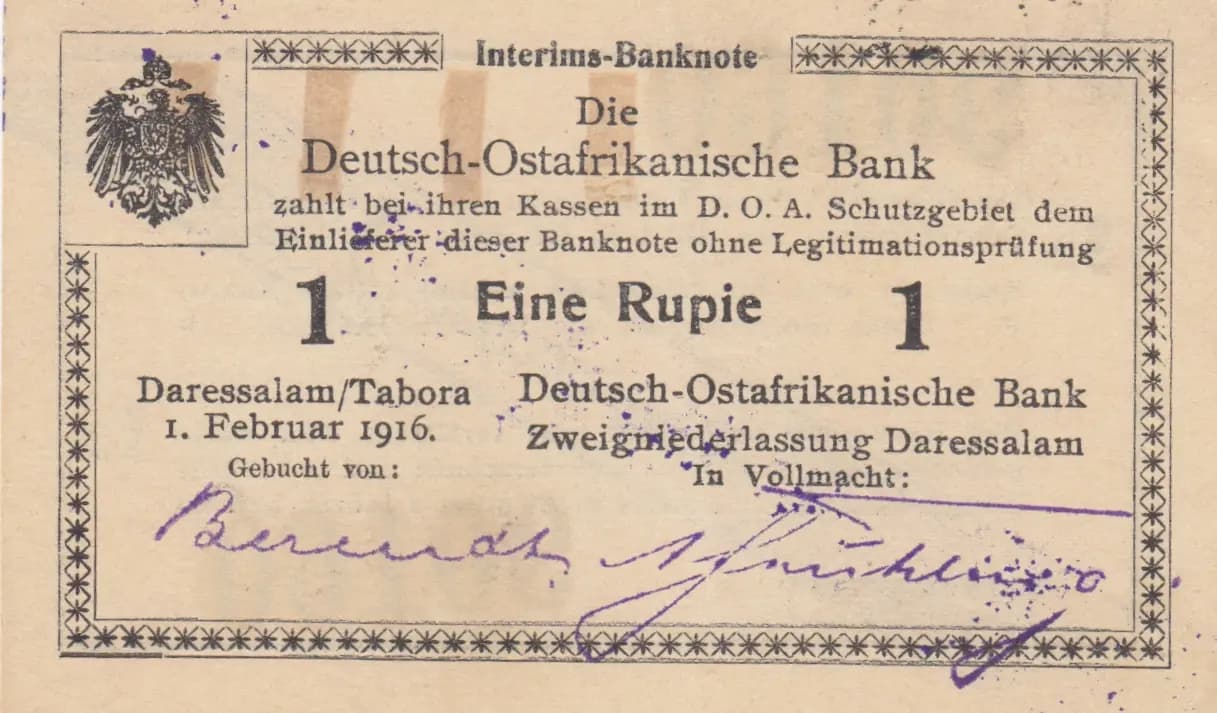
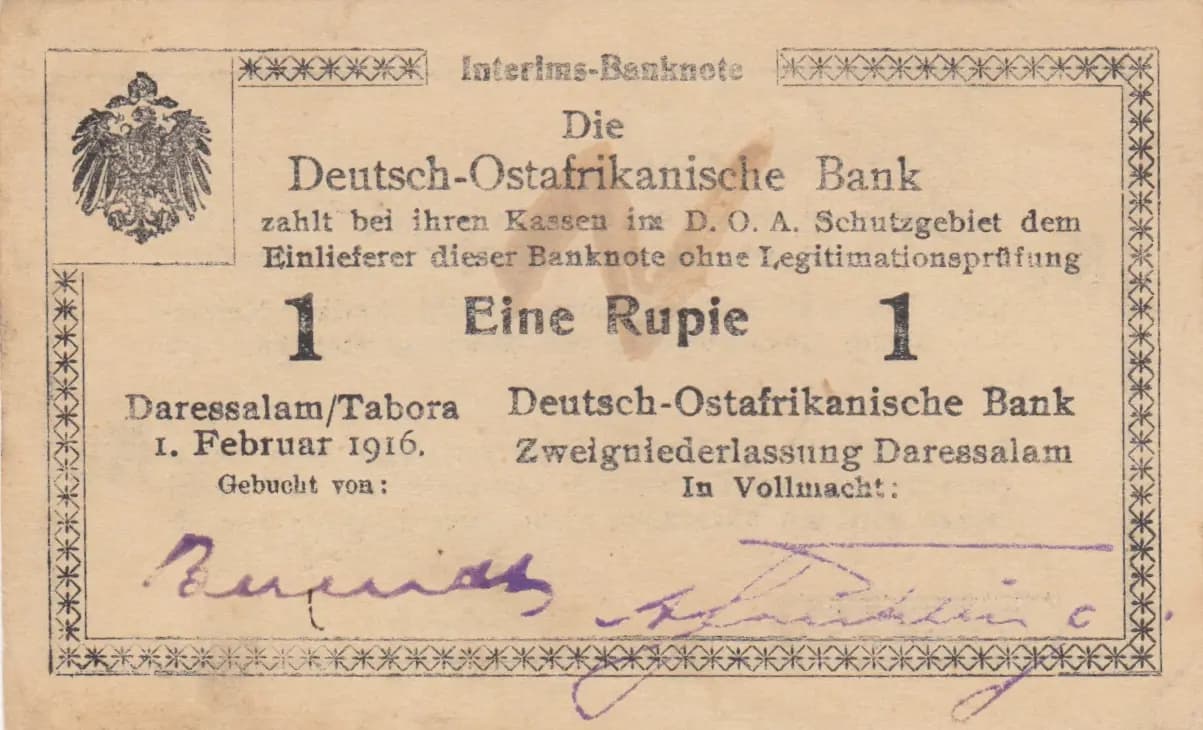
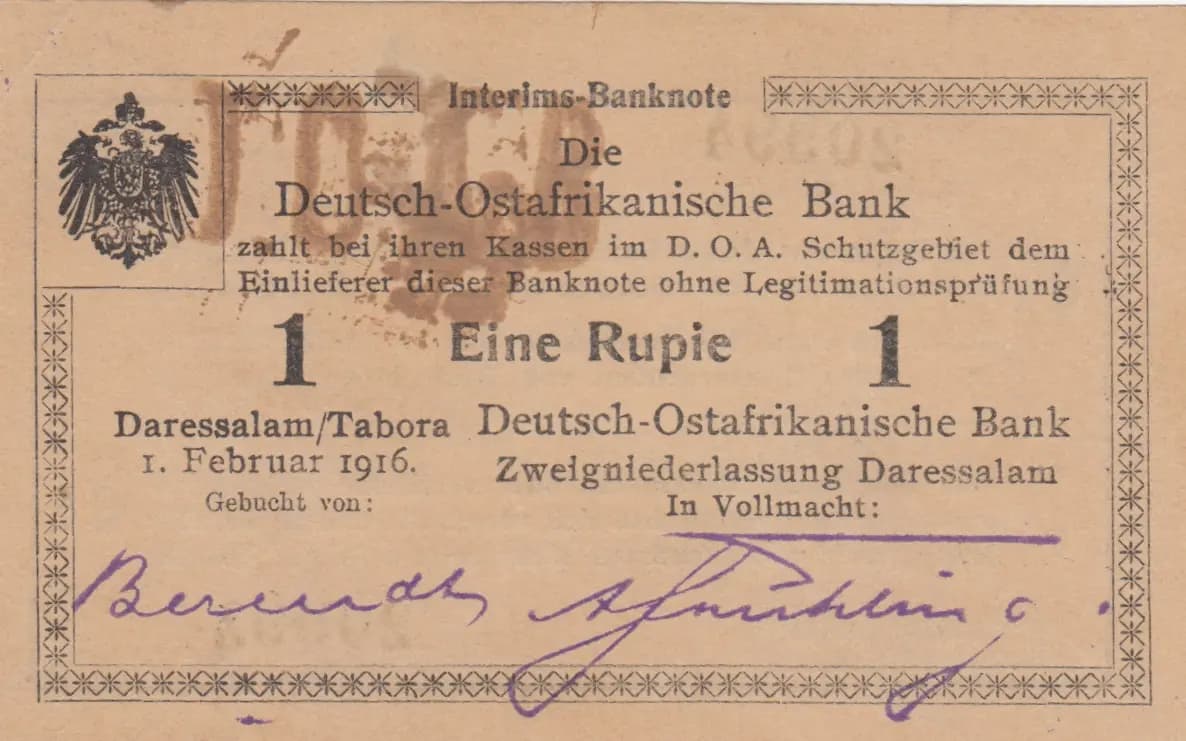
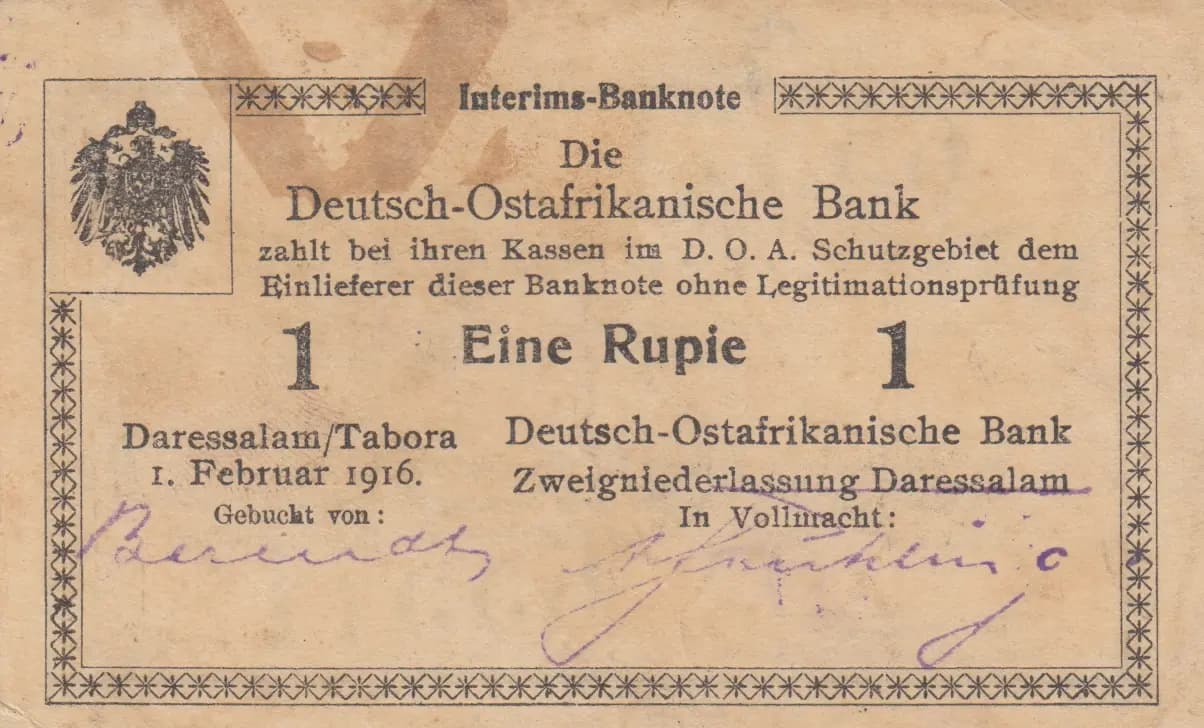
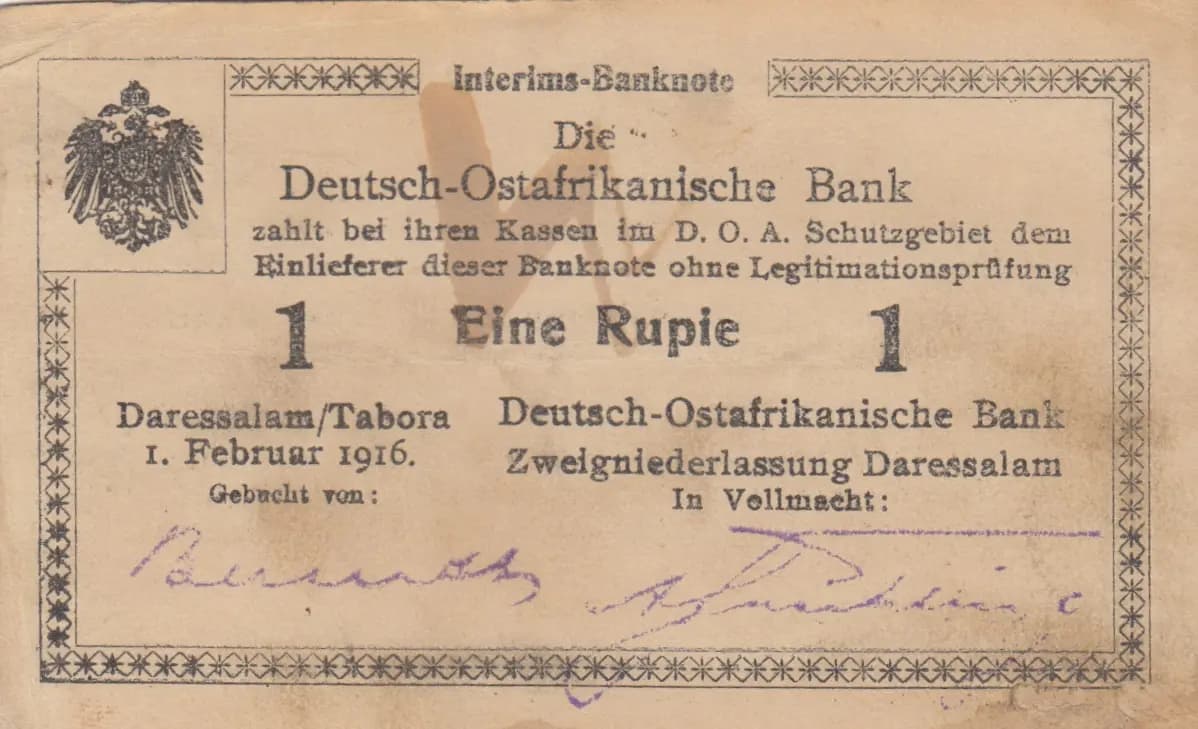
This is a German East African 1 Rupee interim banknote (Interims-Banknote) issued February 1, 1916 by the Deutsch-Ostafrikanische Bank, Pick P-19. The note displays heavy aging with significant foxing, staining, and discoloration consistent with over 100 years of age, though the AU grade reflects relatively well-preserved condition for such an aged document. Notable features include the German Imperial Eagle coat of arms, dual-language text (German and Swahili), period-appropriate handwritten signatures in purple ink, and an official stamp box on the reverse—making this an excellent example of wartime emergency currency from German colonial Africa.
Common. German East African interim banknotes of 1916 were issued in substantial quantities as emergency currency during World War I to maintain commerce in the isolated German colony. While the Pick catalog lists P-19 as a recognized standard type, these notes were produced in sufficient numbers to survive in moderate quantities today. The observed condition (AU with heavy aging but no major damage) is typical rather than exceptional for surviving examples from this period. Serial number 10873 suggests a moderate point in a production run, indicating widespread circulation and issuance. These notes, while historically significant, are regularly encountered in colonial numismatic collections and are not considered scarce.
Issued during World War I when Germany's overseas colonies faced economic isolation, this interim banknote represents emergency wartime currency issued by the colonial German East African Bank. The note's design emphasizes the Imperial German authority through the Reichsadler (Imperial Eagle) coat of arms and references to the Kaiser's government, while the bilingual German-Swahili text reflects the colonial administration's practical need to communicate with the local population in German East Africa. The February 1916 date places this note during the intense military campaign in East Africa, when such interim notes became necessary due to disrupted regular currency supplies.
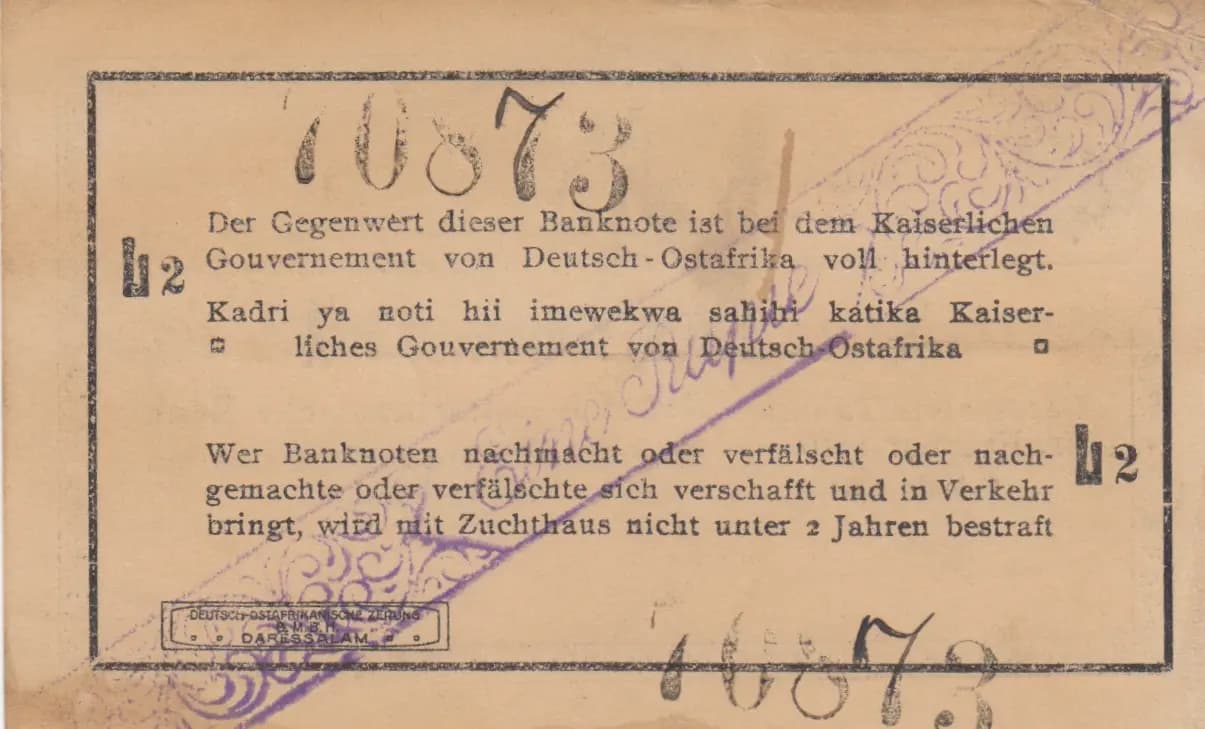
The front of this interim banknote features the Reichsadler (German Imperial Eagle coat of arms) prominently positioned in the upper left corner, symbolizing imperial authority. The note is printed on tan/beige paper in black ink with a simple, functional design befitting emergency wartime currency. The issuing authority 'Deutsch-Ostafrikanische Bank' and branch location 'Daressalam/Tabora' are clearly stated, with the denomination '1 Eine Rupie' (1 Rupee) displayed. Signature lines for authorization ('Gebucht von' and 'In Vollmacht') appear at the bottom, with visible purple handwritten signatures and marks from original processing. The reverse contains legal text in both German and Swahili, a rectangular official stamp/seal box in the lower left corner, counterfeiting penalties, and reassurance text that the note's value is fully backed by the Imperial Government. The bilingual design reflects the colonial administrative structure serving both German officials and local populations.
FRONT: 'Interims-Banknote' (Interim Banknote) / 'Die Deutsch-Ostafrikanische Bank' (The German East African Bank) / 'zahlt bei ihren Kassen im D.O.A. Schutzgebiet dem Einlieferer dieser Banknote ohne Legitimationsprüfung' (pays at its counters in the D.O.A. protectorate to the bearer of this banknote without legitimation examination) / '1 Eine Rupie 1' (1 One Rupee 1) / 'Daressalam/Tabora' / '1. Februar 1916' (1st February 1916) / 'Deutsch-Ostafrikanische Bank Zweigniederlassung Daressalam' (German East African Bank Branch Dar es Salaam) / 'Gebucht von:' (Booked by:) / 'In Vollmacht:' (By Authority:). BACK: 'Der Gegenwert dieser Banknote ist bei dem Kaiserlichen Gouvernement von Deutsch-Ostafrika voll hinterlegt' (The equivalent value of this banknote is fully deposited with the Imperial Government of German East Africa) / 'Kadri ya noti hii imewekwa sahihi kätika Kaiserliches Gouvernement von Deutsch-Ostafrika' (Swahili/German: The value of this note is properly deposited with the Imperial Government of German East Africa) / 'Wer Banknoten nachmacht oder verfälscht oder nachgemachte oder verfälschte sich verschafft und in Verkehr bringt, wird mit Zuchthaus nicht unter 2 Jahren bestraft' (Whoever counterfeits or forges banknotes or obtains counterfeited or forged notes and puts them into circulation will be punished with imprisonment for not less than 2 years) / 'DEUTSCH-OSTAFRIKANISCHE ZEITUNG DARESSALAM' (German East African Newspaper Dar es Salaam) / Serial number '10873'.
This interim banknote was produced using letterpress (relief) printing, the standard method for currency and official documents of the 1916 period. The sharp, clean lines of the text and the Reichsadler are characteristic of letterpress technology. The note exhibits the typical characteristics of early 20th-century German official printing: precise typography, black ink on plain paper stock, and functional rather than elaborate security features. The handwritten signatures and purple ink marks were added during the validation process at the time of issue. No specialized security printer is documented for these emergency interim notes; they appear to have been produced by standard German government printing facilities adapted for wartime currency production.
Series L2 as noted in collector notes. This represents one of the series variants issued during the 1916 interim period. The specific signature combination visible (two handwritten purple signatures) and the Dar es Salaam branch designation are standard for this issue. Serial number 10873 places this within the documented serial range for Pick P-19. No overprints or security variations are evident in this example. The note appears to be a standard variety from the main production run rather than a known sub-variety or limited printing.