1 rupee 1916
“serie P2”
About This Note
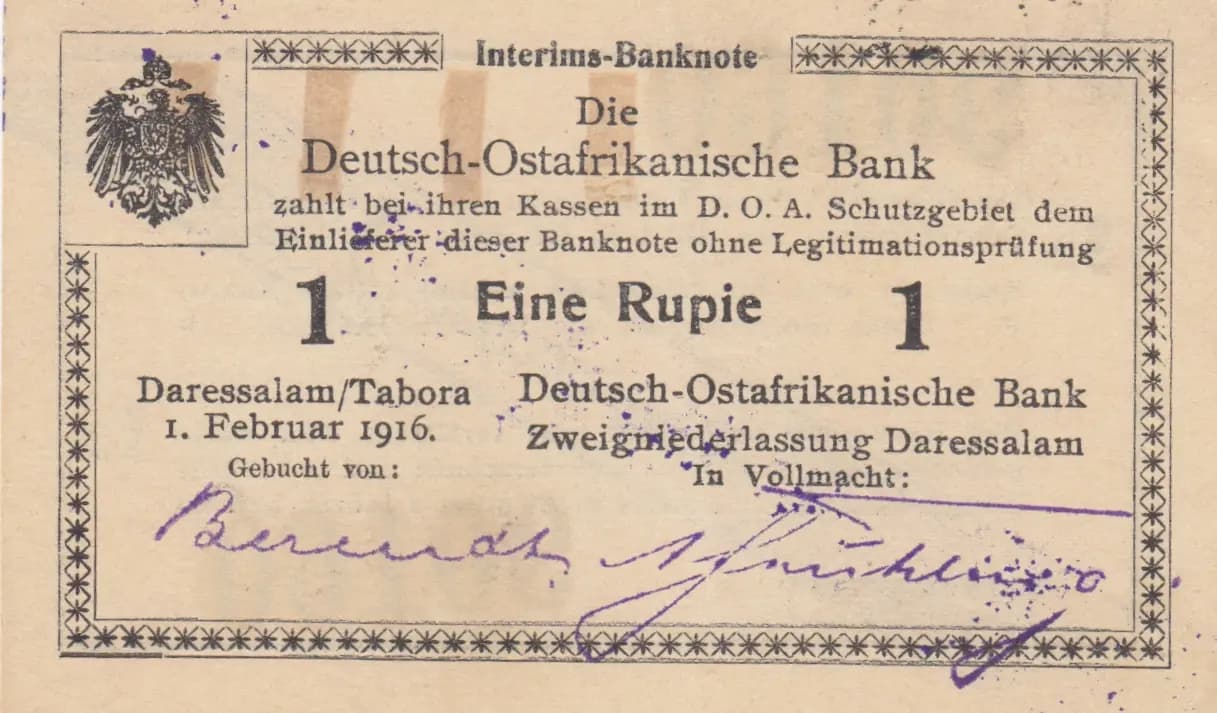
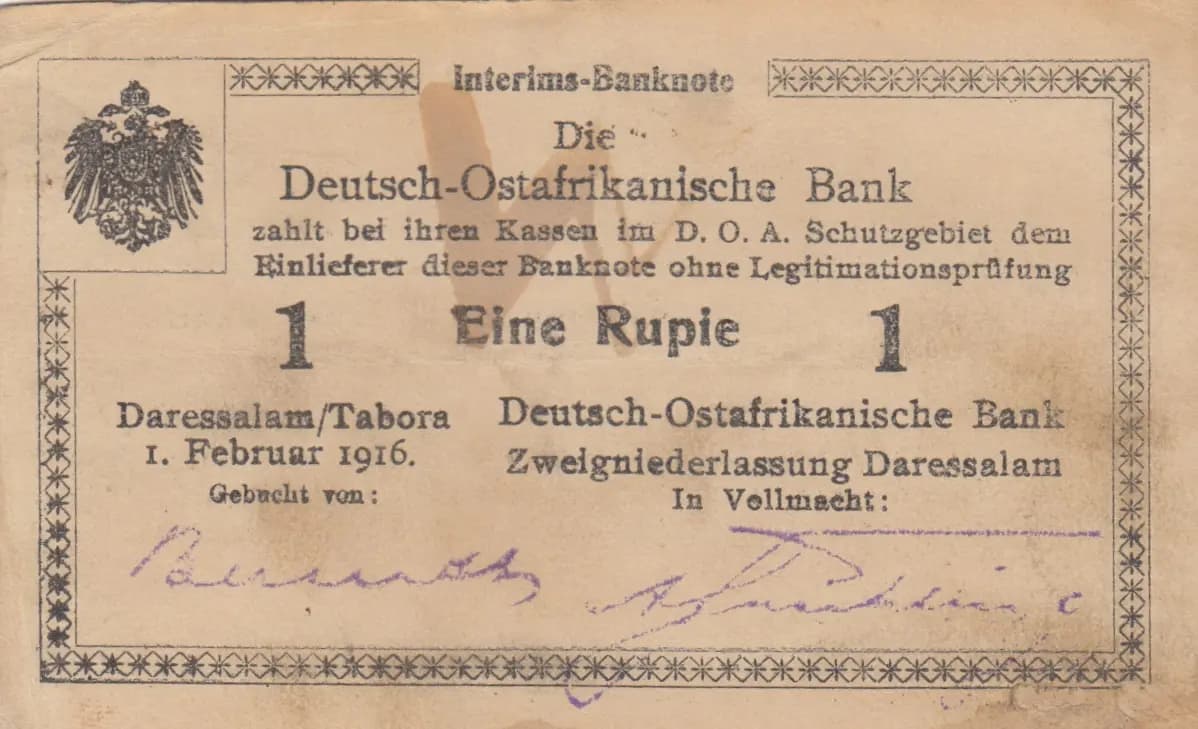
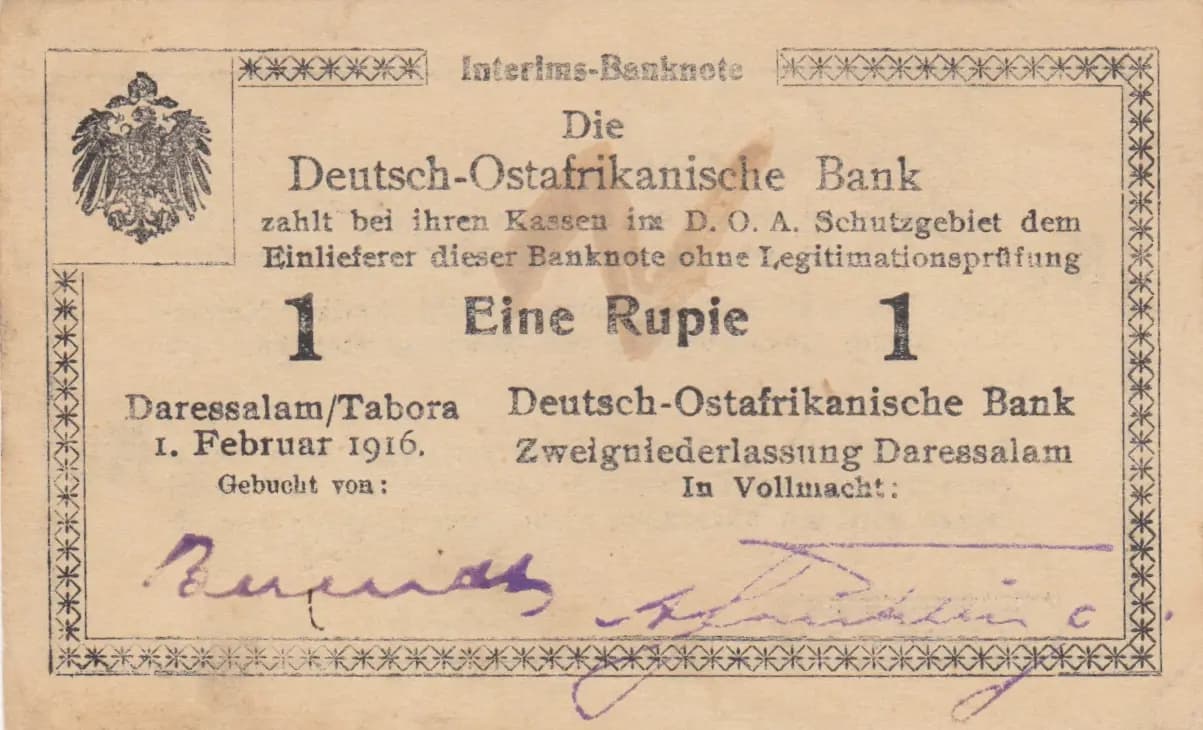
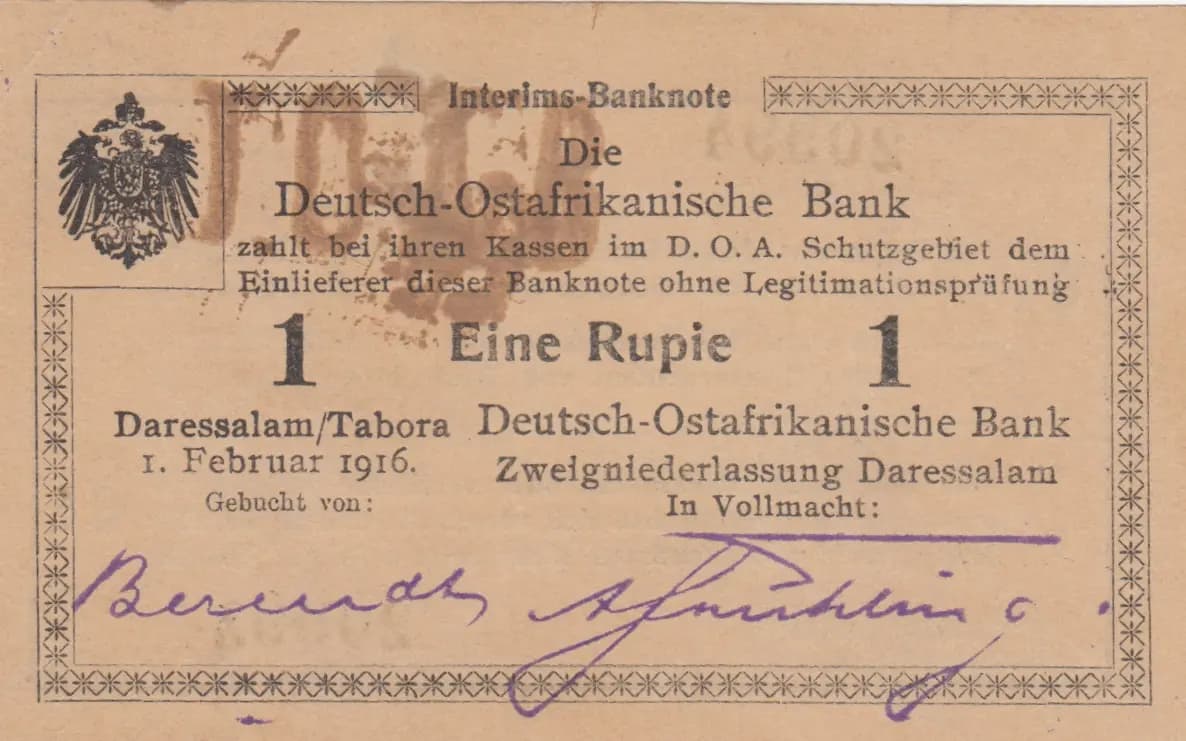
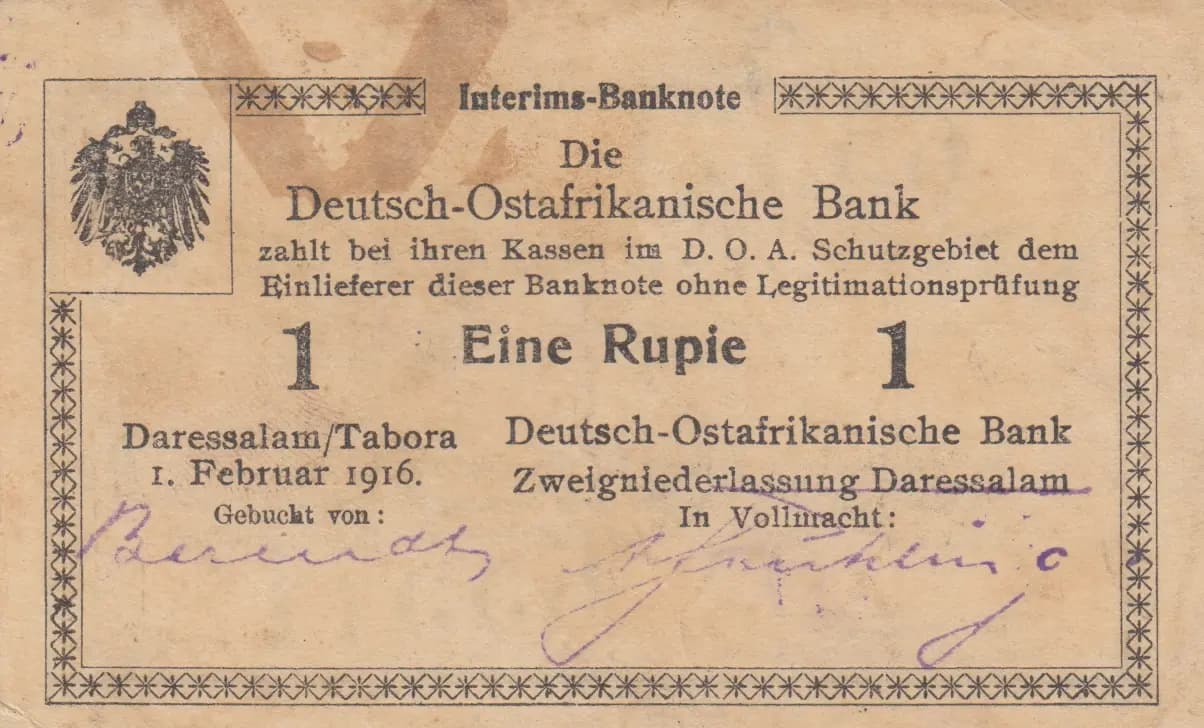
This is a German East African 1 Rupie Interims-Banknote from February 1, 1916, issued by the Deutsch-Ostafrikanische Bank during World War I. The note exhibits an AU condition grade with characteristic age-related patina, tan/beige discoloration, and foxing throughout, yet maintains excellent clarity of printing and legibility of all text and signatures. The presence of handwritten signatures in violet ink and the P2 series designation make this a documented example of emergency wartime currency issued in German colonial Africa.
Common. This is a standard emergency issue from a major German colonial bank with no evidence of limited print run, recall, or exceptional scarcity. The serial number 65571 and P2 series designation indicate this was part of a substantial production series. Interims-Banknoten from German East Africa in this period typically appear regularly in numismatic commerce and auction markets, with AU specimens being readily available.
This interim banknote was issued during the final years of German colonial rule in East Africa, when World War I disrupted normal currency circulation and supply chains. The note's declaration that its value is fully deposited with the Imperial Government of German East Africa reflects the emergency financial measures taken by the colonial administration. The bilingual inclusion of Swahili alongside German inscriptions on the reverse demonstrates the multicultural character of German East African commerce and administration during this period.
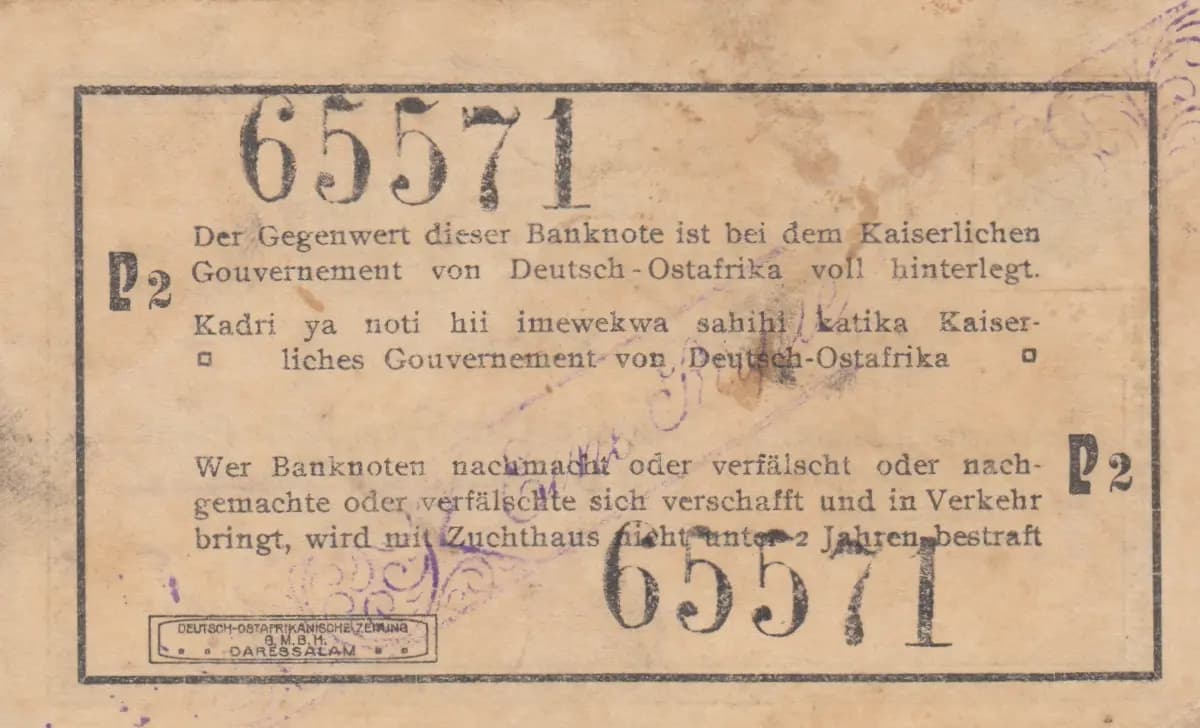
The obverse features the German Imperial double-headed eagle coat of arms with crown and shield positioned in the upper left corner, serving as the primary heraldic symbol and authentication device. The note is framed by ornamental geometric border patterns on all sides typical of early 20th-century German banking practice. Two blank signature lines appear at the bottom, with evidence of handwritten authorization signatures in violet/purple ink. The reverse contains primarily textual matter with the serial number 65571 displayed prominently in large numerals at top and bottom, and includes a small printer's seal or mark from the Deutsch-Ostafrikanische Zeitung at the bottom left. The design layout emphasizes the emergency/interim nature of the issue with its straightforward, text-heavy presentation rather than elaborate vignettes or portraiture.
FRONT: 'Interims-Banknote' (Interim Banknote) — 'Die Deutsch-Ostafrikanische Bank' (The German East African Bank) — 'zahlt bei ihren Kassen im D. O. A. Schutzgebiet dem Einlieferer dieser Banknote ohne Legitimationsprüfung' (pays at its cashiers in the D.O.A. protectorate to the presenter of this banknote without verification of legitimation) — 'Eine Rupie' (One Rupie) — 'Daressalam/Tabora' (two issue locations) — '1. Februar 1916' (1st February 1916) — 'Deutsch-Ostafrikanische Bank' (German East African Bank) — 'Zweigniederlassung Daressalam' (Branch Daressalam) — 'Gebucht von:' (Booked by:) — 'In Vollmacht:' (By authority:). BACK: '65571' (Serial Number, printed twice) — 'Der Gegenwert dieser Banknote ist bei dem Kaiserlichen Gouvernement von Deutsch-Ostafrika voll hinterlegt' (The value of this banknote is fully deposited with the Imperial Government of German East Africa) — 'P 2' (series designation) — 'Kadri ya noti hii imewekwa sahihi katika Kaiserliches Gouvernement von Deutsch-Ostafrika' (Swahili: The value of this note is properly deposited in the Imperial Government of German East Africa) — 'Wer Banknoten nachmacht oder verfälscht oder nachgemachte oder verfälschte sich verschafft und in Verkehr bringt, wird mit Zuchthaus nicht unter 2 Jahren bestraft' (Whoever counterfeits or forges banknotes or procures and circulates counterfeit or forged ones will be punished with imprisonment of not less than 2 years) — 'DEUTSCH-OSTAFRIKANISCHE ZEITUNG D.M.B. DARESSALAM' (German East African Newspaper printer's mark).
Letterpress printing on unwatermarked paper, characteristic of wartime emergency currency production. The German East African Newspaper (Deutsch-Ostafrikanische Zeitung) served as the printer, as indicated by the colophon. The serial number, denominations, and decorative borders were printed in dark gray to black ink with standard mechanical typesetting. The handwritten signatures were added post-print using fountain pen with violet/purple iron gall ink, a common authorization method for emergency notes.
Series P2 as indicated by 'P 2' marking on reverse. Serial number 65571. Dated February 1, 1916 from Daressalam/Tabora dual issue locations. The handwritten signatures are individual but not identified by name on the note itself. This represents a standard P2 series specimen without apparent overprints or unusual variants.