1 rupee 1916
“serie O2”
About This Note
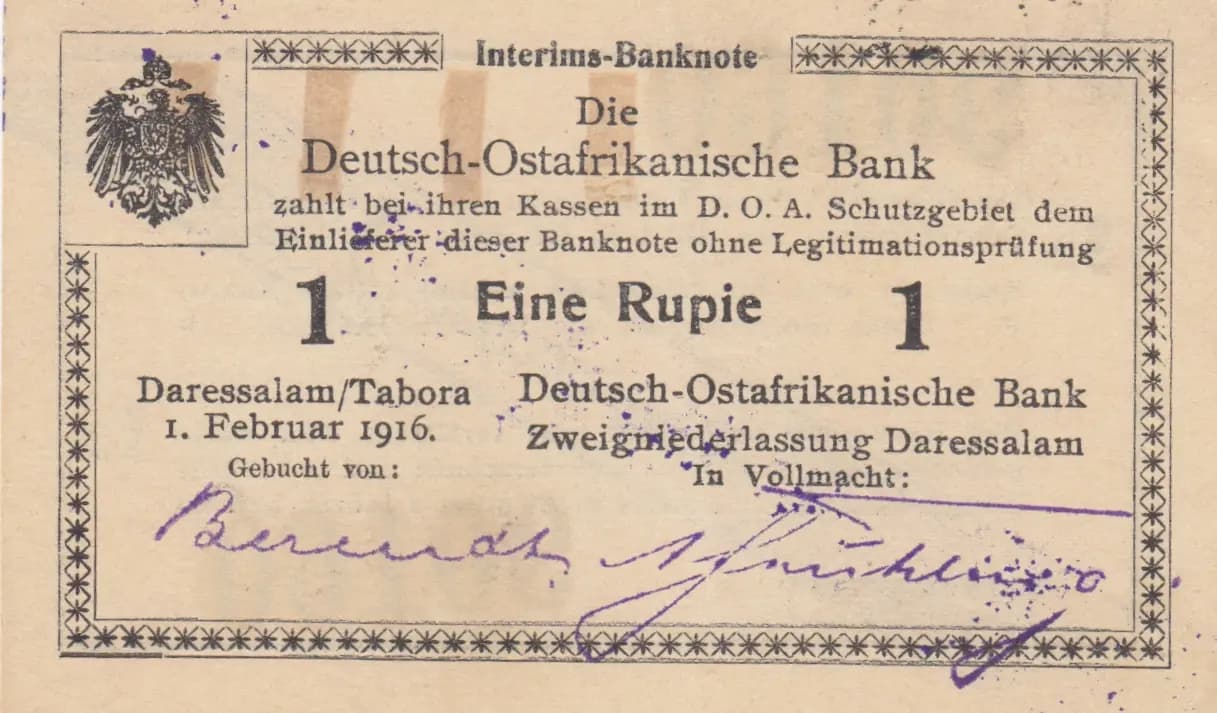
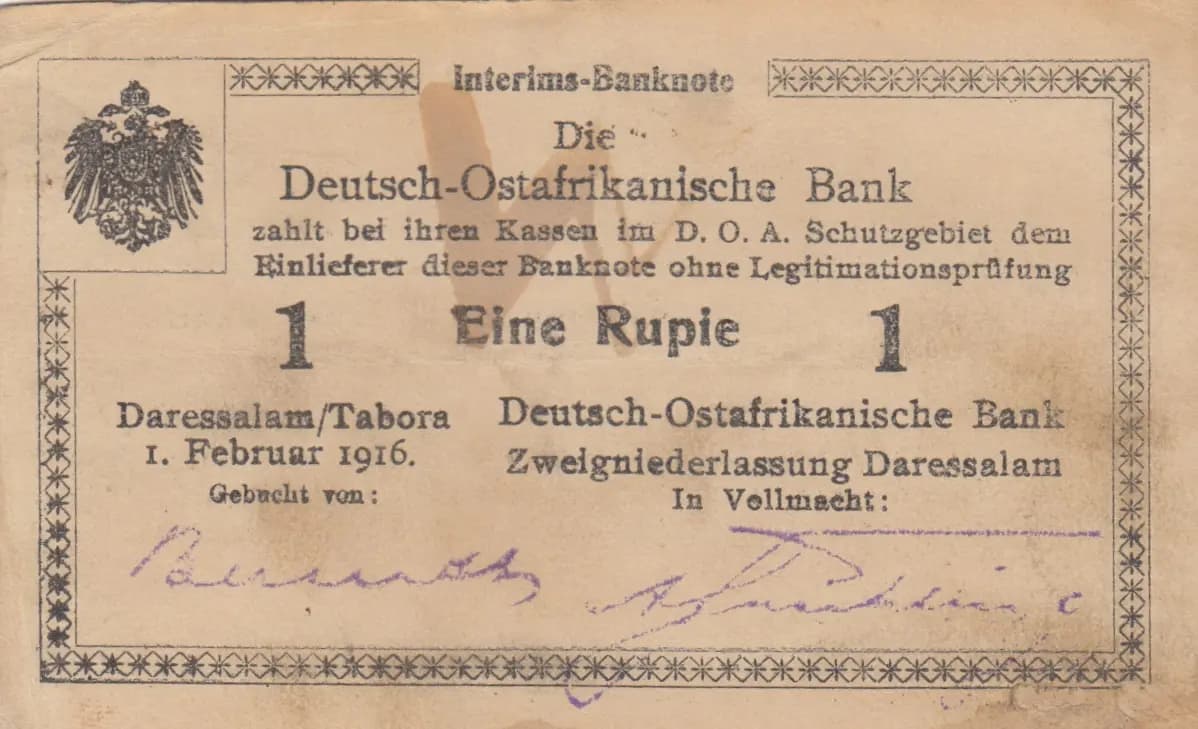
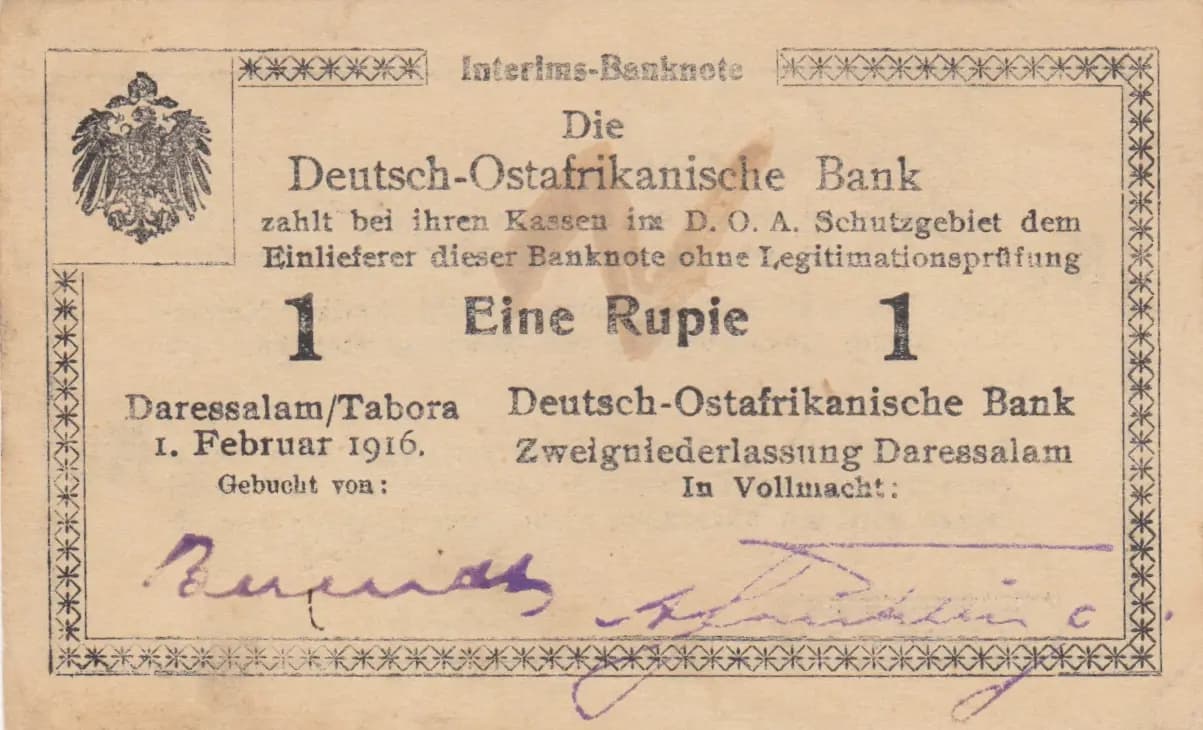
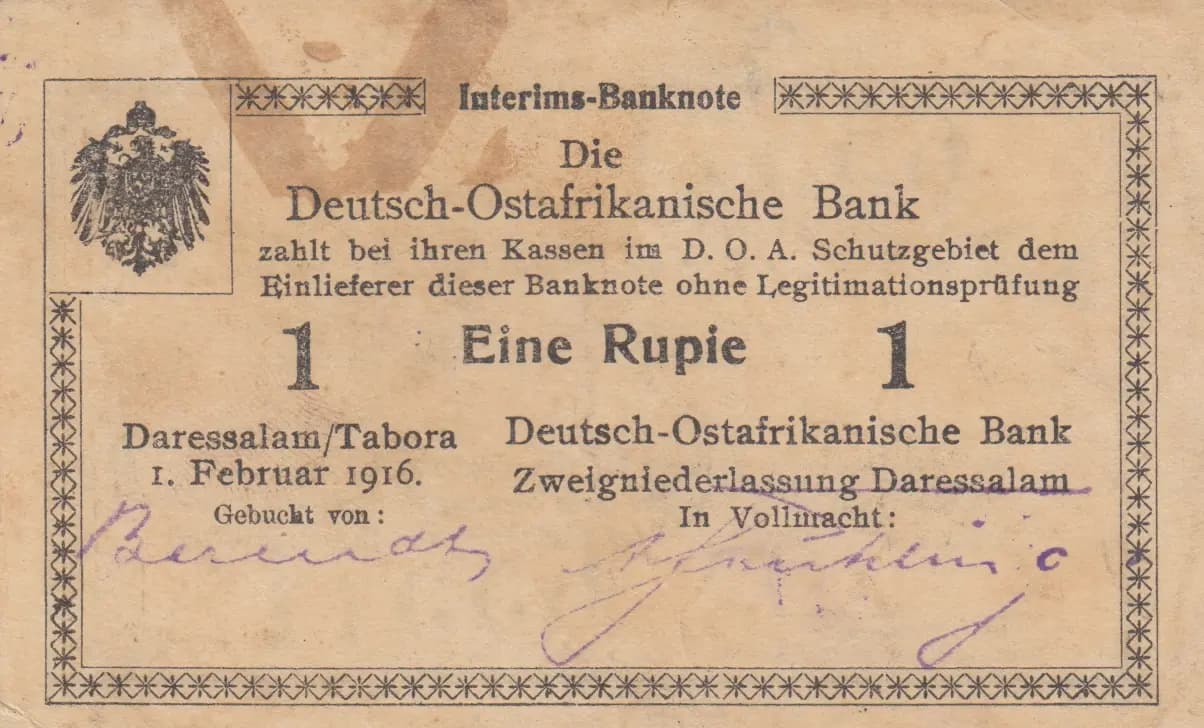
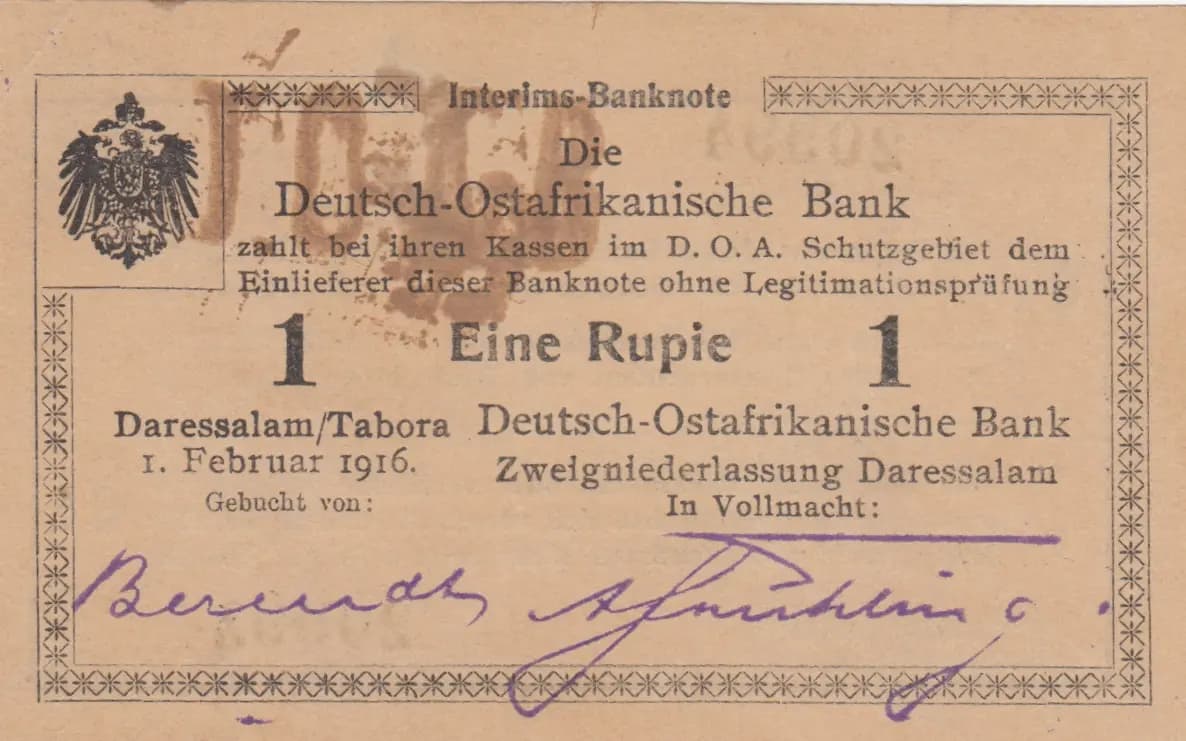
A German East African interim banknote (Interims-Banknote) issued by the Deutsch-Ostafrikanische Bank on February 1, 1916, during wartime conditions in German East Africa. The note displays typical characteristics of emergency currency from this period, featuring handwritten signatures in purple/blue ink and institutional stamps, with an Imperial German Eagle coat of arms prominently displayed on the obverse. In AU condition, this example shows expected age-related patina and foxing consistent with a note now over a century old, retaining strong legibility and the characteristic tan/beige paper coloration of the era.
Common. The 1 Rupee 1916 interim notes from the Deutsch-Ostafrikanische Bank (Pick 19) were issued in substantial quantities to address monetary needs during the final years of German colonial rule in East Africa. While interim notes are generally scarcer than regular issues, this specific denomination and type appears with reasonable frequency in the collector market. The AU condition grade indicates a well-preserved specimen, which adds value, but the note itself is not considered rare or scarce. Many examples survive in various collections, suggesting the original print run was adequate for its purpose.
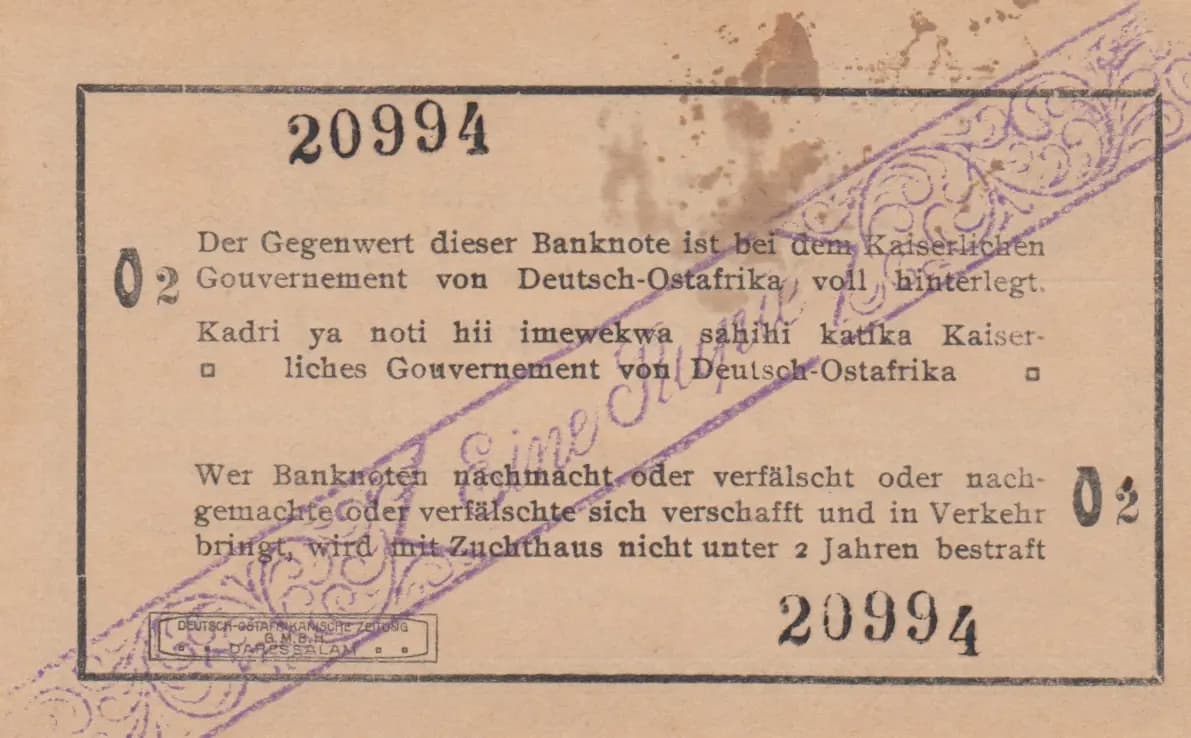
This interim banknote was issued during World War I when German East Africa faced severe monetary strain and disrupted supply lines, necessitating the creation of temporary currency solutions. The dual-language text in German and Swahili reflects the colonial administration's need to communicate with both European officials and indigenous populations in the territory. The explicit statement that the note's value was fully deposited with the Imperial Government served to assure holders of its legitimacy during a period of economic uncertainty in the German protectorate.
The obverse features the Reichsadler (Imperial German Eagle) coat of arms positioned in the upper left corner, serving as the primary heraldic identifier of German authority in the colony. The design is framed by decorative geometric borders including repeating patterns and an ornamental diamond/star pattern frame typical of early 20th-century German banknote design. Two blank signature lines labeled 'Gebucht von:' (Booked by) and 'In Vollmacht:' (By Authority of) appear in the lower section with handwritten signatures in purple/blue ink. The reverse displays the serial number 20994 in opposing corners, bilateral text in German and Swahili as a security measure, legal warnings regarding counterfeiting penalties, and an institutional stamp or seal in the lower left corner. The entire note exhibits a minimalist design consistent with emergency wartime currency, emphasizing legal text and governmental authority rather than elaborate artistic elements.
FRONT: 'Interims-Banknote' (Interim Banknote) | 'Die Deutsch-Ostafrikanische Bank' (The German East African Bank) | 'zahlt bei ihren Kassen im D.O.A. Schutzgebiet dem Einlieferer dieser Banknote ohne Legitimationsprüfung' (pays at its cashier in the D.O.A. protection territory to the depositor of this banknote without legitimation check) | '1 Eine Rupie 1' (1 One Rupee 1) | 'Daressalam/Tabora' (place of issue) | 'Deutsch-Ostafrikanische Bank Zweigniederslassung Daressalam' (German East African Bank Branch Daressalam) | '1. Februar 1916' (February 1, 1916) | 'Gebucht von:' (Booked by:) | 'In Vollmacht:' (By Authority of:) | BACK: Serial number '20994' | '02' (series designation) | 'Der Gegenwert dieser Banknote ist bei dem Kaiserlichen Gouvernement von Deutsch-Ostafrika voll hinterlegt.' (The equivalent value of this banknote is fully deposited with the Imperial Government of German East Africa.) | Swahili: 'Kadri ya noti hii imewekwa sahilii katika Kaiserliches Gouvernement von Deutsch-Ostafrika' (The value of this note is held in trust with the Imperial Government of German East Africa) | 'Wer Banknoten nachmacht oder verfälscht oder nachgemachte oder verfälschte sich verschafft und in Verkehr bringt, wird mit Zuchthaus nicht unter 2 Jahren bestraft' (Whoever counterfeits or forges banknotes or procures or puts into circulation counterfeit or forged notes will be punished with imprisonment for not less than 2 years)
Letterpress printing with additional hand-signed authorization elements. The primary text, borders, decorative elements, and serial numbers were printed using traditional letterpress/relief printing methods standard for German banknote production of the period. The handwritten signatures and institutional stamps were applied post-printing, a common practice for interim notes requiring individual authorization. The Deutsch-Ostafrikanische Bank (which operated under German colonial authority) would have utilized printing facilities available in German East Africa or contracted German security printers for this emergency issue.
Series O2 designation as noted in the collector notes. The serial number observed is 20994. This particular example features handwritten signatures in purple/blue ink by two authorized officials (names not legible in provided images), which is typical for interim banknotes of this type where individual authorization stamps and signatures varied by transaction. The February 1, 1916 date and Daressalam/Tabora dual issuing location designations are consistent with known examples of this Pick number. No major varieties (overprints, color shifts, or date variations) are apparent in this specimen.