1 rupee 1916
About This Note
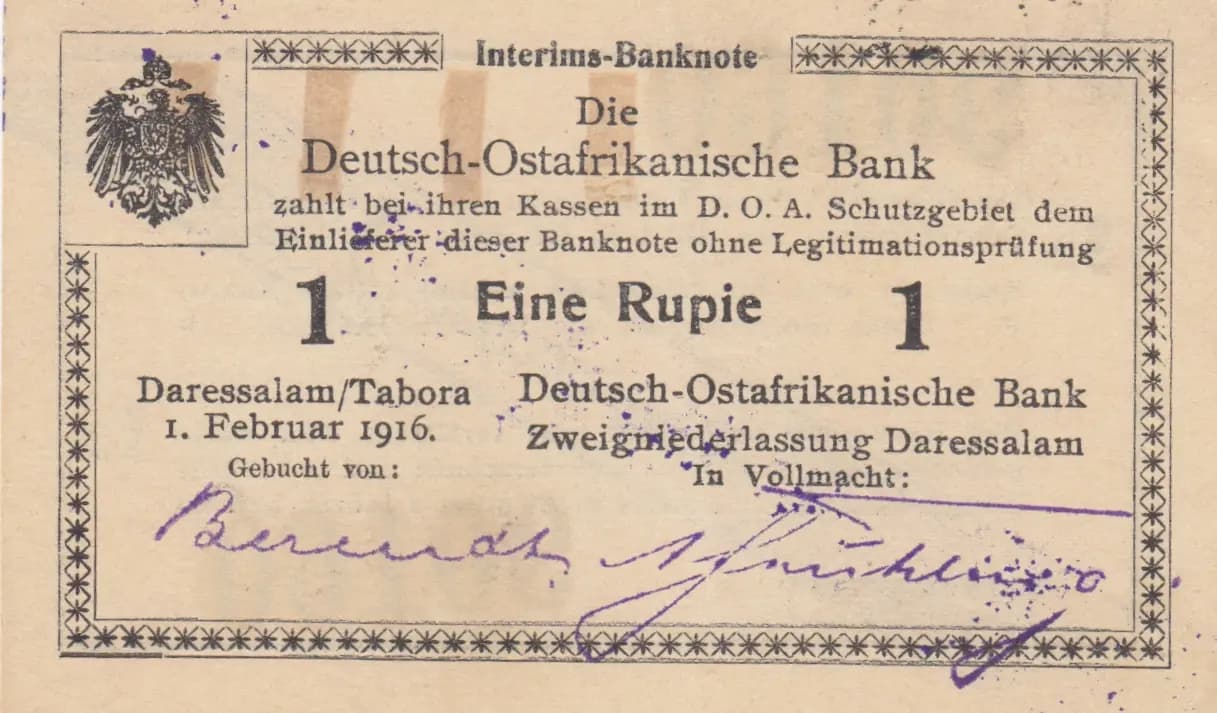
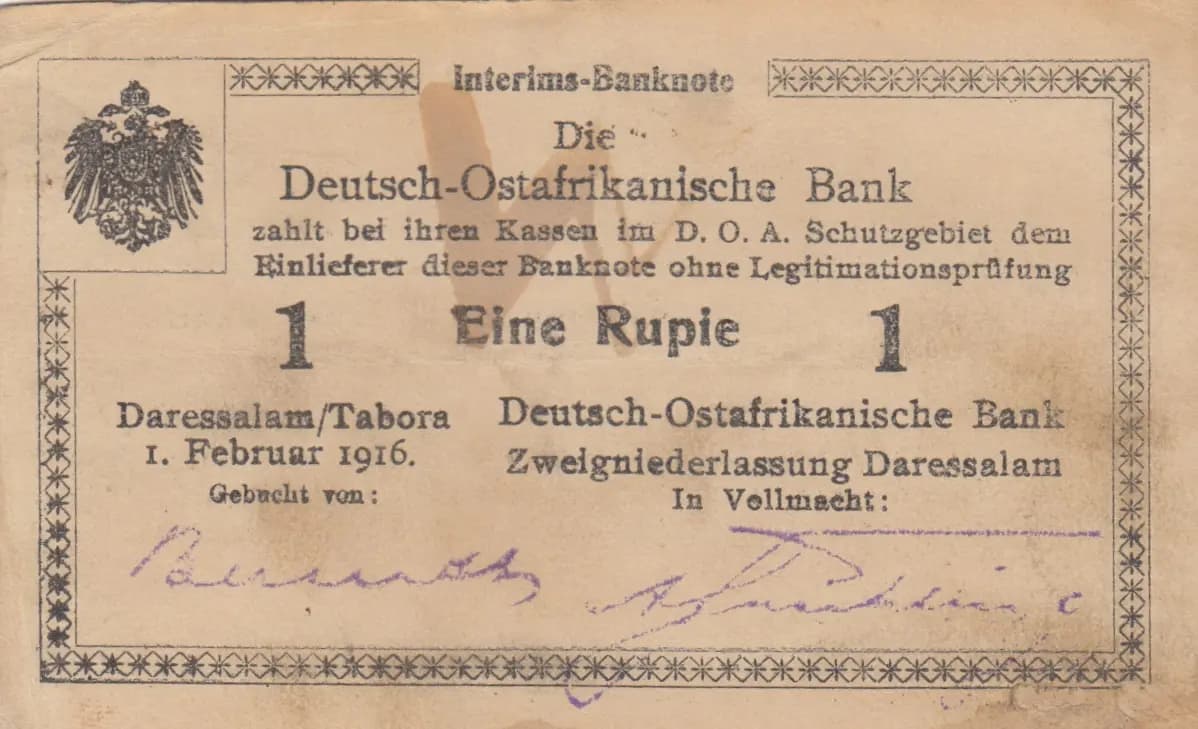
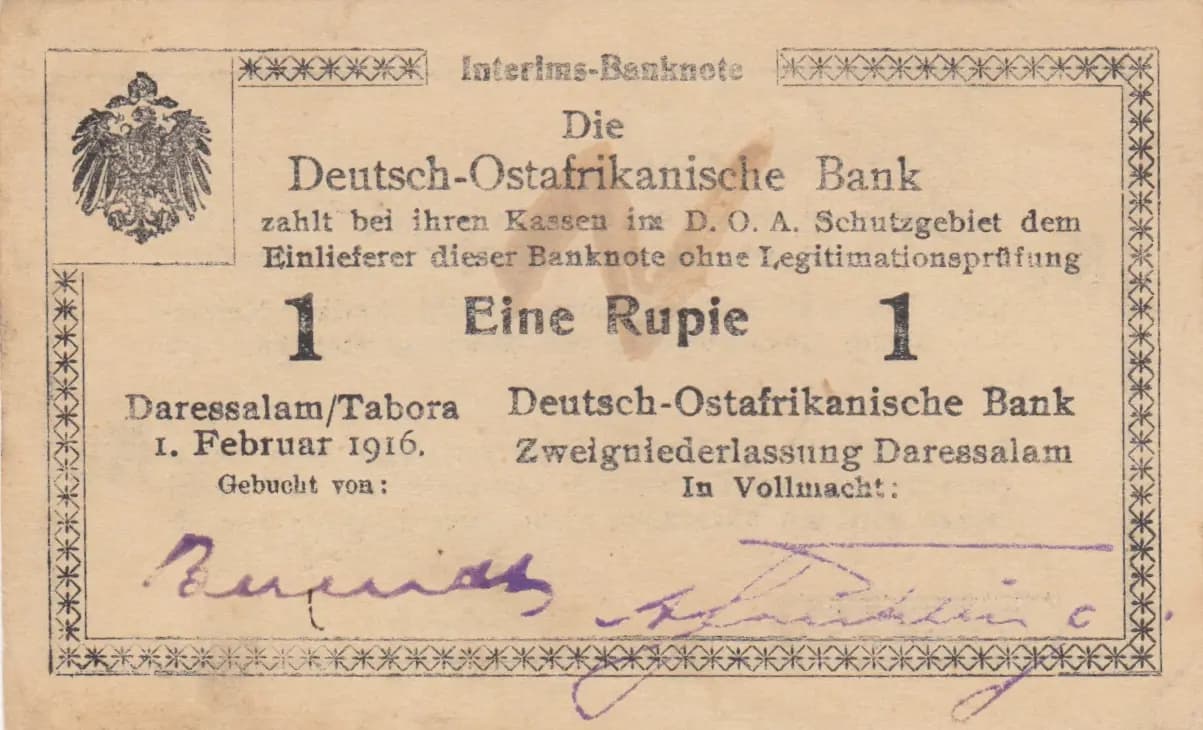
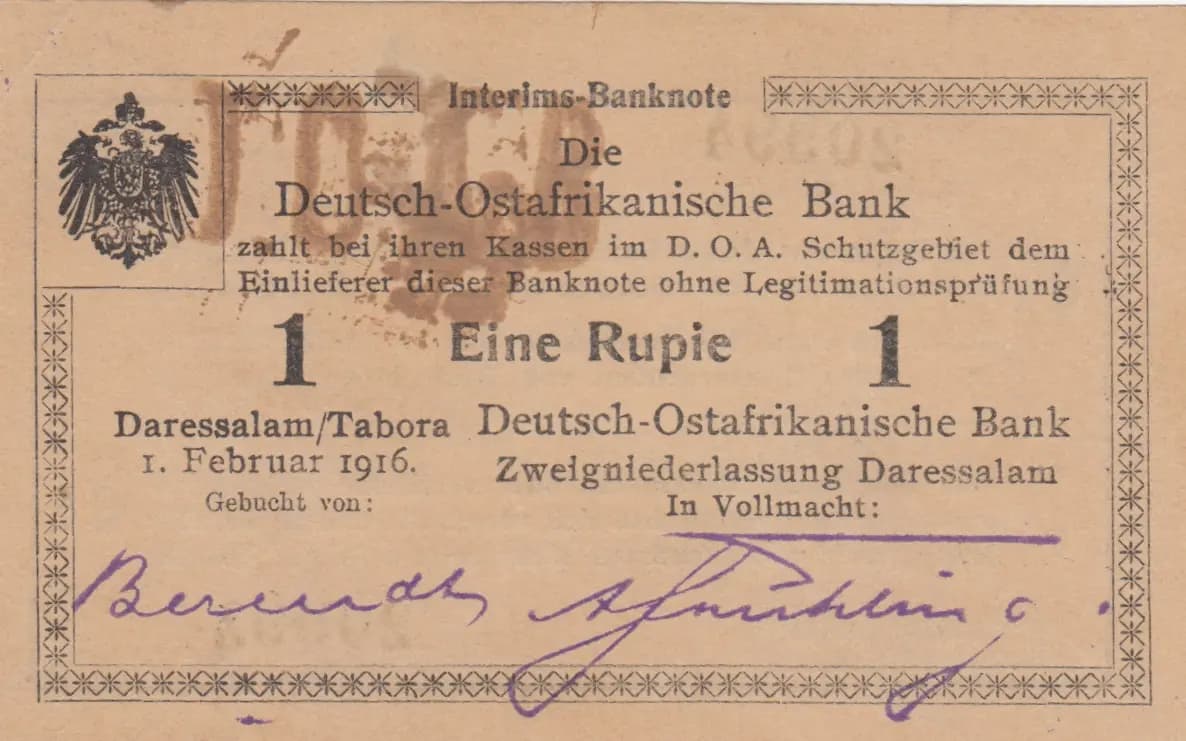
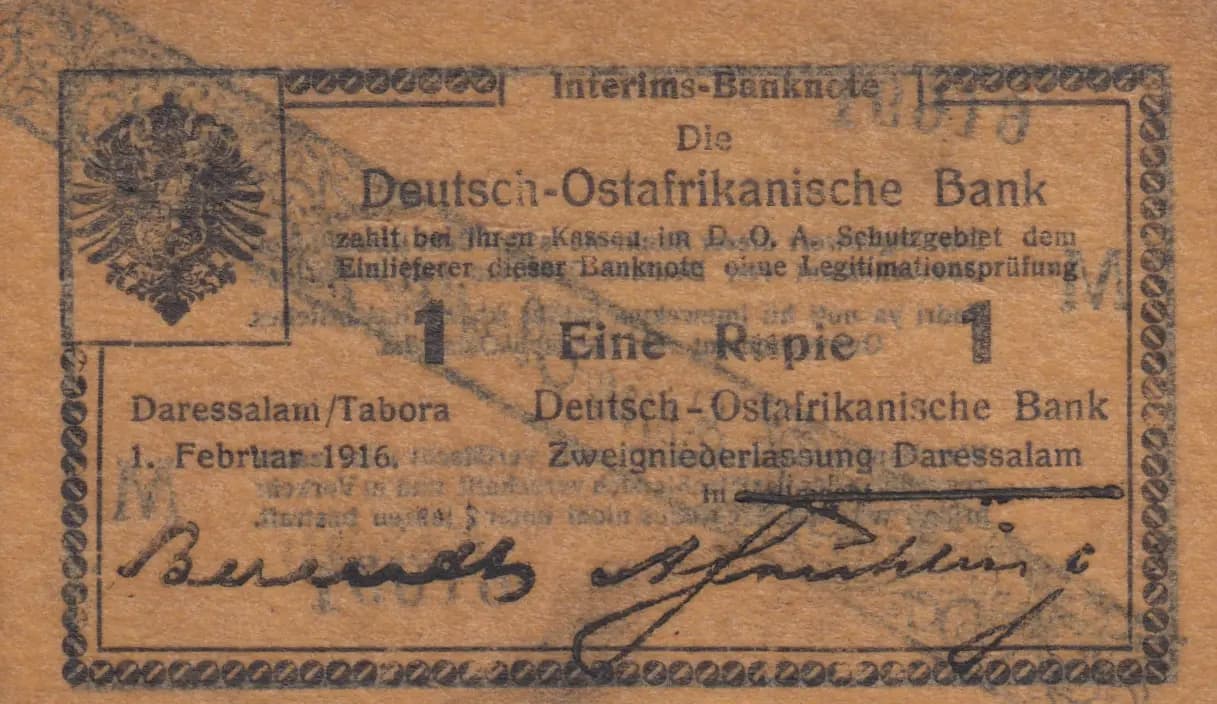
A highly interesting German East African 1 Rupee interim banknote from February 1, 1916, issued by the Deutsch-Ostafrikanische Bank during the final years of German colonial rule in Africa. The note displays excellent aged patina with tan-brown coloration and clear legibility of all text and design elements, consistent with AU condition. Notable features include the striking German Imperial Eagle (Reichsadler) coat of arms on the obverse, bilingual German-Swahili inscriptions, and a handwritten signature, making this an important artifact of colonial African monetary history.
Common. This 1 Rupee interim note from 1916 was issued in substantial quantities by the Deutsch-Ostafrikanische Bank to address currency shortages during World War I in German East Africa. The denomination (1 Rupee) and the interim nature of the issue suggest wide circulation and printing. Examples appear regularly in the collector market. AU condition examples are more desirable than lower grades, but the note itself is not scarce. The historical significance and condition rarity (AU) make individual examples collectible, but the underlying note type is common among German East African currency collectors.
This interim banknote was issued during World War I when German East Africa faced severe economic disruption and currency shortages. The note's German and Swahili inscriptions reflect the colonial administrative structure, with the Reichsadler symbolizing German imperial authority. The explicit statement that 'the value of this banknote has been made available by the German East African Kaiser Government' demonstrates the wartime financial measures taken to maintain economic function in an increasingly isolated German protectorate, ultimately ending with Germany's military defeat in the region by late 1918.
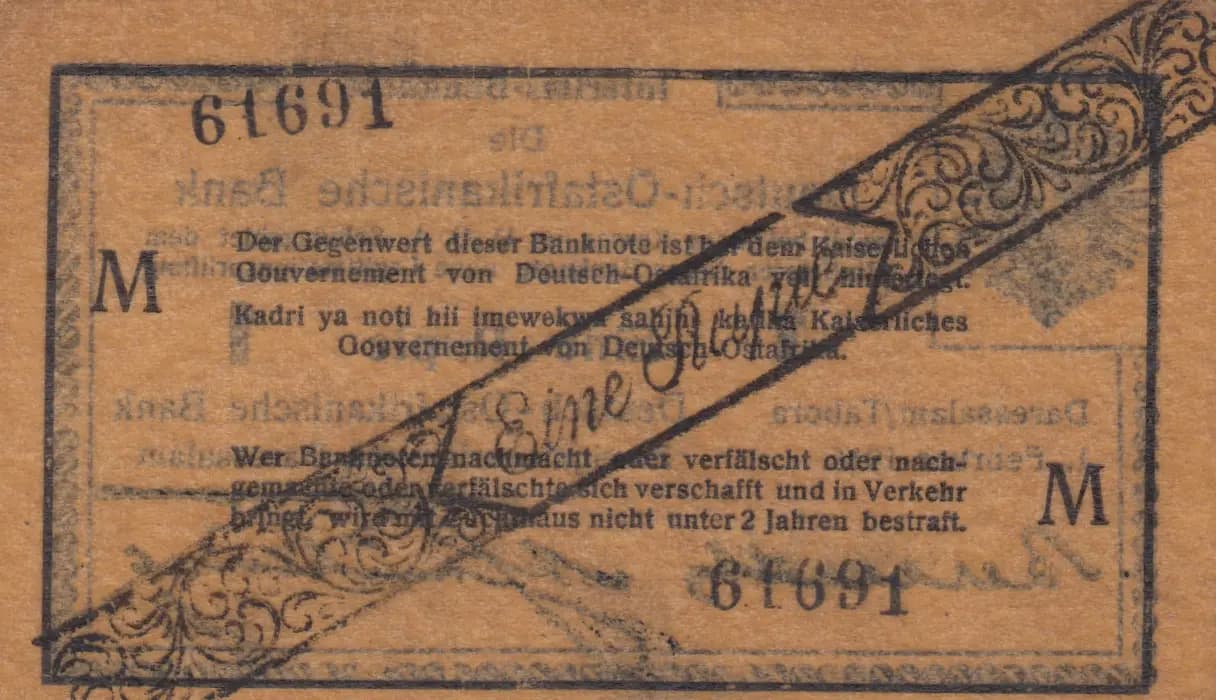
The obverse features the German Imperial Eagle (Reichsadler) coat of arms prominently displayed in a rectangular frame on the left side, symbolizing German sovereignty. The design incorporates an ornamental decorative border with repeating geometric patterns characteristic of early 20th-century German banknote design. Denomination and issuer information are centrally and right-aligned in carefully set typography. The reverse displays complementary ornamental corner designs and maintains the same decorative border framework. The 'M' denomination markers appear on both left and right sides of the reverse. A handwritten signature appears at the bottom of the obverse, typical of interim notes issued during wartime when time and resources were limited. The bilingual German-Swahili text throughout reflects the colonial administrative context.
FRONT SIDE: 'Internus-Banknote' (Interim Banknote) | 'Die Deutsch-Ostafrikanische Bank' (The German East African Bank) | 'zahlt bei ihren Kassen im D.O.A.-Schutzgebiet dem Einlieferer dieser Banknote ohne Legitimationsprüfung' (pays at its cashiers in the D.O.A. protectorate to the deliverer of this banknote without verification of legitimacy) | 'Eine Rupie' (One Rupee) | 'Deutsch-Ostafrikanische Bank' (German East African Bank) | 'Zweigniederlassung Daressalam' (Branch office Dar es Salaam) | 'Daressalam/Tabora' (Dar es Salaam/Tabora) | '1. Februar 1916' (1st February 1916). BACK SIDE: 'Der Gegenwert dieser Banknote ist hinter dem Kaiser-Gouvernement von Deutsch-Ostafrika zur Verfügung gestellt' (The value of this banknote has been made available by the German East African Kaiser Government) | 'Kadri ya noti hii imewekuwa sahihi kwa Kaisari-Serikali ya Katika Deutsch-Ostafrika' (The value of this note has been confirmed correct by the Kaiser Government in German East Africa—Swahili) | 'Wer Banknoten nachmacht oder verfälscht oder nachgemachte oder verfälschte sich verschafft und in Verkehr bringt wird mit Geldstrafe bis nicht unter 2 Jahren bestraft' (Whoever counterfeits or falsifies banknotes or procures counterfeit or falsified ones and puts them into circulation will be punished with a fine or not less than 2 years imprisonment). Serial numbers visible: 61691, BF691.
Letterpress printing on banknote paper with black ink. The crisp legibility of all text elements and the consistent impression of the ornamental borders observed in both the visual analysis and the aged patina are consistent with high-quality letterpress production typical of German banknote manufacturers of the 1916 period. The handwritten signature was added post-printing, a common practice for interim emergency issues. While the external catalog references Thomas de la Rue as a printer for related East African currency of this era, the specific printer for this Deutsch-Ostafrikanische Bank interim issue may differ; Pick catalog data should be consulted for definitive printer attribution.
This note is identified as Pick P-18a (1 Rupee, 1916). Key identifying features include: the date of '1. Februar 1916' on the obverse, the 'Zweigniederlassung Daressalam' (Dar es Salaam branch) designation, and the specific serial number BF691 paired with 61691. Variations within the P-18a designation may exist based on signature varieties (different authorized signatories) and serial number prefixes. The handwritten signature visible on this specimen represents an authorized signatory variant. Collectors should note the distinction between interim notes (Interims-Banknote) issued in 1916 and regular series notes; this is definitively an interim issue as explicitly stated in the design.