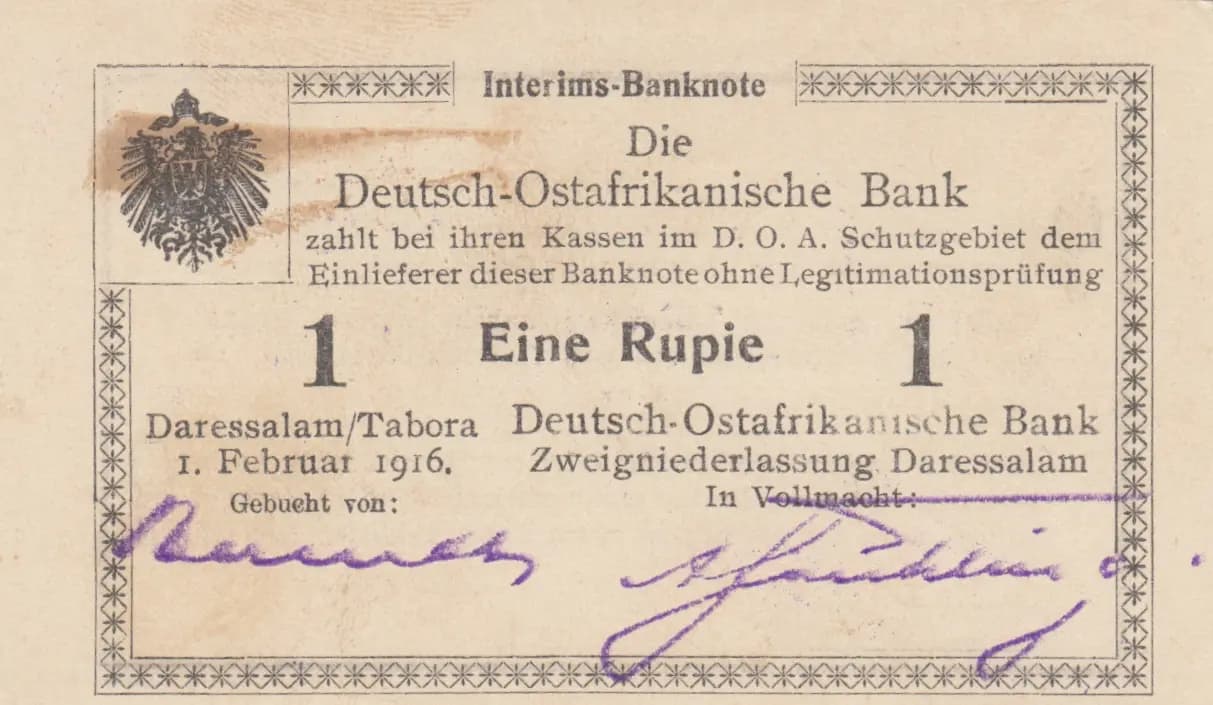
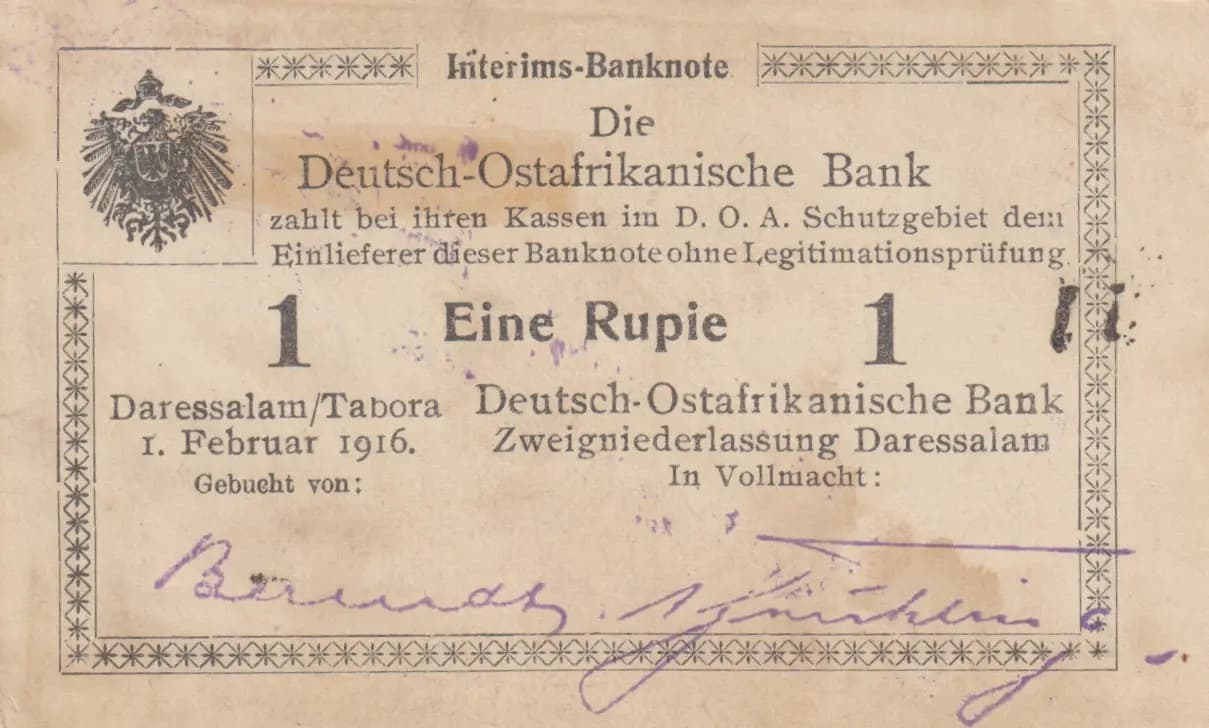
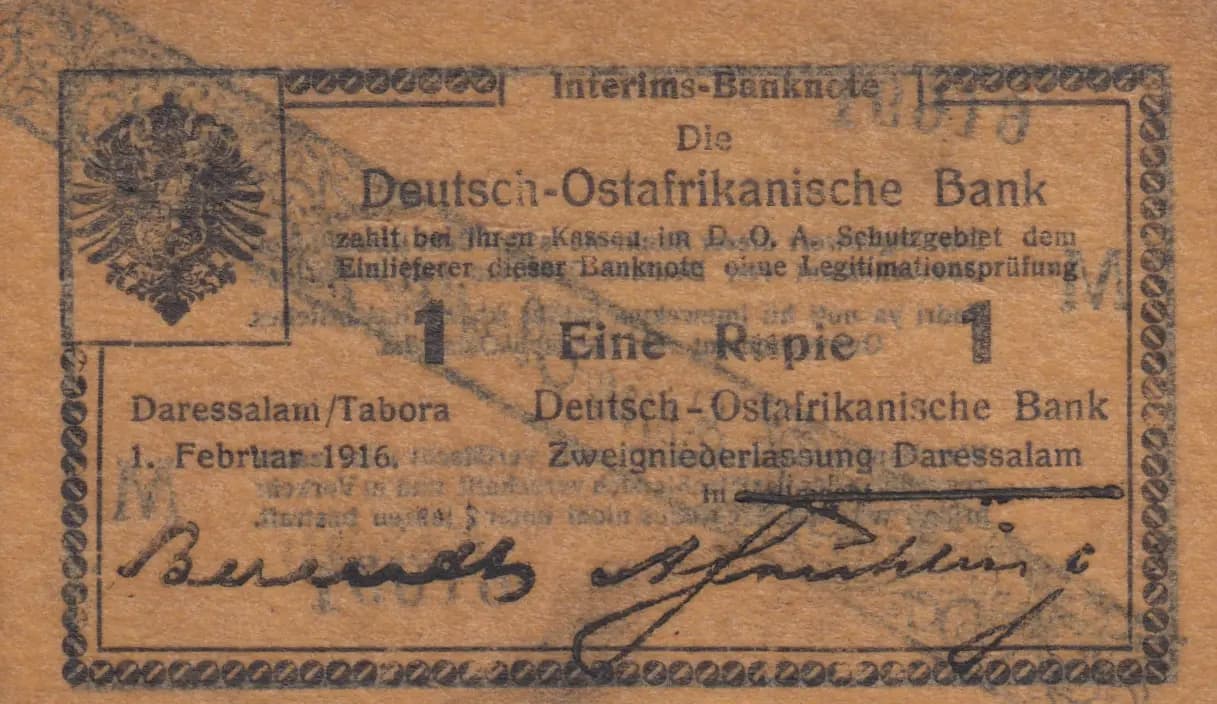
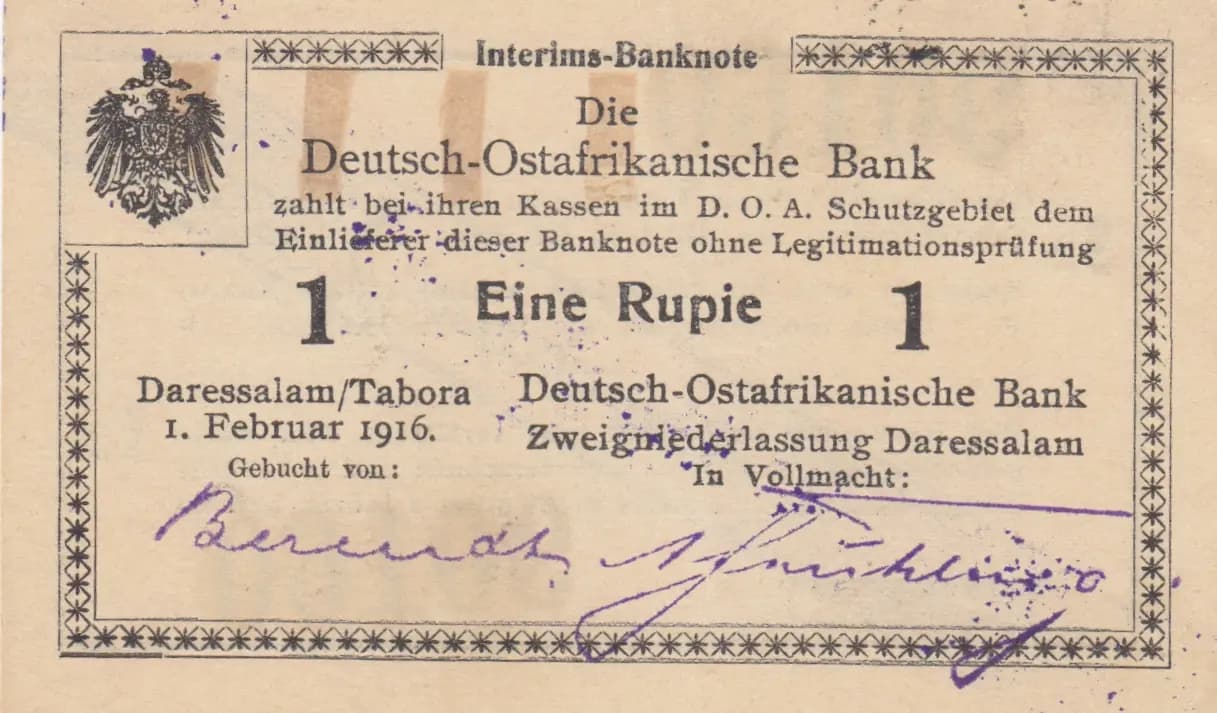
1 rupee 1916
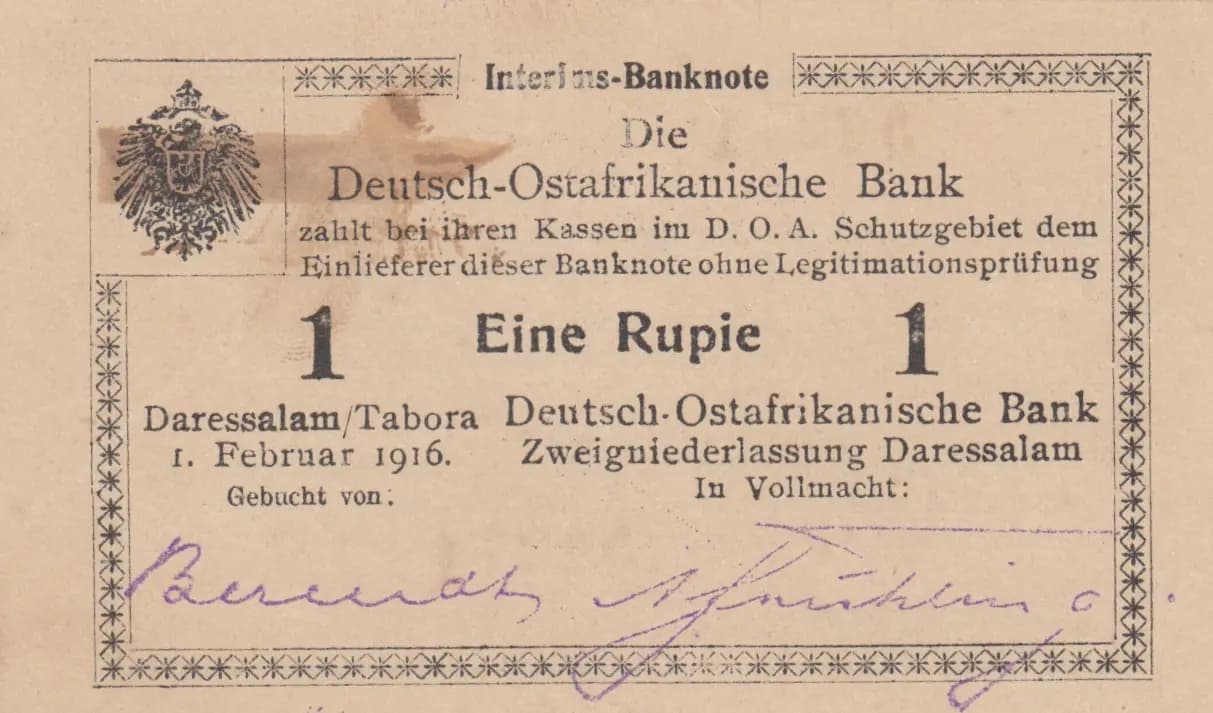
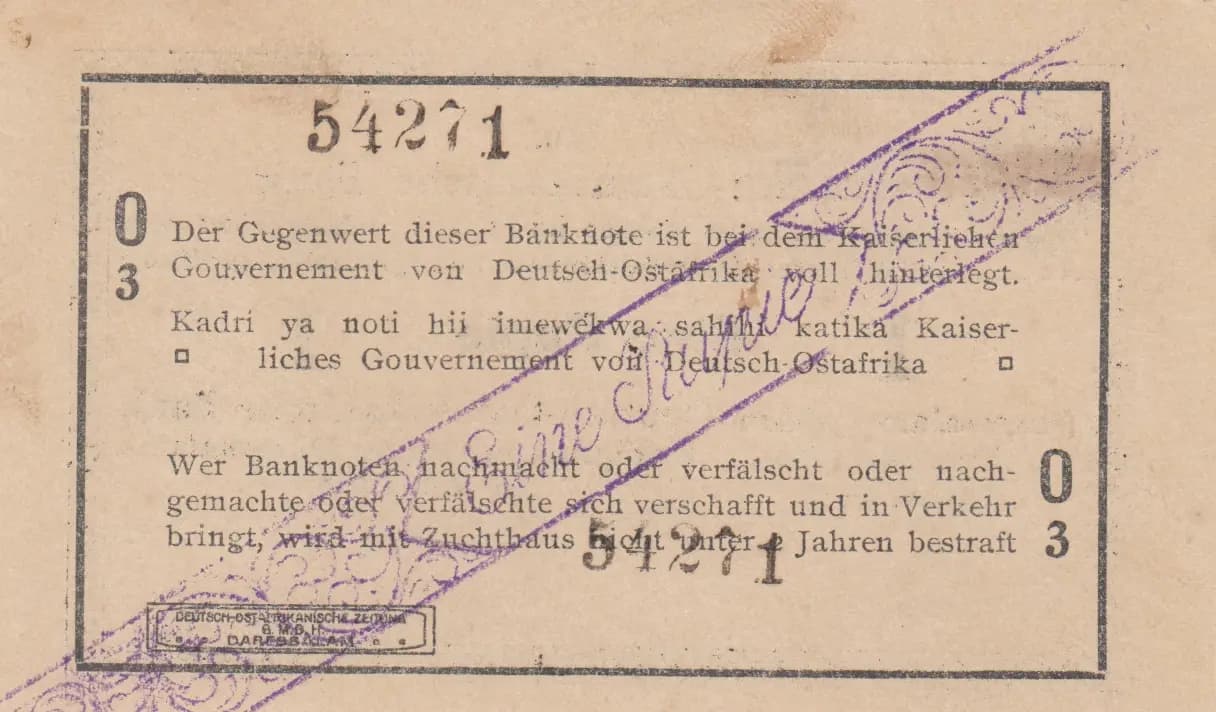
“serie O3”
About This Note
This is an Interims-Banknote (interim banknote) issued by the Deutsch-Ostafrikanische Bank on February 1, 1916, during Germany's colonial period in East Africa. The note exhibits significant age-related patina with cream/tan discoloration and foxing throughout, consistent with its AU grade and nearly 110-year age. The front features the German Imperial double-headed eagle coat of arms, while the reverse contains legal text in both German and Swahili, with handwritten signatures and official markings that suggest archival handling or official examination.
common
This interim banknote was issued during World War I when the Deutsch-Ostafrikanische Bank required emergency currency solutions in German East Africa (modern-day Tanzania). The presence of both German and Swahili inscriptions reflects the colonial administration's need to communicate with local populations in the D.O.A. (Deutsch-Ostafrikanisches Schutzgebiet) protected territory. The Imperial Government backing statement on the reverse underscores the official nature of this emergency currency, issued as Germany faced financial pressures during the First World War.
The obverse features the German Imperial coat of arms—a double-headed eagle with crown and shield—positioned on the left side, reflecting the authority of the German colonial administration. The denomination 'Eine Rupie' (One Rupee) is prominently displayed, indicating the currency's value in the East African rupee system adopted in the territory. The note is surrounded by decorative borders with repeating cross/star patterns and ornamental frames. The reverse contains extensive legal and administrative text in both German and Swahili, with an official bank stamp/seal at the bottom left. Handwritten signatures in purple/blue ink appear on both sides, indicating authorized officials who approved the note's issue. The serial number '54271' with series designation 'O3' are printed on the reverse. The overall design is utilitarian, reflecting the emergency nature of interim currency rather than the more elaborate designs typical of regular banknote issues.
FRONT: 'Interims-Banknote' (Interim Banknote) | 'Die Deutsch-Ostafrikanische Bank' (The German East African Bank) | 'zahlt bei ihren Kassen im D. O. A. Schutzgebiet dem Einlieferer dieser Banknote ohne Legitimationsprüfung' (pays at its cashiers in the D.O.A. protected territory to the presenter of this banknote without legitimacy verification) | 'Eine Rupie' (One Rupee) | 'Daressalam/Tabora Deutsch-Ostafrikanische Bank' (Daressalam/Tabora German East African Bank) | '1. Februar 1916' (1st February 1916) | 'Zweigniederslassung Daressalam' (Branch Office Daressalam) | Handwritten signatures 'Berndt, Schmädler & C.' BACK: Serial number '54271' | '03' (series designation) | 'Der Gegenwert dieser Banknote ist bei dem Kaiserlieher Gouvernement von Deutsch-Ostafrika woll hinterlegt.' (The value of this banknote is properly deposited with the Imperial Government of German East Africa.) | Swahili inscription: 'Kadri ya noti hii imewekwa sahihi katika Kaiserliches Gouvernement von Deutsch-Osfrika' (The value of this note has been properly placed with the Imperial Government of German East Africa) | 'Wer Banknoten nachmacht oder verfälscht oder nachgemachte oder verfälschte sich verschafft und in Verkehr bringt, wird mit Zuchthaus bist unter 4 Jahren bestraft' (Whoever counterfeits or forges banknotes or procures counterfeit or forged notes and brings them into circulation shall be punished with imprisonment for up to 4 years)
The note was produced using letterpress printing, evidenced by the crisp impression of text and the decorative border elements visible throughout. The German and Swahili text, as well as the ornamental frames, show the characteristic relief printing associated with early 20th-century banknote production. The handwritten signatures were added post-printing in manuscript form using ink, a common practice for authorization on interim notes. The printer information indicates 'Berndt, Schmädler & C.' handled the printing, though this may refer to local production arrangements within the D.O.A. administration.
This note is identified as Pick-20a from series O3 (as noted in catalog data), with serial number 54271. The series designation 'O3' visible on the reverse indicates this is from a specific printing series. The February 1, 1916 date from Daressalam/Tabora identifies this as part of the early interim issue. Known varieties of this Pick number may include different series designations and signature combinations; this example represents the O3 series variant. The handwritten authorization signatures (Berndt, Schmädler & C.) may vary between notes depending on which official signed the particular batch.