1 rupee 1916
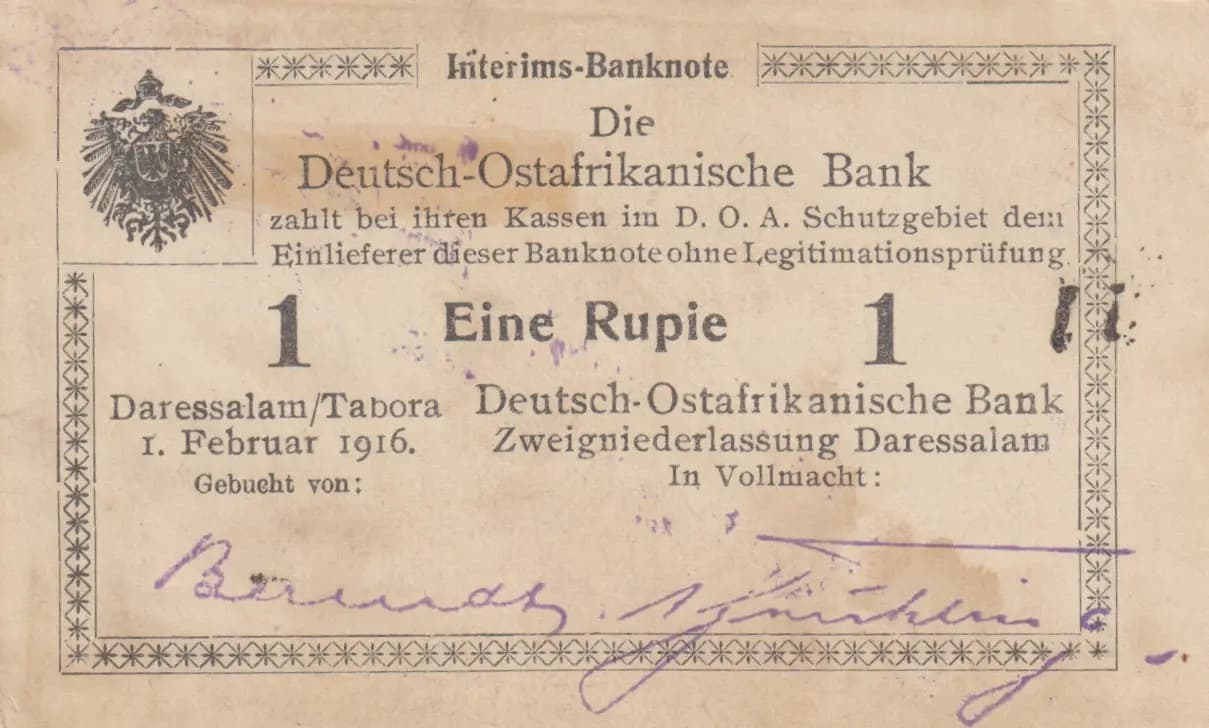
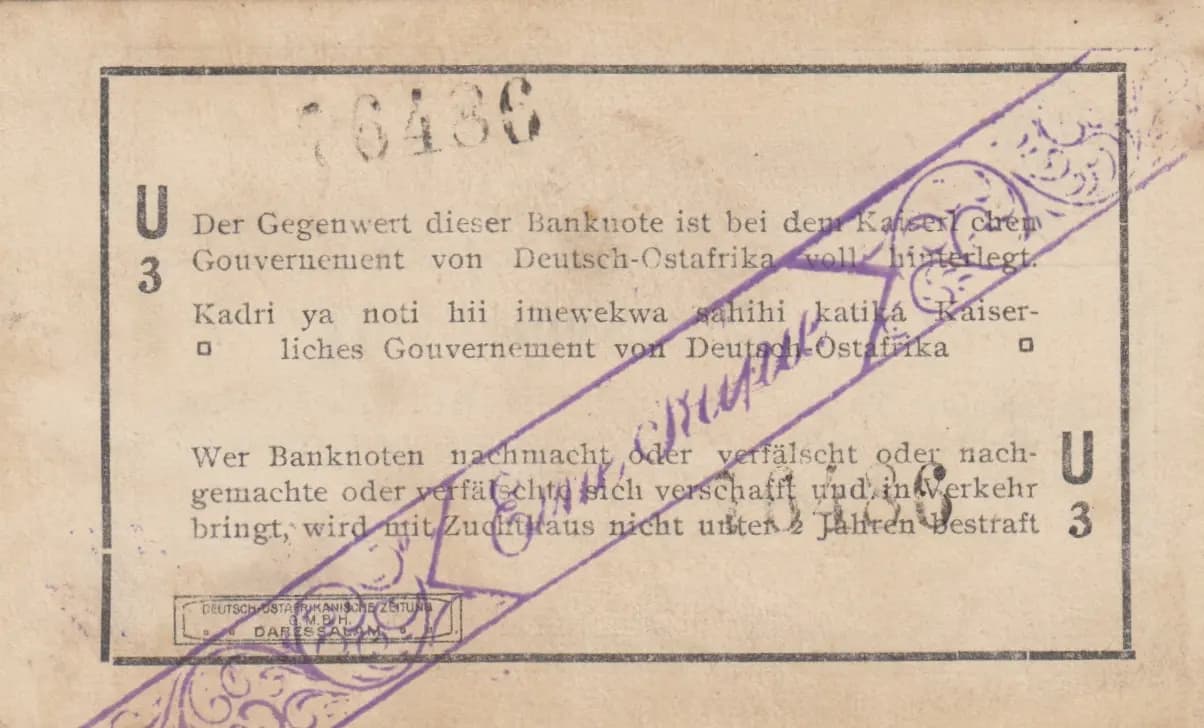
“serie U3”
About This Note
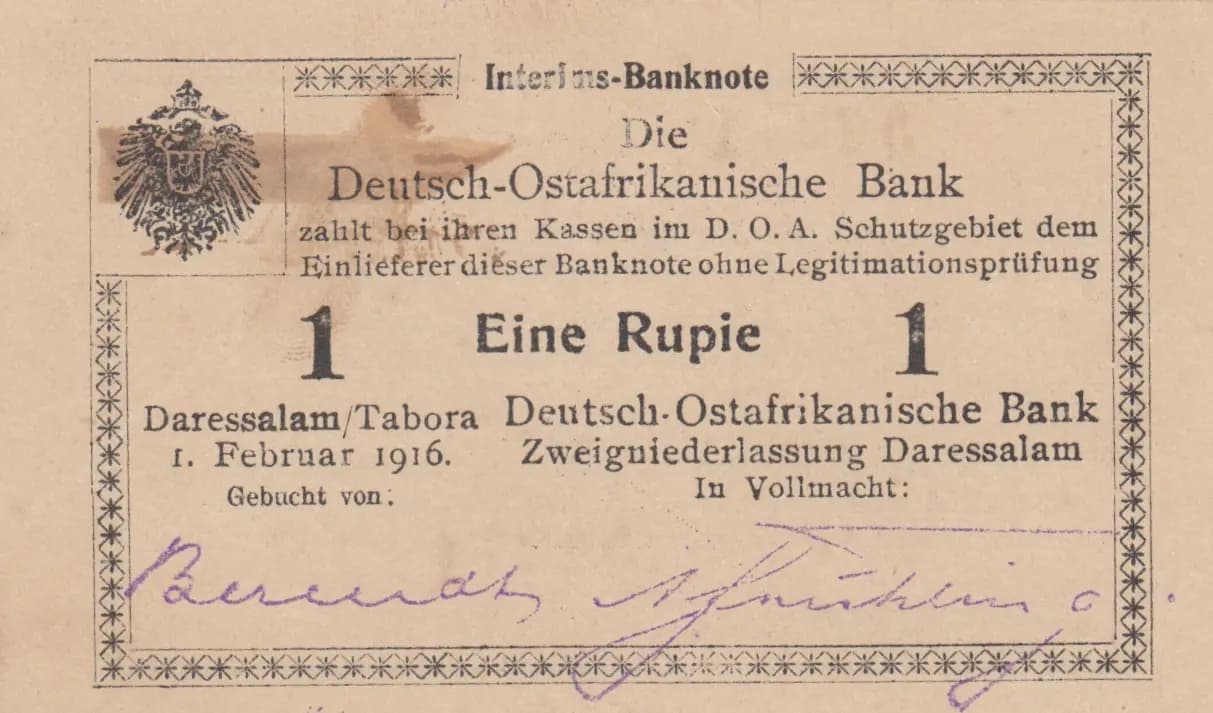
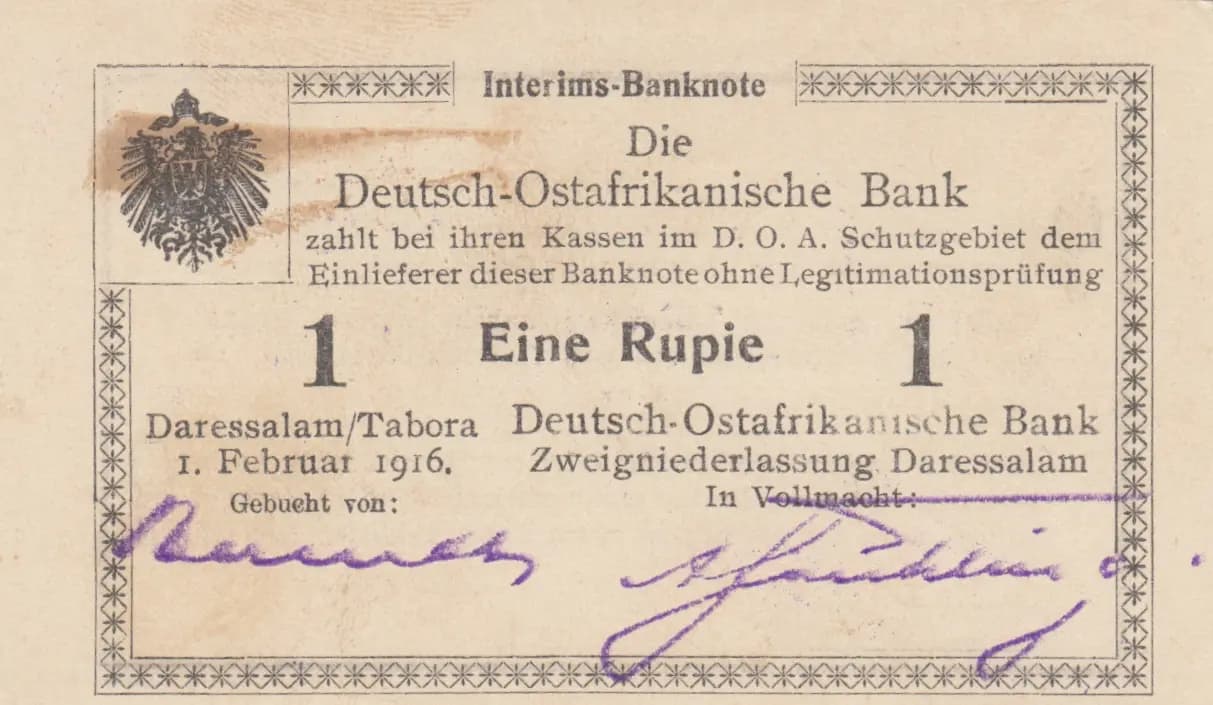
An exceptional example of a 1916 interim banknote (Interims-Banknote) issued by the Deutsch-Ostafrikanische Bank during German East Africa's final years of colonial rule. The note is presented in AU condition with visible period annotations in purple/violet ink and characteristic aging patina on tan/beige paper. This historical emergency currency represents a fascinating numismatic artifact from a short-lived colonial territory, featuring bilingual German-Swahili text and bearing the distinctive Serie U3 designation noted by collectors.
Common. While German East African banknotes are historically significant, interim banknotes from 1916 of the Deutsch-Ostafrikanische Bank were produced in substantial quantities to facilitate wartime commerce. The 1 Rupie denomination was the most frequently circulated value in emergency currency series. The AU condition grade and Serie U3 designation do not represent scarce varieties. These notes, though historically important and increasingly sought by collectors of colonial currency, do not command premium prices indicating rarity. Numerous examples have survived due to their thick paper construction and the historical preservation efforts by collectors interested in German colonial numismatics.
This interim banknote was issued on February 1, 1916, during the final stages of German colonial administration in East Africa, as World War I severely disrupted normal banking operations. The dual language presentation (German and Swahili) reflects the colonial administrative structure, while the Imperial German coat of arms and references to the Kaiser's government underscore the Reich's direct sovereignty over the D.O.A. (Deutsch-Ostafrikanische Afrika) protection territory. The very existence of emergency currency such as this interim note demonstrates the economic strain and isolation experienced by German East Africa during the war years, preceding the territory's loss to Allied forces by 1918.
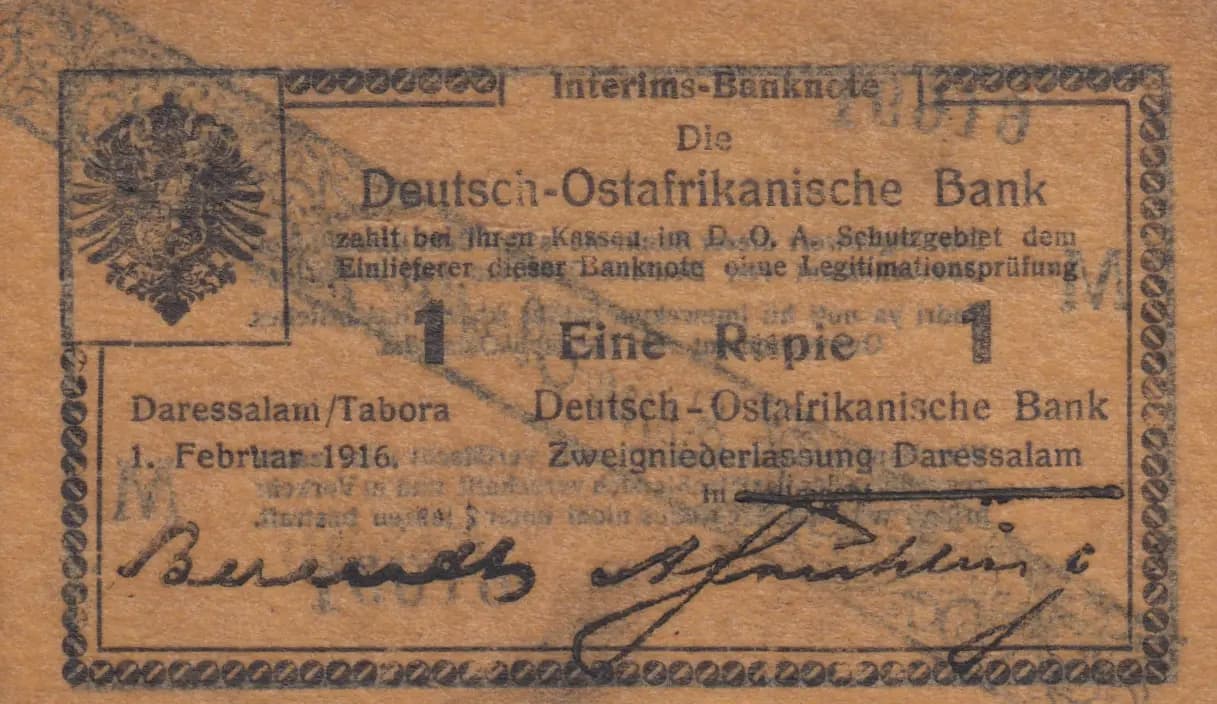
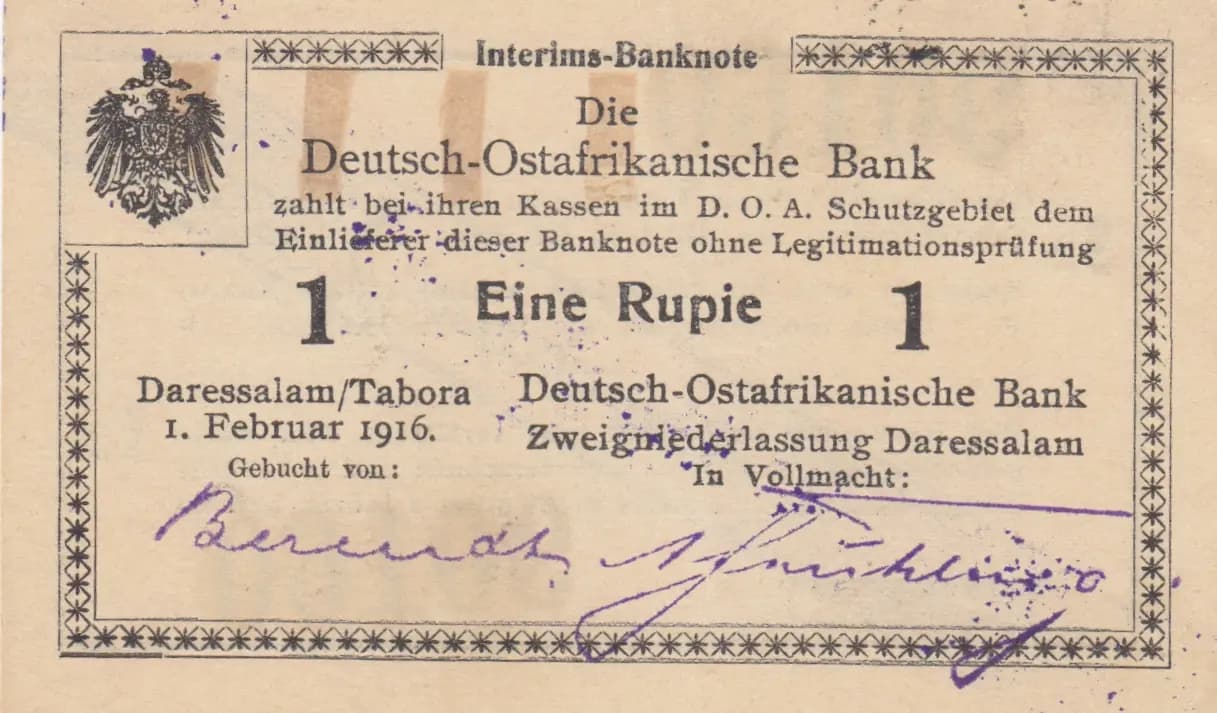
The banknote features the Imperial German double-headed eagle coat of arms with crown and ornamental shield prominently displayed in the upper left corner of the obverse, symbolizing imperial authority. The denomination is stated in both numerical form ('1') and written German ('Eine Rupie'), reflecting the colonial currency system of German East Africa which used the rupie as its standard monetary unit. The reverse contains substantial legal text in two languages—German and Swahili—establishing the note's validity and warning against counterfeiting, with a printer's mark or stamp visible at the bottom center. The note is printed in black ink on tan/beige paper with purple/violet ink used for administrative annotations, processing marks, and cancellation stripes that cross the document diagonally on the reverse side. Handwritten signatures appear on the obverse, indicating authorized personnel. The bilingual presentation and administrative markings throughout reflect the practical necessities of German colonial governance in East Africa during wartime conditions.
FRONT: 'Interims-Banknote' (Interim banknote) | 'Die Deutsch-Ostafrikanische Bank' (The German East African Bank) | 'zahlt bei ihren Kassen im D.O.A. Schutzgebiet dem Einlieferer dieser Banknote ohne Legitimationsprüfung' (pays at its counters in the D.O.A. protection territory to the deliverer of this banknote without examination of legitimation) | 'Eine Rupie' (One Rupie) | Denomination: '1' | 'Daressalam/Tabora' (place of issue) | '1. Februar 1916' (1st February 1916) | 'Gebucht von:' (Booked by:) | 'Deutsch-Ostafrikanische Bank Zweigniederlassung Daressalam' (German East African Bank Branch Daressalam) | 'In Vollmacht:' (In authority:) | BACK: 'U 3' (series designation) | 'Der Gegenwert dieser Banknote ist bei dem Kassel über Gouvernement von Deutsch-Ostafrika wohl hinterlegt.' (The value of this banknote is well deposited at the counter at the Government of German East Africa.) | 'Kadri ya noti hii jimewekwa salihi kati'ka Kaiser-liches Gouvernement von Deutsch-Ostafrika' (Swahili: The value of this note is well deposited with the Imperial Government of German East Africa) | 'Wer Banknoten nachmacht oder verfälscht oder nachgemachte oder verfälschte sich verschafft und inwerkehr bringt, wird mit Zuchthaus nicht unter 2 Jahren Bestraft' (Whoever counterfeits or forges banknotes or obtains counterfeit or forged ones and puts them into circulation will be punished with imprisonment of not less than 2 years) | 'DEUTSCH-OSTAFRIKANISCHE BANK DARESSALAM' (German East African Bank Daressalam)
This interim banknote was produced using letterpress printing, evidenced by the crisp black ink impressions characteristic of early 20th-century banknote production. The primary text, coat of arms, and denomination numerals show the uniform pressure and clean edges typical of relief printing. The purple/violet ink used for administrative annotations and processing marks was applied separately, likely by hand or through secondary stamping operations after the main printing run. The printer for this series is not definitively identified in the visual analysis, but production would have been handled by the Deutsch-Ostafrikanische Bank's printing facilities or contracted German security printers capable of banknote production during the colonial period.
This note is cataloged as Pick 20a and bears the series designation 'U 3' as noted on the reverse side. The series letter 'U' combined with the numeral '3' represents a specific printing batch of the 1916 interim series. The date of issue is fixed as 1. Februar 1916 (1st February 1916), with dual issuance locations cited as Daressalam/Tabora. Collector notes specifically reference 'serie U3,' confirming this as a documented variety within the interim banknote series. The handwritten signatures present variations that may indicate different authorized signatories for different branches or time periods within the series, though specific signature varieties would require comparison with other examples to definitively establish.