1 rupee 1916
“serie W2”
About This Note
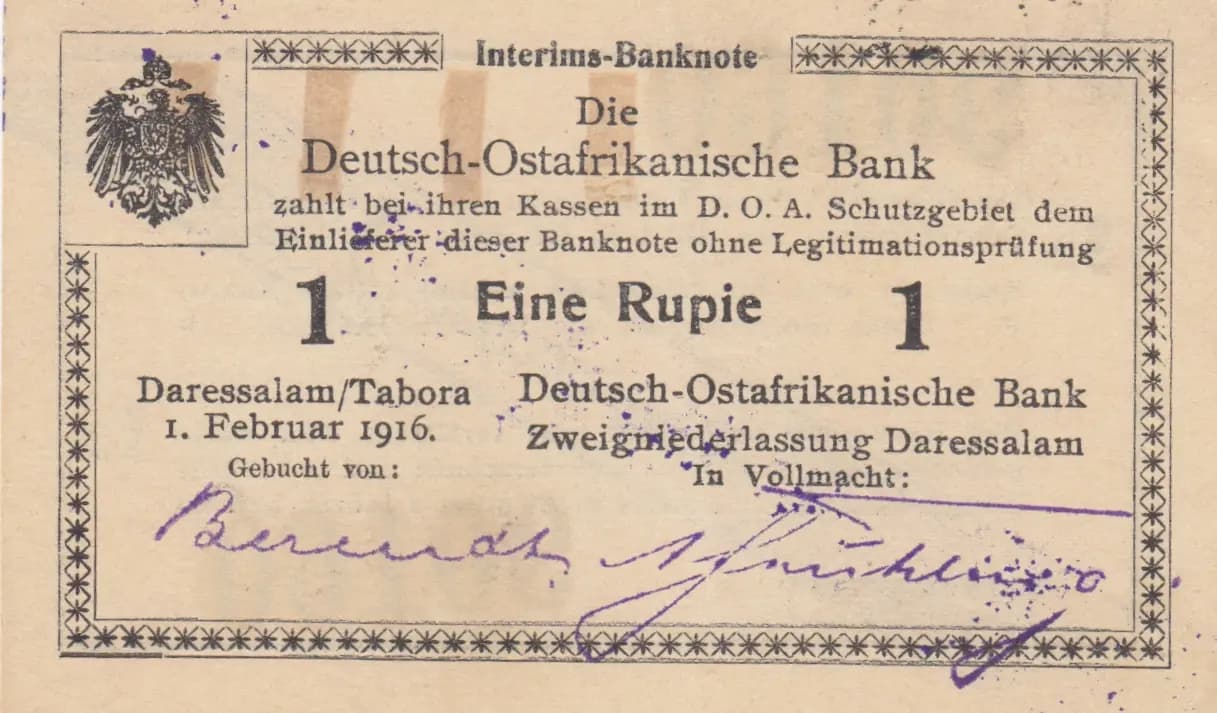
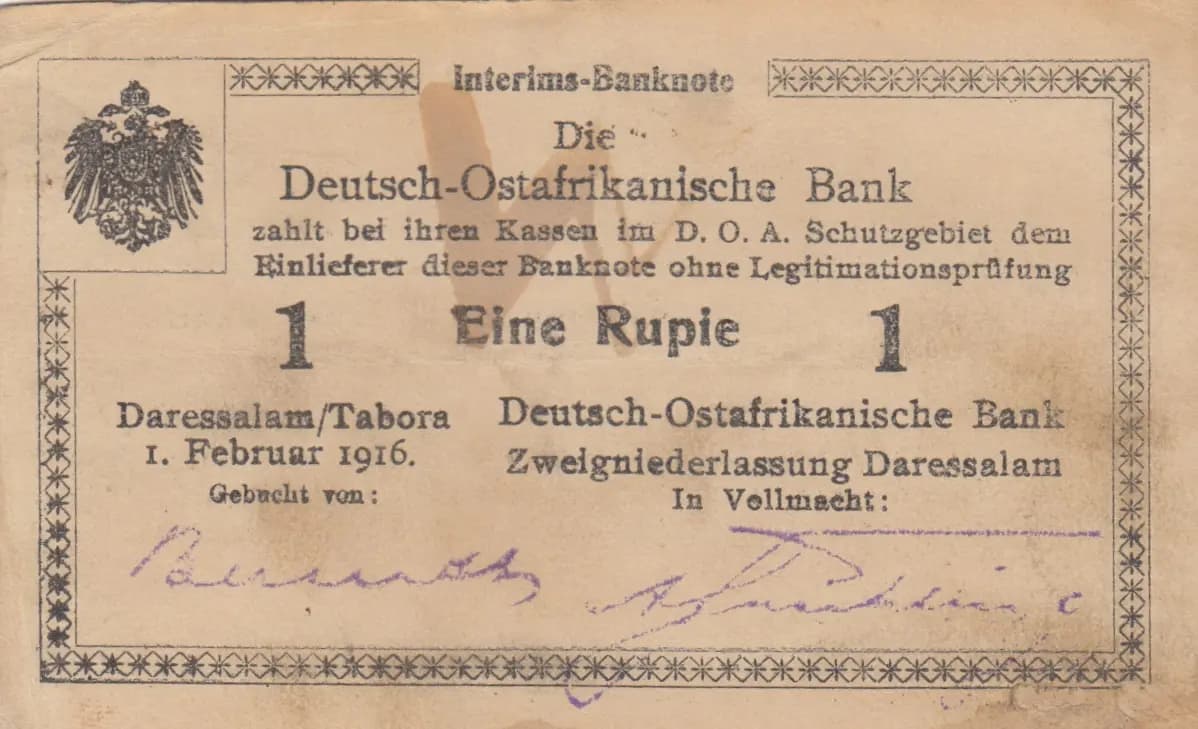
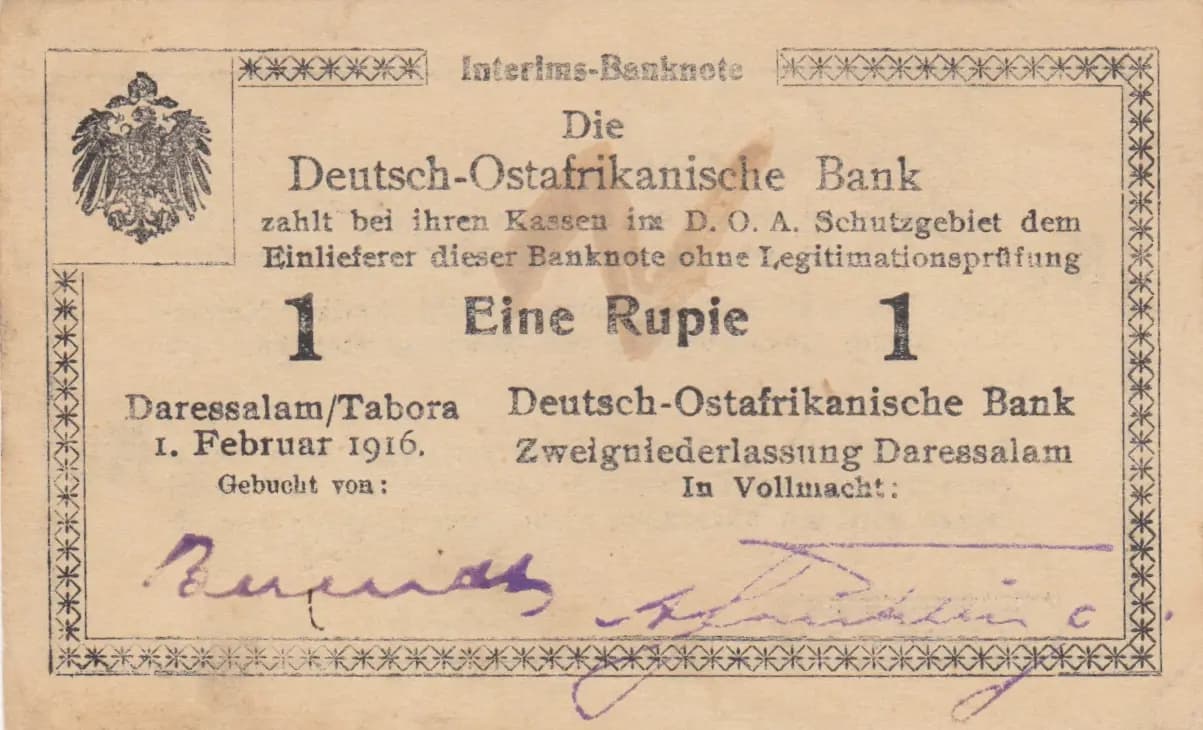
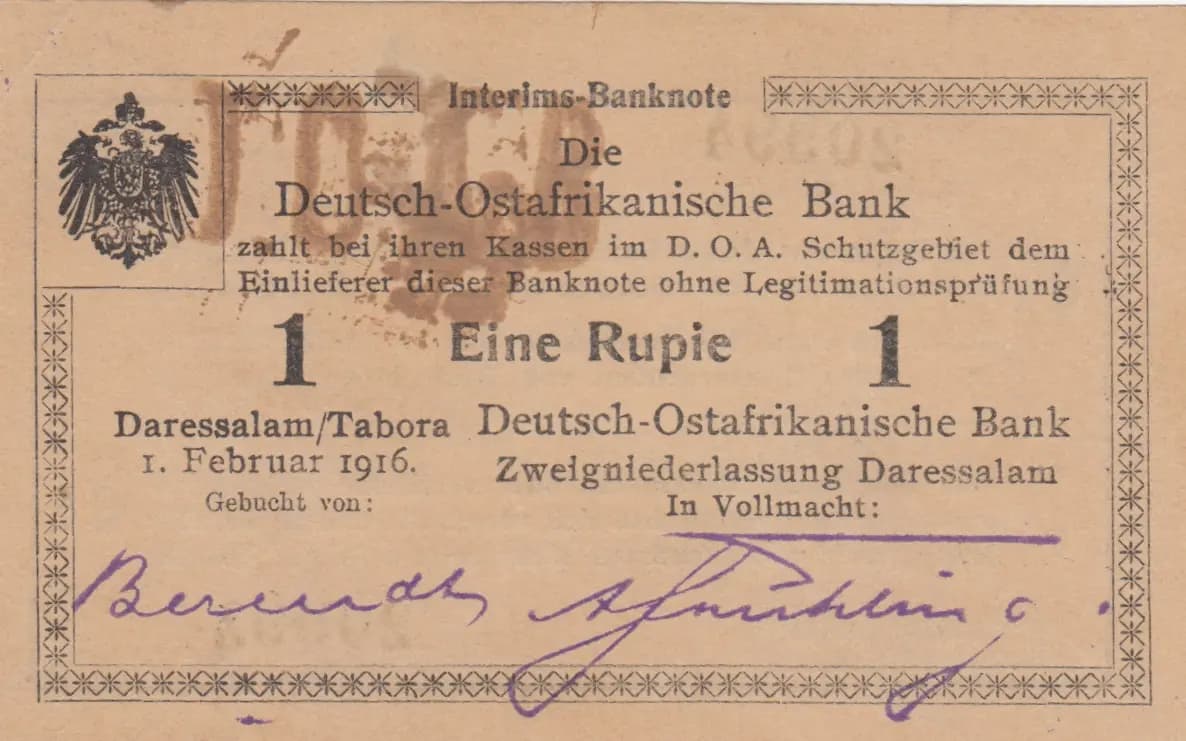
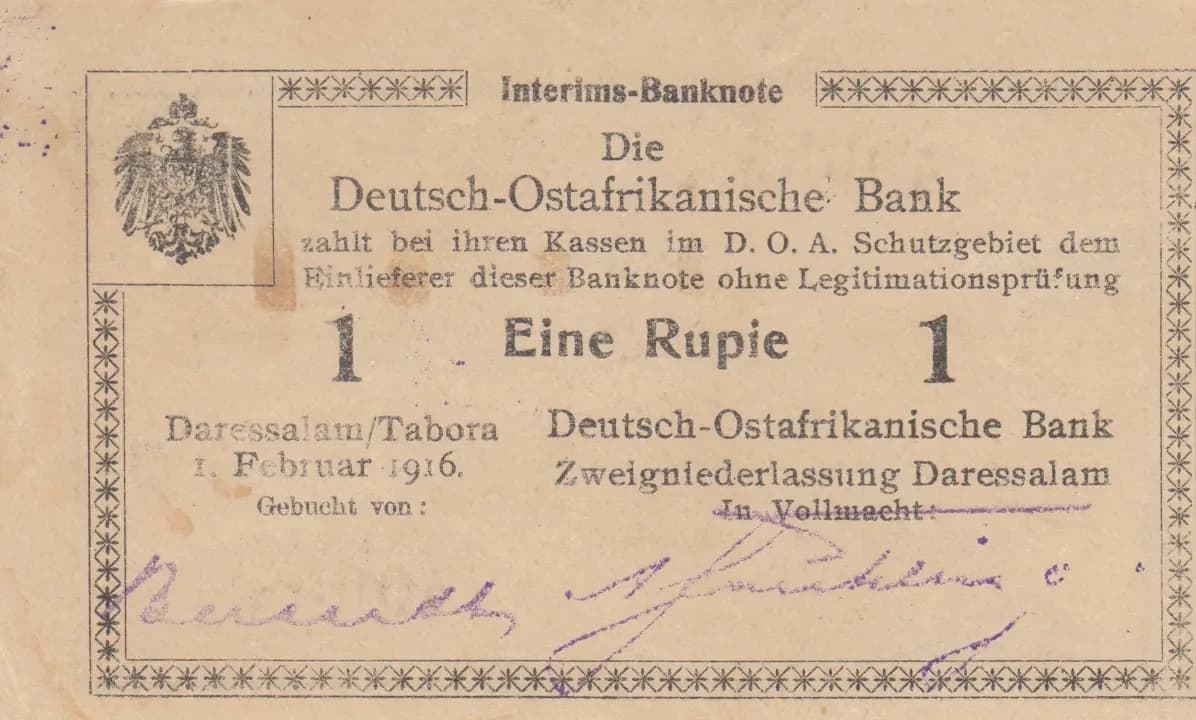
This is an interim banknote (Interims-Banknote) issued by the Deutsch-Ostafrikanische Bank on February 1, 1916, during the final years of German colonial rule in East Africa. The note exhibits excellent AU condition with a cream-colored patina, purple handwritten signatures, and a serial number 49655. The German Imperial double-headed eagle coat of arms dominates the design, making this a historically significant artifact of German East African currency during World War I.
Common. The Deutsch-Ostafrikanische Bank issued interim banknotes in relatively large quantities during the final years of German East Africa (1916-1918) to meet emergency currency demands during World War I. While scarce in pristine condition today due to age and handling, these interim notes were produced in sufficient numbers that they remain common in the collector market. AU condition examples are more desirable but not exceptionally rare.
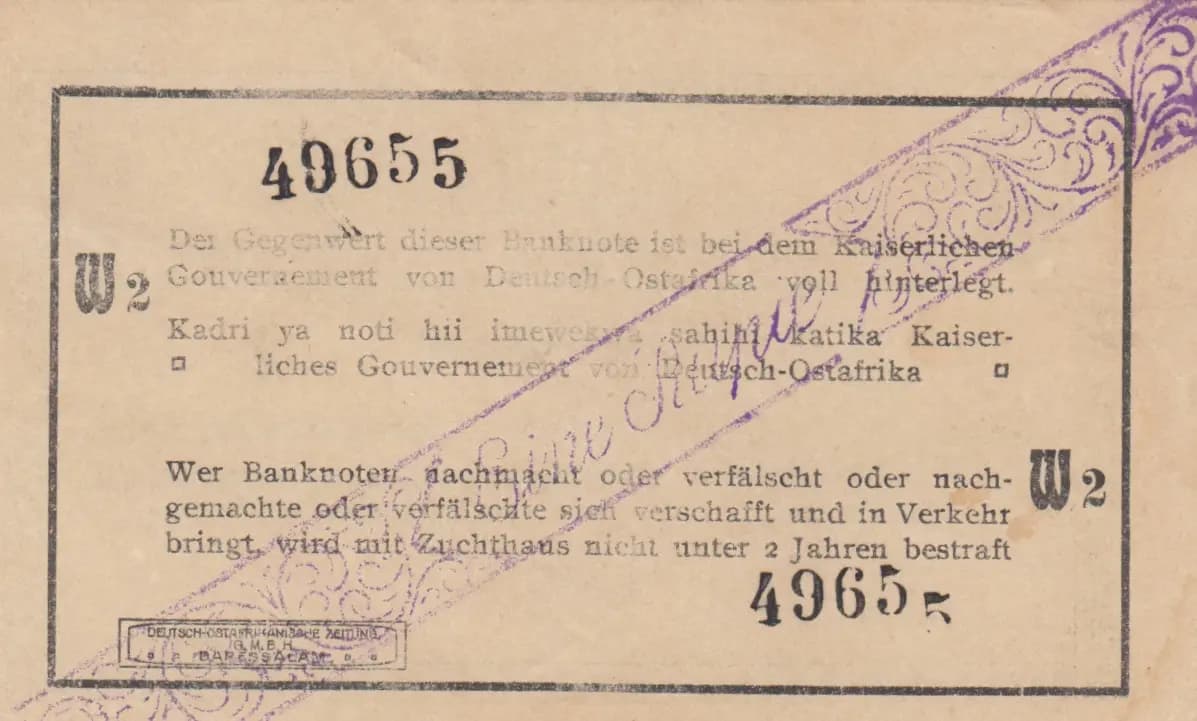
Issued during the collapse of German colonial authority in East Africa during World War I, this interim banknote represents emergency currency measures taken by the Deutsch-Ostafrikanische Bank. The note's bilingual German-Swahili inscriptions reflect the colonial administration's need to communicate with both German officials and the local population. The explicit statement that the note's value was fully deposited with the Imperial Government of German East Africa underscores the wartime currency crisis and the bank's attempt to maintain confidence in paper money during military defeat.
The note features a classical colonial German design with the German Imperial coat of arms—a double-headed eagle with crown—prominently positioned in the upper left corner. The denomination 'Eine Rupie' (One Rupee) appears in the center with the numeral '1' displayed. The design utilizes decorative border patterns composed of repeating star or asterisk symbols in a geometric arrangement. The front side includes handwritten signatures and administrative markings in purple/violet ink, typical of interim banknotes that required manual authorization. The reverse side contains extensive legal text regarding counterfeiting penalties and a declaration of full backing by the Imperial Government. A small embossed or printed seal from the 'Deutsch-Ostafrikanische Zeitung' (German East African Newspaper) appears in the lower left of the reverse. The note's color scheme is predominantly cream/beige on aged paper with dark gray printed text and purple/violet handwritten elements.
FRONT SIDE: 'Interims-Banknote' (Interim Banknote) / 'Die Deutsch-Ostafrikanische Bank' (The German East African Bank) / 'zahlt bei ihren Kassen im D.O.A. Schutzgebiet dem Einlieferer dieser Banknote ohne Legitimationsprüfung' (pays at its tills in the D.O.A. protectorate to the person who deposits this banknote without a legitimacy check) / 'Eine Rupie' (One Rupee) / '1. Februar 1916' (1st February 1916) / 'Deutsch-Ostafrikanische Bank Zweigniederlassung Daressalam' (German East African Bank Branch Daressalam) / 'In Vollmacht' (By Power of Attorney) / 'Gebucht von:' (Booked by:) / BACK SIDE: '49655' (serial number) / 'Der Gegenwert dieser Banknote ist bei dem Kaiserlichen Gouvernement von Deutsch-Ostafrika voll hinterlegt.' (The equivalent value of this banknote has been fully deposited with the Imperial Government of German East Africa.) / 'Wer Banknoten nachmacht oder verfälscht oder nachgemachte oder verfälschte sich verschafft und in Verkehr bringt, wird mit Zuchthaus nicht unter 2 Jahren bestraft' (Whoever counterfeits or forges banknotes or procures counterfeit or forged ones and puts them into circulation will be punished with hard labor for not less than 2 years) / 'DEUTSCH-OSTAFRIKANISCHE ZEITUNG' (German East African Newspaper)
Letterpress printing on aged cream-colored paper with additional handwritten signatures and administrative marks executed in purple/violet ink. The decorative border patterns and imperial coat of arms were printed using traditional typography. The newspaper seal/stamp on the reverse appears to be embossed or printed as part of the production process. The overall production method reflects early 20th-century colonial banking practice, combining professional printing with manual authorization signatures.
Series W2 as noted in the collector notes. Serial number 49655 is documented on this example. The note represents the standard interim banknote type issued on February 1, 1916, with characteristic handwritten authorization marks. The specific branch designation (Daressalam/Tabora) and date are consistent with the Pick P-19 standard catalog listing. No significant varieties are known to exist for this pick number beyond normal serial number variation and signature variations from different authorizing officers.