1 rupee 1916
“serie R2”
About This Note
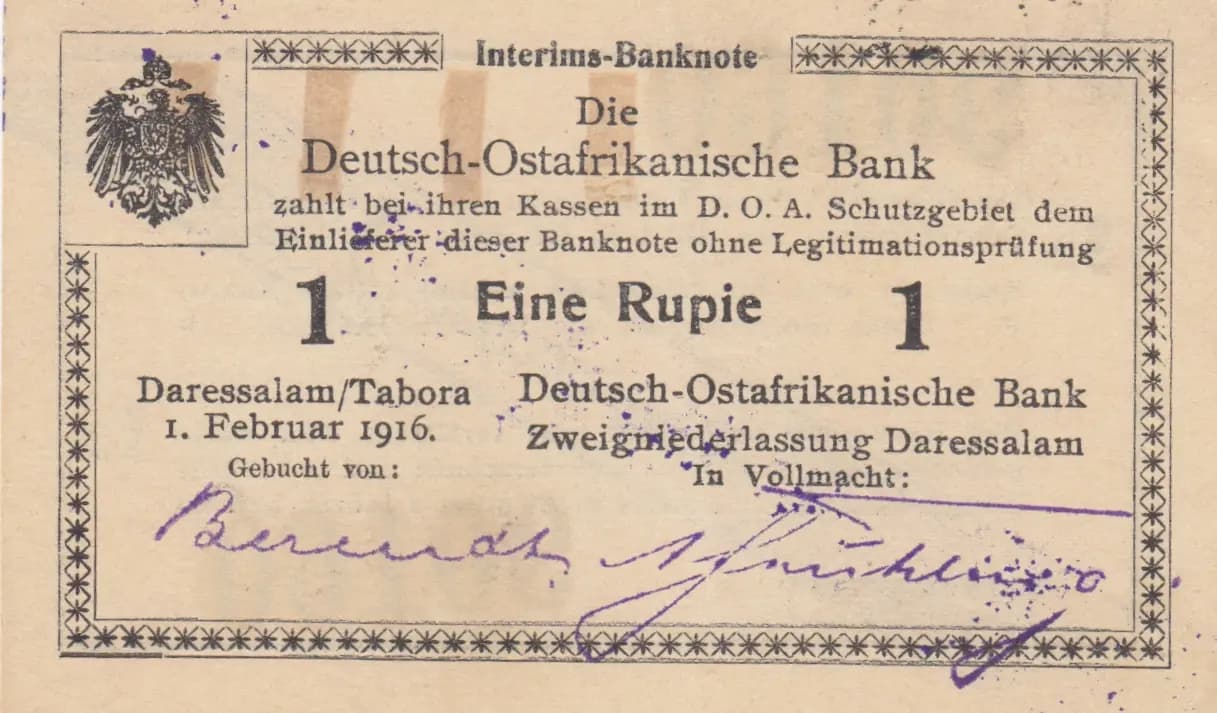
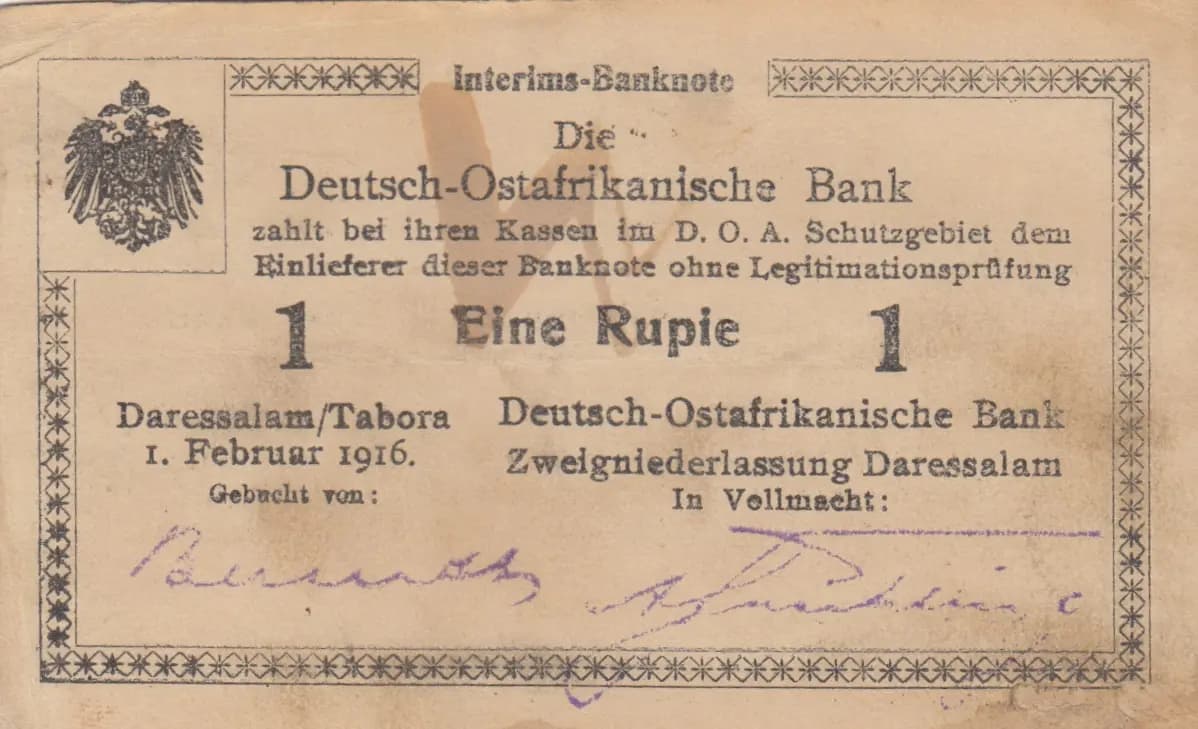
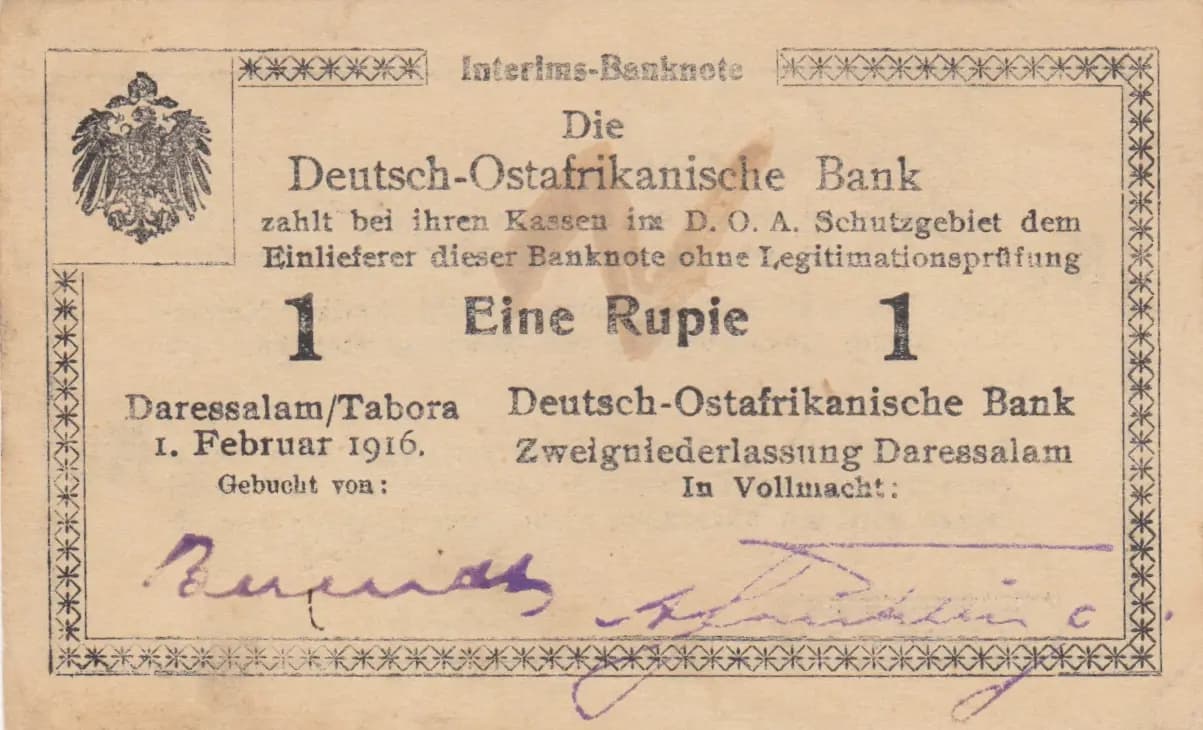
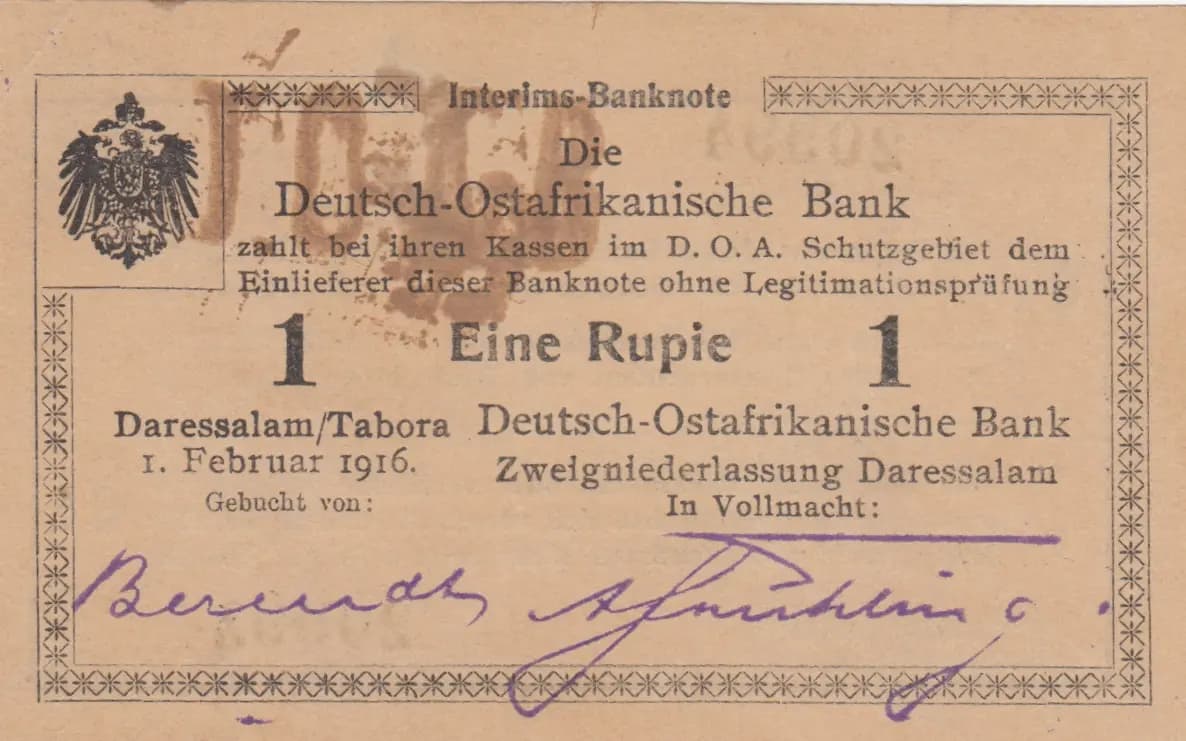
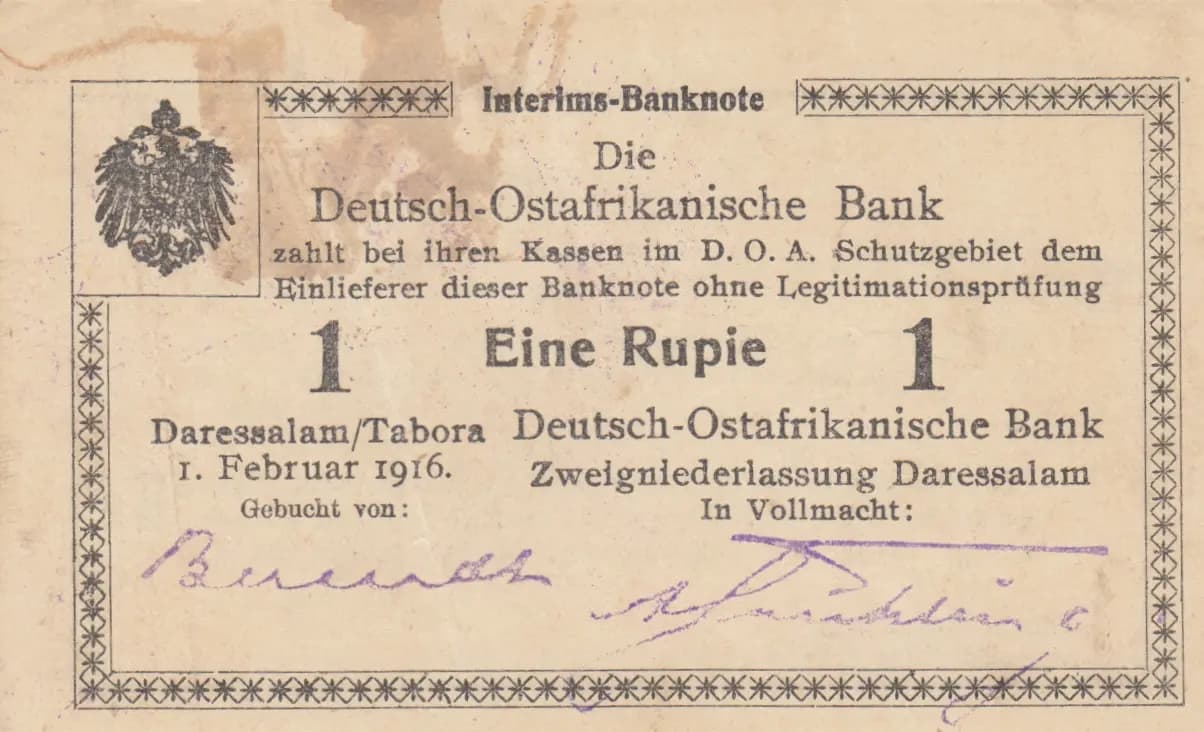
This is a fascinating interim banknote from the Deutsch-Ostafrikanische Bank, issued February 1, 1916, during Germany's administration of East Africa. The note exhibits significant aging with extensive foxing and brown staining throughout the cream-colored paper, consistent with AU condition for a note of this age and origin. The presence of handwritten signatures, official stamps from the Deutsch-Ostafrikanische Zeitung, and the dual German-Swahili text make this a historically important example of colonial-era currency.
common. While this is a colonial-era note from a defunct issuing authority (German East Africa), the 1 Rupee denomination from 1916 is relatively common in collector markets. Thousands were issued during the brief period of German administration, and survival rates are reasonable for a note now over 100 years old. The AU condition grade and series R2 designation do not represent particularly scarce varieties. The note's age and historical interest provide numismatic value, but it is not rare by standard philatelic metrics.
This interim banknote was issued by the Deutsch-Ostafrikanische Bank during World War I, when German East Africa (D.O.A. Schutzgebiet) faced severe currency shortages due to the naval blockade and war disruptions. The Imperial German double-headed eagle emblem reflects the note's status as official currency of a German colonial possession. The bilingual German-Swahili inscriptions and reference to the Imperial Government's backing demonstrate the complex administrative structure of the colony, with the note serving as both a financial instrument and a symbol of German authority in East Africa.
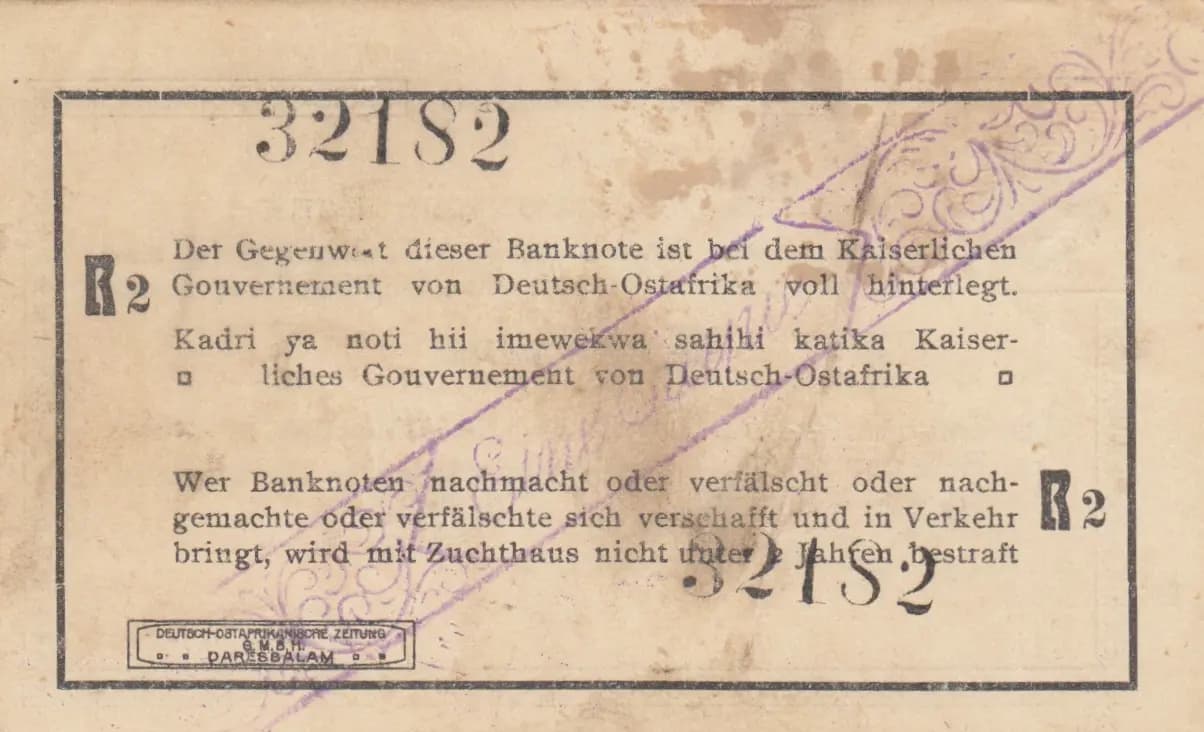
This interim banknote features a minimalist design typical of emergency wartime currency. The obverse displays the Imperial German double-headed eagle coat of arms (Reichsadler) crowned and positioned in the upper left, symbolizing sovereign German authority over the colony. The main text is centered in black typography on cream/beige paper stock. Two handwritten signatures in purple/blue ink appear at the bottom—one marked 'Gebucht von' (Booked by) and another 'In Vollmacht' (By power of attorney)—indicating the authorization of specific officials. A decorative geometric border pattern with cross-hatched design frames the note. The reverse displays the serial number 32182 prominently and includes dual-language legal text in German and Swahili, emphasizing the note's legitimacy and official backing by the Imperial Government. An official rectangular stamp from the Deutsch-Ostafrikanische Zeitung (German East African Newspaper) appears in the lower left, likely applied during archival recording. The series designation 'R 2' is visible on both sides.
FRONT SIDE: 'Interims-Banknote' (Interim Banknote); 'Die Deutsch-Ostafrikanische Bank zahlt bei ihren Kassen im D.O.A. Schutzgebiet dem Einlieferer dieser Banknote ohne Legitimitationsprüfung' (The German East African Bank pays at its cashiers in the D.O.A. protectorate to the bearer of this banknote without verification of legitimacy); 'Eine Rupie' (One Rupee); 'Daressalam/Tabora' (Dar es Salaam/Tabora branch offices); '1. Februar 1916' (1st February 1916); 'Deutsch-Ostafrikanische Bank Zweigniederlassung Daressalam' (German East African Bank Branch Office Dar es Salaam); 'Gebucht von:' (Booked by:); 'In Vollmacht:' (By power of attorney:) [followed by handwritten signatures]. BACK SIDE: '32182' (serial number); 'R 2' (series designation); 'Der Gegenwart dieser Banknote ist bei dem Kaiserlichen Gouvernement von Deutsch-Ostafrika voll hinterlegt.' (The counterpart of this banknote is fully deposited with the Imperial Government of German East Africa.); 'Kadri ya noti hii imewekwa sahili katika Kaiser-liche Gouvernement von Deutsch-Ostafrika' (Swahili translation of the deposit statement); 'Wer Banknoten nachmacht oder verfälscht oder nachgemachte oder verfälschte sich verschafft und in Verkehr bringt, wird mit Zuchthaus nicht unter 2 Jahren bestraft' (Whoever counterfeits or forges banknotes or obtains counterfeit or forged notes and puts them into circulation will be punished with imprisonment of not less than 2 years); 'DEUTSCH-OSTAFRIKANISCHE ZEITUNG DARESSALAM' (German East African Newspaper Dar es Salaam - stamp).
This note was produced using letterpress printing, a standard method for banknotes of the 1916 period. The crisp black text on cream paper, the uniformity of the typography, and the geometric border pattern are characteristic of letterpress production. The handwritten signatures and manuscript additions (including the newspaper stamp) were applied after initial printing, suggesting this was a hybrid production method combining mechanical printing with manual authorization marks. No evidence of advanced security printing techniques (such as intaglio or specialized security threads) is visible, which is consistent with the designation as an 'interim' emergency issue during wartime.
This specific note is identified as series R2, which is noted in the collector remarks and confirmed by the 'R 2' marking visible on both sides of the note. The serial number is 32182. The handwritten signatures appear to include 'Biesanth' or similar, though the second signature is partially illegible due to age and fading. The February 1, 1916 date is standard for this issue. No major varieties (such as significant date variants, signature variants, or overprint types) are documented for Pick 19 in standard references, making this a straightforward example of the base issue without rare variety status.