1 rupee 1916
“serie Q2”
About This Note
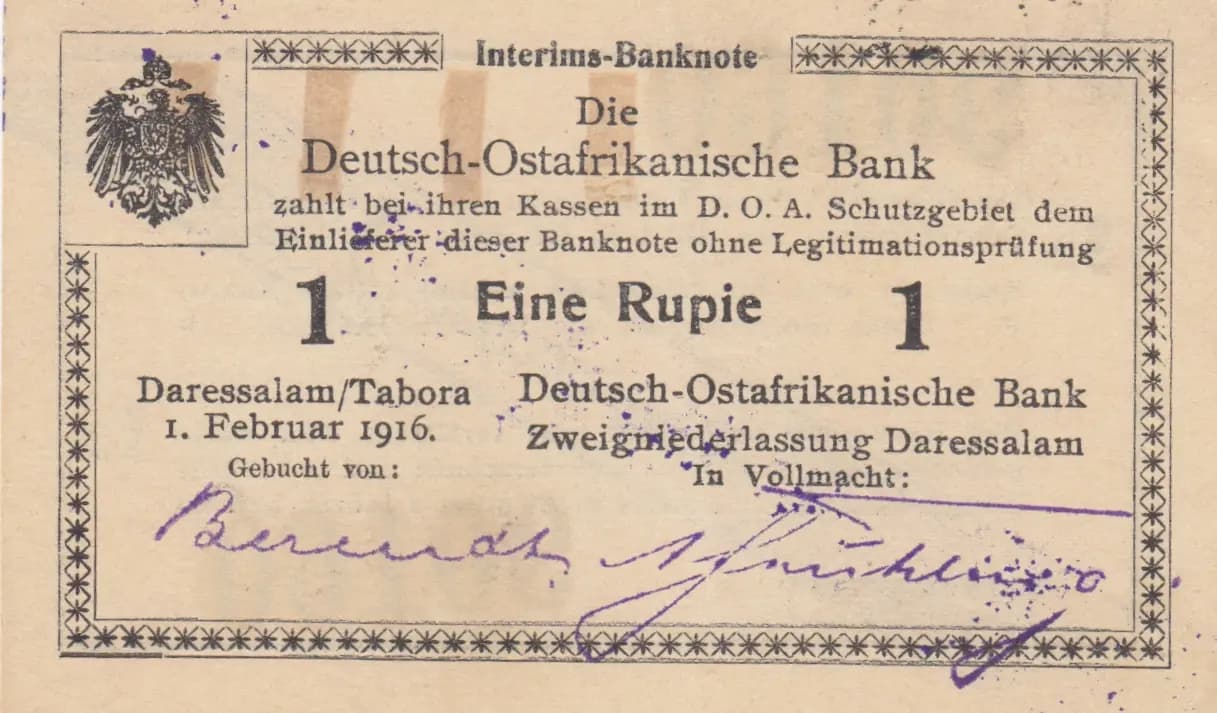
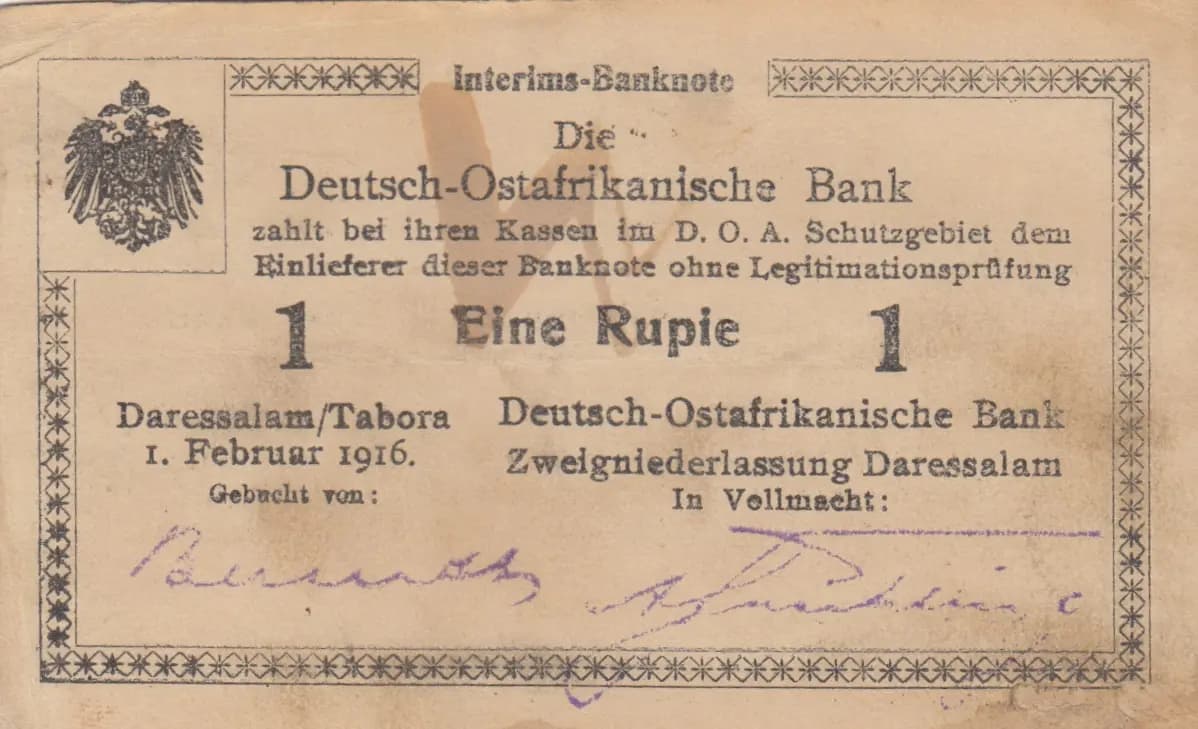
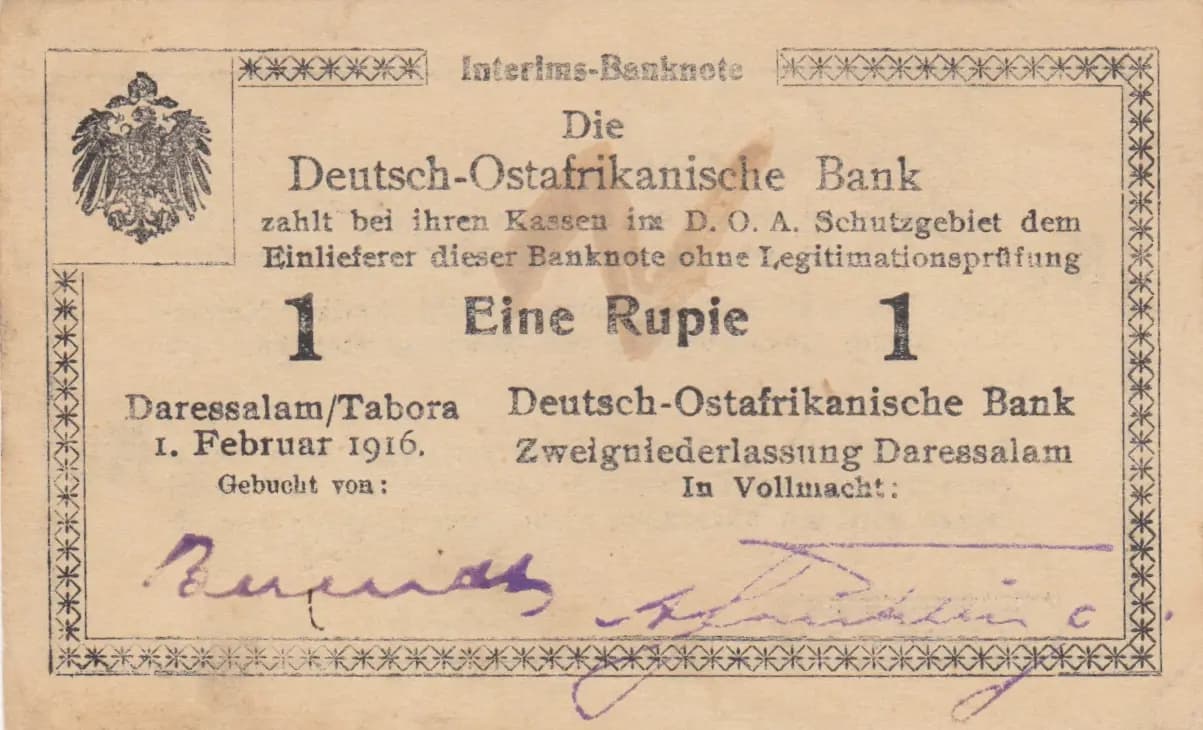
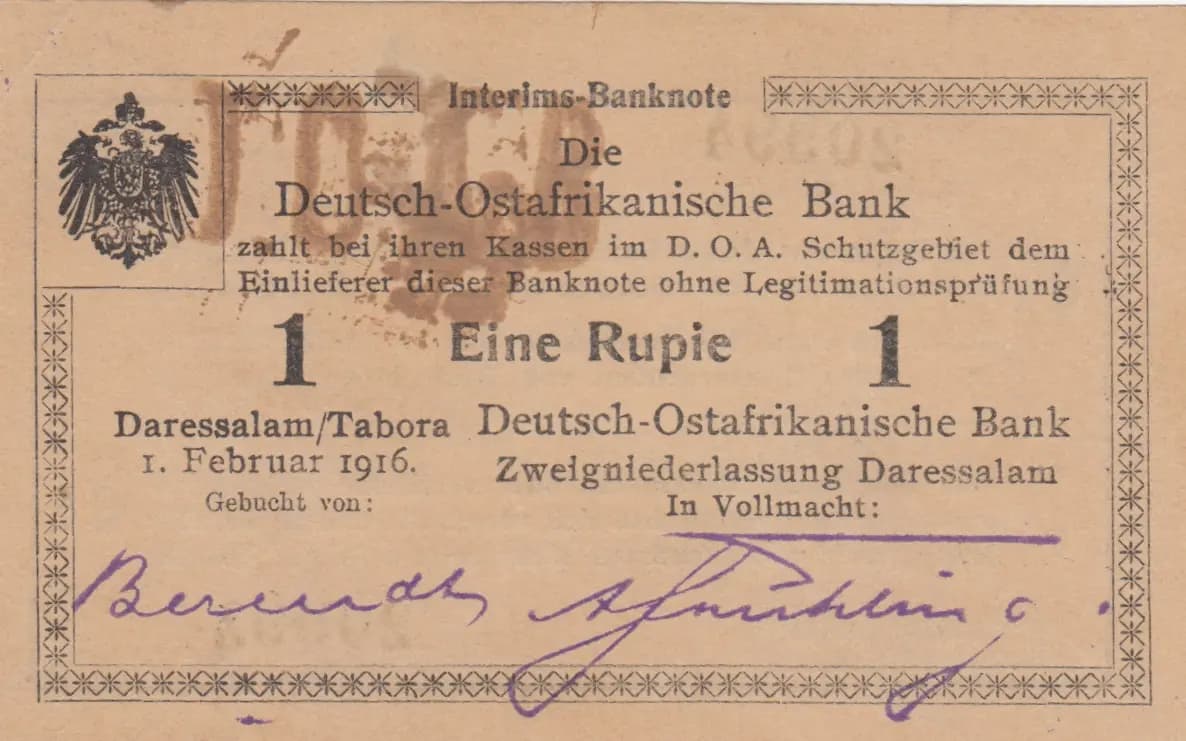
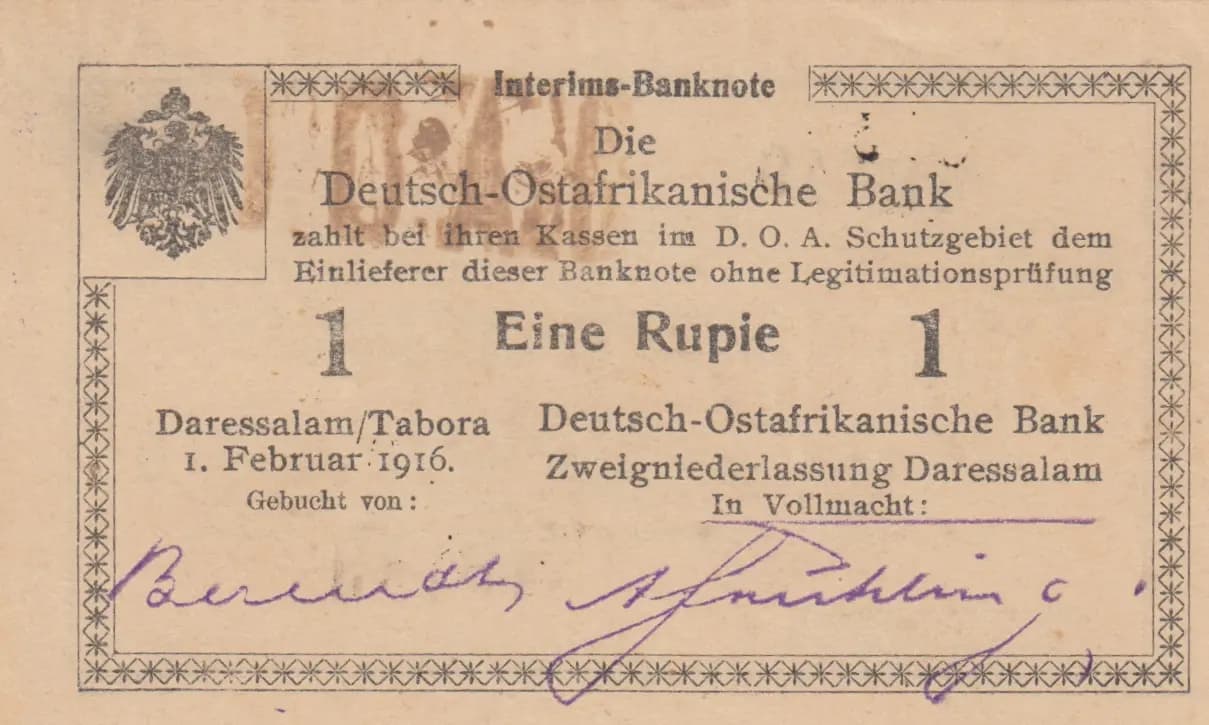
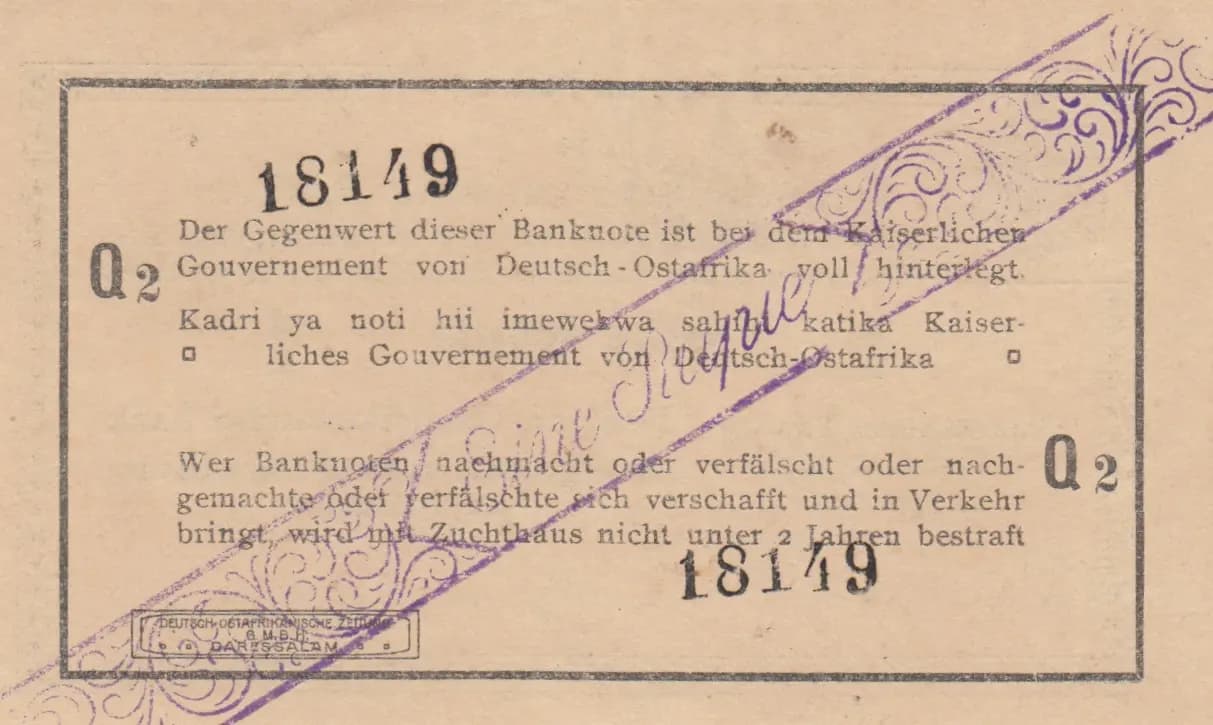
A remarkable German East African 1 Rupee interim banknote from 1916, issued during World War I by the Deutsch-Ostafrikanische Bank. This AU-condition example displays the characteristic tan and brown patina of early 20th-century German colonial currency, with period-appropriate foxing and aged paper consistent with its 108-year history. The note is particularly notable as an Interims-Banknote (emergency interim note), representing a fascinating artifact of wartime colonial finance, and features the serie Q2 designation with serial number 18149 and handwritten authentication marks characteristic of this emergency issue.
Common. While German East African notes are collectable and this specific Pick-19 represents an interesting wartime interim issue, the series was produced in substantial quantities to meet colonial circulating needs. The AU condition grade is relatively attainable for this issue; many examples survive due to the paper's durability and the note's later removal from circulation. No evidence of restricted print runs or recall exists for this particular serie Q2 variant. The presence of handwritten authentication and the utilitarian design indicate mass production methods adapted for wartime emergency needs rather than limited special releases. Current collector market pricing for similar German East African notes typically ranges $15-40 USD, consistent with common classification.
This interim banknote was issued on 1 February 1916 from the Daressalam and Tabora branches during Germany's struggle to maintain financial control of its East African colony amid World War I. The note's guarantee text explicitly states that the equivalent value was deposited with the Imperial Government of German East Africa, reflecting the wartime measures taken to stabilize the colonial currency. The inclusion of bilingual text (German and Swahili) and the handwritten signatures underscore the provisional nature of these emergency notes issued when standard printing and security procedures were overwhelmed by wartime demands.
This interim banknote features a minimalist design appropriate to its emergency status, with a geometric cross-hatch decorative border forming the primary visual security element. The obverse (front) prominently displays the German Imperial coat of arms—an eagle with crown—positioned on the left side, symbolizing imperial authority over the colony. Large denomination numerals '1' appear on both sides for clarity. The reverse features an ornamental diagonal security stripe with scrollwork decoration traversing the center, typical of German banknote design of the period. The note lacks portraiture, instead relying on heraldic imagery and textual authority. The bilingual German-Swahili text acknowledges the colonial context, while the 'ohne Legitimationsprüfung' (without legitimation review) clause indicates these notes were issued rapidly during wartime. Handwritten signatures and stamps by bank officials authenticate each note individually, a characteristic feature of interim emergency issues where rapid printing precluded the use of engraved signatures.
FRONT SIDE: 'Interims-Banknote' (Interim Banknote) / 'Die Deutsch-Ostafrikanische Bank' (The German East African Bank) / 'zahlt bei ihren Kassen im D.O.A. Schutzgebiet dem Einlieferer dieser Banknote ohne Legitimationsprüfung' (pays at its cashiers in the D.O.A. Protectorate to the depositor of this banknote without legitimation review) / 'Eine Rupie' (One Rupee) / 'Daressalam/Tabora' (place of issue) / '1. Februar 1916' (1 February 1916) / 'Gebucht von: Deutsch-Ostafrikanische Bank, Zweigniederlassung Daressalam' (Booked by: German East African Bank, Daressalam Branch) / 'In Vollmacht:' (By authority:) with handwritten signature. BACK SIDE: Serial number '18149' and serie 'Q2' / 'Der Gegenwert dieser Banknote ist bei dem Kaiserlichen Gouvernement von Deutsch-Ostafrika voll hinterlegt.' (The equivalent of this banknote is fully deposited with the Imperial Government of German East Africa.) / Swahili parallel text with same meaning / 'Wer Banknoten nachmacht oder verfälscht oder nachgemachte oder verfälschte sich verschafft und in Verkehr bringt, wird mit Zuchthaus nicht unter 2 Jahren bestraft' (Whoever counterfeits or forges banknotes or obtains counterfeit or forged ones and puts them into circulation shall be punished with imprisonment of not less than 2 years) / 'DEUTSCH-OSTAFRIKANISCHE ZEITUNGS G.M.B.H. DARESSALAM' (German East African Newspaper Ltd. Daressalam, indicating the printer).
Letterpress printing with hand-stamped and handwritten authentication. The primary text and border work appear to be produced via traditional letterpress (relief printing), consistent with German banknote production of 1916. The ornamental stripe and decorative elements on the reverse also show characteristics of letterpress work. The serial number 18149 and serie designation Q2 were likely applied via secondary printing or hand-stamping. The purple/blue handwritten signatures and official stamps visible on both sides represent the hand-authentication method necessitated by the interim nature of the issue—individual bank officials personally authorized each note. The printer is identified in the visual analysis as 'DEUTSCH-OSTAFRIKANISCHE ZEITUNGS G.M.B.H. DARESSALAM' (German East African Newspaper Ltd.), which served as the local printing facility for these emergency notes.
This example represents the Q2 serie variant of Pick-19 (1 Rupee 1916), serial number 18149. The specific variety is characterized by the February 1 date and dual Daressalam/Tabora branch designation. Known varieties of this issue include different serie prefixes (Q1, Q2, etc.) and different date printings issued during 1916, reflecting the multiple emergency printings required to meet wartime currency demands. The handwritten signature and personal authentication marks vary by individual bank official, making each note technically unique within its serie. No major overprint varieties or known printings for this Pick number are documented in standard catalogs, suggesting this Q2 serie represents a standard production variant rather than a scarce sub-type.