1 rupee 1916
“serie D3”
About This Note
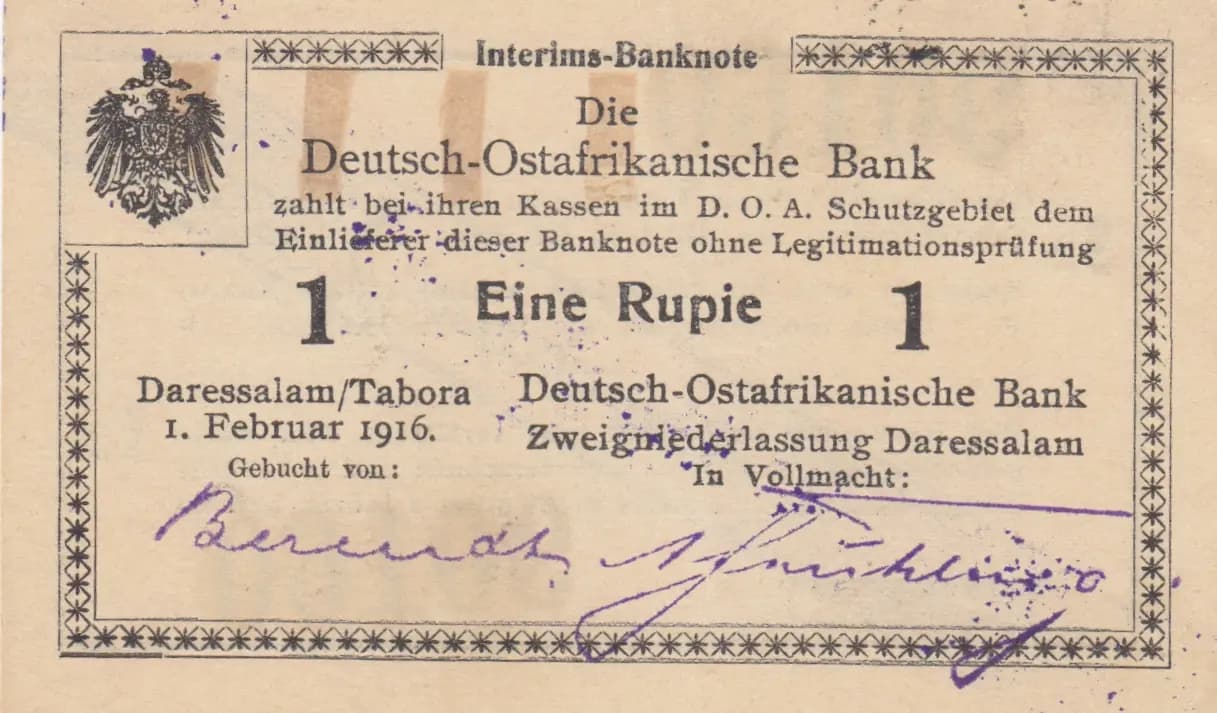
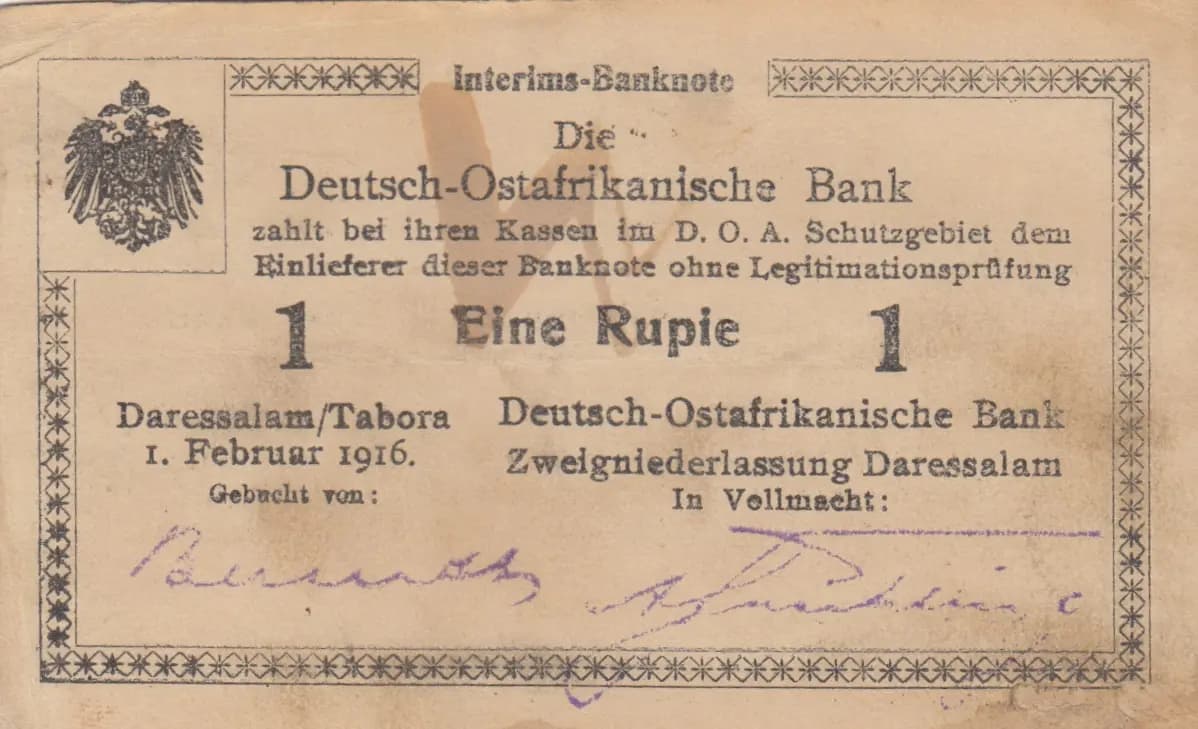
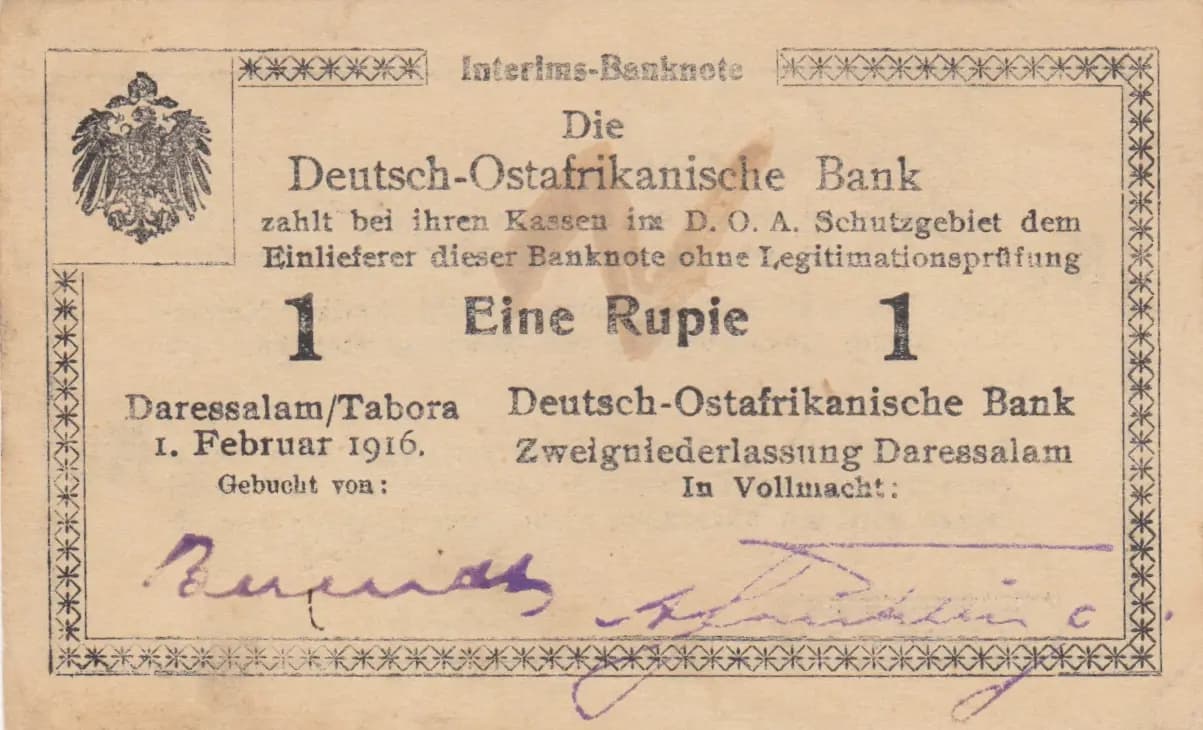
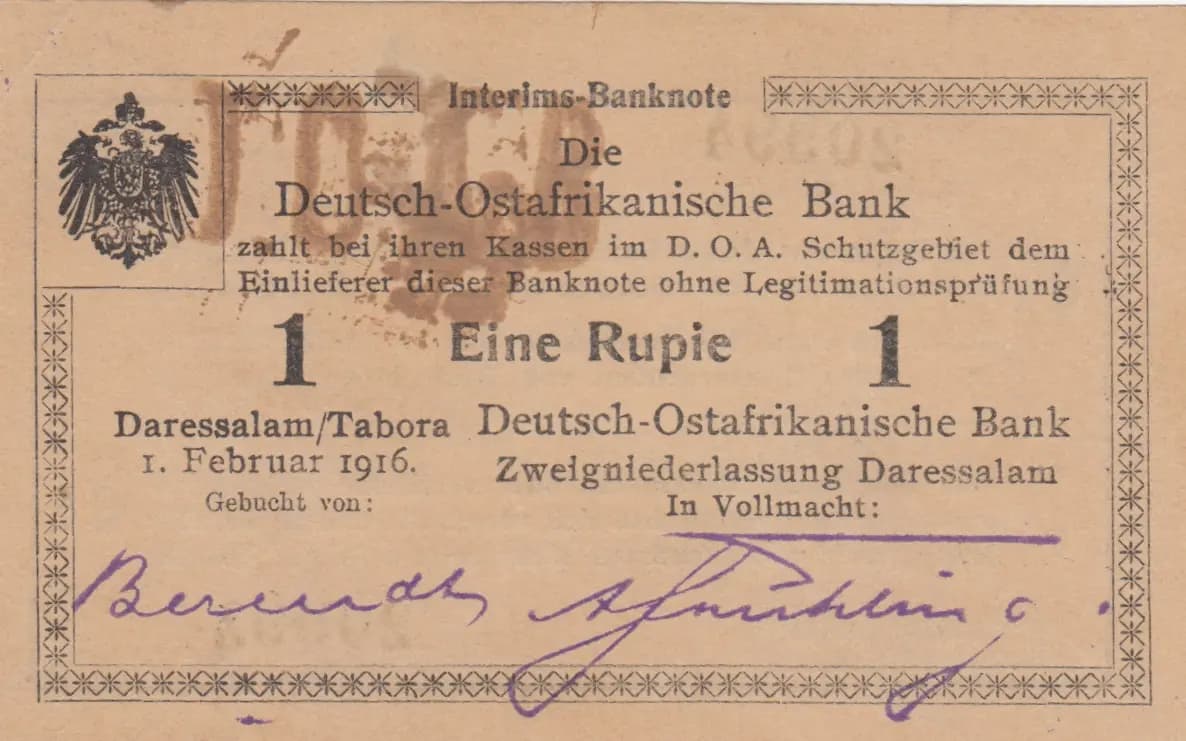
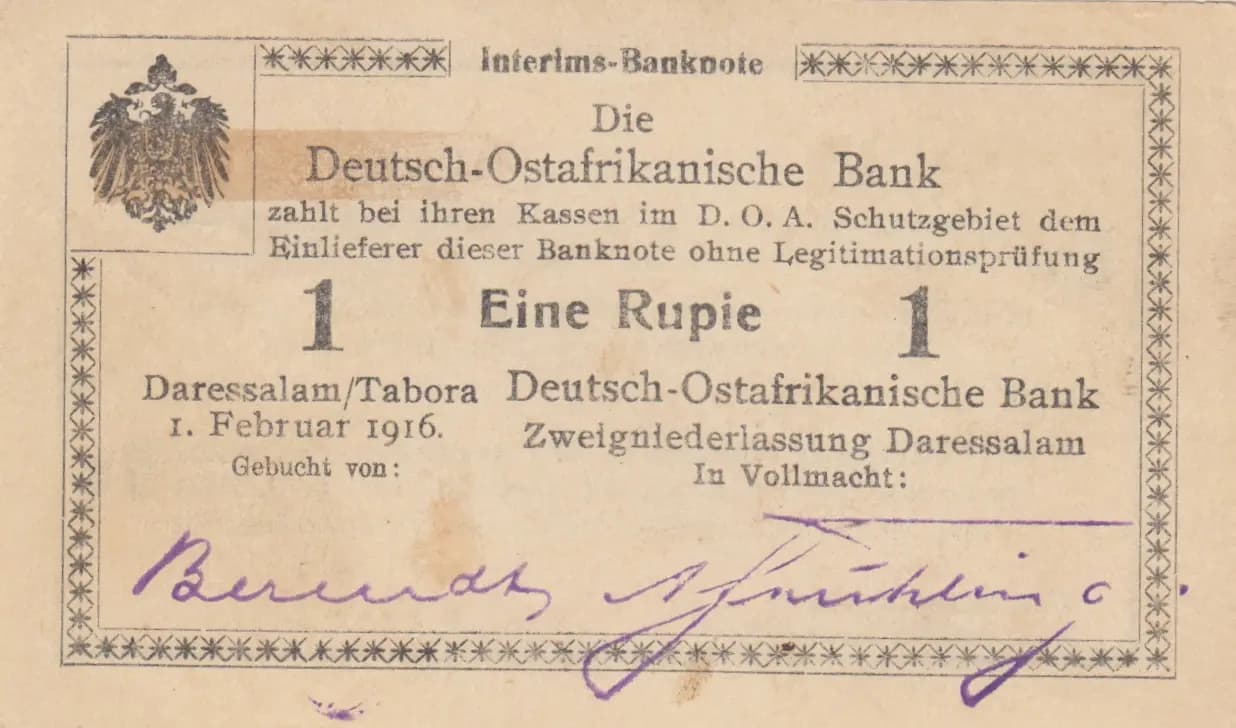
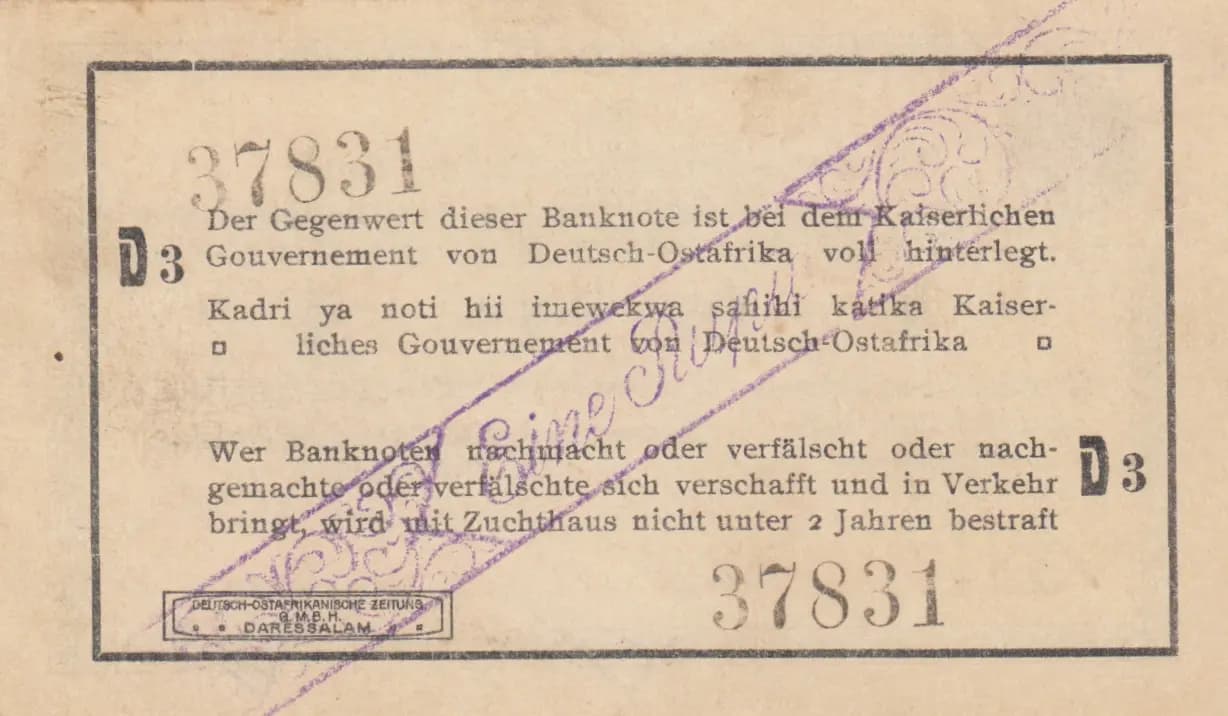
This is a German East African 1 Rupee note from February 1, 1916, issued by the Deutsch-Ostafrikanische Bank during the final years of German colonial rule in East Africa. The note is graded AU with visible aging characteristics including beige/tan discoloration, foxing, and handwritten annotations in purple/blue ink, indicating it saw actual circulation during a tumultuous period. The presence of the German imperial eagle, bilingual German-Swahili text, and the series D3 designation make this an important historical artifact from a short-lived colonial currency system.
Common. The Deutsch-Ostafrikanische Bank issued these interim notes in substantial quantities to meet currency demand during the final years of German colonial rule. The Pick-19 1 Rupee denomination in this series survives in moderate quantities in the collector market, reflecting a reasonably large original circulation. The AU condition grade noted here is not exceptional for this type—many examples survive in circulated to AU condition due to the relatively robust paper quality and age. While historically significant as artifacts of a defunct colonial currency system, these notes are readily available to collectors and do not command premium prices associated with rare issues.
This interim banknote was issued just months before Germany's colonial possessions in East Africa were seized during World War I, making it a final artifact of German imperial rule in the region. The note's dual German-Swahili inscriptions reflect the colonial administrative structure, while the Imperial Government backing statement and Daressalam/Tabora branch locations document the geographic reach of German East African banking. The handwritten annotations and circulation marks visible on this example suggest it was actually used during the chaotic final period of German colonial administration before British takeover in 1916-1917.
The obverse features a formal colonial design with the German Imperial coat of arms (Reichsadler—the double-headed eagle with spread wings) positioned prominently in the upper left corner, symbolizing imperial authority over the East African territory. Decorative asterisk-pattern borders frame the note along the top and left margins, providing an ornamental security element typical of early 20th-century currency design. The denomination '1' appears symmetrically on both left and right sides with 'Eine Rupie' centered, reflecting the rupee-based currency system used in German East Africa. The reverse contains the serial number D3 37831 in opposite corners, a rectangular legal declaration in German and Swahili affirming the note's backing by the Imperial Government, an anti-counterfeiting warning clause, and an official stamp referencing the Deutsche-Ostafrikanische Zeitung (newspaper) in Daressalam, possibly indicating the printing or authentication location. The note's color scheme is natural beige/tan on aged paper, consistent with the period and materials available in the colony.
FRONT SIDE: 'Interims-Banknote' (Interim Banknote) / 'Die Deutsch-Ostafrikanische Bank' (The German East African Bank) / 'zahlt bei ihren Kassen im D.O.A. Schutzgebiet dem Einlieferer dieser Banknote ohne Legitimationsprüfung' (pays at its tills in the D.O.A. protectorate to the deliverer of this banknote without verification of legitimation) / '1 Eine Rupie 1' (1 One Rupee 1) / 'Daressalam/Tabora' (city names) / '1. Februar 1916' (1st February 1916) / 'Gebucht von: Deutsch-Ostafrikanische Bank Zweigniederlassung Daressalam' (Booked by: German East African Bank Branch Daressalam) / 'In Vollmacht: Bernard Aqmitheim o.ö.' (By power of attorney: Bernard Aqmitheim o.ö.). BACK SIDE: 'D3 37831' (Serial number) / 'Der Gegenwert dieser Banknote ist bei dem Kaiserlichen Gouvernement von Deutsch-Ostafrika voll hinterlegt.' (The countervalue of this banknote is fully deposited with the Imperial Government of German East Africa.) / 'Kadri ya noti hii imeyekwa sahithi katika Kaiserliches Gouvernement wa Deutsch-Ostafrika' (Swahili: The value of this note is fully deposited with the Imperial Government of German East Africa) / 'Wer Banknoten nachmacht oder verfälscht oder nachgemachte oder verfälschte sich verschafft und in Verkehr bringt, wird mit Zuchthaus nicht unter 2 Jahren bestraft' (Whoever counterfeits or forges banknotes or procures counterfeit or forged ones and puts them into circulation will be punished with hard labor for not less than 2 years) / 'DEUTSCH-OSTAFRIKANISCHE ZEITUNG DARESSALAM' (German East African Newspaper Daressalam).
This note was produced using letterpress printing, evidenced by the crisp, embossed appearance of the text and the sharp definition of the German imperial coat of arms. The security features—the decorative asterisk borders and the coat of arms itself—were printed as integral design elements rather than applied separately. The bilingual text layout and administrative stamps show characteristics of official government printing practices of the era. While specific printer attribution is not definitively documented in the visual analysis, German East African banknotes of this period were typically produced by established security printers serving the colonial administration, likely firms with German connections given the official nature of the issue.
This example is identified as Series D3, serial number 37831, as printed on both front and reverse. The series letter prefix (D3) is a key variety identifier for German East African rupee notes. The signature of Bernard Aqmitheim o.ö. appears as the authorized issuing official, and this specific signatory and date (1 Februar 1916) help identify this as part of the final issuance batch. The handwritten markings in purple/blue ink, including the diagonal line crossing the back, appear to be post-issue administrative annotations or circulation marks rather than printing varieties, indicating this note was actively used in the colonial banking system before being withdrawn from circulation.