1 rupee 1916
“serie B3”
About This Note
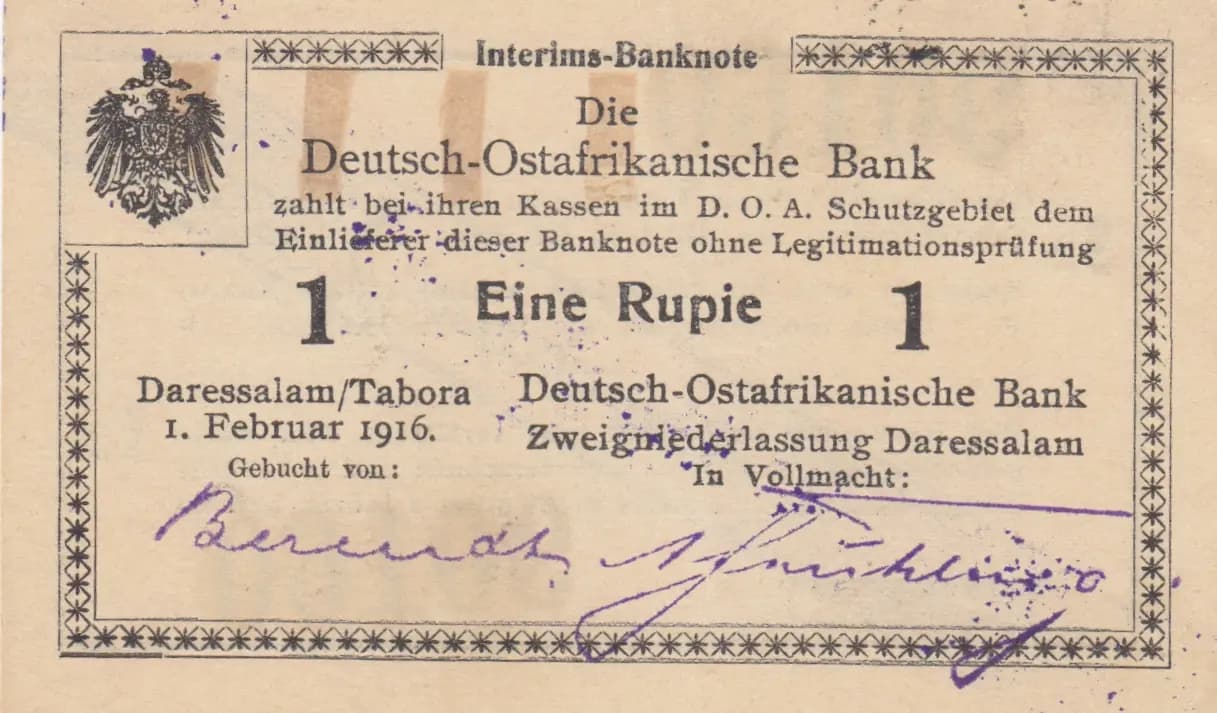
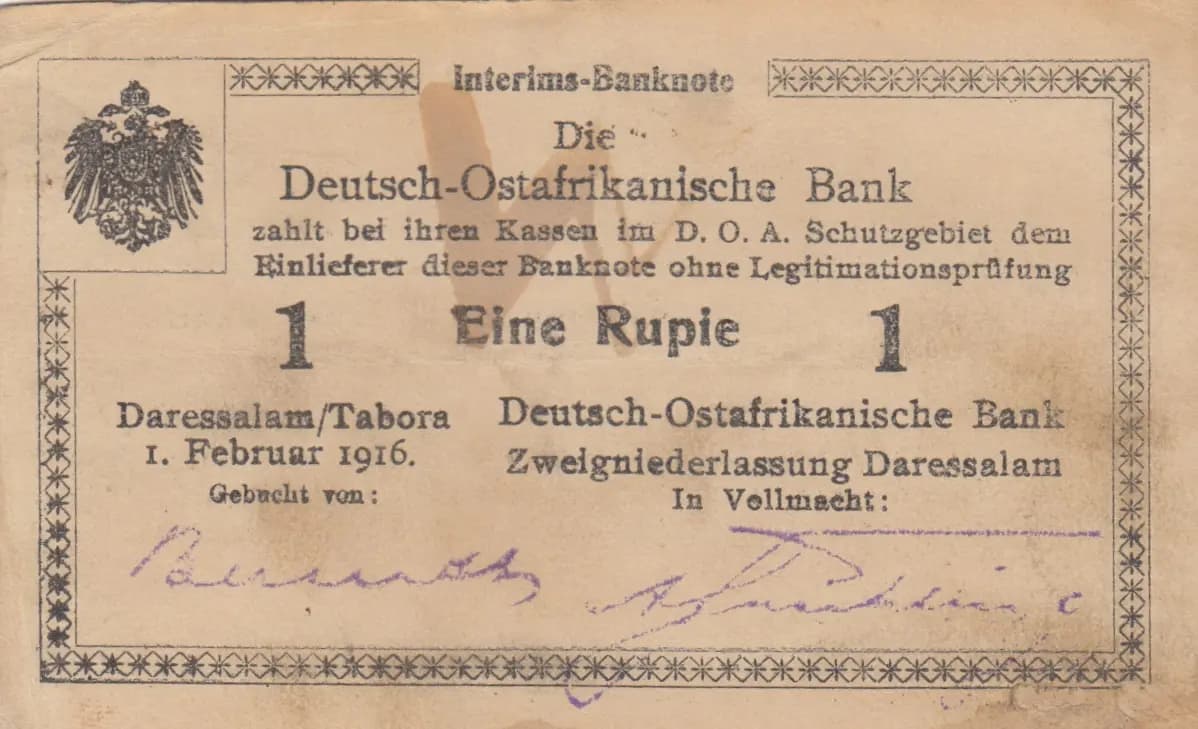
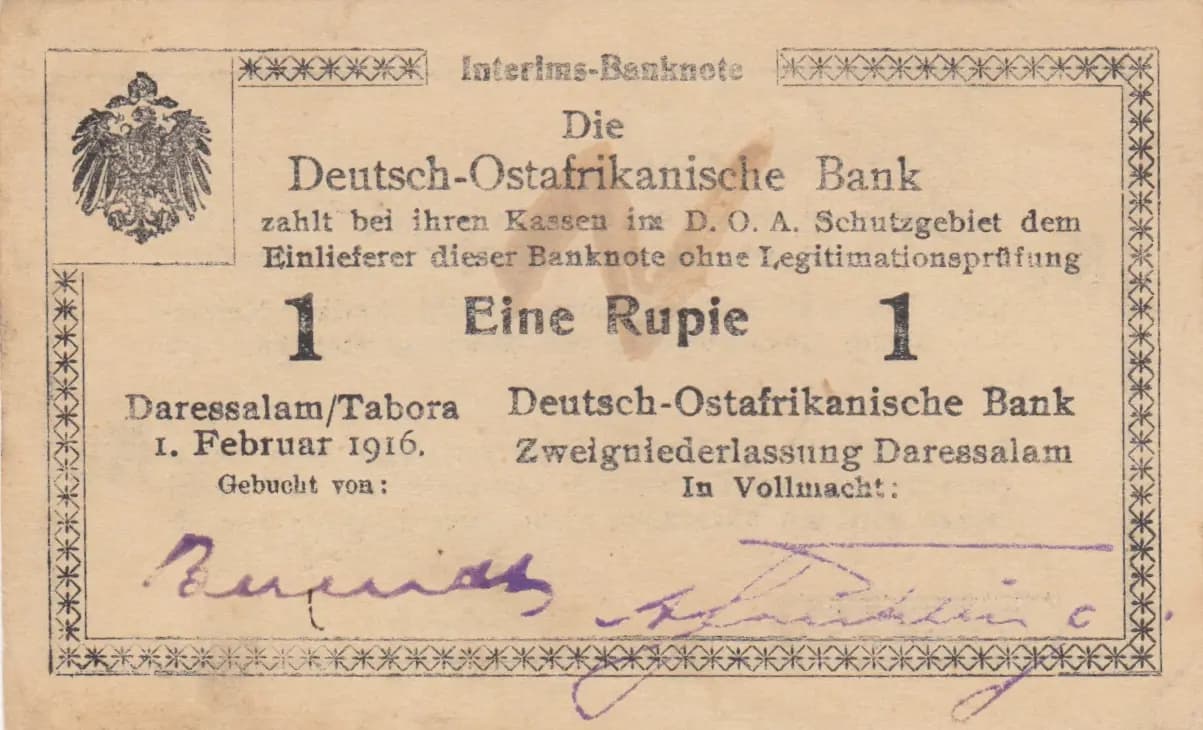
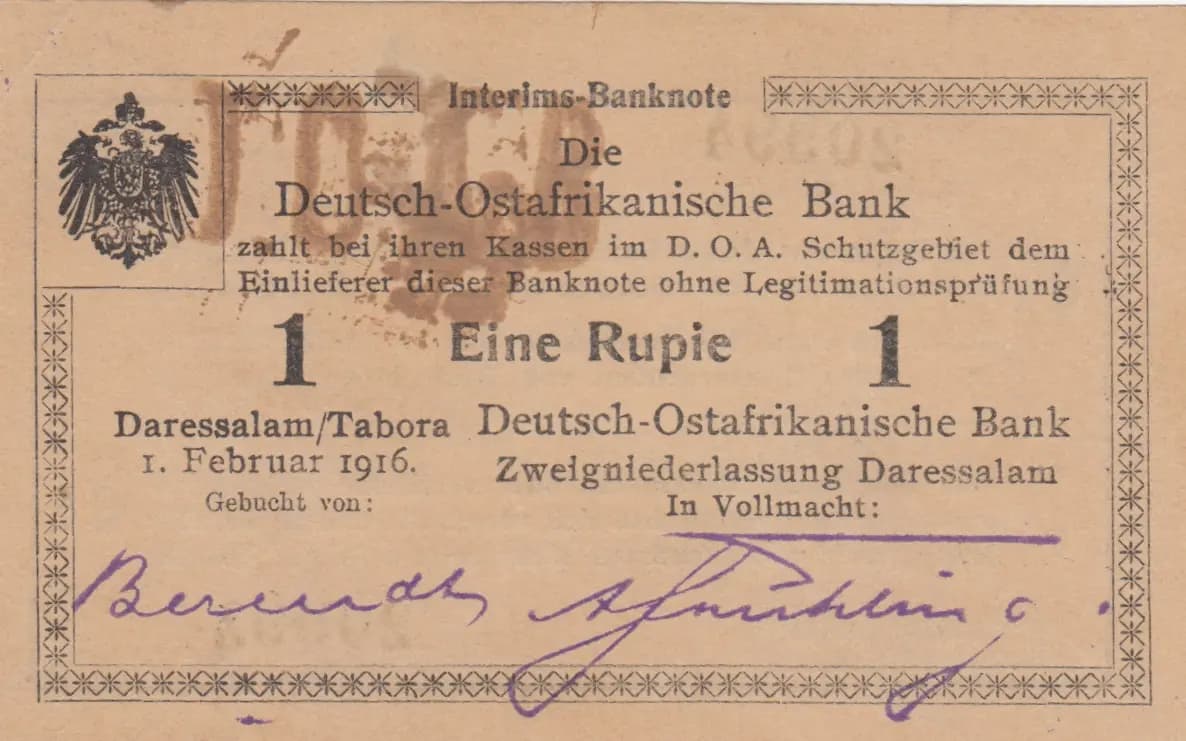
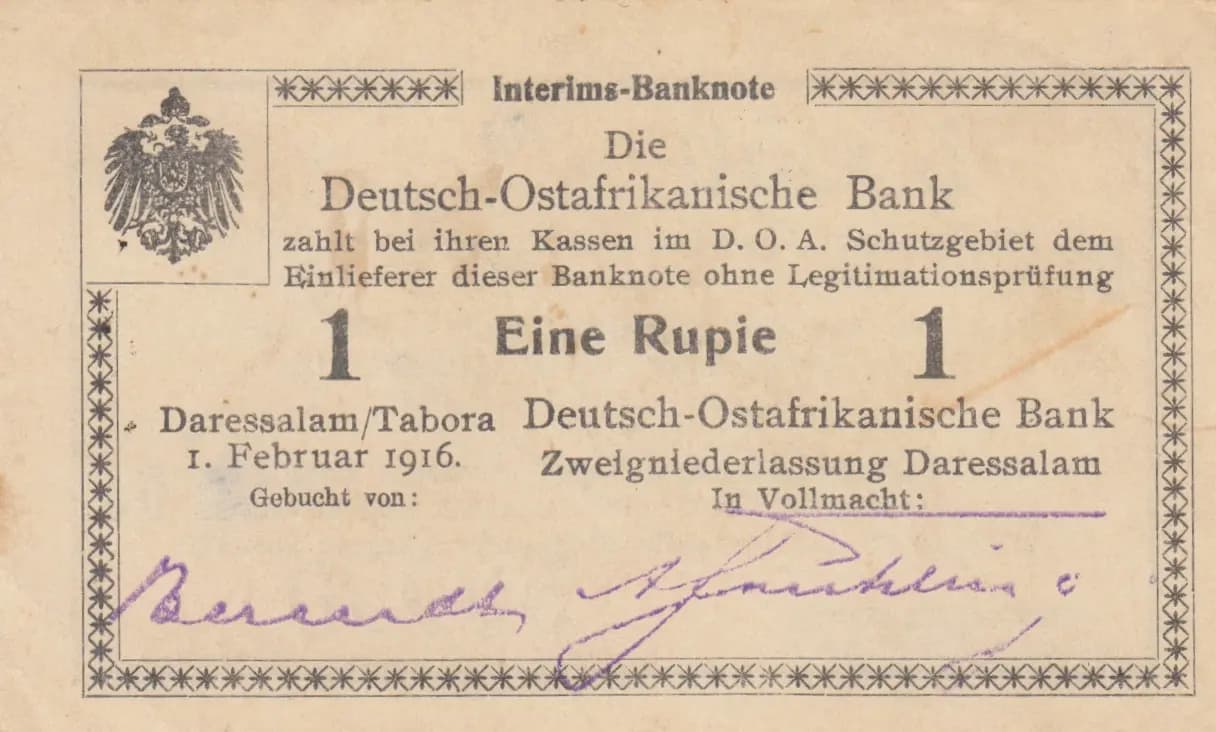
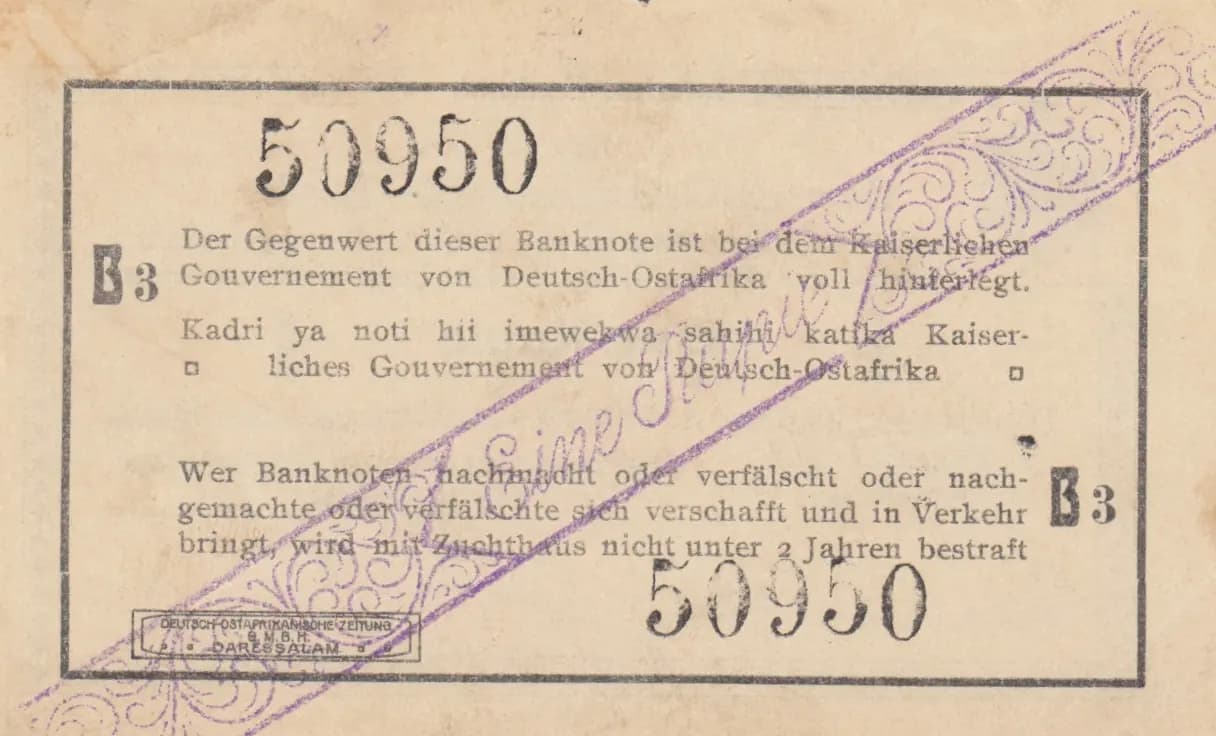
An exceptional example of a German East African 1 Rupee interim banknote (Interims-Banknote) issued February 1, 1916 by the Deutsch-Ostafrikanische Bank from Daressalam/Tabora. The note displays the characteristic beige patina of its age with handwritten signatures and a distinctive diagonal purple cancellation mark across the reverse, indicating it was heavily used during the brief German colonial period in East Africa. In EF condition with series B3 designation, this represents an important piece of World War I-era colonial monetary history.
Common. German East African banknotes from 1916 were issued in substantial quantities to support the colonial economy during WWI. While the German colonial period ended in 1920 and these notes were subsequently withdrawn from circulation, the Deutsch-Ostafrikanische Bank issued multiple denominations and series across several years. Pick catalog number P-19 represents a standard interim issue denomination (1 Rupee) in a well-documented series (B3). The survival of examples in EF condition indicates sufficient original production quantities. The presence of the cancellation mark and handwritten signatures suggests heavy contemporary use rather than restricted circulation. Absent specific evidence of a low print run or early recall, this variety should be assessed as common among collectors of German colonial currency.
This interim banknote was issued during Germany's final years controlling East Africa (1884-1920), with this particular note dated to early 1916, when World War I was reshaping colonial powers in Africa. The Imperial German coat of arms prominently displayed in the upper left reflects the official status of the Deutsch-Ostafrikanische Bank as the territory's official monetary authority under German imperial administration. The bilingual German-Swahili text and dual issue centers of Daressalam and Tabora demonstrate the bank's control over the protectorate's economic infrastructure during the colonial period.
The note features a clean, formal layout typical of German imperial banking documents. The obverse is dominated by the Imperial German double-headed eagle coat of arms with crown and shield positioned in the upper left, serving as both security element and official authority marker. The denomination 'Eine Rupie' is clearly stated in German, with the dual-language protocol reflecting the colonial administration's approach to local populations. The design employs decorative geometric border patterns throughout, providing both aesthetic appeal and anti-counterfeiting protection. Handwritten signature lines for two authorized officials ('Gebucht von' and 'In Vollmacht') indicate the note's nature as a manually authorized interim currency. The reverse contains the serial number 50950 with B3 series designation, extensive legal text in both German and Swahili regarding validity and counterfeiting penalties, and publication information for the Deutsch-Ostafrikanische Zeitung printing house in Daressalam. A large diagonal cancellation or validation mark in purple/blue ink crosses the reverse, suggesting either period-specific handling protocols or post-issuance processing.
FRONT: 'Interims-Banknote' (Interim Banknote) / 'Die Deutsch-Ostafrikanische Bank zahlt bei ihren Kassen im D.O.A. Schutzgebiet dem Einlieferer dieser Banknote ohne Legitiationsprüfung' (The German East African Bank pays at its cashiers in the D.O.A. protectorate to the presenter of this banknote without legitimation examination) / 'Eine Rupie' (One Rupee) / 'Daressalam/Tabora' (issue locations) / 'Deutsch-Ostafrikanische Bank, Zweigniederassung Daressalam' (German East African Bank, Daressalam Branch) / '1. Februar 1916' (1 February 1916) / 'Gebucht von:' (Booked by:) / 'In Vollmacht:' (By Power of Attorney:) — BACK: Serial number '50950' with series designation 'B3' / 'Der Gegenwert dieser Banknote ist bei dem Kaiserlichen Gouvernement von Deutsch-Ostarika voll hinterlegt.' (The equivalent of this banknote is fully deposited with the Imperial Government of German East Africa.) / 'Wer Banknoten nachgemacht oder verfälscht oder nachgemachte oder verfälschte sich verschafft und in Verkehr bringt, wird mit Zuchthaus nicht unter 2 Jahren bestraft' (Whoever counterfeits or falsifies banknotes or obtains counterfeit or falsified notes and brings them into circulation shall be punished with hard labor for not less than 2 years) / 'DEUTSCH-OSTAFRIKANISCHE ZEITUNG G.M.B.H. DARESSALAM' (German East African Newspaper Limited Company, Daressalam) — printer/publisher attribution.
Letterpress/relief printing on colored paper stock (beige/cream base), characteristic of early 20th-century German banking practices. The sharp, clear impression of text and the Imperial coat of arms indicates professional typographic composition. The geometric border decorations and fine detail work are consistent with steel engraving or high-quality relief block printing. Handwritten elements (signatures and the diagonal mark) were added post-printing. The note was likely printed by or under supervision of the Deutsch-Ostafrikanische Bank's own printing division, with the Deutsch-Ostafrikanische Zeitung G.M.B.H. credited as the production house.
Series B3 designation (visible on obverse and reverse). Serial number 50950 recorded. The diagonal purple/blue cancellation mark on the reverse is a notable feature of this specific specimen, possibly indicating a particular validation or processing protocol used during the currency's circulation period (1916-1920). The date '1. Februar 1916' appears to be fixed for this interim series. Handwritten signatures are present but not clearly identified as to specific signatories. This particular note represents the B3 series variety with the noted cancellation marking.