1 rupee 1916
“serie Y2”
About This Note
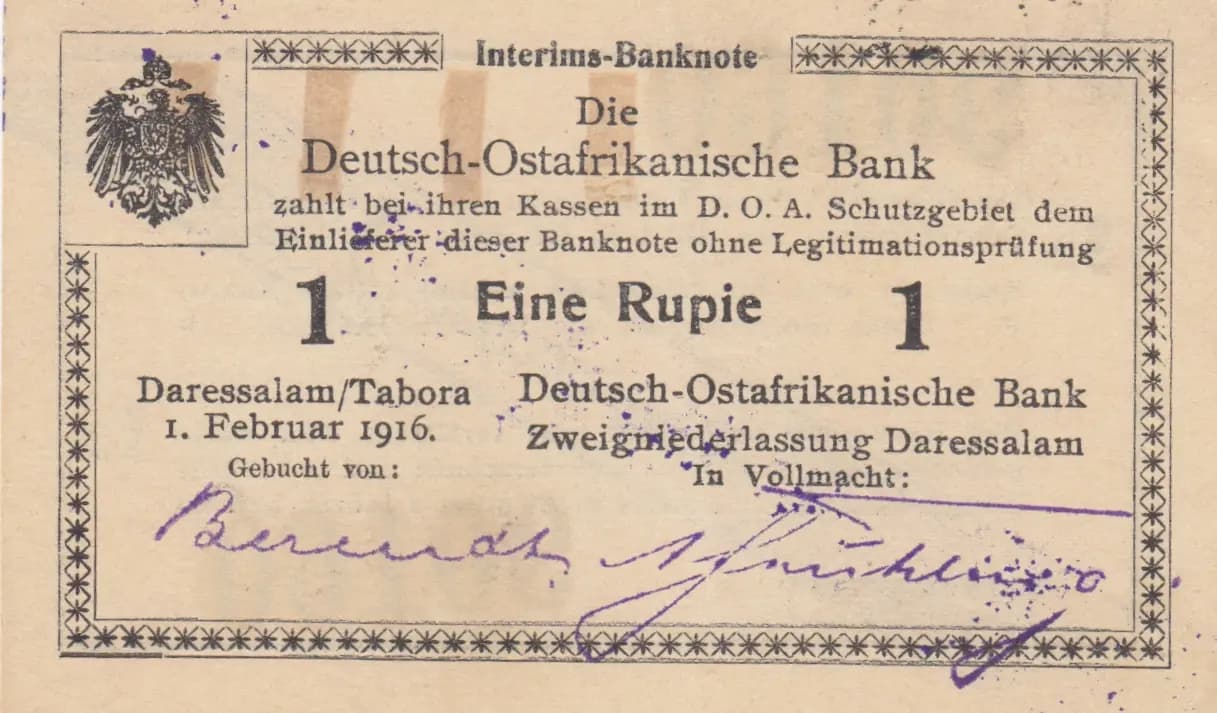
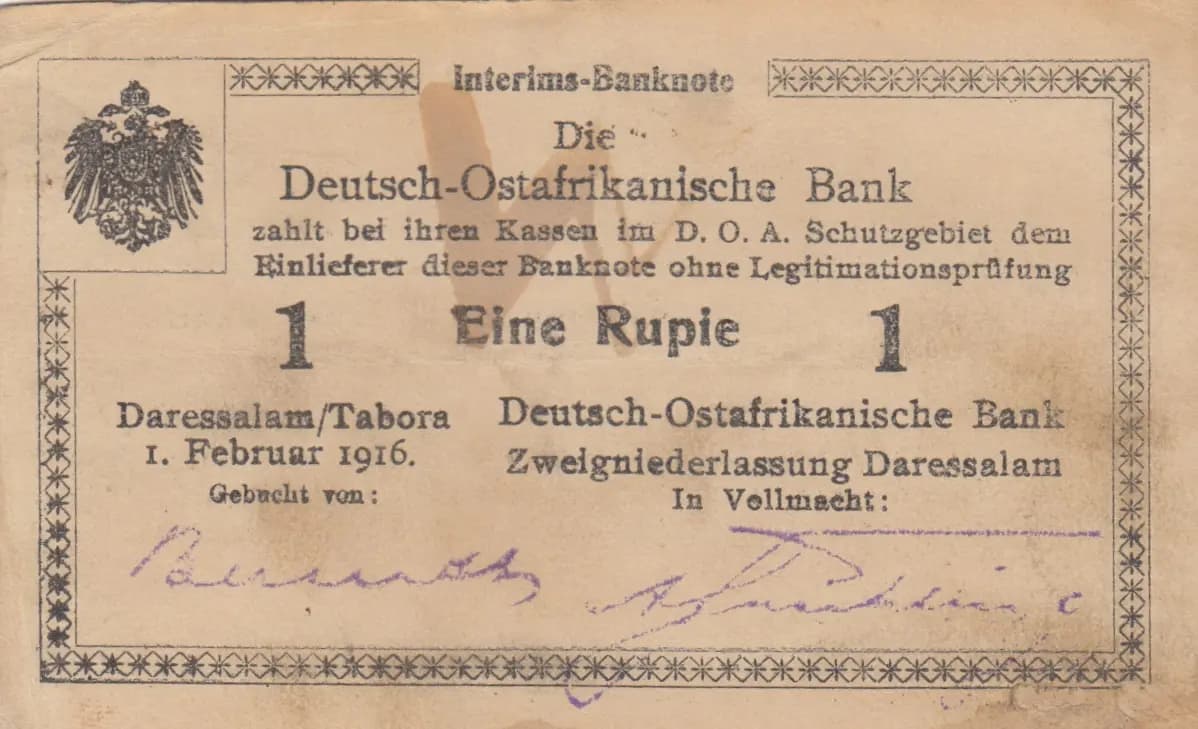
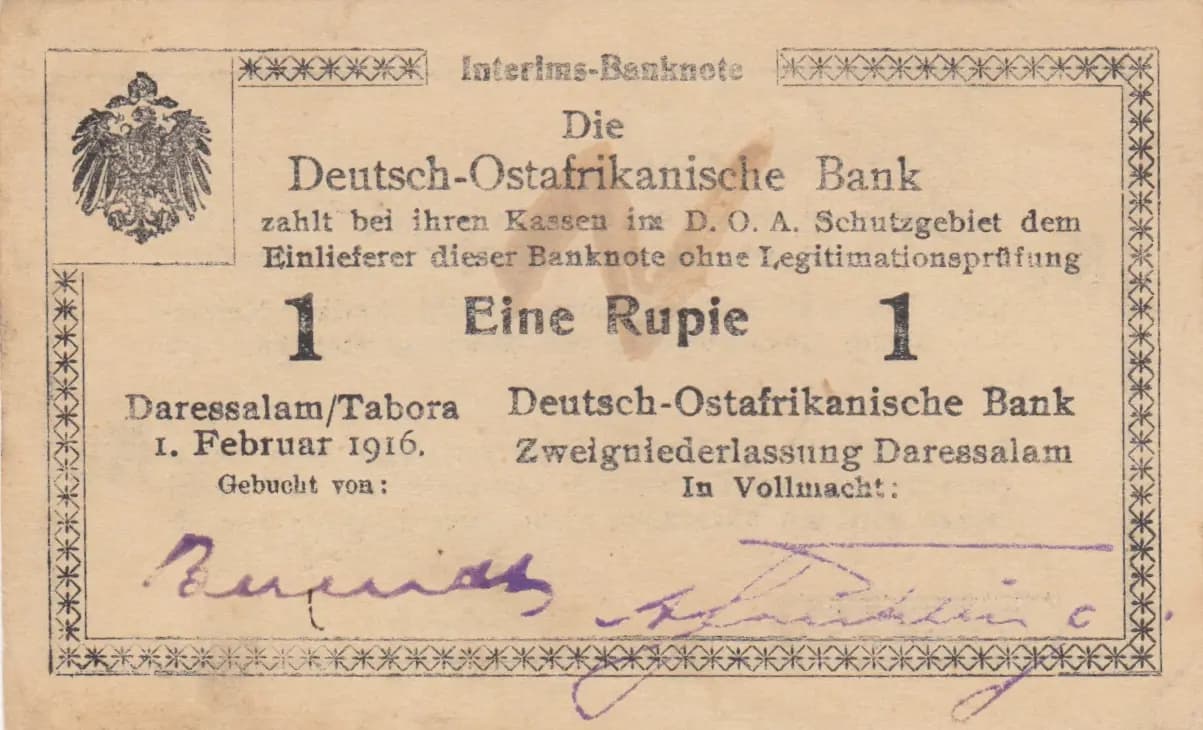
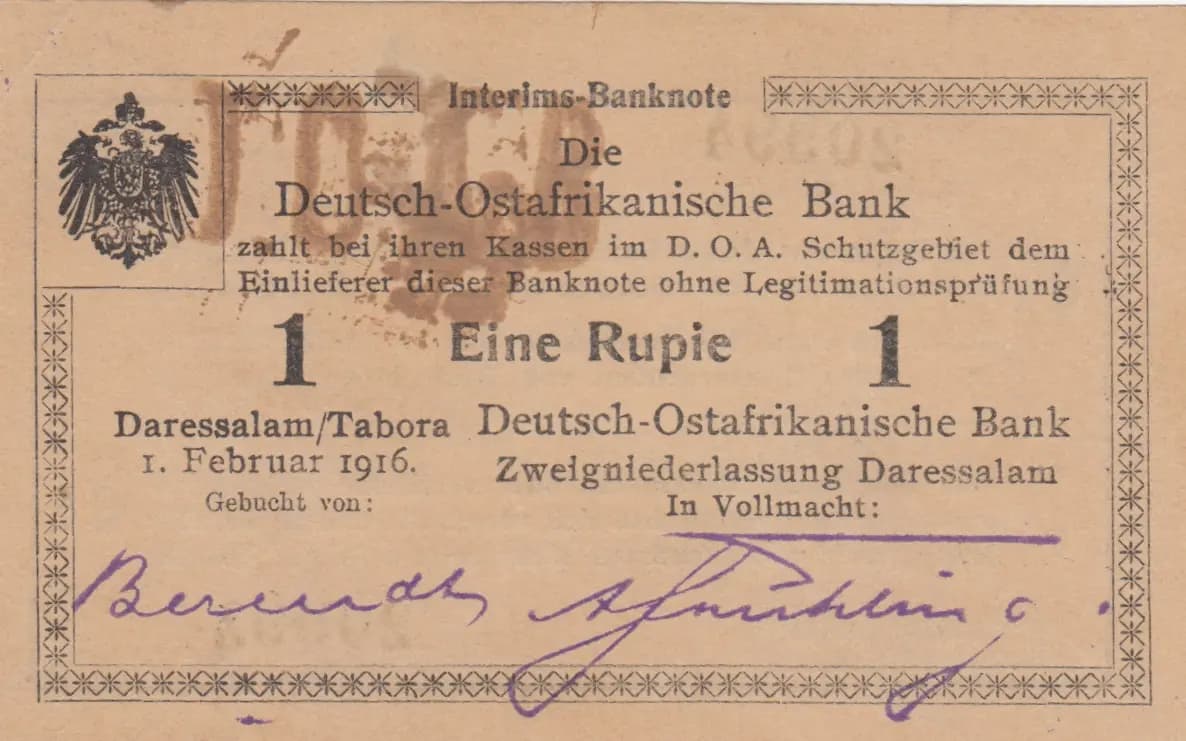
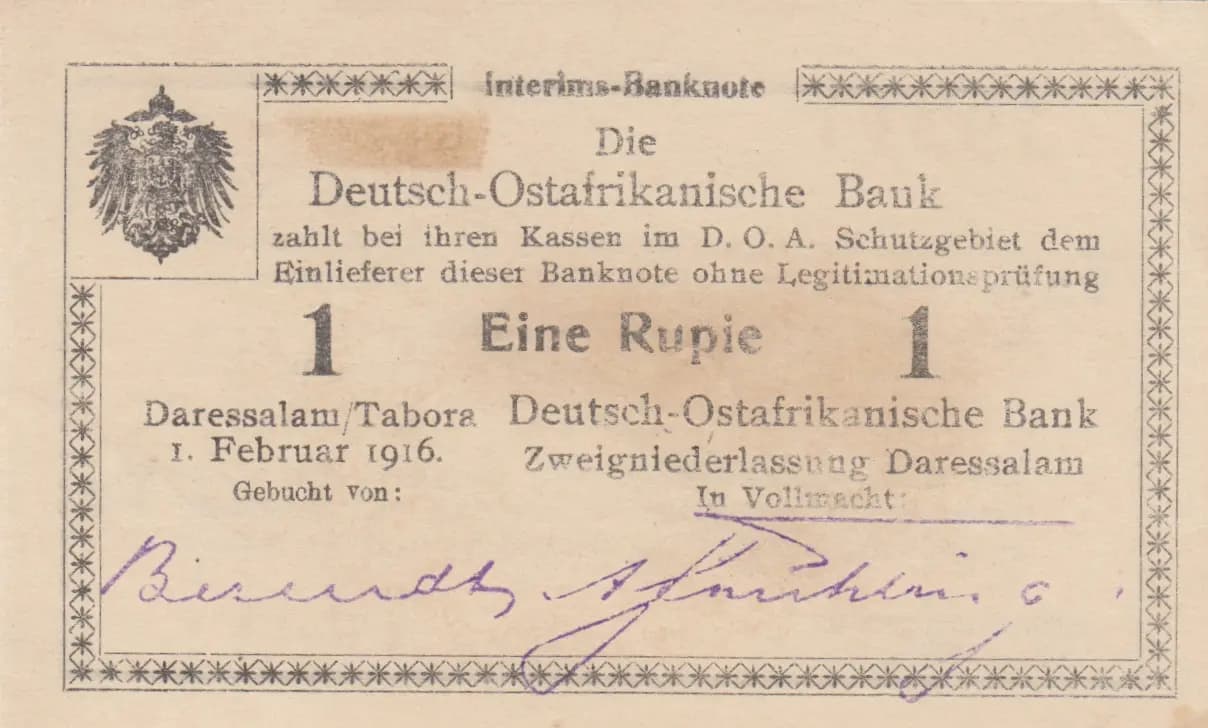
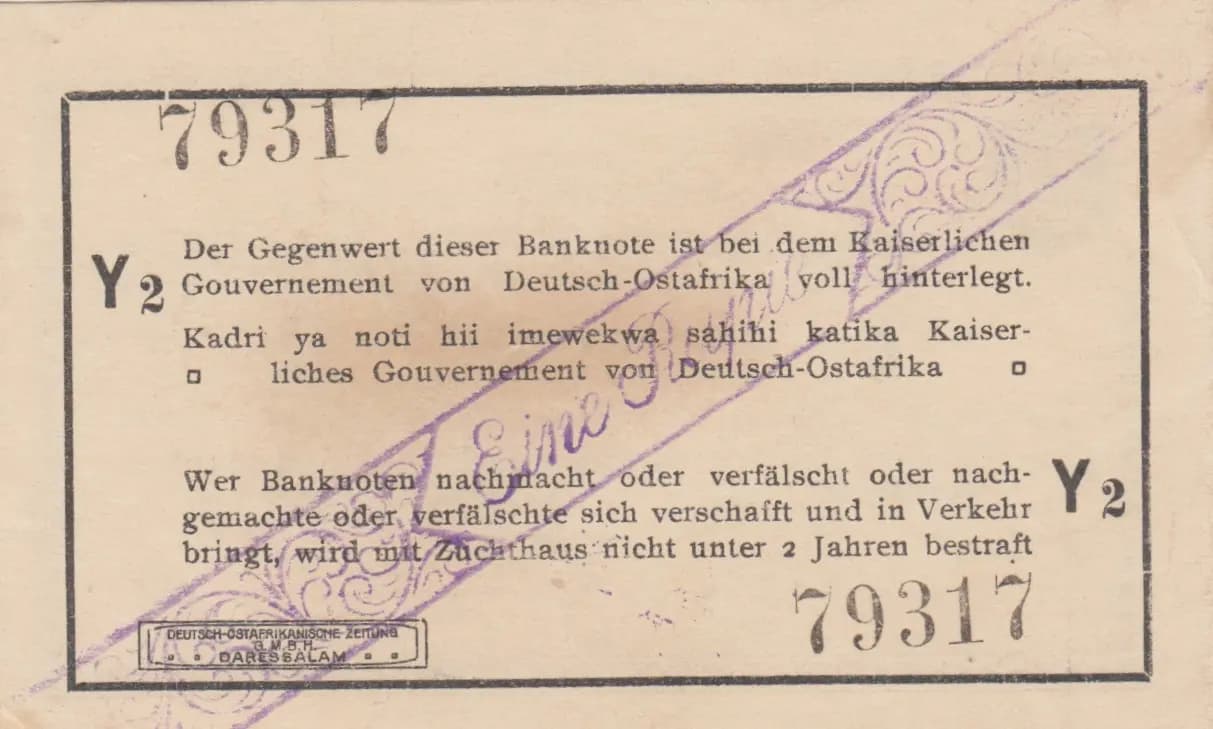
This is a German East African 1 Rupee interim banknote from February 1, 1916, issued by the Deutsch-Ostafrikanische Bank during the final years of German colonial rule in East Africa. The note exhibits an AU condition grade with significant age-related patina including foxing, browning, and yellowing typical of notes over a century old, yet the impressions remain clear with visible handwritten signatures and the serial number 79317 legible on both sides. The presence of the Y2 series designation and the newspaper stamp authentication mark make this an interesting example of emergency wartime currency issued during World War I.
Common. German East African 1 Rupee notes from 1916 (Pick P-19) were produced in substantial quantities as emergency interim currency during the final years of German colonial rule. While colonial era currency has collector interest, this particular denomination and issue are well-represented in collections and appear regularly in the numismatic market. The AU condition grade and Y2 series designation do not represent significant scarcities — multiple series and conditions of this note type exist in circulation among collectors. The lack of documented print run restrictions, absence of immediate recalls, and the note's role as functional emergency currency rather than commemorative issue all support a common classification.
This interim banknote was issued during the German East African campaign of World War I, when the colony faced severe currency shortages and economic disruption. The Imperial German Eagle coat of arms on the obverse represents German sovereignty over the territory, while the dual-language text (German and Swahili) and references to the Imperial Government of German East Africa reflect the colonial administrative structure. The note's legal text warning against counterfeiting with imprisonment penalties underscores the wartime measures taken to stabilize the colonial currency system as German military forces struggled against British, South African, and Allied operations in the region.
The obverse features a formal, austere design typical of German Imperial currency. The Imperial German Eagle (Reichsadler) with crown appears prominently on the left side as the primary heraldic symbol representing German sovereignty. The note is framed by an ornamental border composed of geometric star and cross patterns in black ink, creating a classical security-conscious design. The denomination 'Eine Rupie' (One Rupee) is clearly stated in both word and numeral form. The text is arranged in a centered, hierarchical manner with the bank's name and authorization statement forming the legal basis for the note's validity. Handwritten signatures appear at the bottom in purple/blue ink, suggesting individual authorization by bank officers. The reverse contains dense legal text in German with Swahili translations, emphasizing the note's legitimacy and the legal penalties for counterfeiting. A rectangular authentication stamp from the Deutsch-Ostafrikanische Zeitung (German East African Newspaper) appears at the lower left, an unusual security feature that suggests public newspaper verification of the currency's authenticity.
OBVERSE: 'Interims-Banknote' (Interim Banknote) | 'Die Deutsch-Ostafrikanische Bank' (The German East African Bank) | 'zahlt bei ihren Kassen im D.O.A. Schutzgebiet dem Einlieferer dieser Banknote ohne Legitinations-prüfung' (pays at its counters in the D.O.A. protected territory to the depositor of this banknote without legitimacy verification) | 'Eine Rupie' (One Rupee) | '1' (denomination numeral) | 'Daressalam/Tabora Deutsch-Ostafrikanische Bank' (issuing locations and bank name) | '1. Februar 1916.' (1 February 1916) | 'Gebucht von: Zweigniederlassung Daressalam' (Booked by: Daressalam Branch) | 'In Vollmacht: Bernard Schmidt & Co.' (By proxy: Bernard Schmidt & Co.) REVERSE: '79317' (serial number) | 'Y2' (series designation) | 'Der Gegenwert dieser Banknote ist bei dem Kaiserlichen Gouvernement von Deutsch-Ostafrika voll hinterlegt.' (The countervalue of this banknote is fully deposited with the Imperial Government of German East Africa) | 'Wer Banknoten nachmacht oder verfälscht oder nachgemachte oder verfälschte sich verschafft und in Verkehr bringt, wird mit Zuchthaus nicht unter 2 Jahren bestraft' (Whoever counterfeits or forges banknotes or procures counterfeit or forged ones and puts them into circulation will be punished with imprisonment not less than 2 years) | 'DEUTSCH-OSTAFRIKANISCHE ZEITUNG ... DARESSALAM' (German East African Newspaper stamp/seal authentication mark)
The note exhibits letterpress printing characteristics typical of early 20th-century German banknote production. The crisp impressions of the text, the Imperial Eagle, and the decorative border pattern indicate relief printing using metal type and engraved plates. The serial number 79317 appears to have been applied by hand or separate printing. The handwritten signatures in manuscript ink represent manual authorization by designated bank officers. The newspaper stamp on the reverse appears to be a separate impressed seal using standard office stamping equipment. This combination of commercial letterpress printing with manual signatures and official stamps reflects wartime emergency currency practices where speed and available resources took precedence over the sophisticated anti-counterfeiting measures of peacetime note production.
This note is identified as series Y2 (visible on the reverse), with serial number 79317. The Pick catalog P-19 designation corresponds to the 1 Rupee denomination dated 1 February 1916. The specific variety elements include the Daressalam/Tabora issuance location, the Bernard Schmidt & Co. proxy signature authorization, and the newspaper stamp authentication mark from the Deutsch-Ostafrikanische Zeitung. These administrative details and signature variations likely represent different branch authorizations within the colonial banking structure. Known varieties of Pick P-19 typically include variations in series letters (Y series noted here) and different authorized signature combinations reflecting administrative changes during the 1916 wartime period.