1 rupee 1916
“serie X2”
About This Note
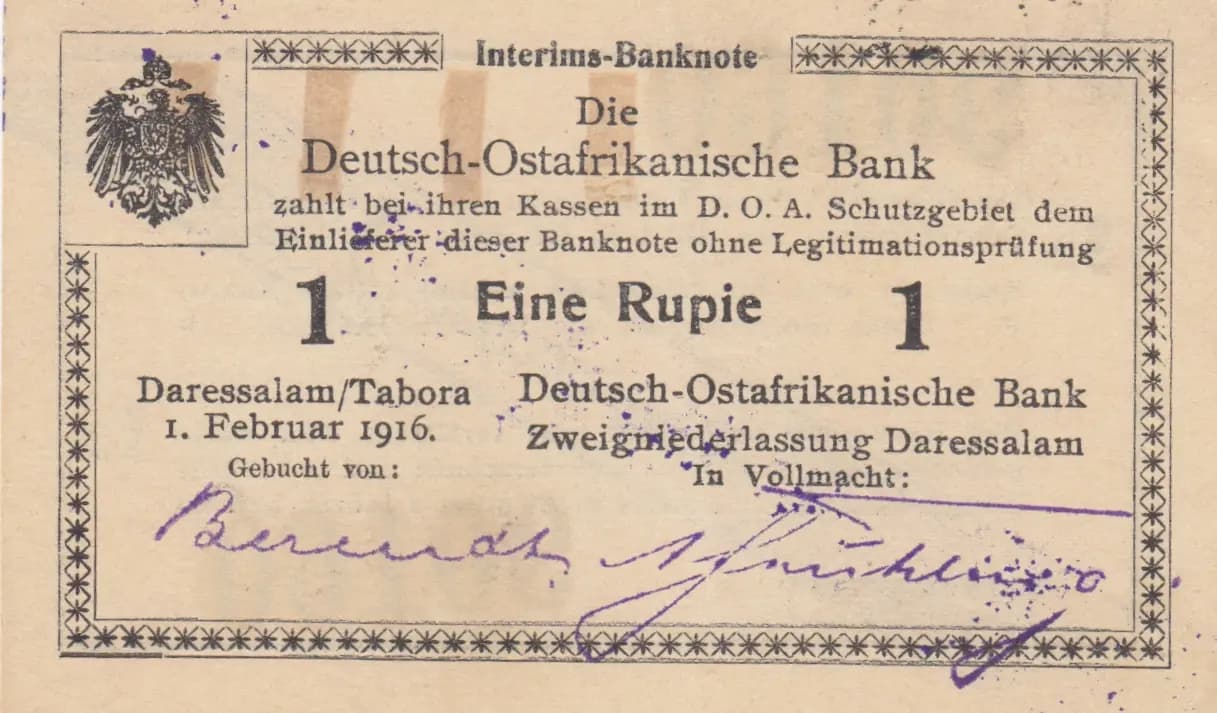
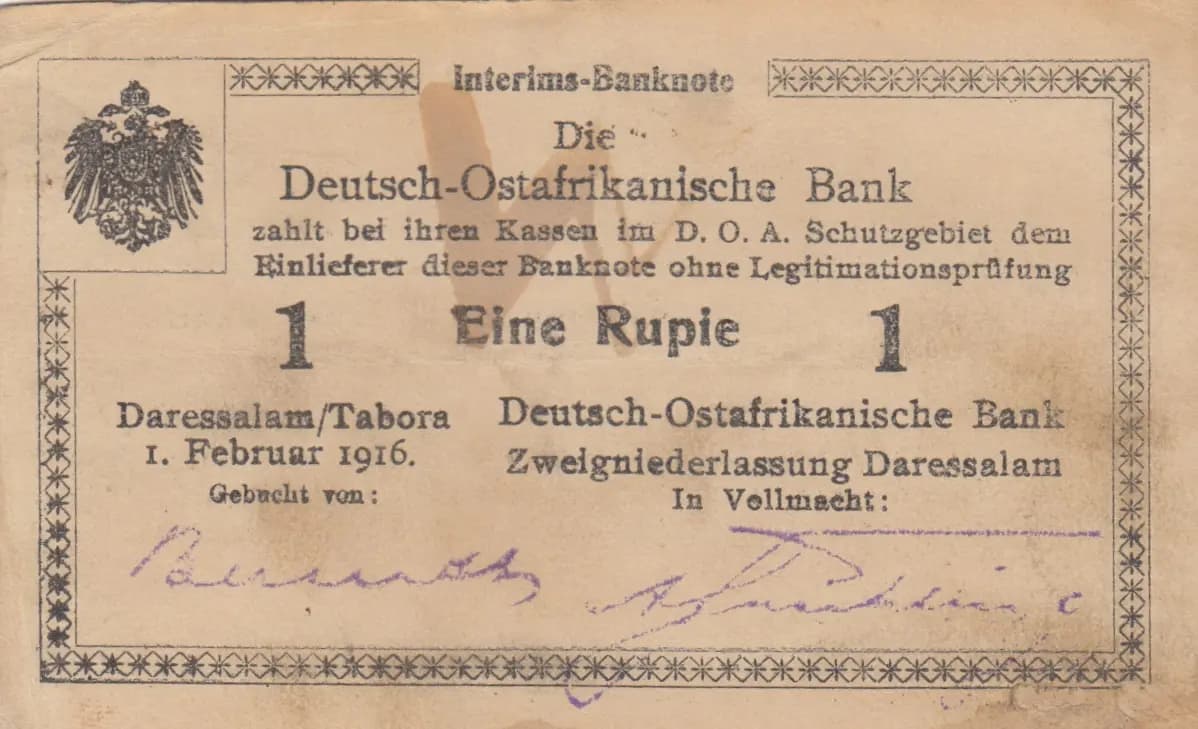
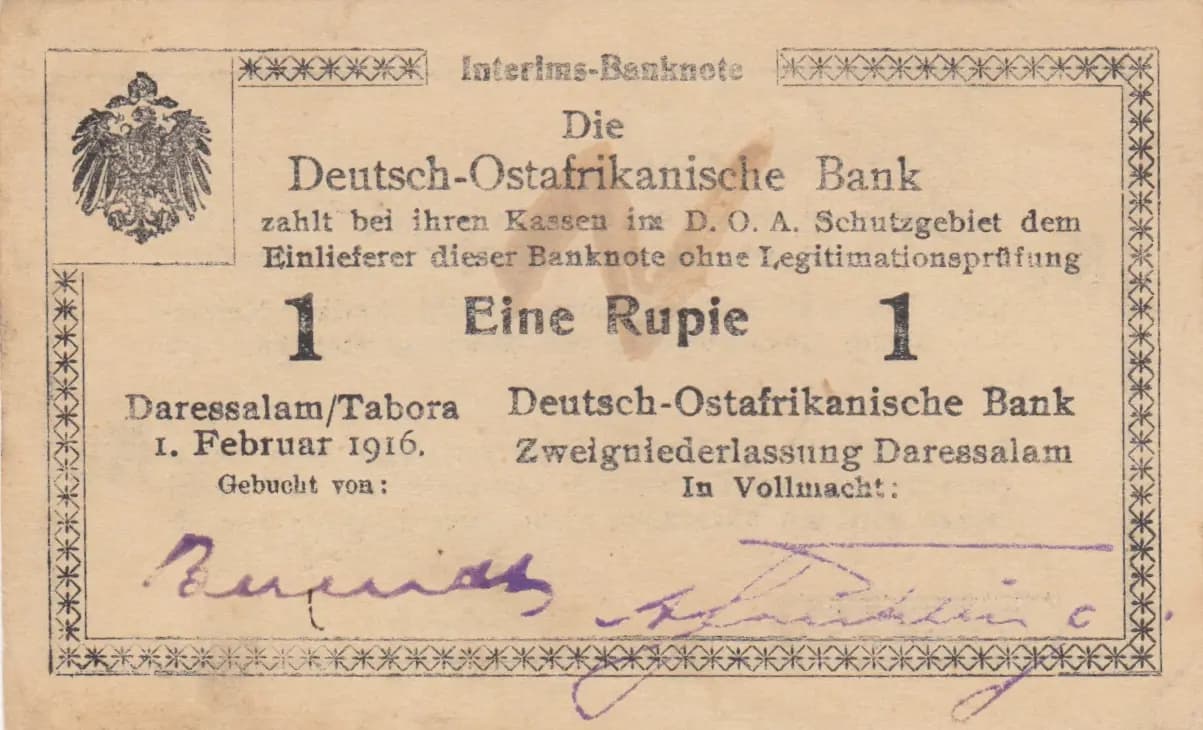
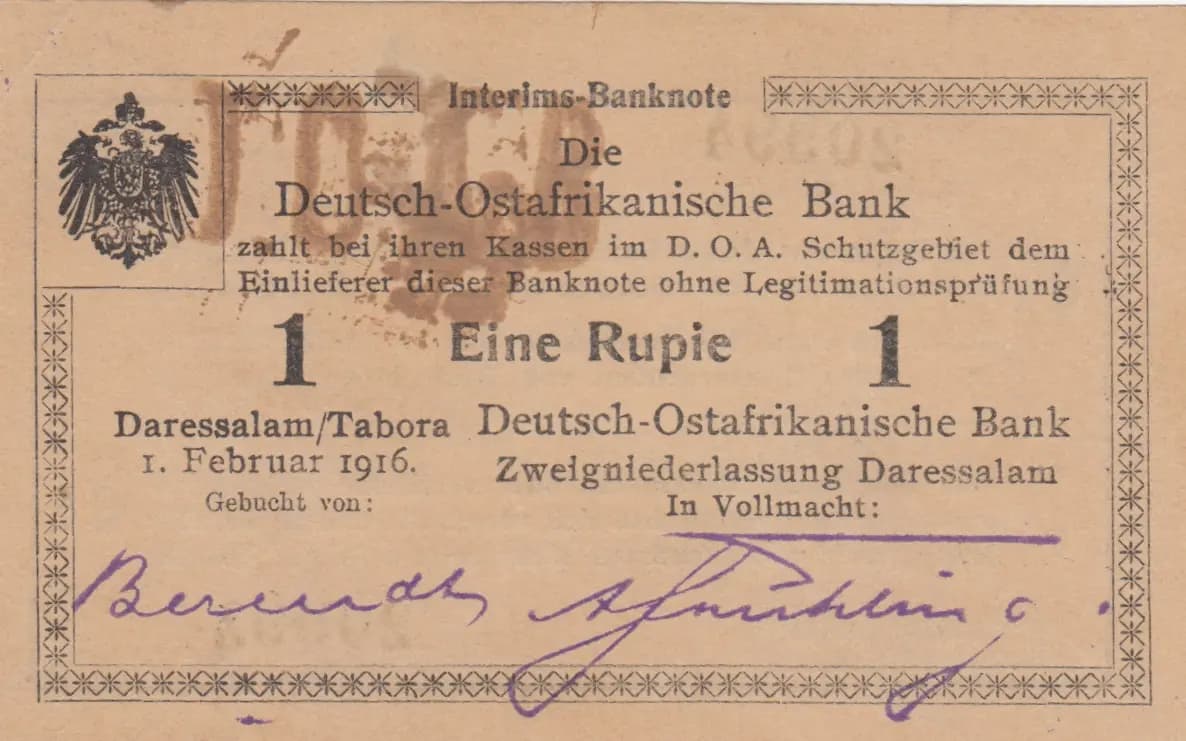
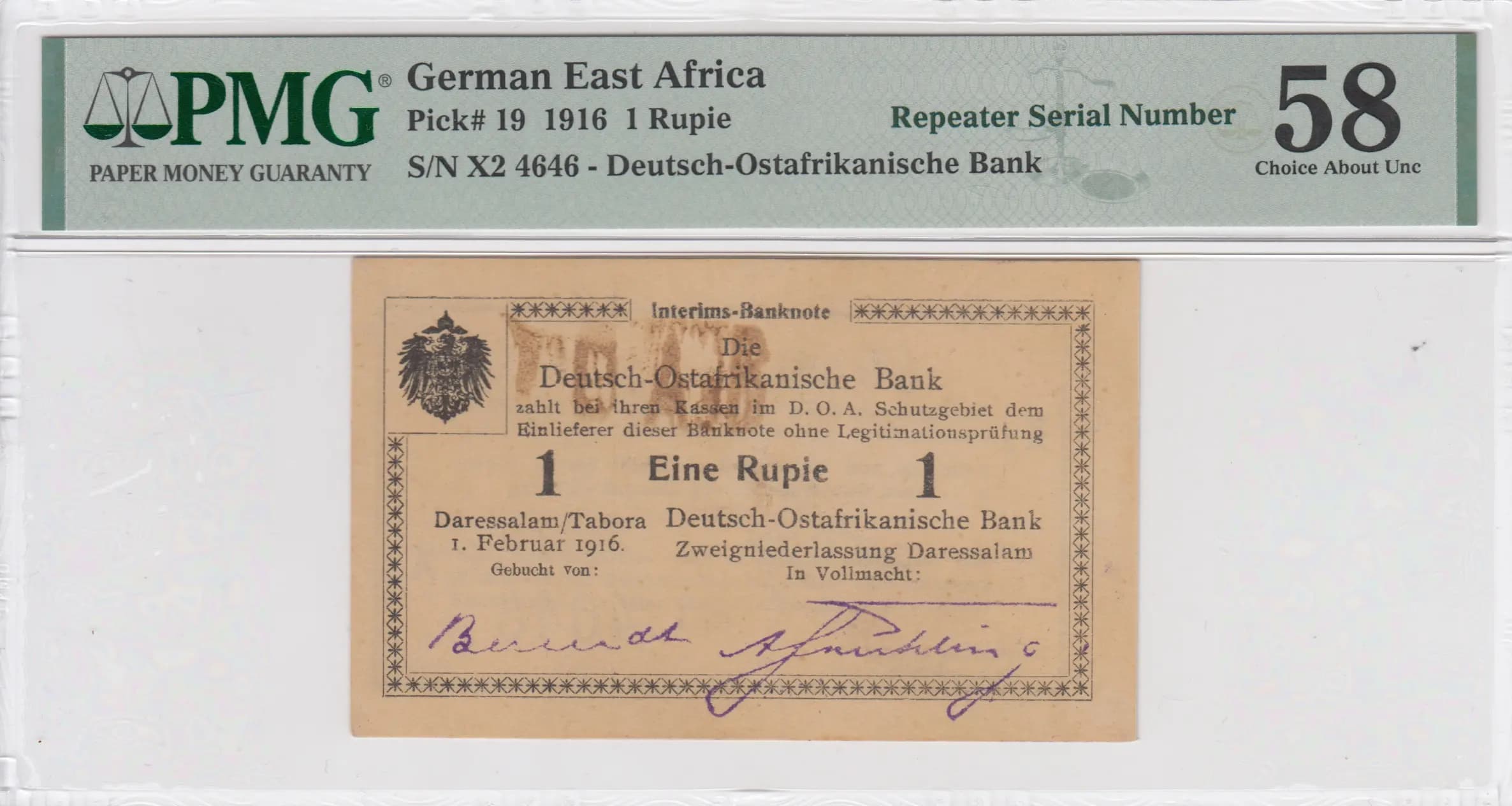
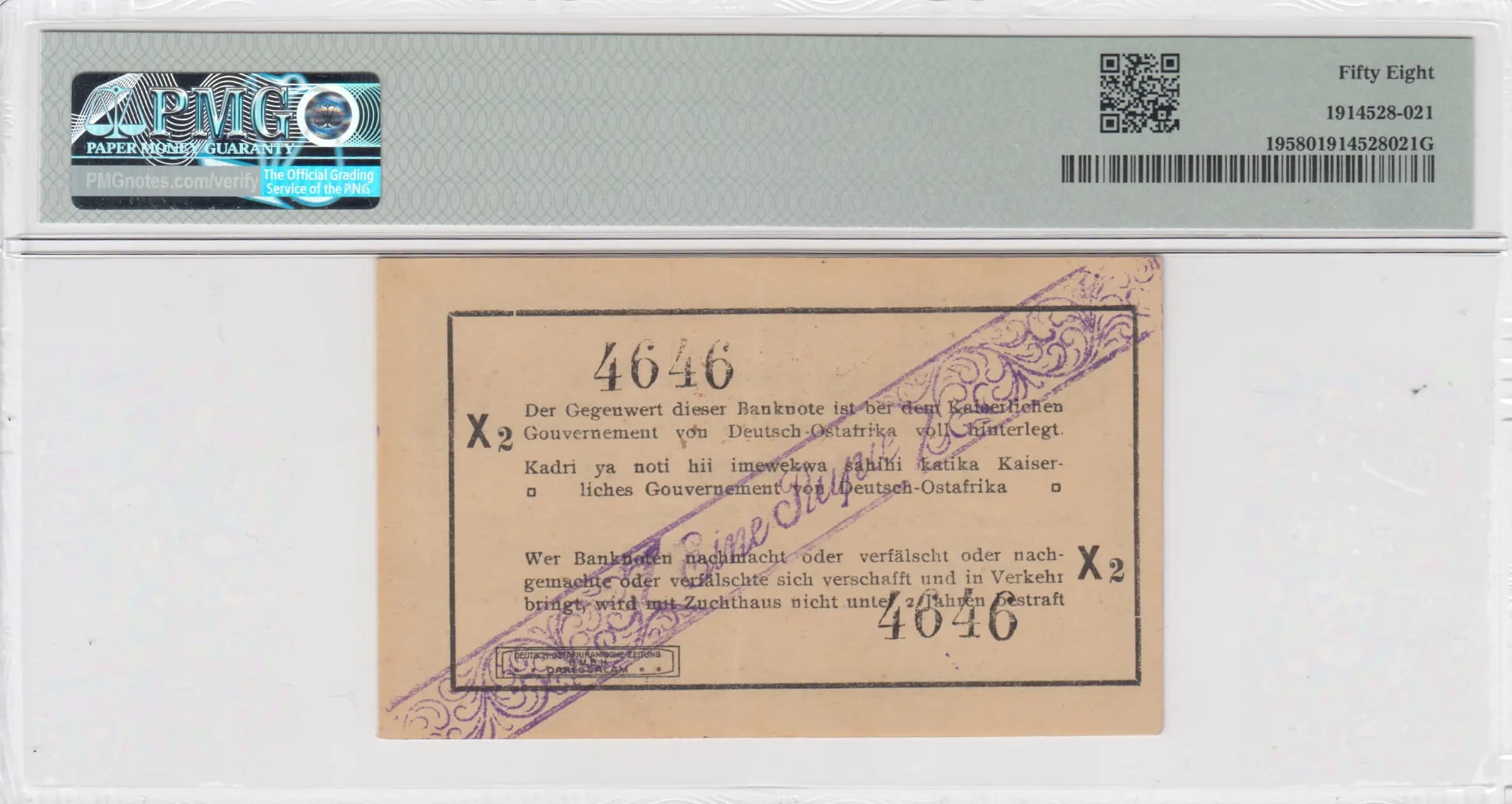
This is a 1 Rupie interim banknote from German East Africa dated 1 February 1916, issued by the Deutsch-Ostafrikanische Bank. The note exhibits PMG 58 condition with cream/beige coloring, visible foxing, creasing, and circulation wear typical of early 20th-century colonial currency. The obverse features the German Imperial Eagle in black and decorative X-pattern borders, with handwritten period signatures in purple/blue ink, while the reverse displays bilingual text in German and Swahili with serial number X2 4646 prominently printed twice—a characteristic security feature of this issue.
Common. The Deutsch-Ostafrikanische Bank issued multiple series of interim banknotes during WWI to address currency shortages in the protectorate. While Pick 19 represents a specific denomination and date, these emergency notes were produced in substantial quantities to facilitate commerce throughout German East Africa. The PMG 58 grade and serial number X2 4646 represent standard circulation examples. These notes remain available in the collector market at modest valuations, indicating adequate surviving supply relative to collector demand. The 1916 date is earlier than some other DOA issues, but does not command premium pricing reflecting scarcity.
This interim banknote represents a critical moment in German East African monetary history, issued during World War I when traditional banking infrastructure was disrupted. The bilingual German-Swahili inscriptions reflect the colonial administration's need to communicate with both European officials and the local East African population. The explicit redemption promise 'at its cashiers in the D.O.A. protectorate' and the statement that 'the equivalent value has been fully deposited with the Imperial Government of German East Africa' demonstrate the emergency measures taken to maintain confidence in colonial currency during wartime.
The obverse features a formal colonial design centered on the German Imperial Eagle coat of arms (Reichsadler) in the upper left, symbolizing imperial authority over the East African territory. The denomination '1' is displayed prominently on both left and right sides with 'Eine Rupie' (One Rupee) spanning the center, emphasizing the Indian currency standard used in German East Africa. Daressalam and Tabora are identified as the note-issuing locations, representing the two major administrative centers of the protectorate. The decorative X-pattern ornamental borders frame the note in classical formal style typical of German Imperial banking documents. The reverse contains the bilingual security warnings and serial number information, with the purple/blue handwritten flourish appearing to be a period authentication mark or handling notation. The overall design reflects the utilitarian aesthetic of wartime emergency currency.
FRONT SIDE: 'Interims-Banknote' (Interim Banknote) / 'Die Deutsch-Ostafrikanische Bank' (The German East African Bank) / 'zahlt bei Ihren Kassen im D.O.A. Schutzgebiet dem Einlieferer dieser Banknote ohne Legitimationsprüfung' (pays at its cashiers in the D.O.A. protectorate to the bearer of this banknote without verification of credentials) / '1 Eine Rupie 1' (1 One Rupie 1) / 'Daressalam/Tabora Deutsch-Ostafrikanische Bank' (Daressalam/Tabora German East African Bank) / '1. Februar 1916' (1st February 1916) / 'Zweigniederlassung Daressalam' (Daressalam Branch) / 'Gebucht von:' (Booked by:) / 'In Vollmacht:' (By proxy:) REVERSE SIDE: 'X2 4646' (Serial number) / 'Der Gegenwert dieser Banknote ist bei dem Kaiserlichen Gouvernement von Deutsch-Ostafrika vollständerlegt.' (The equivalent value of this banknote has been fully deposited with the Imperial Government of German East Africa.) / 'Kadri ya noti hii imewekwa sahihi katika Kaiserliches Gouvernement von Deutsch-Ostafrika' (The value of this note has been properly deposited at the Imperial Government of German East Africa) / 'Wer Banknoten nachahmt oder verfälscht oder gemachte oder verfälschte sich verschafft und in Verkehr bringt wird mit Zuchthuas nicht unter 2 Jahren Strafe' (Whoever counterfeits or forges banknotes or obtains and circulates counterfeit or forged notes will be punished with imprisonment of not less than 2 years)
Letterpress printing with separate applications for text and ornamental borders. The sharp, crisp impression of the German Imperial Eagle, denominational text, and bilateral German-Swahili inscriptions indicates professional printing using movable type and engraved plates. The handwritten signatures and decorative flourish were added post-printing in period purple/blue ink, typical of bank-authorized authentication methods for this era. No evidence of additional security printing techniques such as special inks, microprinting, or advanced anti-counterfeiting measures visible in the visual analysis, consistent with emergency wartime currency protocols.
Serial number variety X2 4646 is confirmed. The 'X2' prefix indicates second series printing; collectors should note that different series prefixes (X1, X2, X3, etc.) exist for this Pick number, potentially representing distinct printings. The handwritten signatures present on this specimen ('Gebucht von:' and 'In Vollmacht:' lines) would vary between individual notes, but the signature lines themselves are standard to the design. The Daressalam/Tabora dual-location designation is consistent with the standard issue, though some notes may show only one location depending on the branch that issued them. No notable overprints or date variations observed on this specimen.