1 rupee 1916
“serie X2”
About This Note
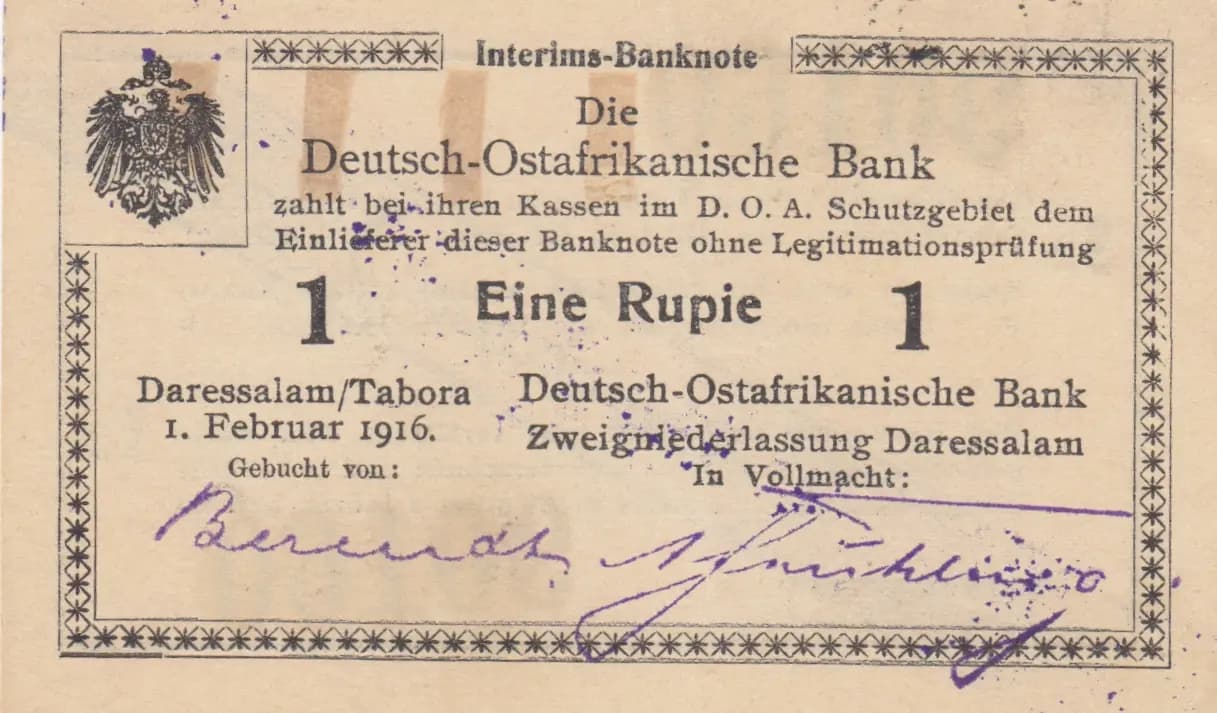
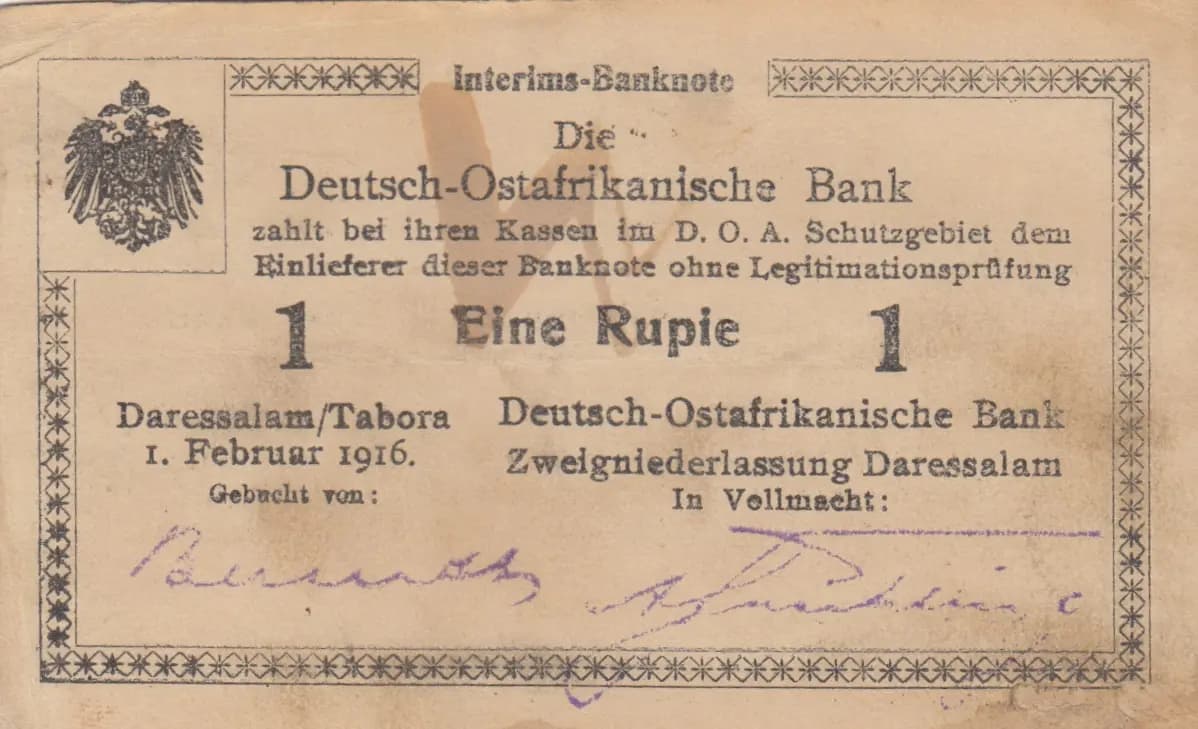
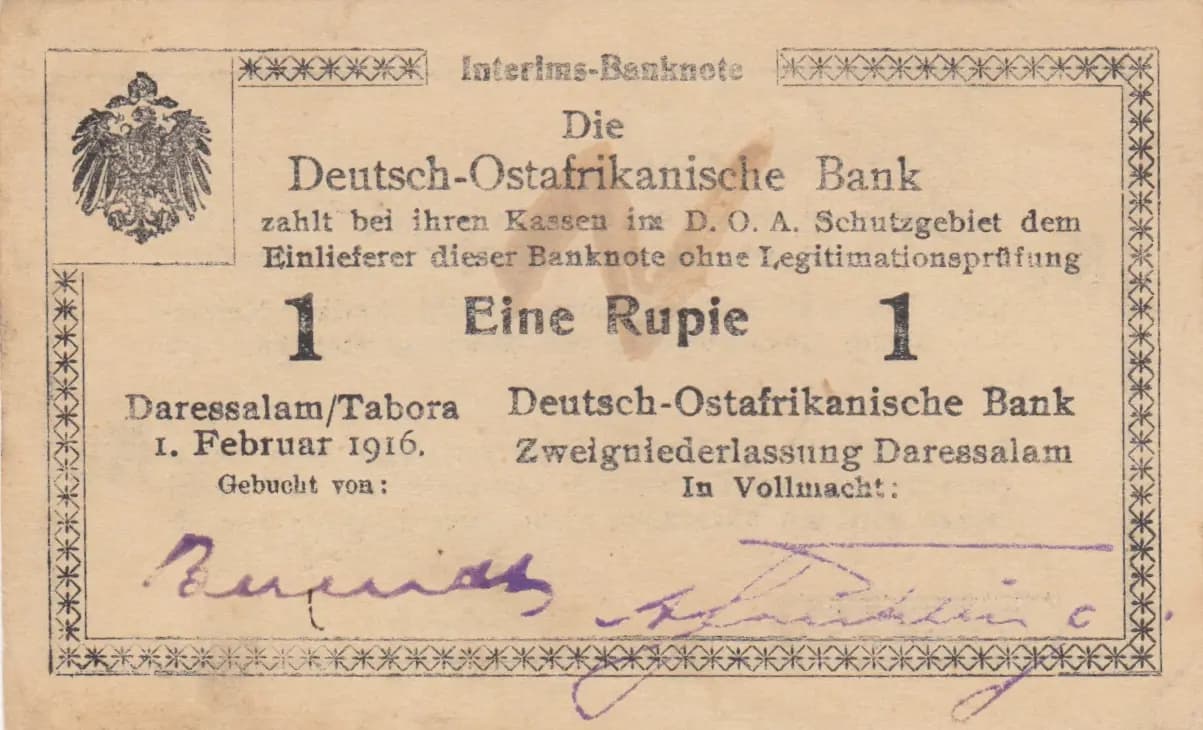
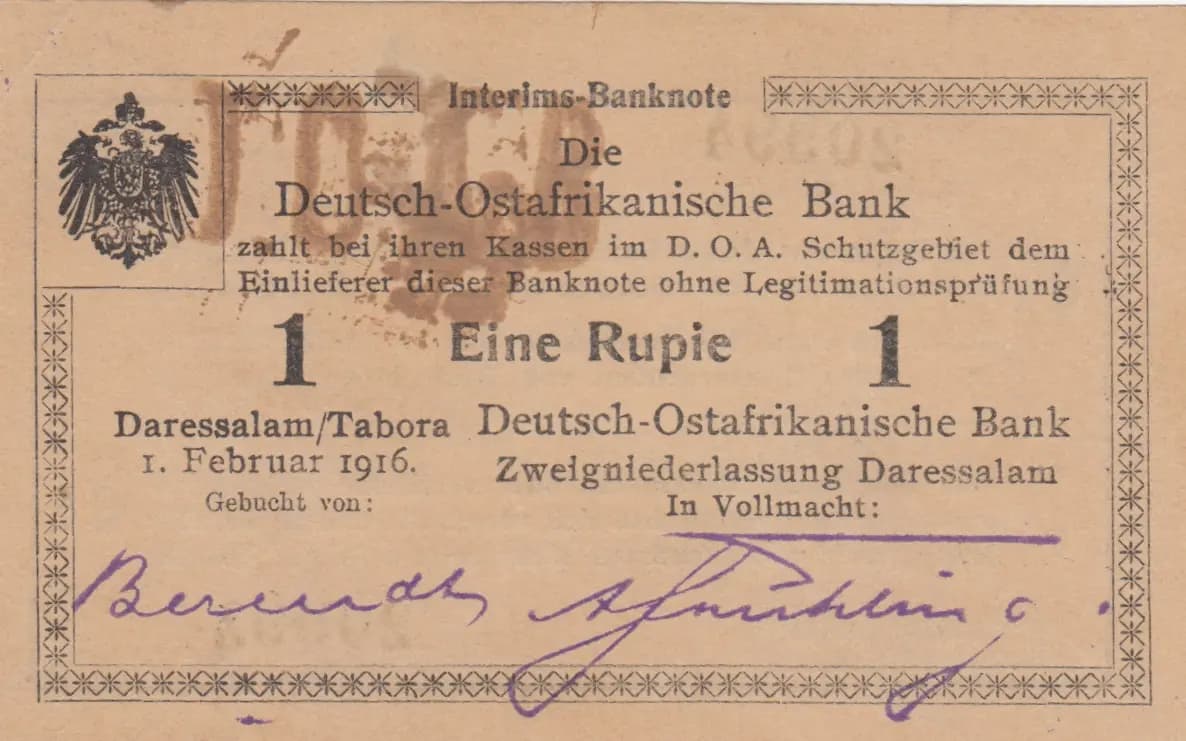
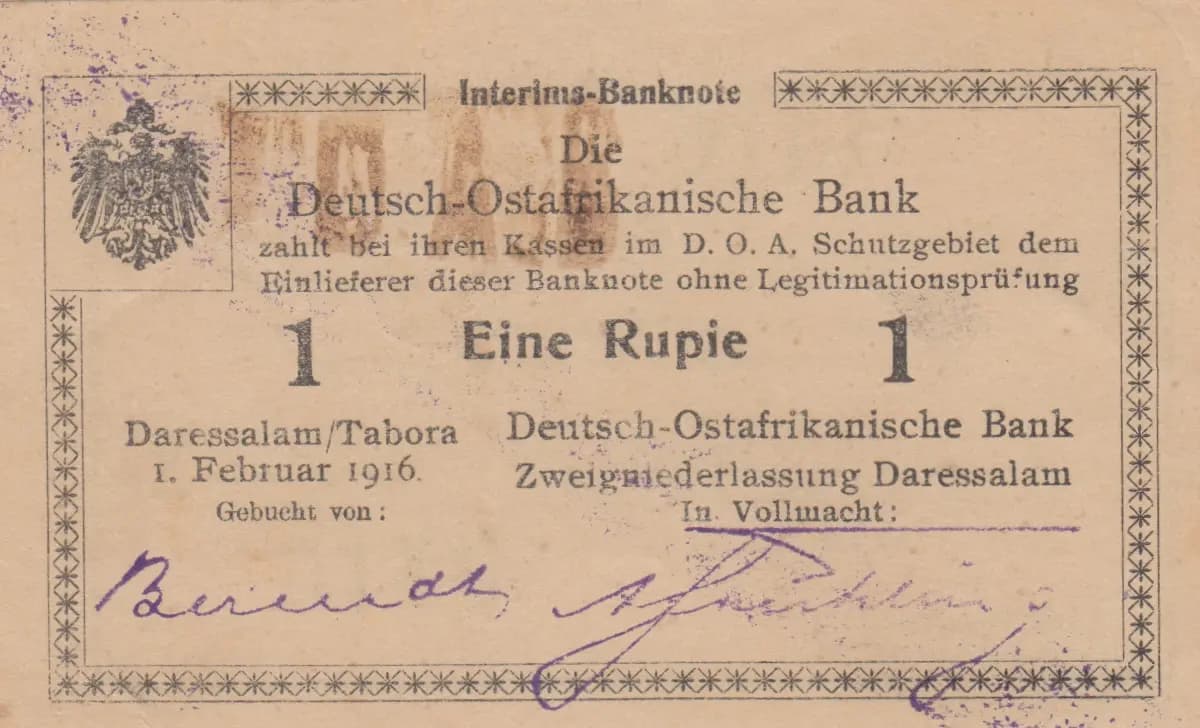
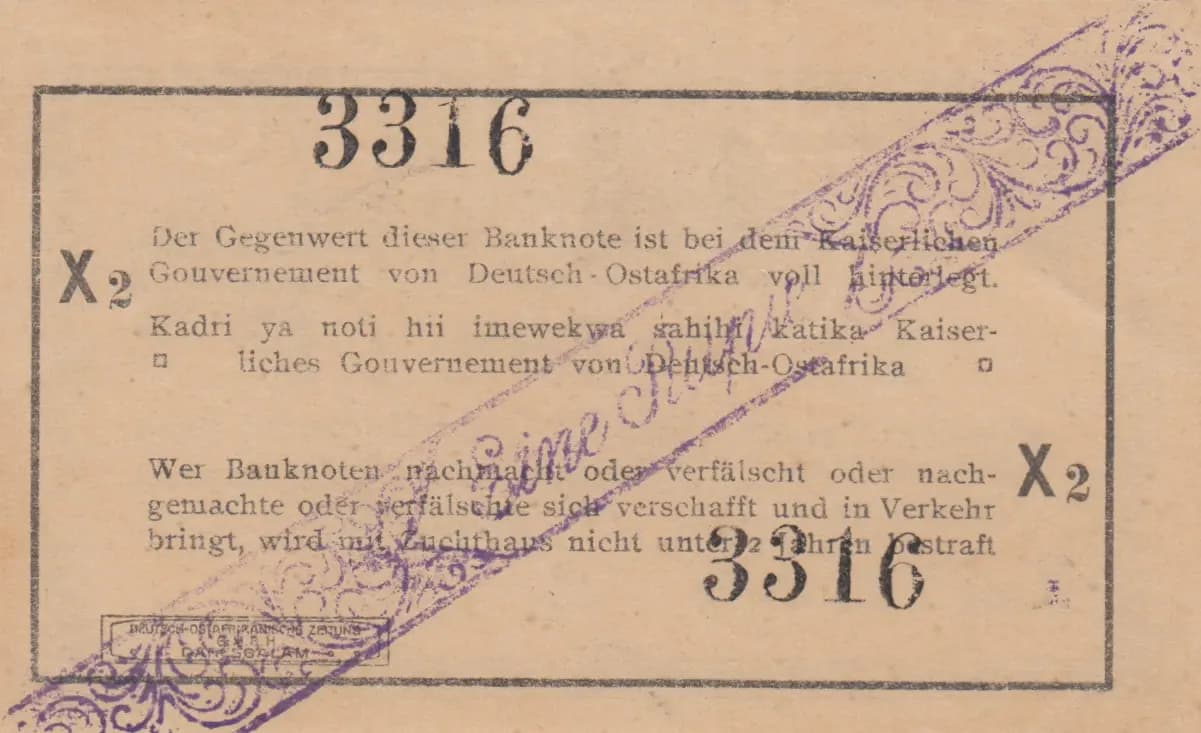
This is an AU-graded 1 Rupee interim banknote from the Deutsch-Ostafrikanische Bank dated 1 February 1916, issued during the final years of German East Africa. The note displays the characteristic German Imperial Eagle coat of arms and features handwritten signatures and purple stamps indicating official authorization from the Daressalam branch. Despite heavy foxing, browning, and age-related discoloration typical of WWI-era East African currency, the note retains good structural integrity with legible inscriptions and visible security features including the decorative diagonal stripe pattern on the reverse.
Common. The 1 Rupee denomination from the 1916 Deutsch-Ostafrikanische Bank interim issue (Pick P-19) was produced in substantial quantities as a low-denomination emergency currency needed for everyday transactions in German East Africa during WWI. While German East African currency is generally collected due to its historical significance, individual notes of this denomination and type regularly appear in the market at modest prices. The AU condition grade and series X2 marking do not represent unusual variants that would significantly impact rarity. No evidence of restricted print runs, early recalls, or scarcity markers applies to this particular issue.
This interim banknote represents an emergency currency issue by the Deutsch-Ostafrikanische Bank during World War I, when German East Africa faced severe monetary and logistical challenges. The dual-language inscriptions (German and Swahili) reflect the colonial administration's need to communicate with both European officials and African subjects in the protectorate. The note's February 1916 date places it during the later stages of the German colonial period in East Africa, just before the territory's military collapse and subsequent League of Nations mandate to Britain.
The obverse features the German Imperial Eagle (Reichsadler) with crown and shield positioned prominently on the left side, serving as the primary heraldic emblem of German authority. The note employs a decorative geometric border pattern framing the entire design. The denomination 'Eine Rupie' is clearly marked, with the date and issuing location (Daressalam/Tabora) indicating this as an official emergency issue. Handwritten signatures and authorization marks, including the name 'Berndt, Alwiki' as authorized representative, validate the note. The reverse displays a distinctive decorative diagonal stripe with ornamental patterns running across the center, serving both as a design element and security feature. Serial number 3316 appears twice (upper and lower positions) for verification purposes, with series marking 'X 2' flanking the design on both sides. The entire note is printed in black on tan/cream paper stock with purple/violet stamps and handwritten notations overlaid for administrative processing.
FRONT SIDE: 'Interims-Banknote' (Interim Banknote) / 'Die Deutsch-Ostafrikanische Bank' (The German East African Bank) / 'zahlt bei ihren Kassen im D. O. A. Schutzgebiet dem Einlieferer dieser Banknote ohne Legitimationsprüfung' (pays at its tills in the D. O. A. protectorate to the bearer of this banknote without verification of legitimacy) / 'Eine Rupie' (One Rupee) / 'Daressalam/Tabora' (Daressalam/Tabora) / '1. Februar 1916' (1st February 1916) / 'Gebucht von:' (Booked by:) / 'Deutsch-Ostafrikanische Bank Zweigniederlassung Daressalam' (German East African Bank Branch Daressalam) / 'In Vollmacht:' (By Power of Attorney:) / 'Berndt, Alwiki' (handwritten signature). BACK SIDE: '3316' (Serial number) / 'Der Gegenwert dieser Banknote ist bei dem Kaiserlichen Gouvernement von Deutsch-Ostafrika voll hinterlegt.' (The value of this banknote is fully deposited with the Imperial Government of German East Africa) / 'Kadri ya noti hii imewekwa sahihi katika Kaisarliche Government von Deutsch-Ostafrika' (mixed Swahili-German text regarding deposit of note value) / 'Wer Banknoten nachahmt oder verfälscht oder nachgeauchte oder verfälschte sich verschafft und in Verkehr bringt, wird mit Zuchthaus nicht unter 2 Jahren bestraft' (Whoever counterfeits or forges banknotes or obtains counterfeit or forged ones and puts them into circulation will be punished with hard labor for not less than 2 years) / 'X 2' (series marking).
This interim banknote was produced using letterpress/typography printing, which was the standard method for German East African currency during WWI. The impression characteristics visible in the design details—including the sharp serif typefaces and crisp lines of the geometric borders and imperial eagle—are consistent with letterpress production. The purple/violet stamps and handwritten signatures were applied post-printing as authorization and administrative marks. The decorative elements, including the diagonal stripe pattern and border work, show the precision typical of German security printing standards of the period, though this interim note lacks the advanced security features found in higher-denomination currency.
Series X2 is noted on this specimen, visible on both obverse and reverse. Serial number 3316 with the X2 series designation represents one of many numbered notes within the interim issue. The handwritten signature 'Berndt, Alwiki' as authorized representative may indicate a specific series variant within the 1916 issue. Known varieties for Pick P-19 include different series designations and signature combinations reflecting different authorization periods and branch locations (Daressalam and Tabora). This particular example combines the X series designation with Daressalam branch issuance and early February 1916 dating.