50 francs 1964
About This Note
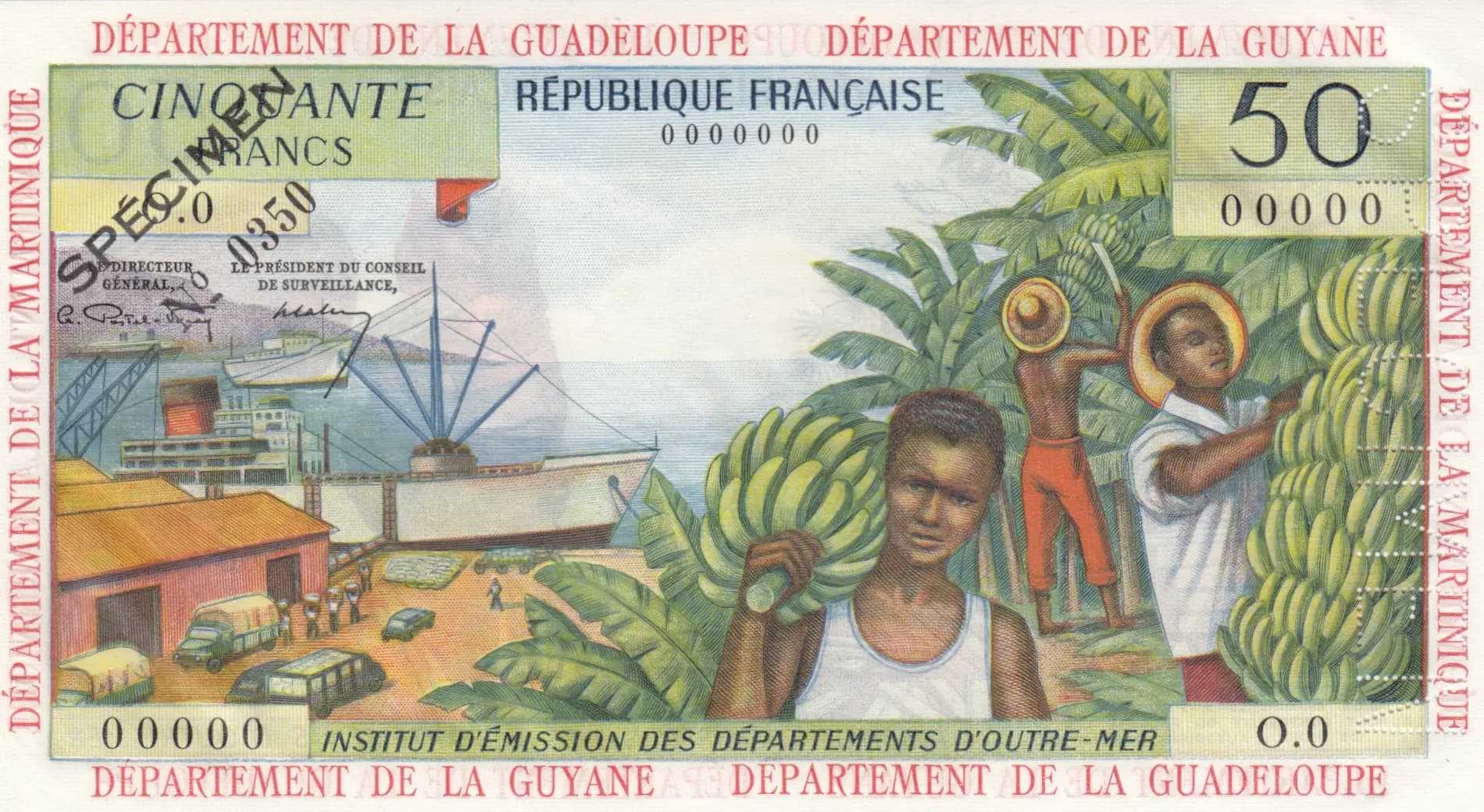
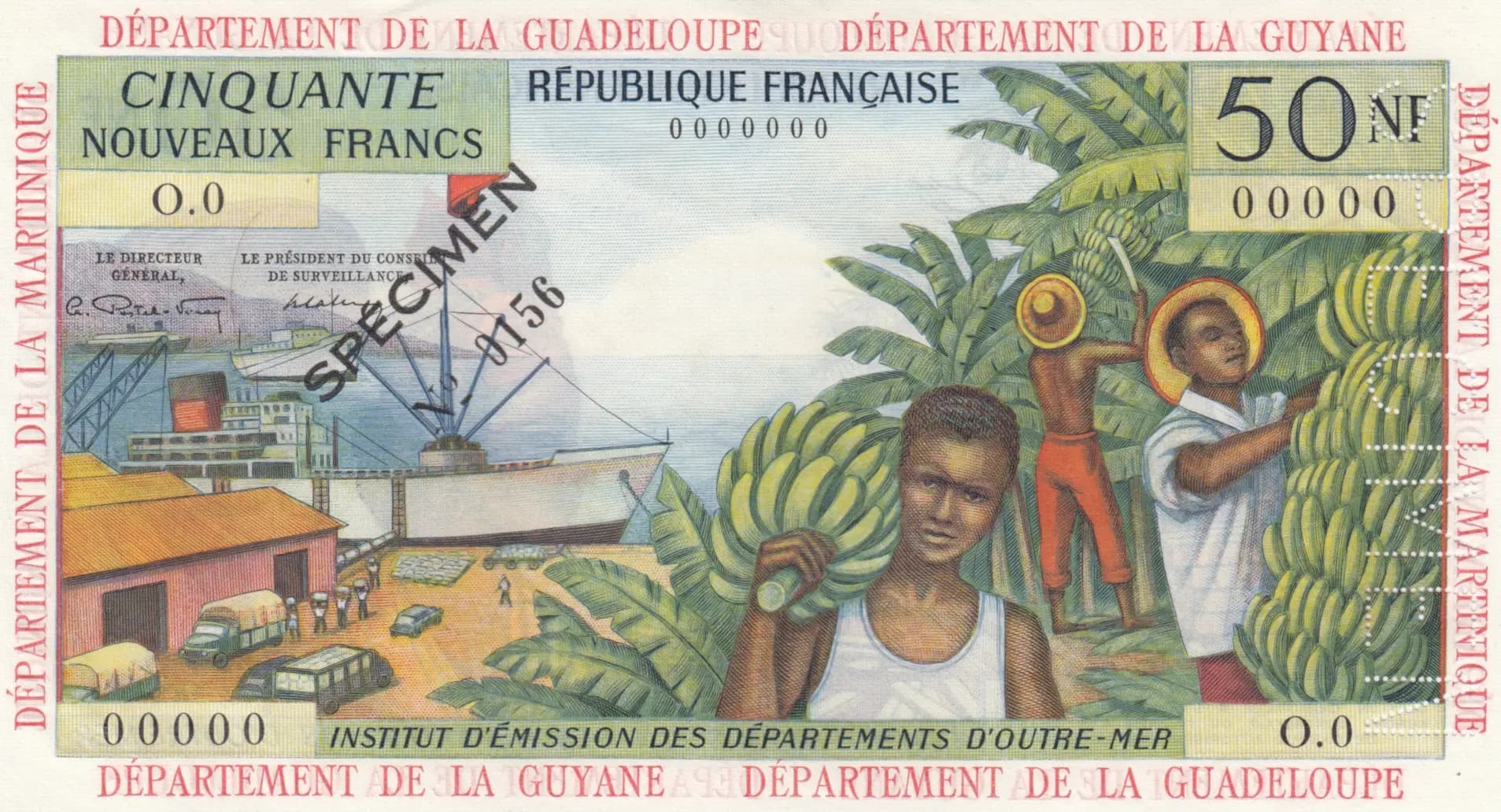
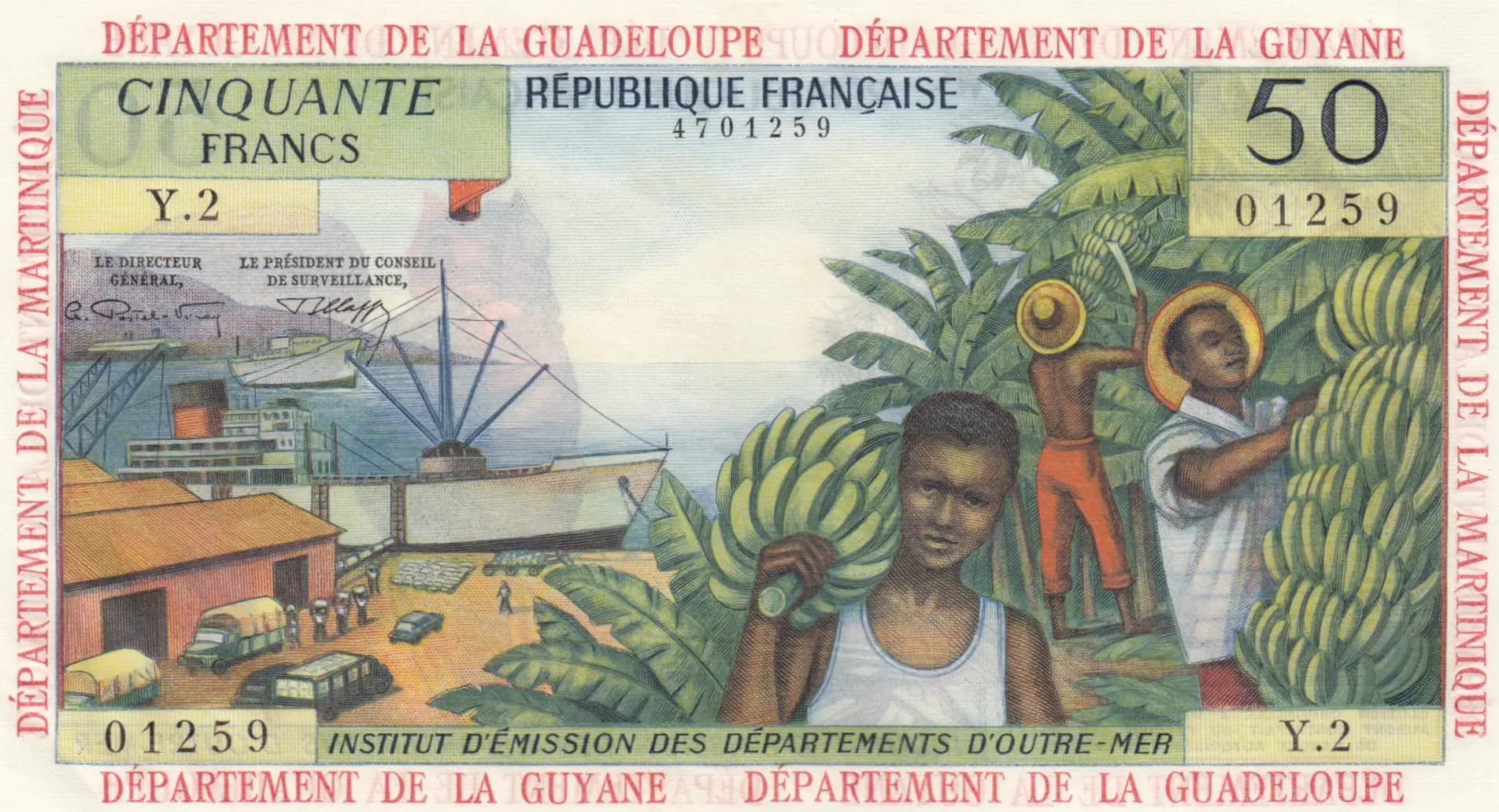
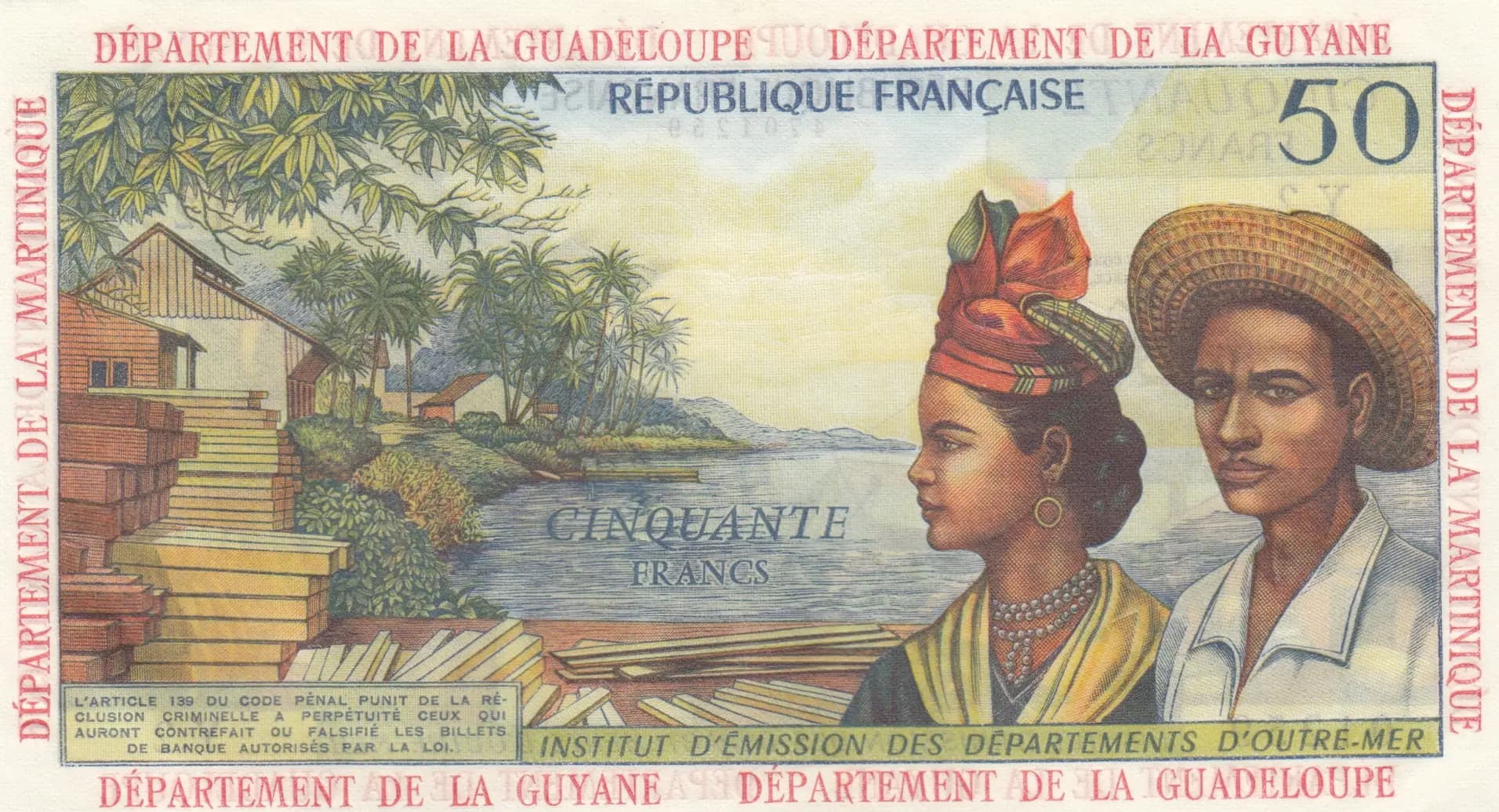
This is an uncirculated 1964 French Antilles 50 francs note (Pick-9b) issued by the Institut d'Emission des Départements d'Outre-Mer, showcasing the economic and cultural identity of the French Caribbean departments. The obverse depicts a striking contrast between maritime commerce—a cargo ship at a modern port facility—and agricultural production with banana harvesters, while the reverse features two indigenous Caribbean women in traditional dress alongside a colonial-era elevated wooden dwelling. The note exhibits exceptional preservation with no signs of circulation, vibrant color printing, and fine engraving throughout, representing an excellent example of mid-20th century French colonial currency design.
Common. The Institut d'Emission des Départements d'Outre-Mer issued this denomination across multiple production runs throughout the 1960s for circulation in three major French Caribbean territories with substantial populations. While specific print run data is not definitively available, the existence of multiple catalog varieties (P-9a, P-9as, P-9b, P-9s) suggests reasonably large production quantities to warrant variant classification. The uncirculated condition increases collector desirability but does not make the note scarce; UNC examples of this type are regularly available in the numismatic market at moderate prices typical of 1960s French colonial currency.
Issued in 1964 during the height of the French colonial period in the Caribbean, this note commemorates the three primary French Antilles departments—Guadeloupe, Martinique, and French Guiana—as integral territories of the French Republic. The dual imagery of the port facility and banana plantation reflects the economic foundations of these territories, which were heavily dependent on maritime trade and agricultural export, particularly of tropical produce. The representation of traditional Caribbean culture alongside modern infrastructure symbolized France's vision of modernizing its overseas departments while acknowledging their distinctive heritage and populations.
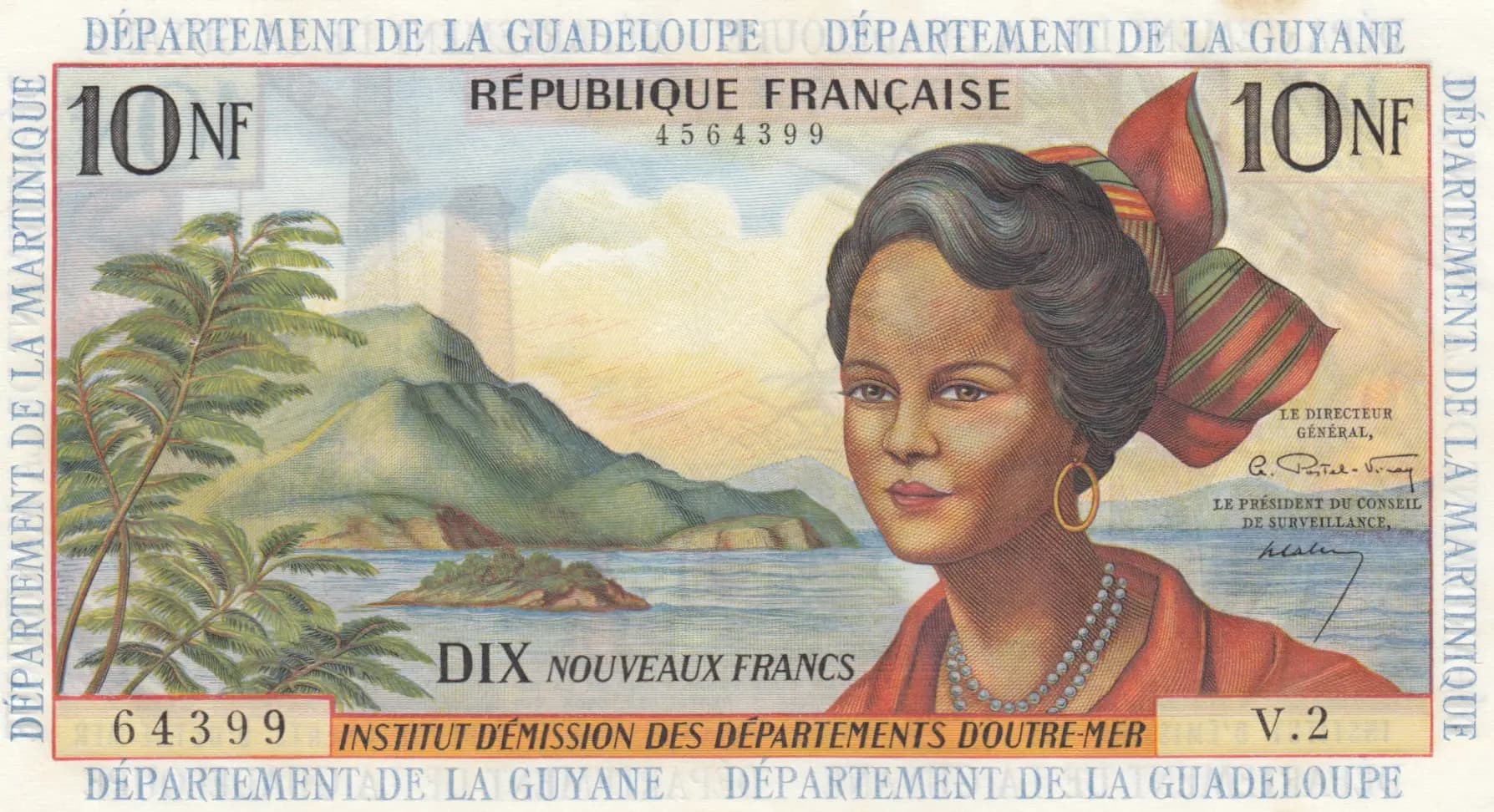
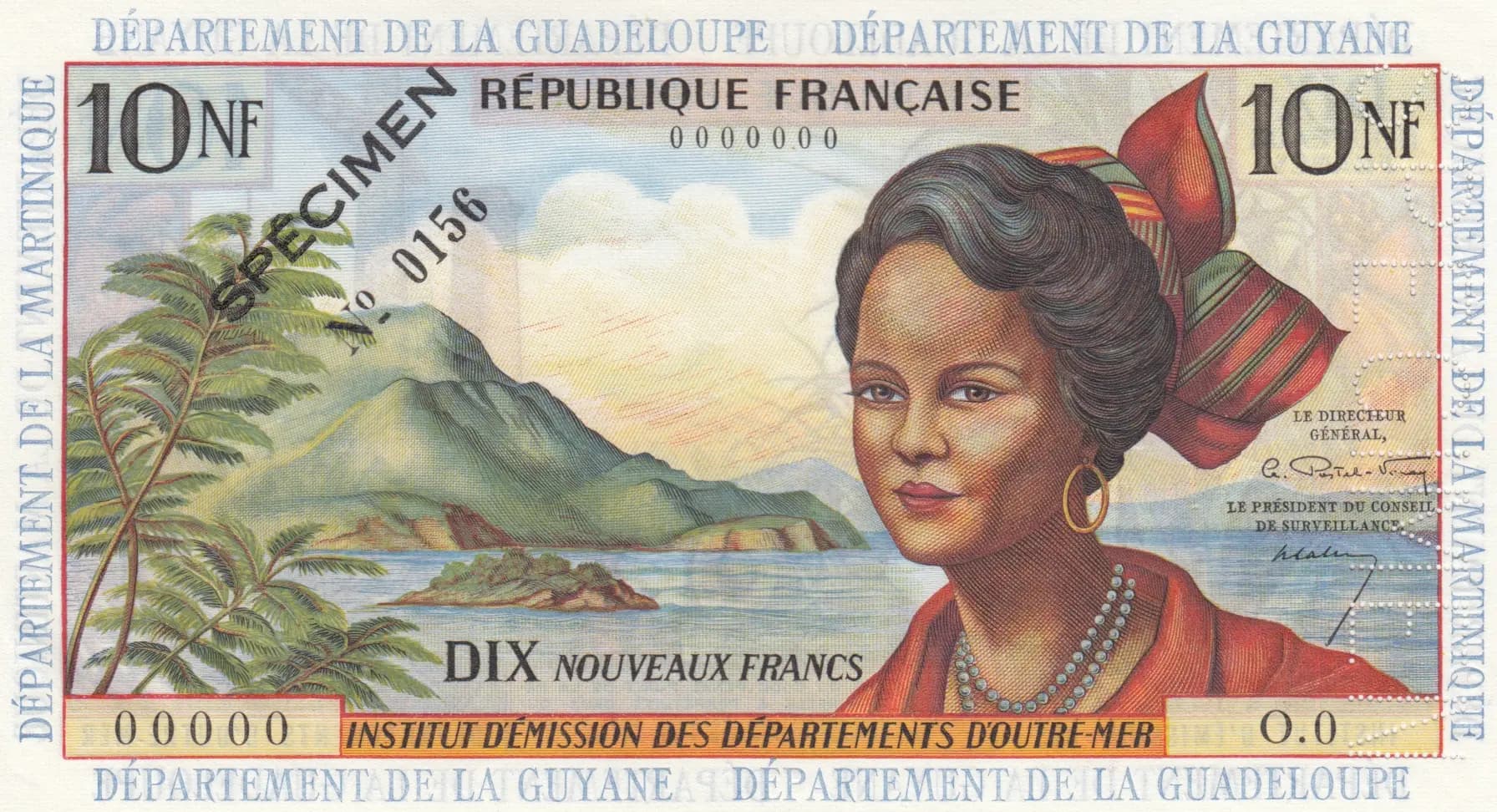
The obverse features a dynamic composition contrasting economic activities: on the left, a modern port facility with a cargo ship flying the French flag, a red-roofed warehouse, loading dock infrastructure with crane equipment, and dock workers; on the right, a tropical agricultural scene depicting banana cultivation with an adult male worker and young child harvesting banana bunches from lush tropical vegetation. The reverse displays two female portraits in profile—one wearing a traditional red headwrap with gold decorative elements and olive-yellow clothing (likely representing Martinique or Guadeloupe creole heritage), and another wearing a tan straw hat and white clothing with a pearl necklace (possibly representing French Guiana's European heritage). These portraits are accompanied by a colonial-era wooden plantation house elevated on pillars, surrounded by palm trees and tropical foliage with a waterway or coastline in the background. The overall design palette employs greens, yellows, browns, oranges, reds, and blues on a cream base, with decorative border elements framing all imagery. The note is dominated by fine line engraving and detailed portraiture throughout.
FRONT SIDE: 'CINQUANTE FRANCS' (Fifty Francs) / 'Y.2' (Security code) / 'DÉPARTEMENT DE LA GUADELOUPE' (Department of Guadeloupe) / 'DÉPARTEMENT DE LA GUYANE' (Department of French Guiana) / 'RÉPUBLIQUE FRANÇAISE' (French Republic) / 'INSTITUT D'ÉMISSION DES DÉPARTEMENTS D'OUTRE-MER' (Issuing Institute of Overseas Departments) / 'DÉPARTEMENT DE LA MARTINIQUE' (Department of Martinique) / 'LE DIRECTEUR GÉNÉRAL' (The General Director) / 'LE PRÉSIDENT DU CONSEIL DE SURVEILLANCE' (The President of the Supervisory Board) / Serial number: '4701259' / Denomination: '50'. REVERSE SIDE: 'CINQUANTE FRANCS' (Fifty Francs) / 'DÉPARTEMENT DE LA GUADELOUPE' (Department of Guadeloupe) / 'DÉPARTEMENT DE LA GUYANE' (Department of French Guiana) / 'DÉPARTEMENT DE LA MARTINIQUE' (Department of Martinique) / 'RÉPUBLIQUE FRANÇAISE' (French Republic) / 'INSTITUT D'ÉMISSION DES DÉPARTEMENTS D'OUTRE-MER' (Issuing Institute of Overseas Departments) / 'L'ARTICLE 139 DU CODE PÉNAL PUNIT DE LA RÉCLUSION CRIMINELLE À PERPÉTUITÉ CEUX QUI AURAIENT CONTREFAIT OU FALSIFIÉ LES BILLETS DE BANQUE AUTORISÉS PAR LA LOI' (Article 139 of the Penal Code punishes with life imprisonment those who would counterfeit or falsify banknotes authorized by law) / Denomination: '50'.
Intaglio engraving (line engraving), evidenced by the fine line work, detailed portrait rendering, and complex background patterns visible throughout both sides. The multi-color printing technique appears to employ separate color passes characteristic of French banknote production from the Banque de France's security printer (likely Bradbury Wilkinson & Co. or the French state printing works), creating the vibrant but controlled color palette with excellent registration. The fine line printing and absence of visible dot patterns confirm traditional intaglio rather than lithographic methods.
This specimen is catalogued as Pick-9b, identified by its Woman's Head watermark, distinguishing it from the P-9a, P-9as, and P-9s variants also bearing the same Woman's Head watermark but classified separately in the Pick catalog system. The 'Y.2' code visible on the obverse may indicate a specific printing series or security feature designation. The serial number '4701259' should be recorded for variety identification purposes. No overprints or date variations are evident, consistent with the 1964 base design. The P-9b designation suggests this note may represent a later printing of the design or a specific administrative variant issued by the Institut d'Emission.