10 nouveaux francs 1963
About This Note
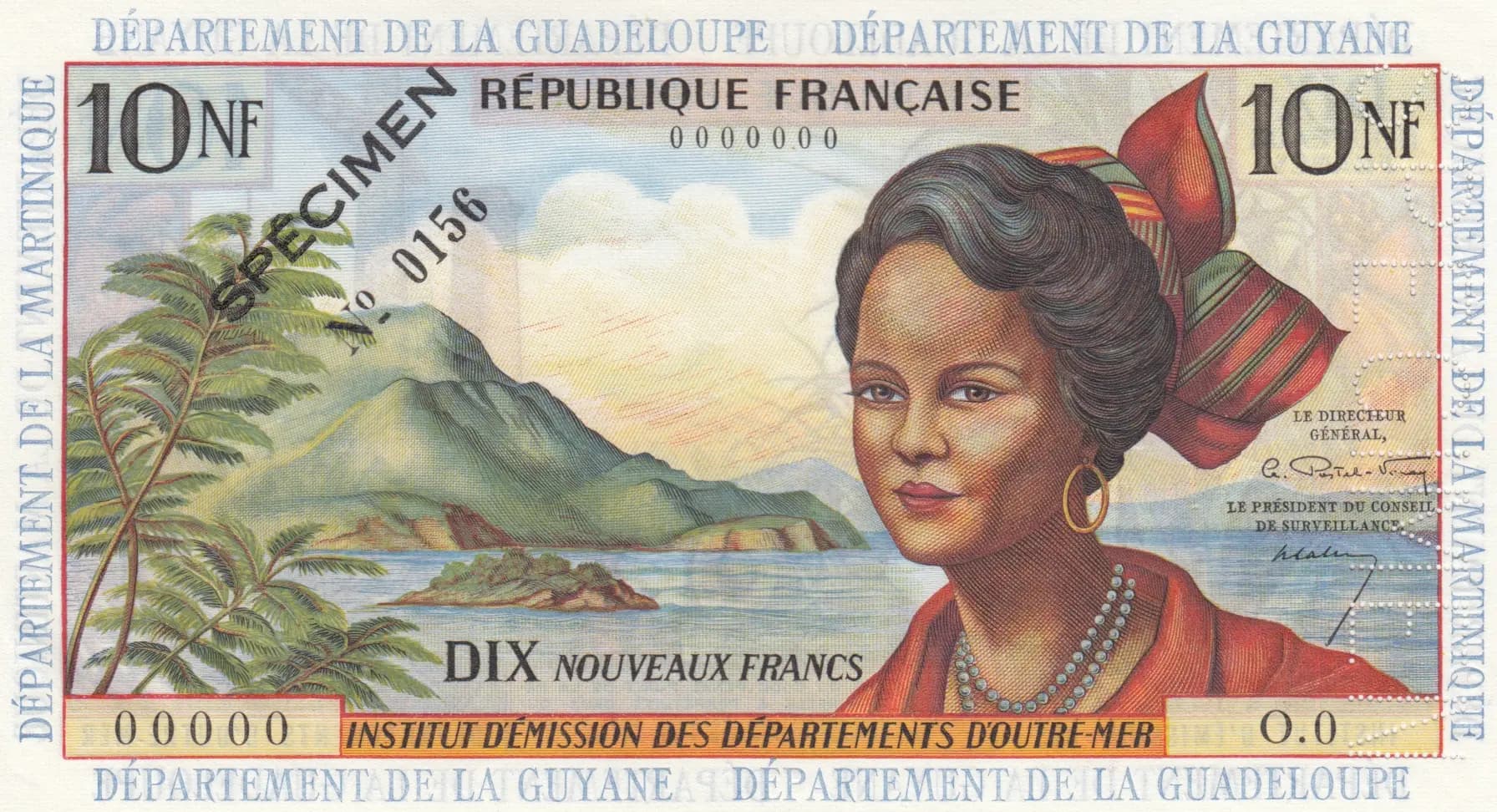
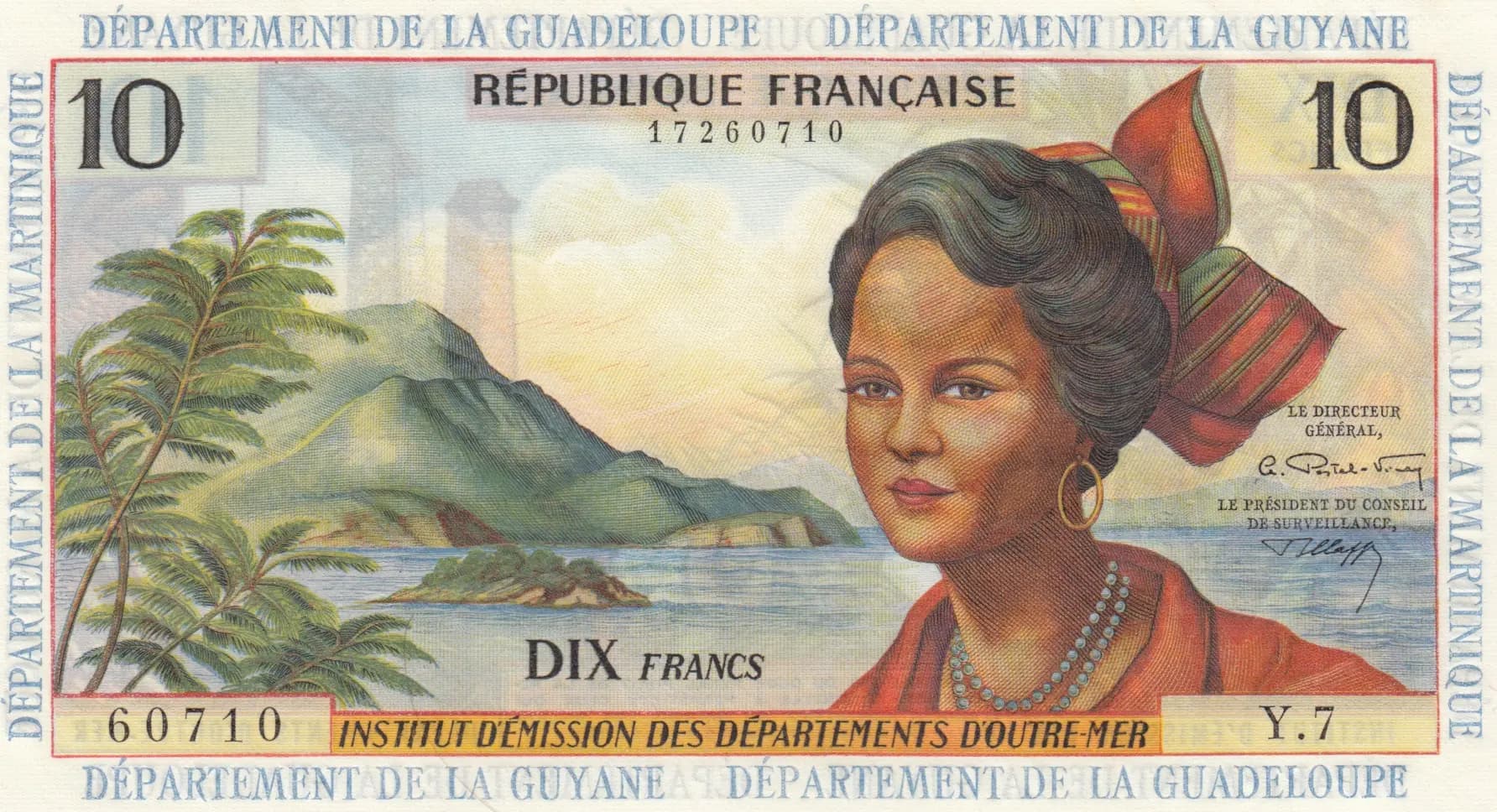
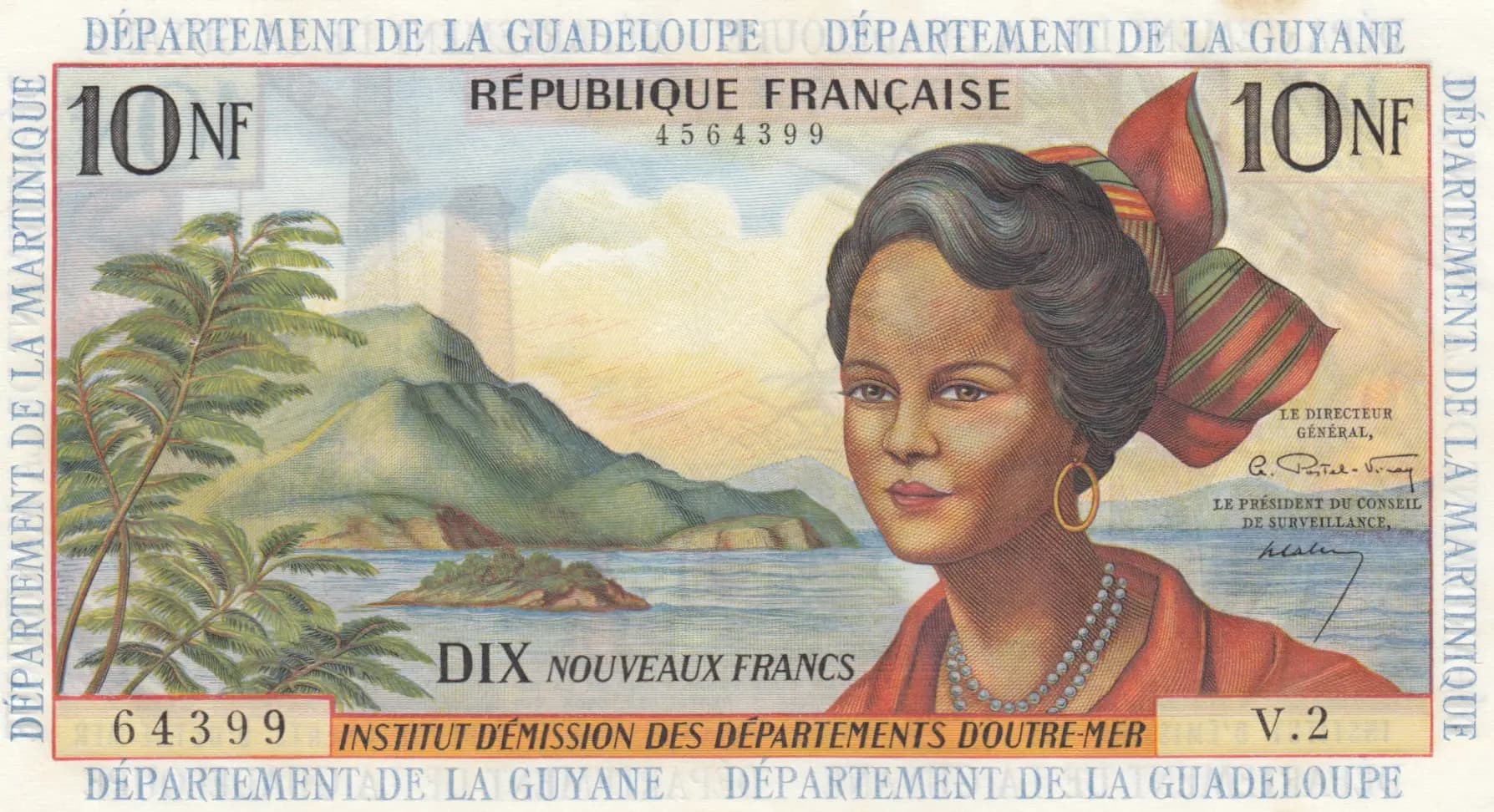
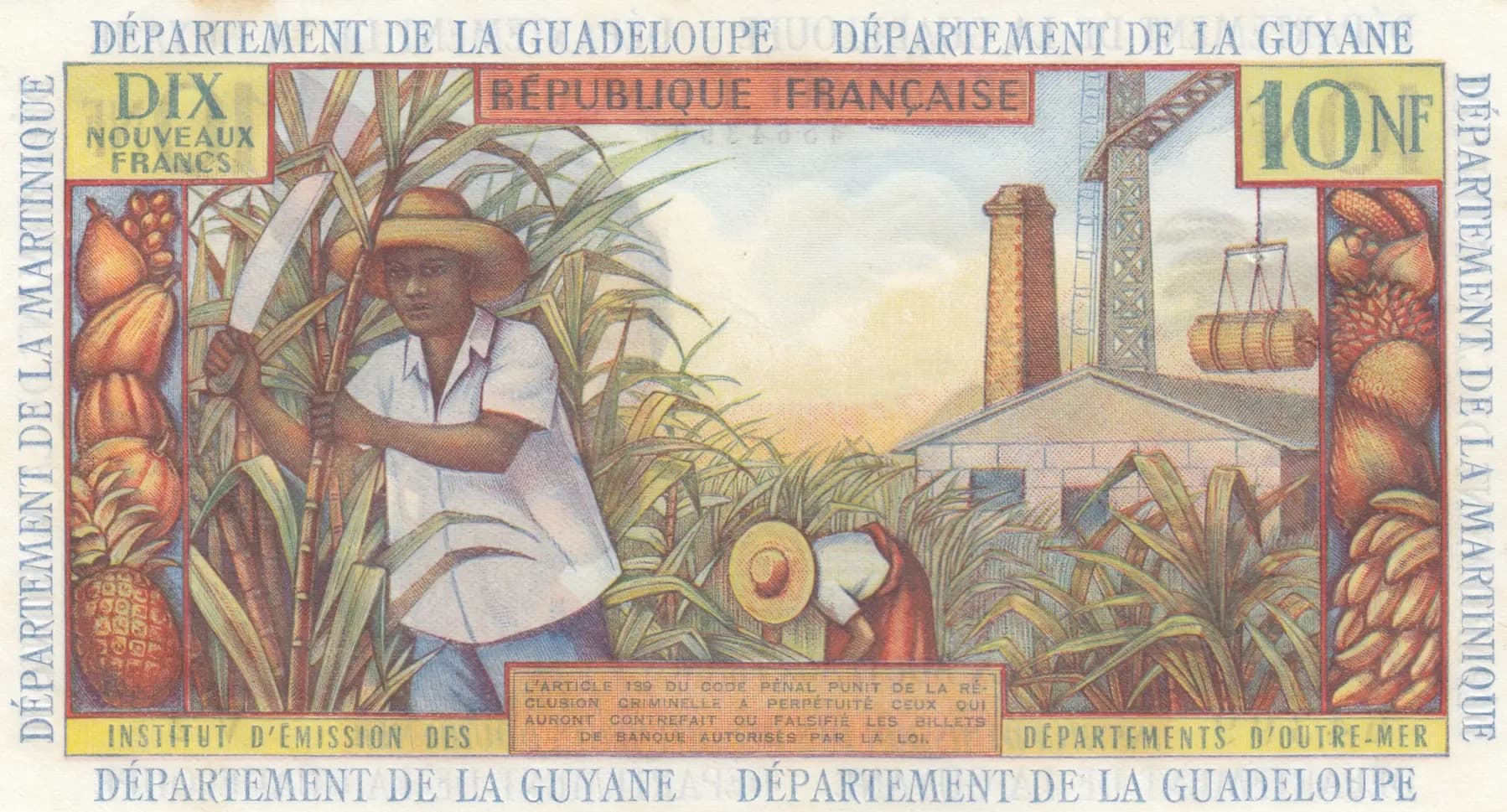
This is an uncirculated 1963 French Antilles 10 nouveaux francs note (Pick-5) issued by the Institut d'Emission des Departements d'Outre-Mer, representing the currency of France's Caribbean overseas departments. The note displays exceptional condition with crisp printing, vibrant color gradation (blues, greens, reds, and earth tones), and intricate engraving throughout both sides. The front features a finely rendered portrait of a woman in traditional Caribbean dress with a pearl necklace and red bow, set against a tropical landscape with mountains and palm trees, while the reverse depicts colonial-era agricultural and industrial scenes including sugar cane harvesting, factory buildings, and a harbor with sailing ship.
Common. The 1963 10 nouveaux francs of the French Antilles (Pick-5) represents a standard circulation-era banknote from a stable, long-operating issuing authority (Institut d'Emission des Departements d'Outre-Mer). With no indication of a brief issue period, large recall, or minimal print run, and given that these notes were issued as regular currency for the French Caribbean's substantial population, examples remain readily available in the collector market. The existence of catalogued variants (P-5a and P-5s) further suggests significant production runs. Uncirculated examples are desirable but not scarce, making this a common note even in premium condition.
This banknote commemorates the economic foundation of French Caribbean territories during the post-colonial period, with imagery celebrating the sugar cane, cacao, and pineapple industries that defined Guadeloupe and French Guiana's commercial identity. The 1963 date marks the Nouveau Franc era (introduced in 1960), reflecting France's monetary modernization and its continued fiscal integration of overseas departments. The depicted labor scenes and agricultural symbols represent the tropical wealth extraction that historically characterized these French Antilles territories, presented through a romanticized aesthetic typical of mid-20th century colonial-era currency design.
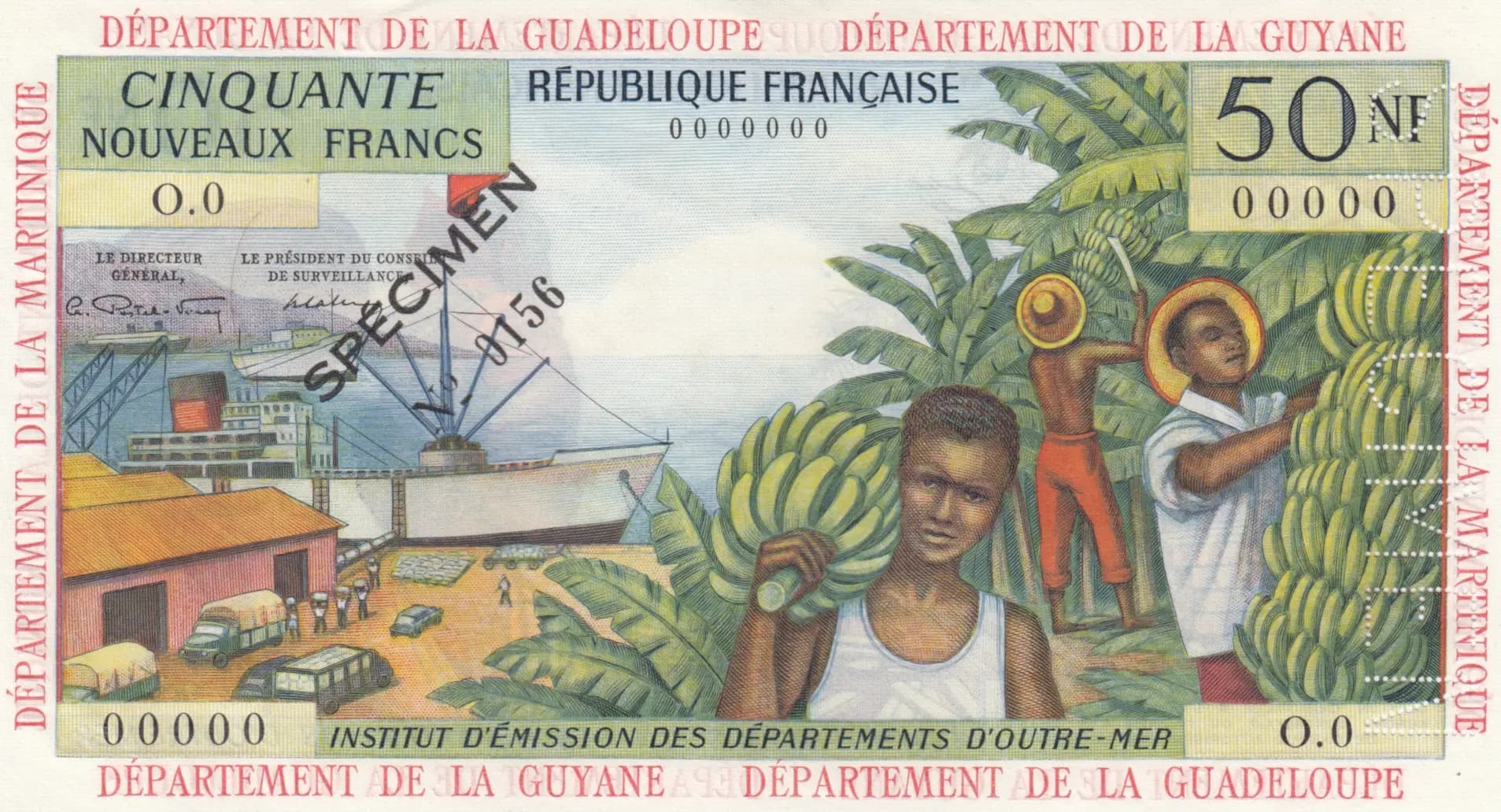
The obverse features an allegorical female portrait in right profile, representing the personification of the French Caribbean territories, adorned with traditional period dress including a red garment, pearl necklace, and gold hoop earrings, with a red bow in dark hair. Behind this central figure stretches a romanticized tropical landscape incorporating coastal mountains, calm waters with small islands, and a solitary palm tree—visual metaphors for the island territories of Guadeloupe and French Guiana. The reverse presents a composite scene celebrating colonial economic activity: workers (depicted as a man in light clothing and a woman in red garment) harvest sugar cane in a foreground plantation field, while background elements show an industrial factory complex with prominent chimney stack and a two-masted sailing ship in the adjacent harbor, symbolizing the export trade. Decorative borders frame the composition with agricultural products indigenous to the region—pineapples and cacao pods—emphasizing the territories' primary economic resources. The denomination appears in multiple formats (numerically as '10NF' and textually as 'DIX NOUVEAUX FRANCS') positioned in the corners and central areas of both sides.
FRONT: 'DÉPARTEMENT DE LA GUADELOUPE' (Department of Guadeloupe), 'DÉPARTEMENT DE LA GUYANE' (Department of French Guiana), 'RÉPUBLIQUE FRANÇAISE' (French Republic), 'DIX NOUVEAUX FRANCS' (Ten New Francs), '10NF' (10 New Francs), 'INSTITUT D'ÉMISSION DES DÉPARTEMENTS D'OUTRE-MER' (Institute of Issue of Overseas Departments), 'LE DIRECTEUR GÉNÉRAL' (The Director General), 'LE PRÉSIDENT DU CONSEIL DE SURVEILLANCE' (The President of the Supervisory Board), Serial number '4564399', Version marking 'V.2'. BACK: 'DÉPARTEMENT DE LA GUADELOUPE' (Department of Guadeloupe), 'DÉPARTEMENT DE LA GUYANE' (Department of French Guiana), 'DIX NOUVEAUX FRANCS' (Ten New Francs), 'RÉPUBLIQUE FRANÇAISE' (French Republic), '10NF' (10 New Francs), 'INSTITUT D'ÉMISSION DES DÉPARTEMENTS D'OUTRE-MER' (Institute of Issue of Overseas Departments), 'L'ARTICLE 139 DU CODE PÉNAL PUNIT DE LA RÉCLUSION CRIMINELLE À PERPÉTUITÉ CEUX QUI AURAIENT CONTREFAIT OU FALSIFIÉ LES BILLETS DE BANQUE AUTORISÉS PAR LA LOI' (Article 139 of the Criminal Code punishes with life imprisonment those who counterfeit or falsify banknotes authorized by law).
Intaglio engraving (line engraving), characterized by the fine line detail visible throughout the portrait, the intricate scenic rendering, and the security features observed in the visual analysis. The sophisticated color gradation, shading transitions, and the crisp registration between color separations indicate multi-color intaglio printing. The printer for French Antilles currency of this era was typically Banque de France's security printing division or contracted specialized security printers, though specific attribution requires archival records. The use of fine line patterns, detailed portraiture, and complex background landscapes are hallmarks of intaglio security printing standards employed for official currency.
The observed note is consistent with the P-5a variety as catalogued by PMG. The version marking 'V.2' visible on the obverse, combined with the signature positions ('LE DIRECTEUR GÉNÉRAL' and 'LE PRÉSIDENT DU CONSEIL DE SURVEILLANCE' on the right side of the obverse), and serial number format suggest this is the standard variety. The P-5s variant (likely representing a specimen or special printing) differs from this circulating variety. Serial number '4564399' and the specific signature blocks would be consistent with standard production runs of the P-5a variety.