10 nouveaux francs 1963 specimen
About This Note
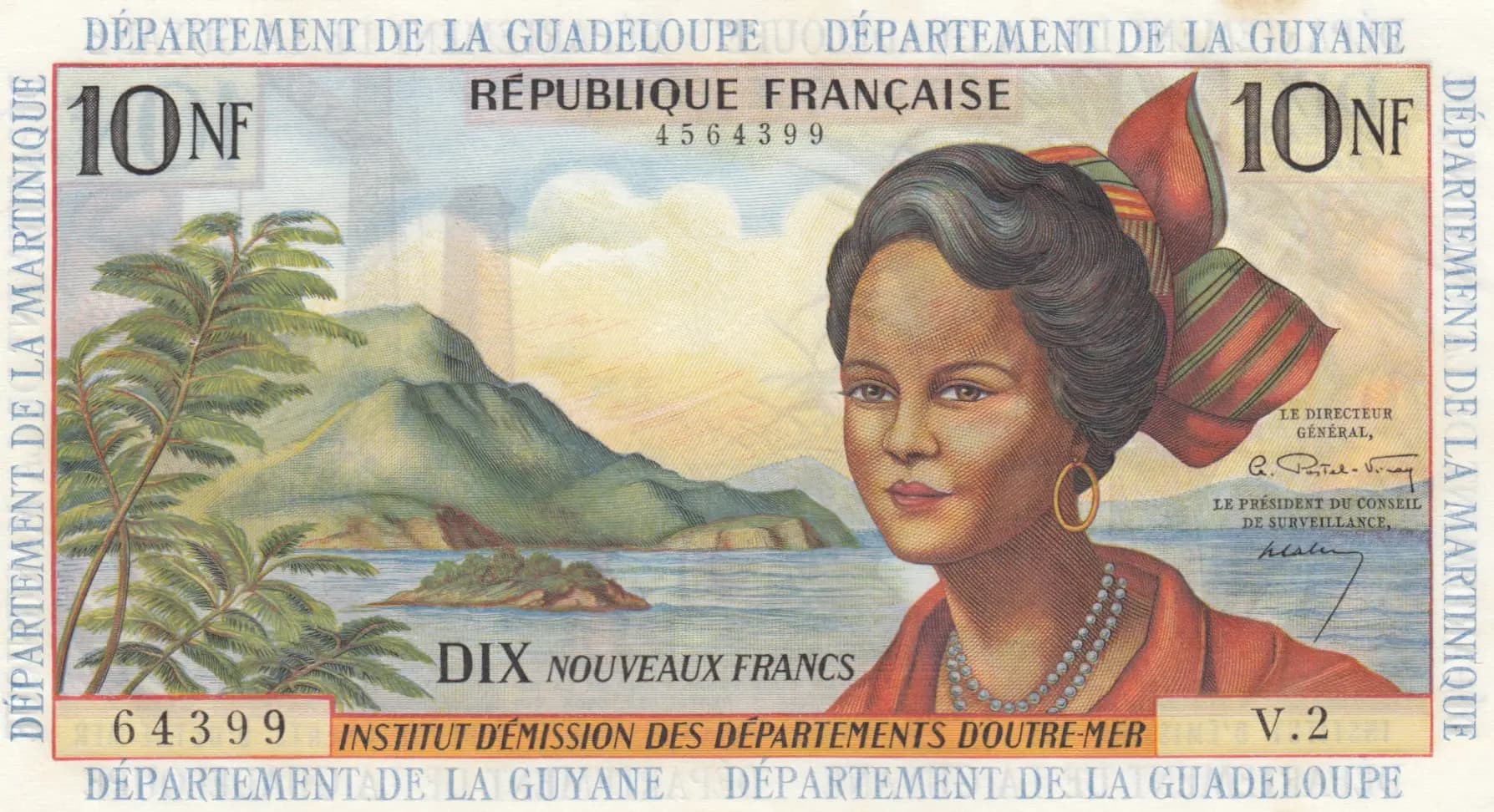
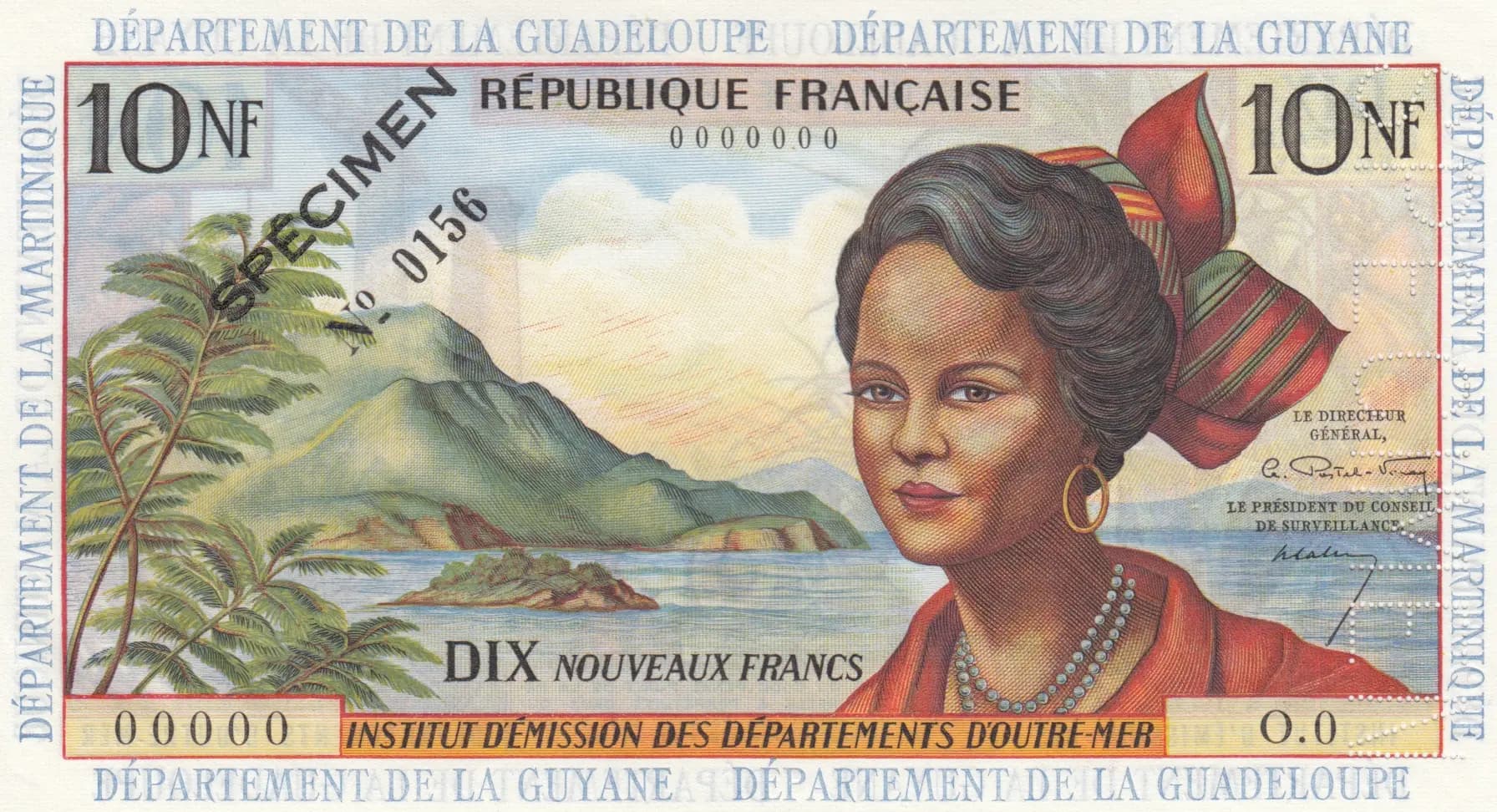
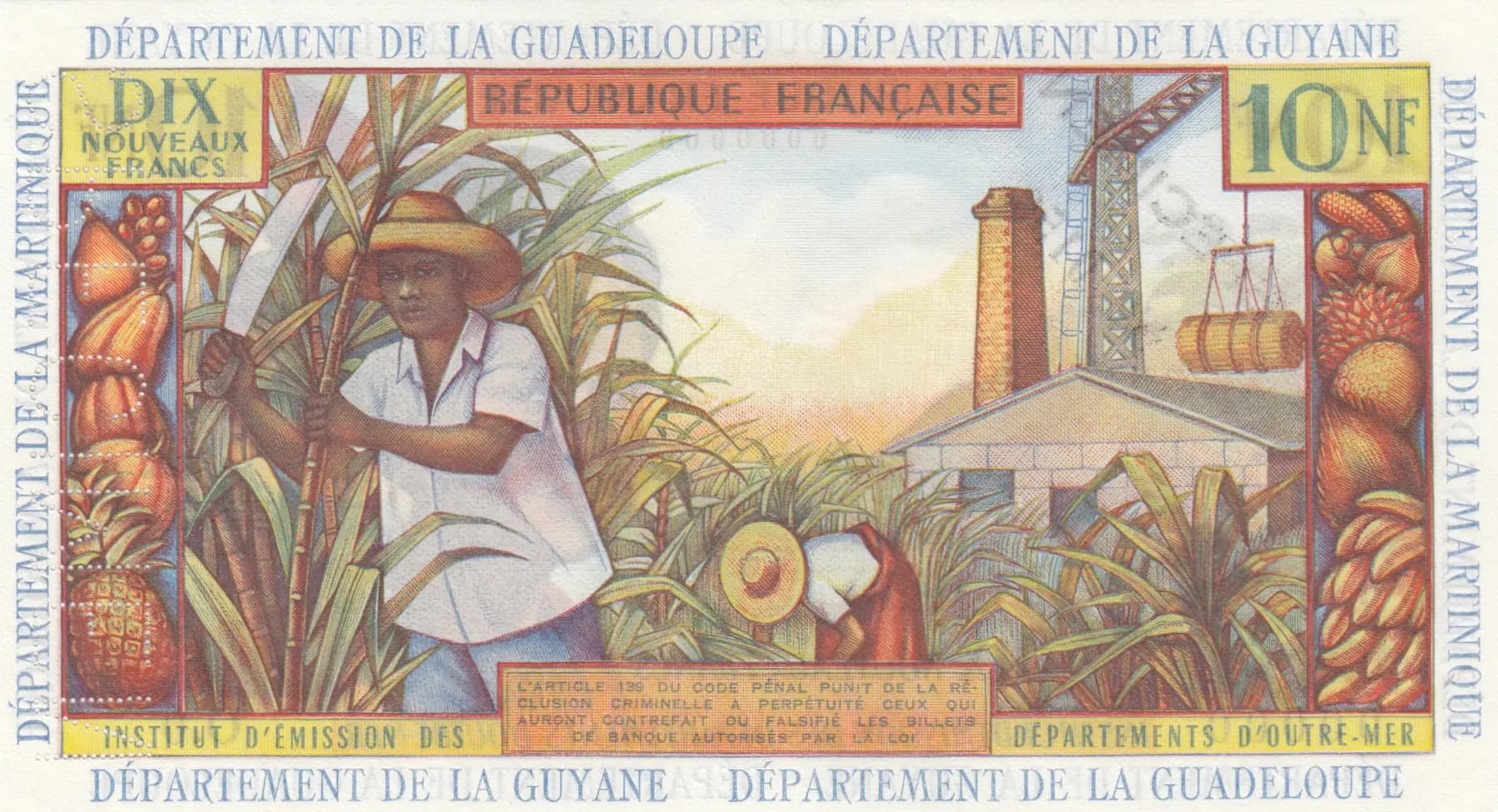
This is an uncirculated 1963 specimen banknote from the Institut d'Emission des Departements d'Outre-Mer, representing the French Antilles territories. The 10 Nouveaux Francs note features a striking portrait of a woman in red on the obverse and depicts the colonial economic focus through agricultural and industrial imagery on the reverse, including sugar cane harvesting and factory scenes. As a specimen note with diagonal SPECIMEN overprint and null serial numbers, this represents an exceptional piece of French overseas monetary history in pristine condition.
Common. The 10 Nouveaux Francs (Pick-5) from the French Antilles 1963 series represents standard circulation-intended currency for overseas departments with substantial population bases. While specimen notes (P-5s variant) are rarer than circulation versions, specimens themselves were produced in sufficient quantities for archival, banking, and official purposes and regularly appear in collections. No evidence of restricted print runs, early recall, or extreme scarcity exists for this denomination and issuer. Specimen notes of this type and era typically trade in modest price ranges, consistent with common classification.
Issued in 1963, this banknote reflects the economic foundation of the French Antilles during the post-war decolonization period, when Guadeloupe and French Guyana remained overseas departments. The reverse design explicitly celebrates the sugar and agricultural industries that dominated these territories' economies, with detailed depictions of sugar cane processing facilities, tropical crops including cacao and pineapples, and laborers—imagery reflecting the colonial extraction economy of the era. The issuing authority, IEDOM, was established to manage currency for these overseas French territories, representing a transitional monetary system between traditional colonialism and modern departmental status.
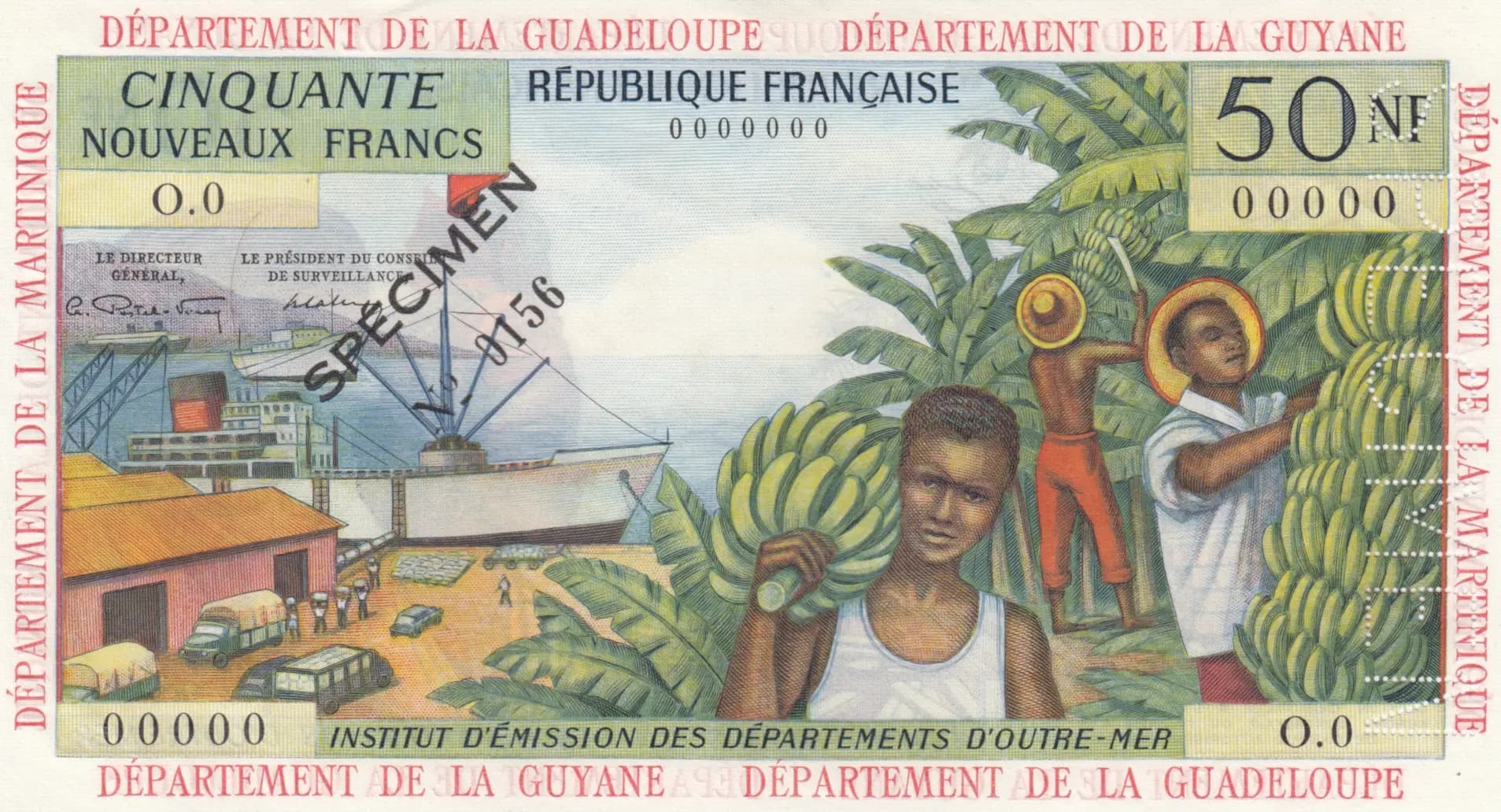
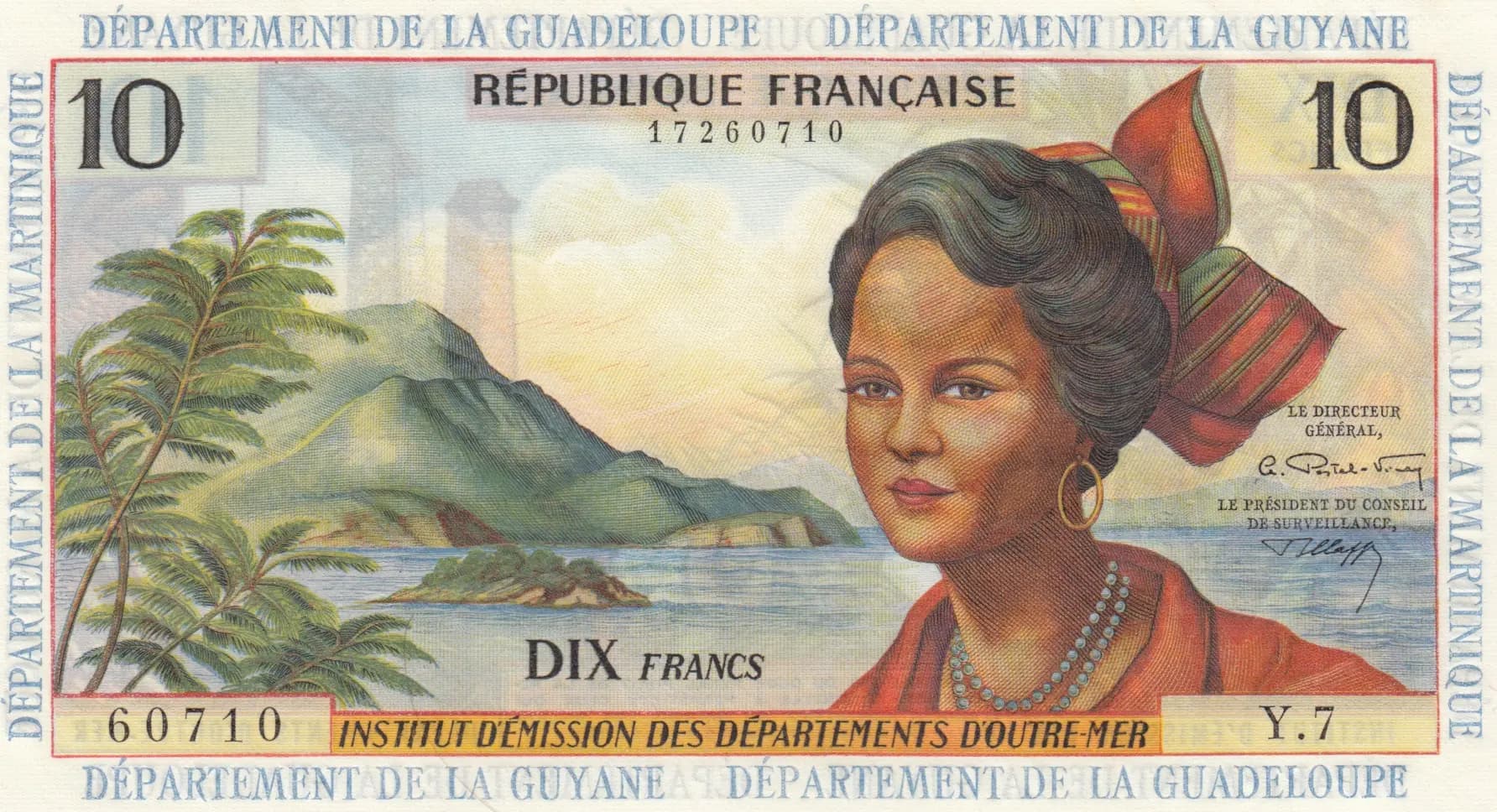
The obverse features a three-quarter facing portrait of a woman—likely representing the Creole populations of the Antilles—wearing distinctive red garments with a red bow in her hair, pearl necklace, and gold hoop earrings, positioned on the right side of the note. The left side presents a romanticized tropical landscape with palm trees, mountains, and a coastal seascape with distant islands, symbolizing the natural wealth of the territories. The reverse depicts the economic reality of the colonies: on the left, a male laborer in white shirt and hat harvesting sugar cane; in the center and right, an industrial factory complex with prominent chimney, storage facilities, and metal framework representing the sugar processing industry. Decorative borders frame tropical agricultural products—cacao pods and pineapples—emphasizing the primary export crops. The color palette of cream, red, blue, green, and brown creates visual distinction between the aspirational imagery on the obverse and the industrial-agricultural focus on the reverse.
FRONT SIDE: 'DÉPARTEMENT DE LA GUADELOUPE' (Department of Guadeloupe), 'DÉPARTEMENT DE LA GUYANE' (Department of Guyana), 'RÉPUBLIQUE FRANÇAISE' (French Republic), '10 NF' (10 New Francs), 'DIX NOUVEAUX FRANCS' (Ten New Francs), 'SPECIMEN' (Specimen marking), 'INSTITUT D'EMISSION DES DÉPARTEMENTS D'OUTRE-MER' (Institute of Issue of Overseas Departments), 'LE DIRECTEUR GÉNÉRAL' (The General Director), 'LE PRÉSIDENT DU CONSEIL DE SURVEILLANCE' (The President of the Supervisory Board). REVERSE SIDE: 'DÉPARTEMENT DE LA GUADELOUPE' (Department of Guadeloupe), 'DÉPARTEMENT DE LA GUYANE' (Department of Guyana), 'RÉPUBLIQUE FRANÇAISE' (French Republic), '10 NF' (10 New Francs), 'DIX NOUVEAUX FRANCS' (Ten New Francs), 'INSTITUT D'EMISSION DES DÉPARTEMENTS D'OUTRE-MER' (Institute of Issue of Overseas Departments), 'L'ARTICLE 135 DU CODE PÉNAL PUNIT DE LA RÉCLUSION CRIMINELLE À PERPÉTUITÉ CEUX QUI AUROIENT CONTREFAIT OU FALSIFIÉ LES BILLETS DE BANQUE AUTORISÉS PAR LA LOI' (Article 135 of the Penal Code punishes with life imprisonment those who would counterfeit or falsify banknotes authorized by law).
Intaglio engraving (steel plate recess printing), evidenced by the fine line work, precise detail, and multiple color layers visible in the design elements. The note displays characteristic intaglio security features including complex decorative borders, fine engraved portraiture, and intricate background patterns. The specimen overprint and null serial numbers are printed in a flat printing process overlaying the engraved base design. This was standard for French banknote production of the era, likely produced by Banque de France or an affiliated French security printer.
This note is the specimen variant (P-5s) as indicated by the diagonal 'SPECIMEN' overprint and null serial numbers (0000000 and 0 0 0 0 0 / O.0 formats). The catalog data confirms two variants exist for Pick-5: the standard circulation issue (P-5a) and this specimen variant (P-5s). No signature varieties, date variations, or additional overprints are evident from the visual analysis. The specimen designation makes this variant notably distinct from circulated examples, though specimens remain relatively obtainable compared to rare circulation issues of the same design.