10 francs 1964
About This Note
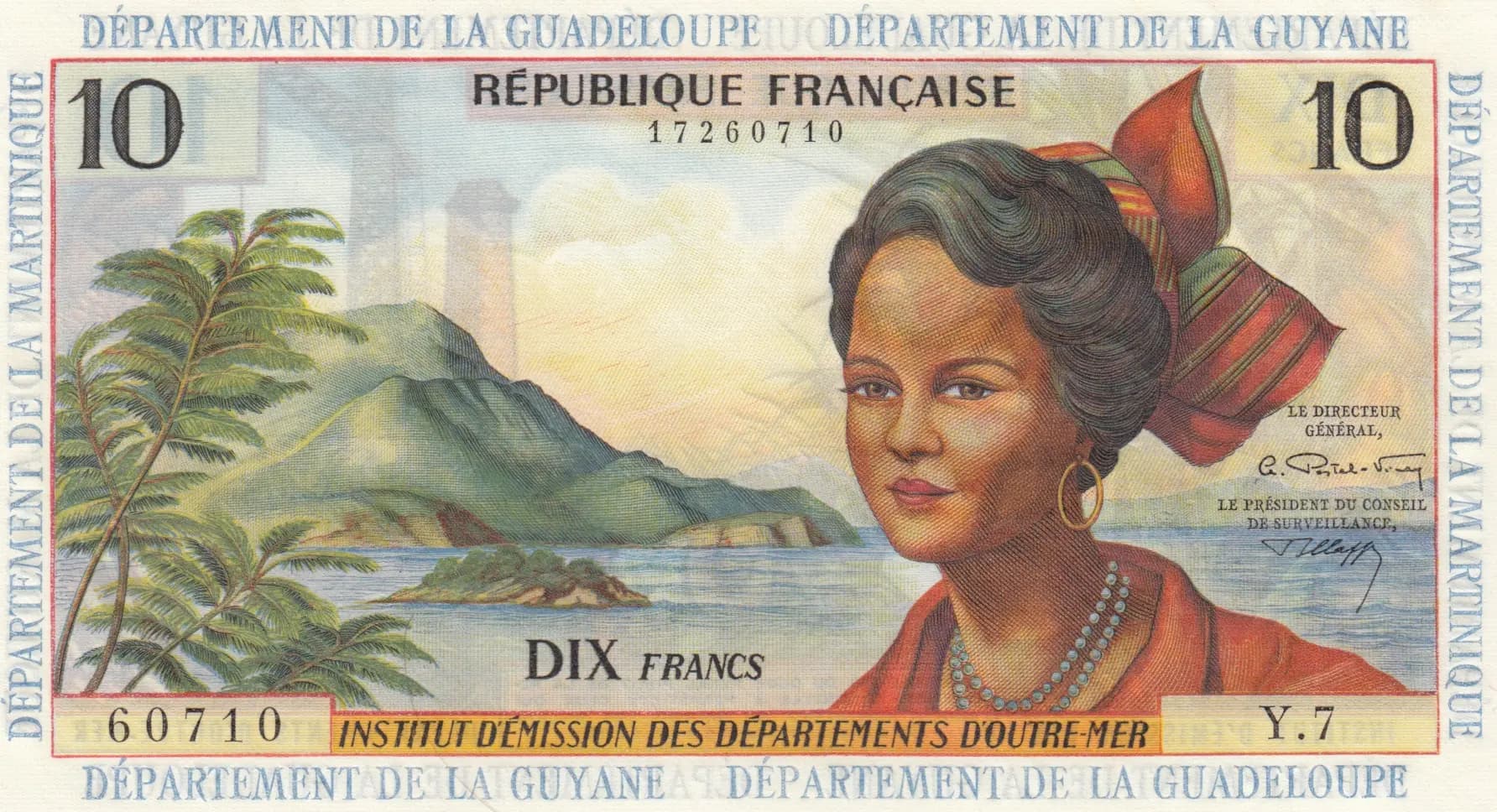
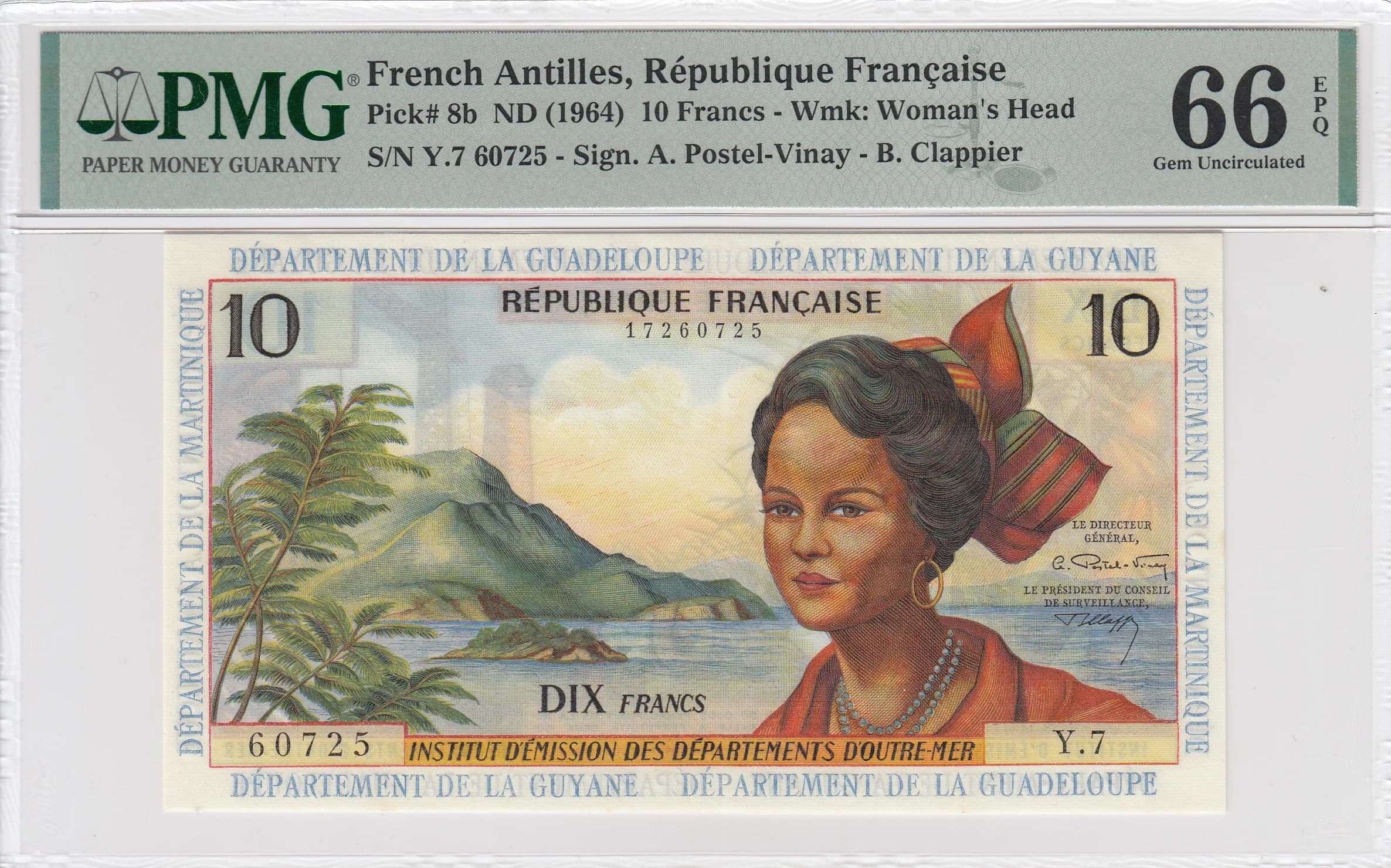
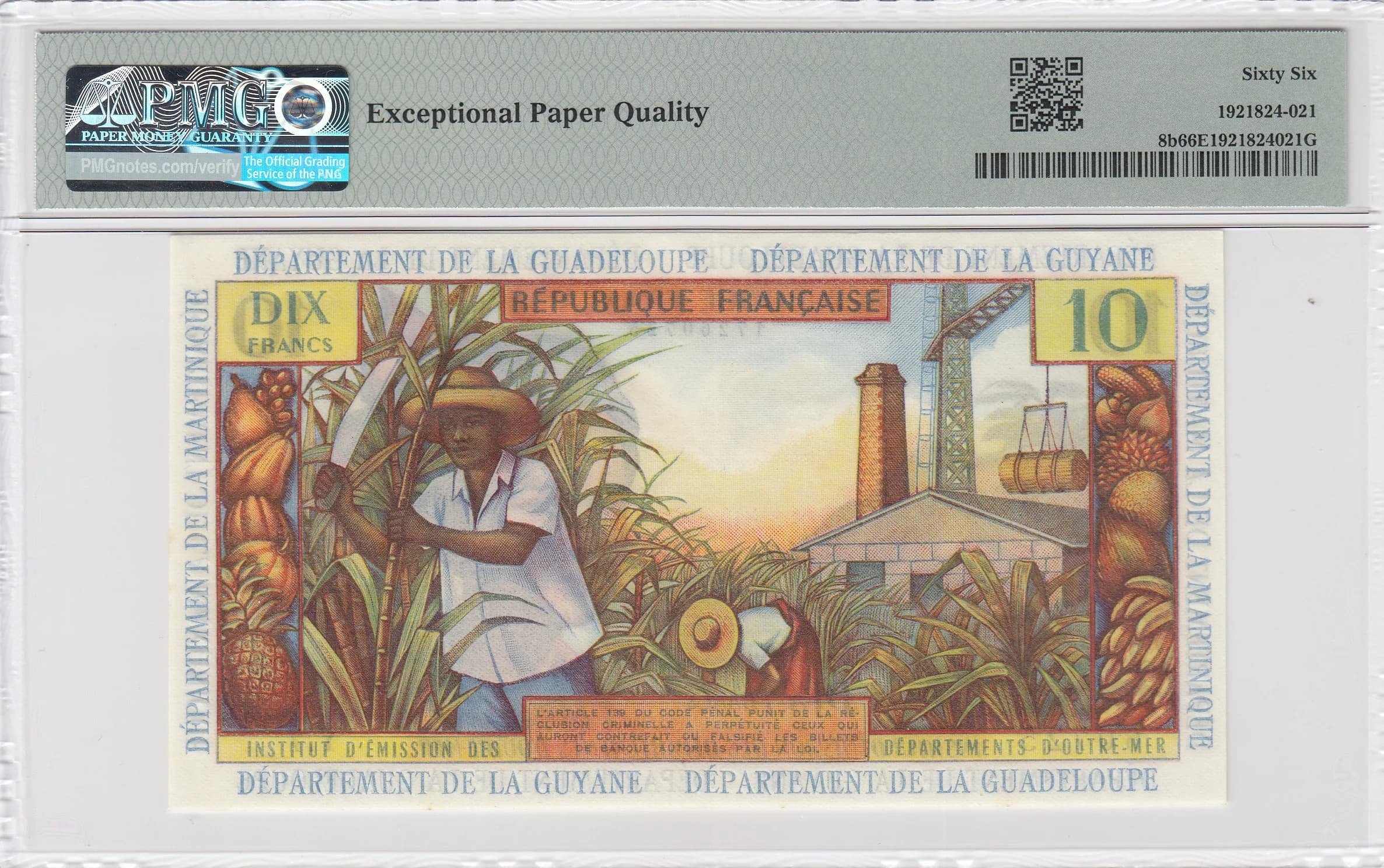
This is a PMG 66 EPQ (Gem Uncirculated) example of the 1964 French Antilles 10 Francs (Pick-8b), issued by the Institut d'Emission des Departements d'Outre-Mer. The note displays pristine condition with sharp printing, vibrant colors, and no visible wear, featuring a striking portrait of a woman in traditional red head wrap on the obverse and an evocative scene of sugar cane harvest with industrial factory imagery on the reverse, representing the economic foundation of the Caribbean territories.
Common. The 1964 French Antilles 10 Francs issue represents a standard denomination from a well-established official issuing authority (Institut d'Emission des Departements d'Outre-Mer) with no historical record of restricted print runs or early recalls. These notes circulated broadly throughout Guadeloupe and Guyana during the 1960s-1970s and were produced in quantities typical of regular currency denominations. While the PMG 66 EPQ grade represents exceptional condition (uncirculated with exceptional paper quality), the Pick-8b variety itself is not scarce. Gem-graded examples command modest premiums reflective of their superior preservation rather than inherent rarity.
This banknote was issued during the early post-colonial period for the French overseas departments of Guadeloupe and Guyana, reflecting France's continued monetary control of these Caribbean territories. The imagery directly illustrates the economic importance of sugar cane cultivation and industrial processing to these departments' economies in the mid-20th century. The depiction of both agricultural labor and industrial infrastructure underscores the transition from plantation agriculture to modernized production during this transitional period in Caribbean economic history.
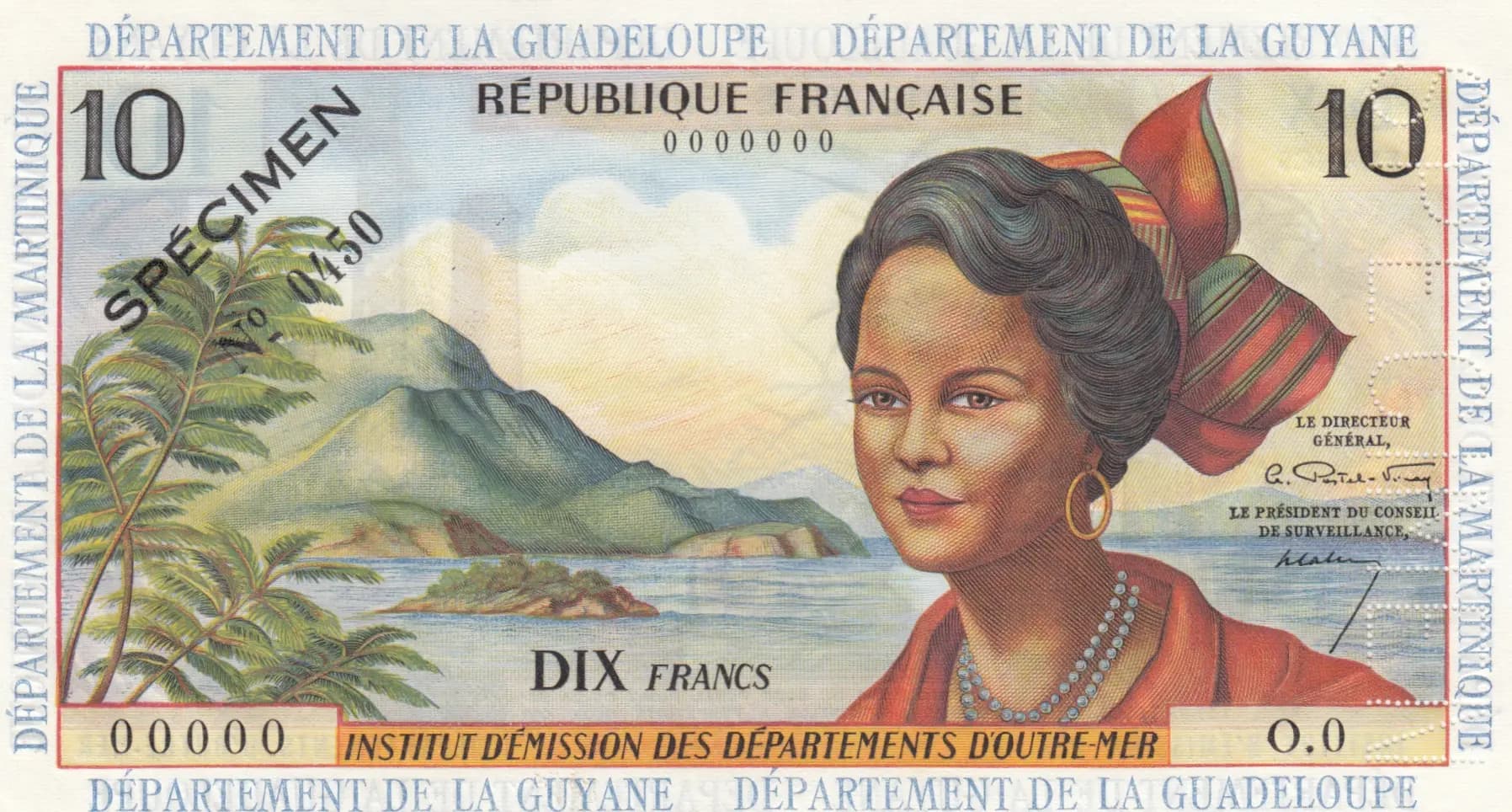
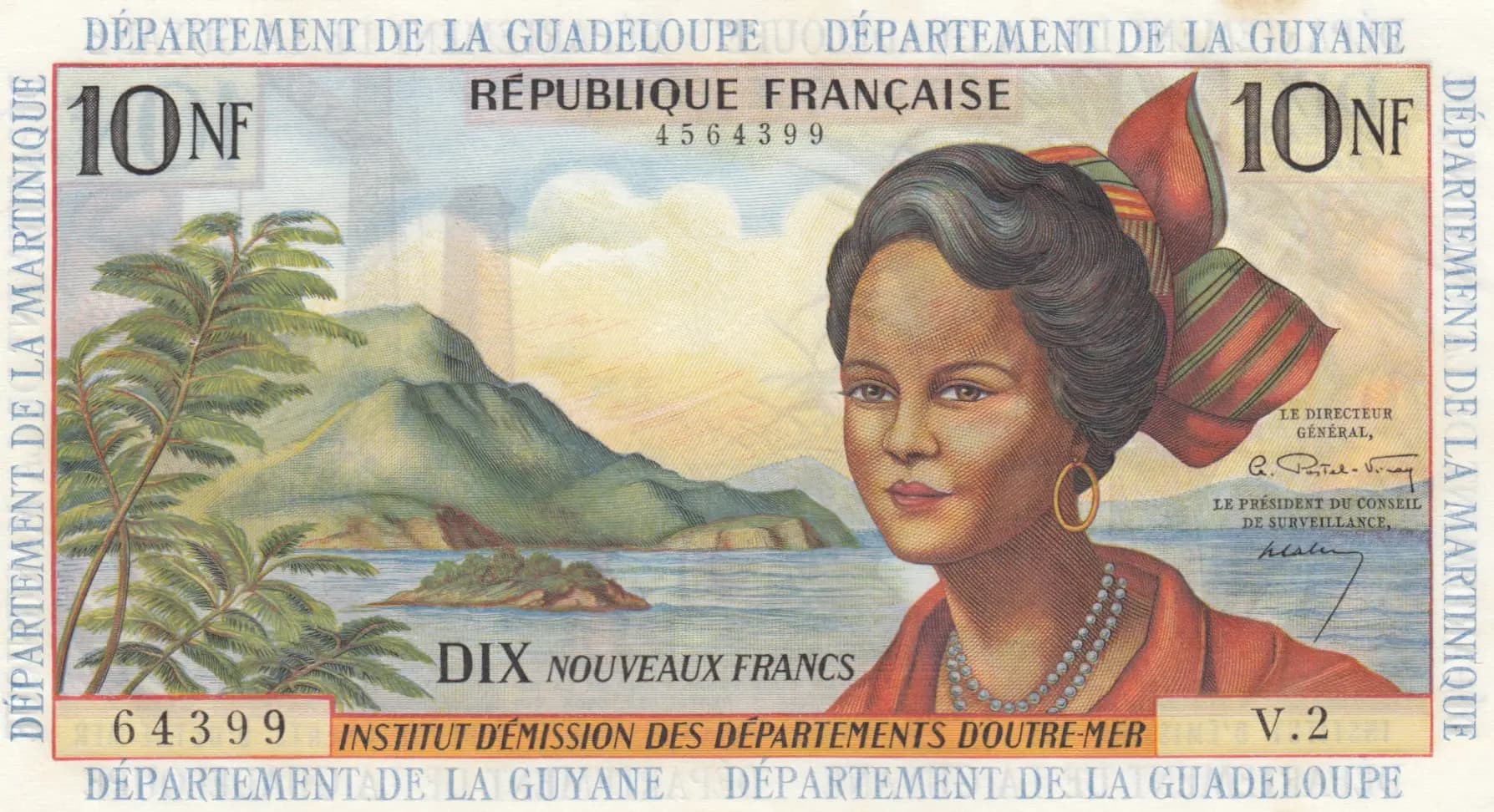
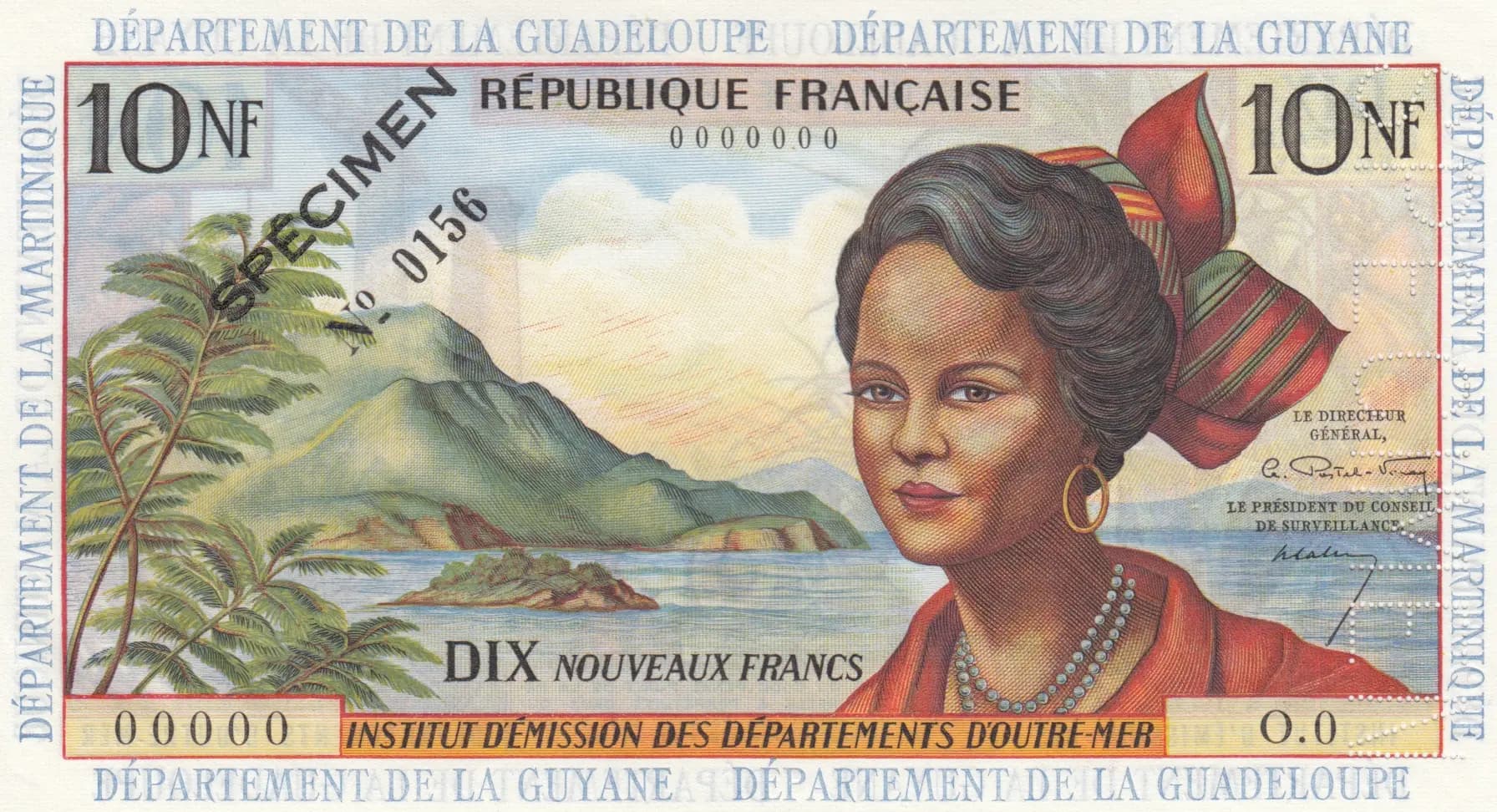
The obverse features a carefully rendered portrait of an unidentified woman of Creole heritage wearing a distinctive red head wrap (traditional Caribbean headscarf) and matching red garment adorned with a pearl necklace, positioned on the right side of the note. The left side displays a tropical landscape vignette depicting a mountainous volcanic coastline typical of Guadeloupe's geography, complete with palm trees, water, and a small island formation rendered in muted greens and blues against a cream background. The reverse showcases a more detailed occupational scene featuring a male laborer in a wide-brimmed hat and light-colored work clothing engaged in harvesting sugar cane. Behind him rises an industrial complex with prominent brick smokestack, processing facilities, and cargo-handling equipment, representing the mechanized sugar industry central to the territories' colonial economy. The color palette shifts to warmer tones—yellows, browns, and reds—reflecting the agricultural and industrial themes. Denomination numerals '10' and textual 'DIX FRANCS' appear on opposite lateral margins of both sides, with 'RÉPUBLIQUE FRANÇAISE' anchoring the top center.
FRONT SIDE: 'RÉPUBLIQUE FRANÇAISE' (French Republic) | 'DÉPARTEMENT DE LA GUADELOUPE' (Department of Guadeloupe) | 'DÉPARTEMENT DE LA GUYANE' (Department of Guyana) | 'DIX FRANCS' / '10' (Ten Francs) | 'INSTITUT D'ÉMISSION DES DÉPARTEMENTS D'OUTRE-MER' (Institute of Issue of Overseas Departments) | 'LE DIRECTEUR GÉNÉRAL' (The General Director) | 'LE PRÉSIDENT DU CONSEIL DE SURVEILLANCE' (The President of the Supervisory Board) | Serial number elements including 'Y.7' denomination indicator. BACK SIDE: 'RÉPUBLIQUE FRANÇAISE' (French Republic) | 'DIX FRANCS' / '10' (Ten Francs) | 'DÉPARTEMENT DE LA GUADELOUPE' and 'DÉPARTEMENT DE LA GUYANE' (Departments listed) | 'INSTITUT D'ÉMISSION DES DÉPARTEMENTS D'OUTRE-MER' (Institute of Issue of Overseas Departments) | 'L'ARTICLE 186 DU CODE PÉNAL PUNIT DE LA RÉCLUSION CRIMINELLE LE VOL OU LA CONTREFAÇON DE BILLETS DE BANQUE' (Article 186 of the Criminal Code punishes with imprisonment the theft or counterfeiting of banknotes) | PMG certification markings: 'Exceptional Paper Quality', 'Sixty Six' (grade), certification number '1921824-021', and verification website 'PMGnotes.com/verify'.
Multi-color offset lithography with fine-line intaglio engraving elements, typical of banknote production standards of the 1960s. The note exhibits carefully registered color separations with detailed line work and precise gradient shading throughout both sides. The watermark (Woman's Head) is visible in lighter density areas. Security features include fine line engraving patterns and sophisticated color gradations that would have been produced by a specialized currency printer, likely under French state supervision given the 'Banque de France' legal references.
This is cataloged as Pick-8b, identified by the Woman's Head watermark. The PMG Population Report indicates this Pick number exists in four documented variants: P-8a (standard Woman's Head watermark), P-8as (Woman's Head watermark, specimen), P-8b (standard variant, the example presented), and P-8s (variant). The specific Pick-8b designation distinguishes this note from its related varieties. The observed serial number format 'Y.7' prefix and the absence of specimen overprints confirm this as a standard circulation issue of the P-8b variety rather than a specimen or special issue variant.