Fatty millionere 1000 joys 1918
About This Note
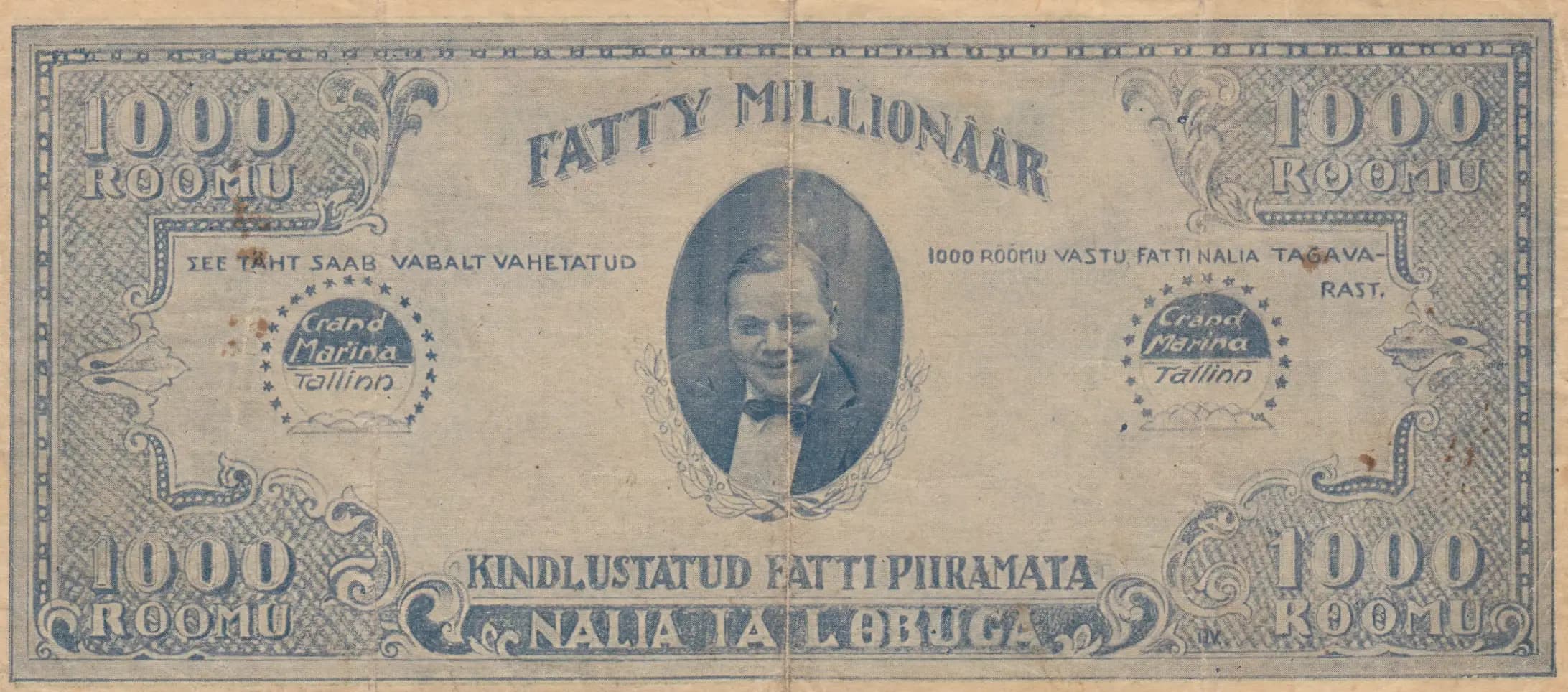
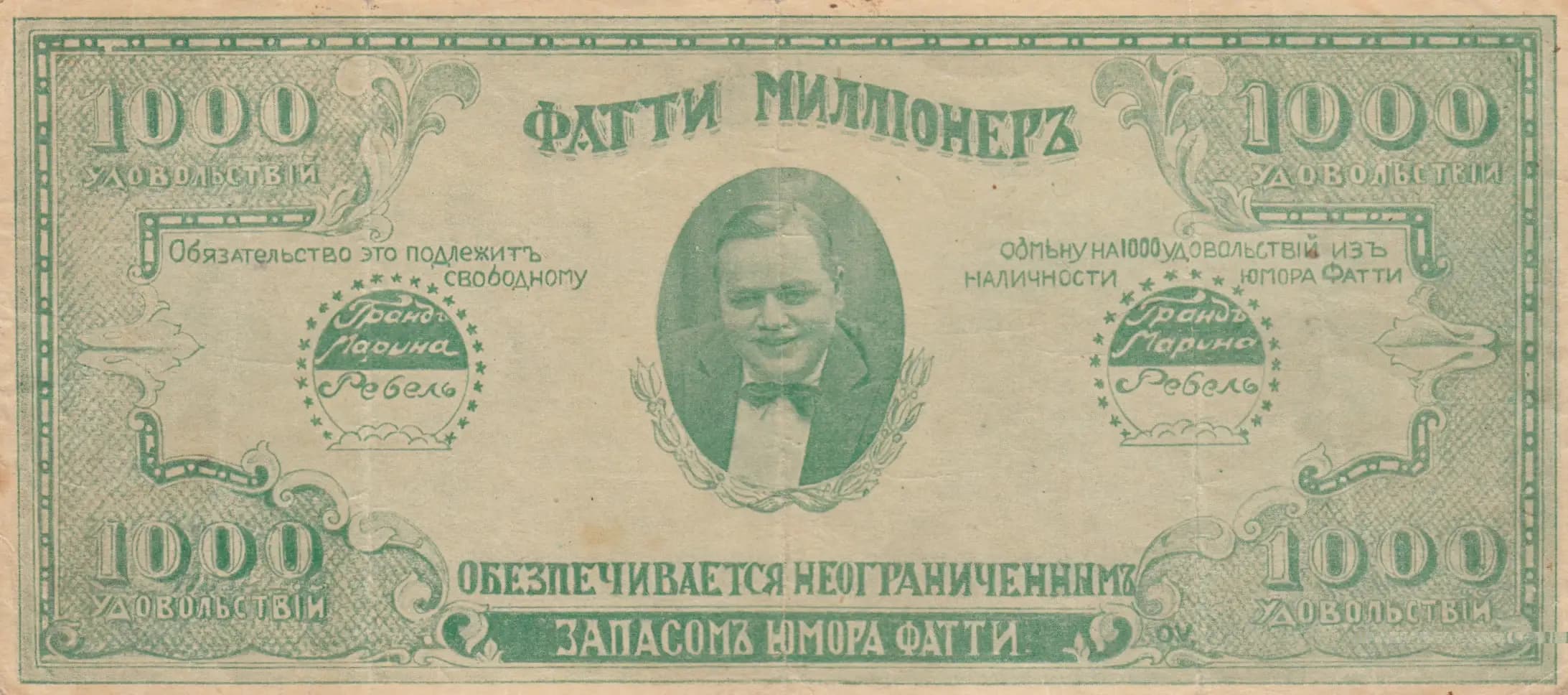
This is a remarkable 1918 satirical banknote issued by Cinema Grand Marina in Tallinn, Estonia, during a period of social and political upheaval following independence. The note features bilingual inscriptions in Estonian and Russian (Cyrillic), with humorous text referencing 'Fatty Millionaire' and absurdist guarantees backed by undefined 'nalia' and 'lõhud' — clearly a comedic or propagandistic piece rather than genuine currency. In VF condition, the note displays a vertical center crease, scattered foxing, and faded coloring (beige on front, pale green on back), consistent with over a century of aging.
This note should be classified as RARE. The Pick catalog designation of 'P-unlisted' indicates it does not appear in the standard Pick numismatic reference, which itself signals limited recognition and circulation. Cinema Grand Marina Tallinn was a specific, non-governmental issuer with no mandate for large print runs. The 1918 period of Estonian independence saw numerous localized, experimental, and satirical issues that were produced in limited quantities. The specific combination of bilingual text, the satirical nature of the guarantees, and the theatrical venue of origin all suggest this was a limited-circulation novelty or promotional piece rather than a mass-produced currency note. VF condition examples would be scarcer than lower grades, as these notes were likely treated as ephemera rather than carefully preserved currency.
This note emerges from a pivotal moment in Estonian history when the country had just declared independence (February 1918) but faced occupation and political chaos. The use of both Estonian and Russian languages reflects Tallinn's multilingual population and the transitional nature of the period. The satirical nature—with its fictional 'Fatty Millionaire' character and nonsensical financial guarantees—suggests this was either a cinema promotional item, a political satire, or an example of the numerous emergency and novelty issues that proliferated during the 1918 period of instability.
This bilingual note features a centrally positioned oval portrait of a middle-aged man in formal 19th-century attire with bow tie, facing slightly right. The portrait appears on both sides but serves as the focal point for distinctly different textual contexts. The front employs Estonian language with a beige/tan background and blue decorative elements, while the back uses Russian Cyrillic script with pale green coloring and green ornamental flourishes. Both sides feature the denomination '1000' in all four corners rendered in ornate serif typography with elaborate scrollwork. Art Nouveau-style decorative borders frame the portrait on both sides, with circular institutional seals positioned left and right of the central oval. The front seals identify 'Grand Marina Tallinn' while the back seals reference 'Grand Marina Rebel,' suggesting either a deliberate design variation or a satirical commentary on the issuing institution's shifting allegiances during the politically volatile 1918 period.
FRONT SIDE (Estonian): The denomination reads '1000 ROOMU' (1000 joy/delight). The header states 'FATTY MILLIONAAR' (Fatty Millionaire). Additional text includes: 'SEE TÄHT SAAB VABALT VAHETATUD' (This note can be freely exchanged), '1000 ROOMU VASTU FATTI NALIA TAGAVA-RAST' (1000 joy against Fatty Nalia's guarantee), and 'KINDLUSTATUD FATTI PIURAMATA NALIA JA LÕHUGA' (Secured by Fatty's uneaten nalia and lõhud). The issuer seal reads 'Grand Marina Tallinn'. BACK SIDE (Russian/Cyrillic): The denomination reads '1000 ДОВОЛЬСТВИИ' (1000 satisfaction/contentment). The header states 'ФАТТИ МИЛЛИОНЕРZ' (Fatty Millionaire). Additional satirical text references free exchange and unclear guarantees involving 'imora Fatti' (Fatty's assets). The issuer seal reads 'Grand Marina Rebel'. The absurdist nature of guarantees—referencing undefined items like 'nalia' and 'lõhud'—reinforces the satirical or novelty character of the issue.
Based on visual characteristics, this note was produced using letterpress or relief printing techniques typical of 1918 Estonia. The crisp serif typography, the registration of the blue and green colored ornamental elements, and the overall aesthetic are consistent with period printing practices. The presence of two distinctly designed sides (Estonian front, Russian back) with different color schemes (blue versus green) suggests either sequential printing passes or production by a local Estonian printer adapting to serve a multilingual population. The ornamental borders and corner designs show the hallmarks of hand-engraved or lithographic ornaments typical of early 20th-century small-run printing.
Two distinct varieties are evident within this single catalog entry: (1) FRONT VARIETY - Estonian language version with blue decorative elements, beige/tan background, and 'Grand Marina Tallinn' seals; (2) BACK VARIETY - Russian Cyrillic language version with green decorative elements, pale green background, and 'Grand Marina Rebel' seals. The deliberate linguistic and color differentiation between obverse and reverse suggests this may represent either two separate printings for different audiences or a deliberate bilingual design choice. No serial numbers are visible in the provided images, so additional varieties based on numbering cannot be assessed. The presence of 'Rebel' nomenclature on the reverse may indicate a secondary printing or overprinting during shifting political circumstances in 1918.