50 marka 1919
“serie D”
Market Prices
About This Note
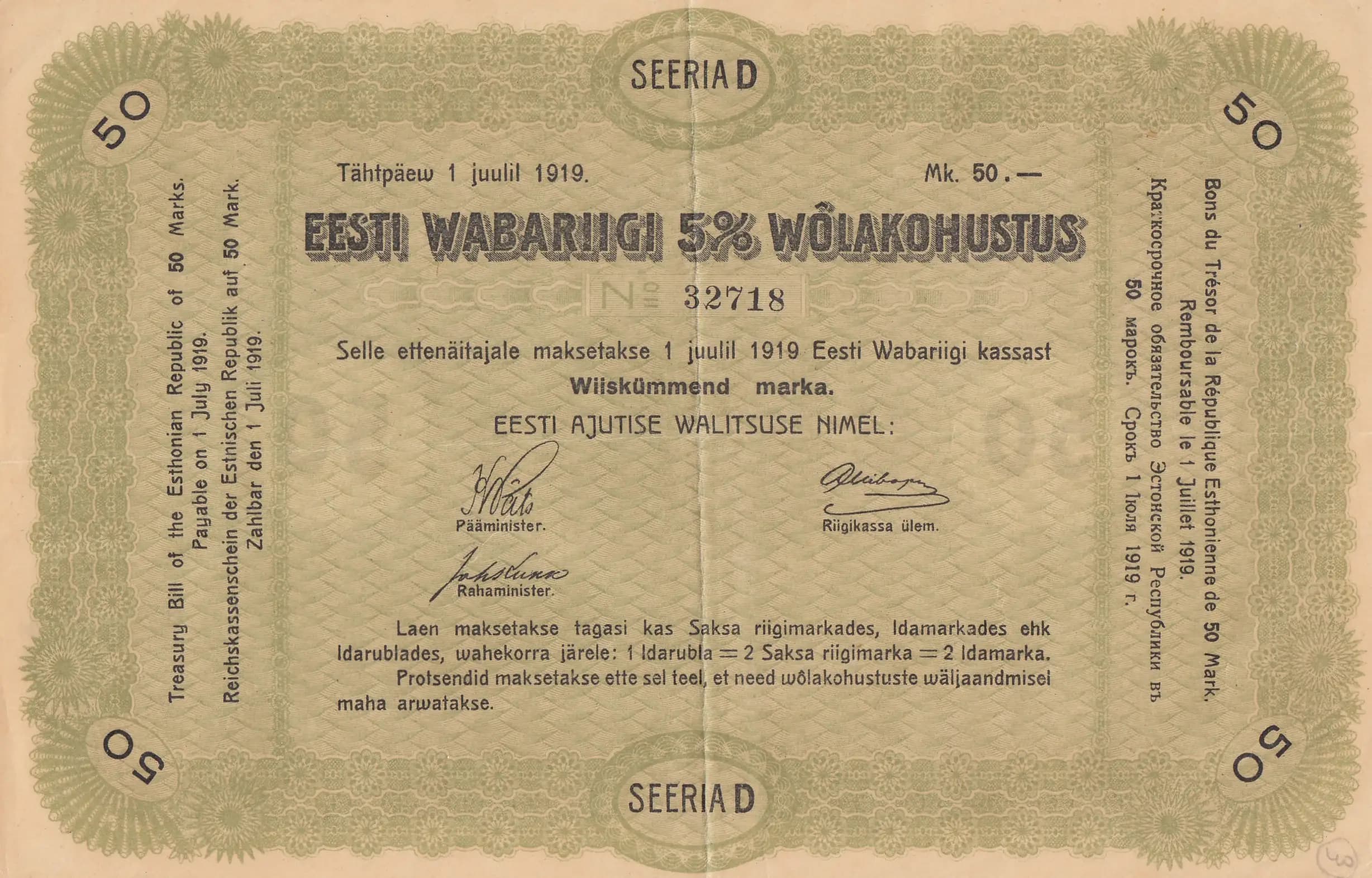
This 50 Marka treasury bond from the Estonian Republic (dated July 1, 1919) is a striking example of early Estonian monetary instruments issued during the nation's struggle for independence. The note displays the characteristic ornate decorative design typical of this series, with elaborate fan-pattern rosettes and geometric borders rendered in tan and olive-green tones. In VF condition with a visible vertical fold and age-related discoloration, this Series D specimen represents a formative period in Estonian numismatic history and remains a sought-after piece for collectors of Baltic and early 20th-century currency.
Common. This note appears in the market at multiple price points ranging from approximately $45 to $275 USD depending on condition, with VF specimens typically commanding $54.90 to $245.00 USD based on the eBay data provided. The availability of multiple examples at moderate prices, combined with the regular circulation these bonds received, indicates a reasonably substantial original print run. The 1919 Estonian debt obligations were not recalled or remarkably scarce issues. While early Estonian currency is collectible and valued by specialists in Baltic numismatics, this particular denomination and series does not demonstrate the characteristics of a rare issue—rather, it represents a common example of early Estonian monetary instruments that remain moderately available to collectors.
Issued on July 1, 1919, this 50 Marka bond represents the Estonian Provisional Government's efforts to establish financial sovereignty during the nascent Estonian Republic's emergence from Russian imperial rule. The multilingual inscriptions in Estonian, German, and French reflect the complex geopolitical environment of post-WWI Eastern Europe, where Estonia negotiated its independence and financial structures. The note's function as a 5% debt obligation, redeemable in multiple currency standards (German marks, East marks, or East rubles), illustrates the transitional monetary chaos of the period and Estonia's attempts to stabilize its economy during the Russian Civil War and the War of Independence (1918-1920).
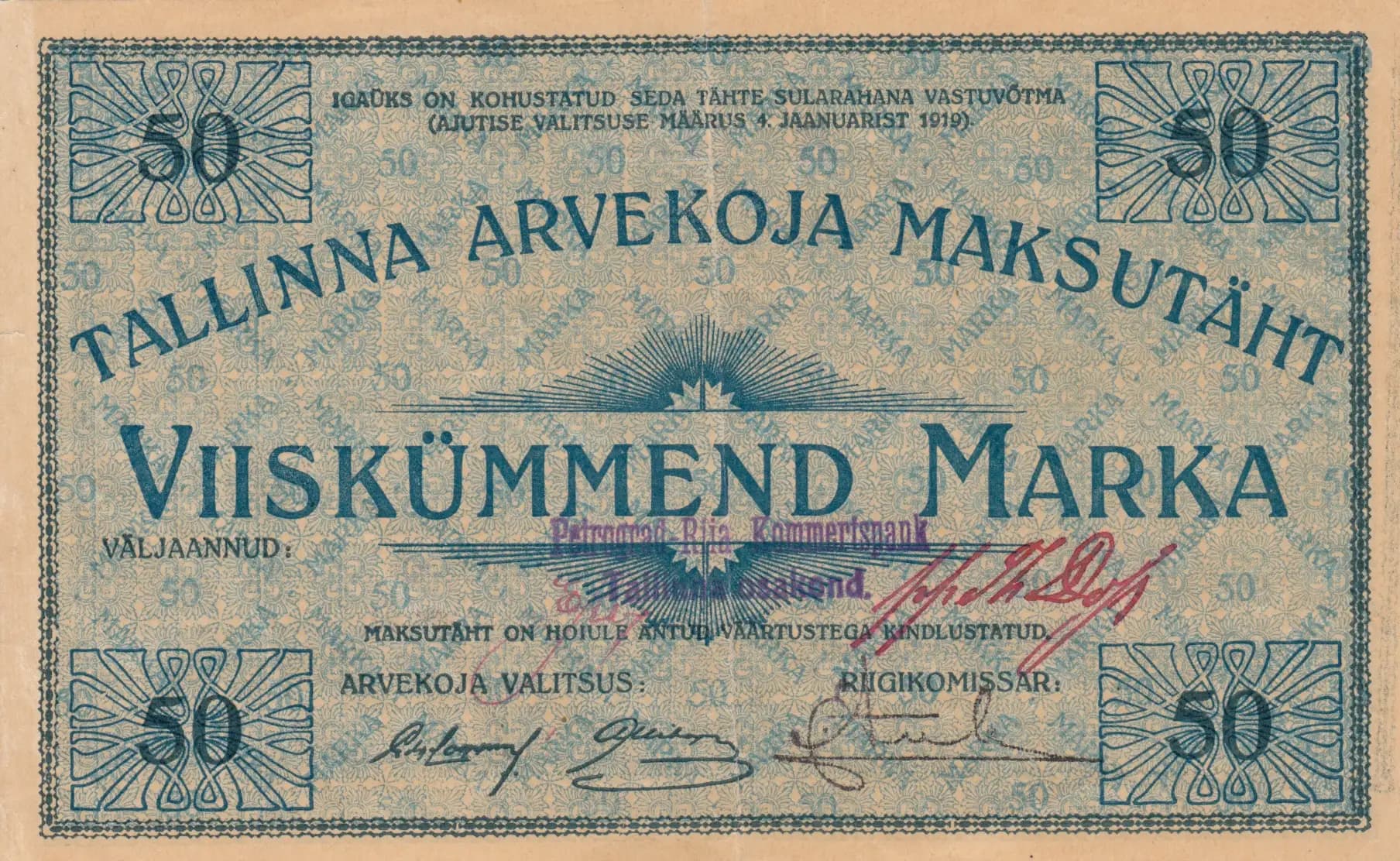
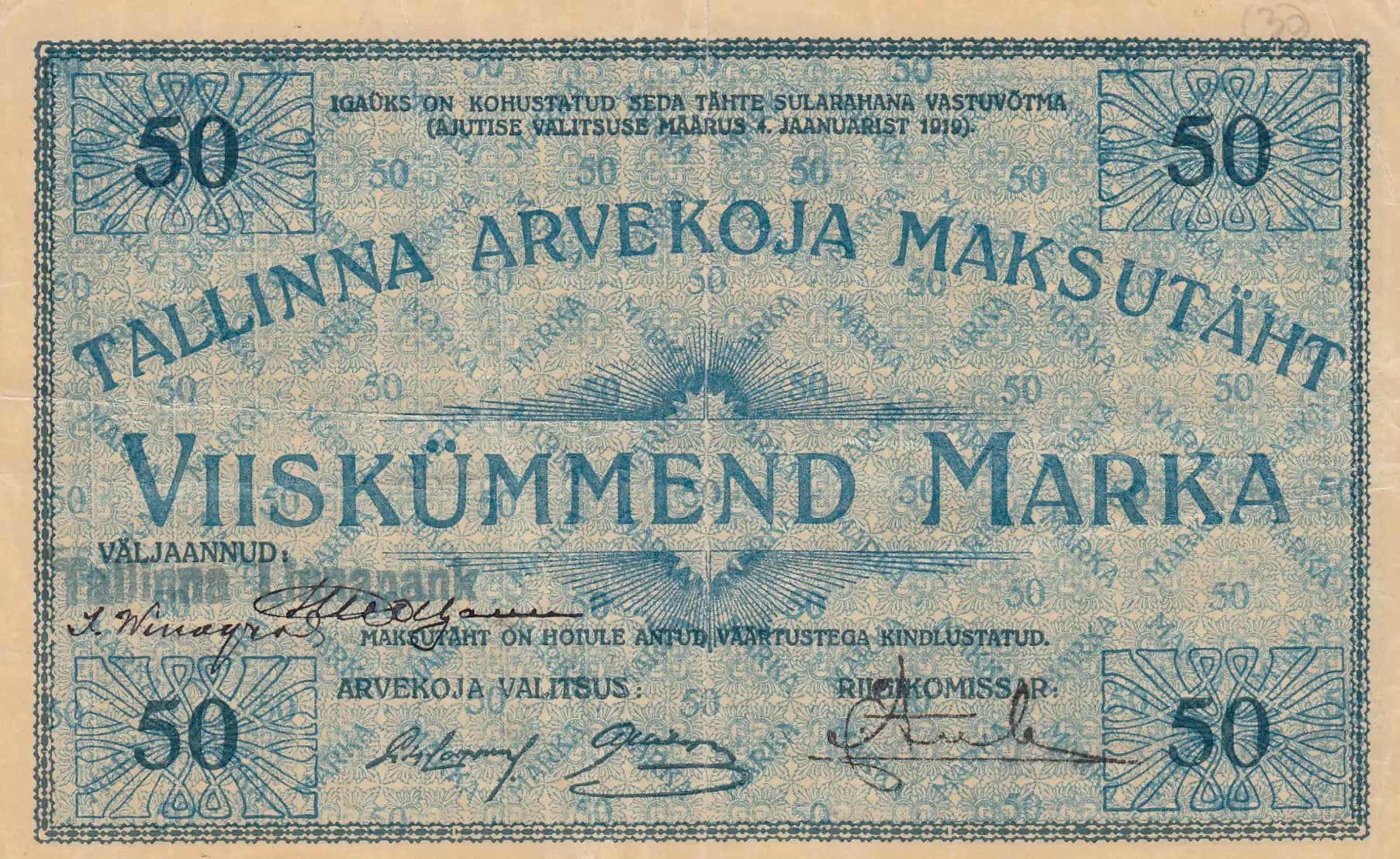
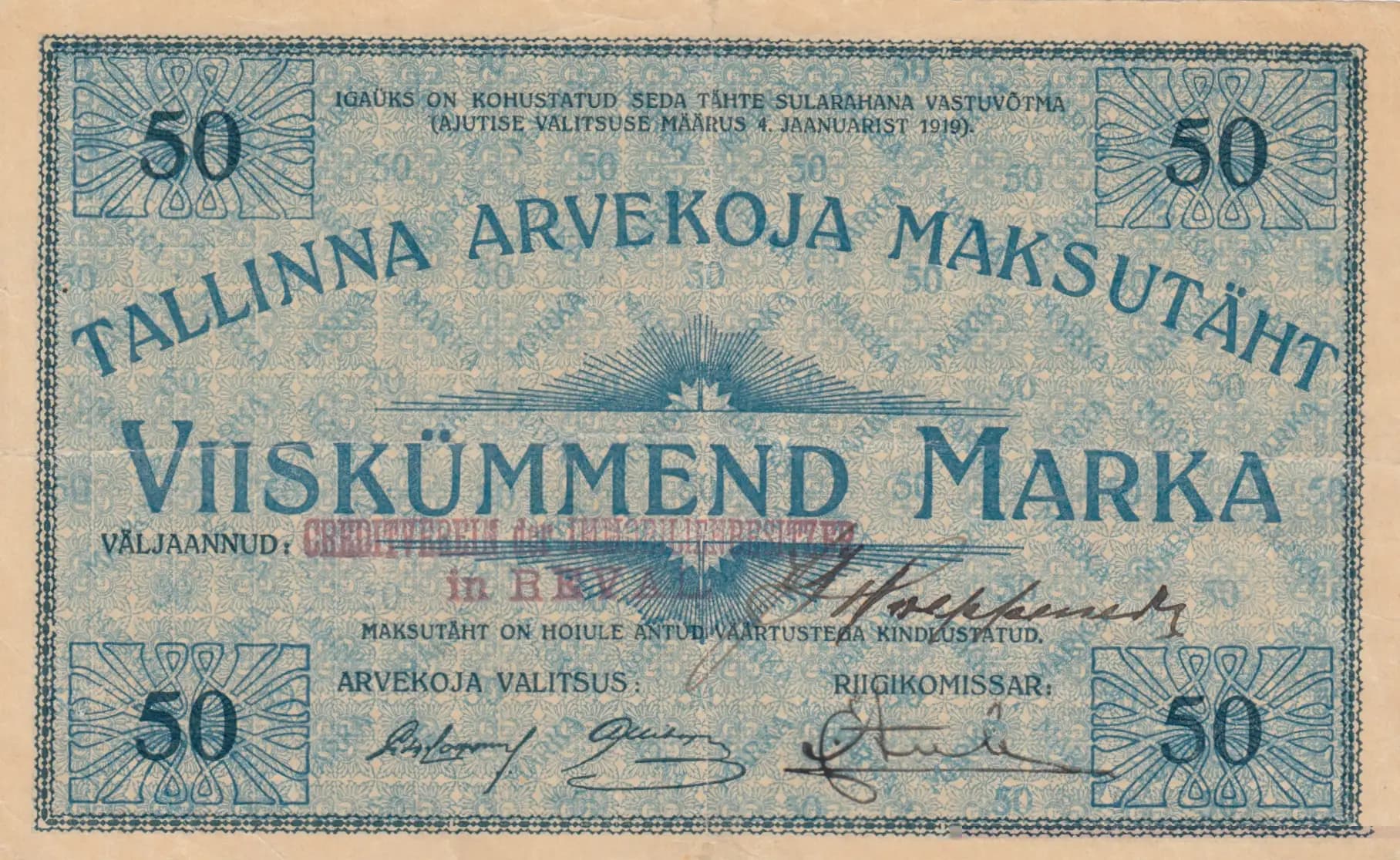
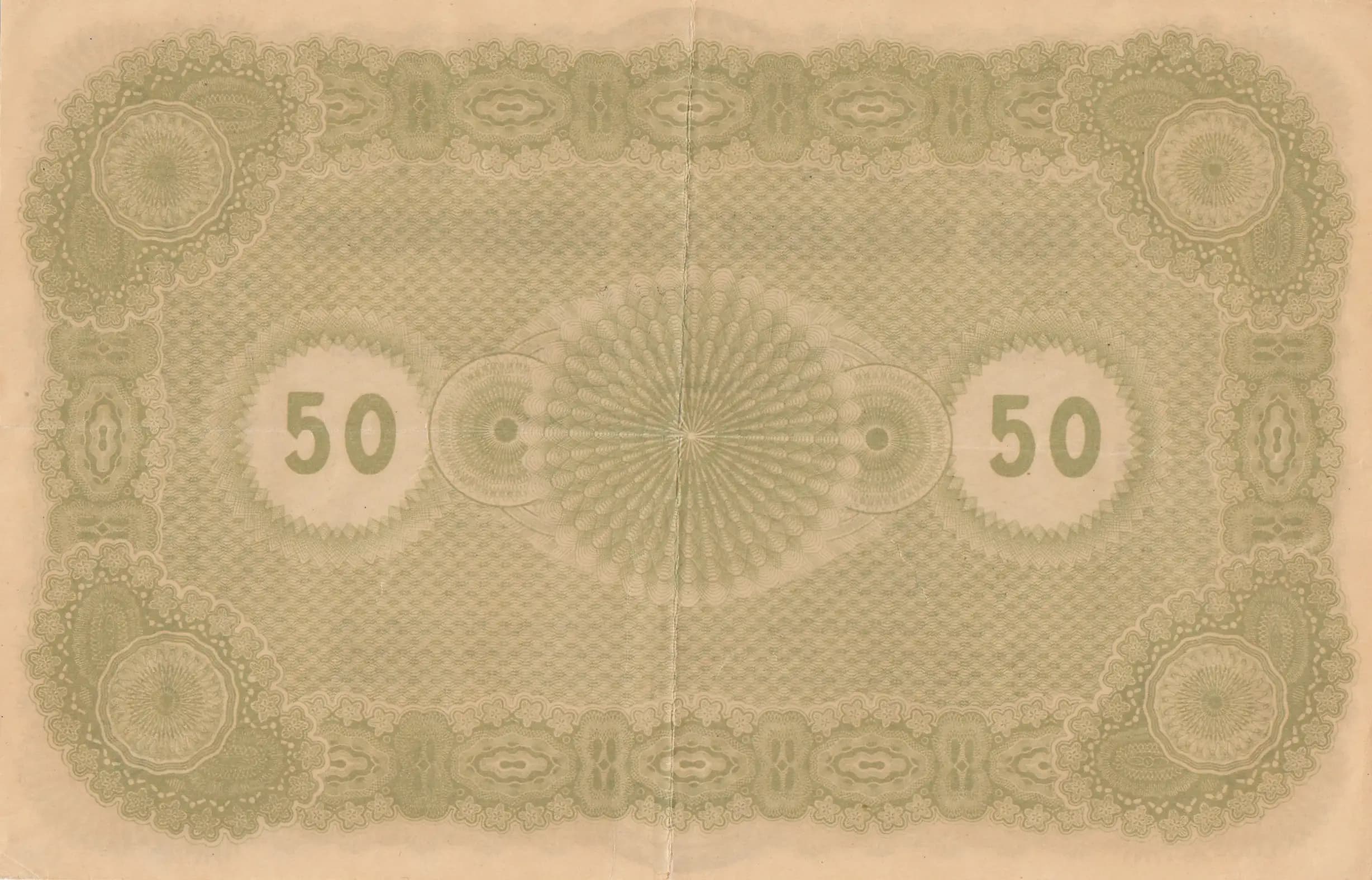
This 50 Marka treasury bond features a purely ornamental design without portraits or depicted landmarks, relying instead on intricate geometric and floral patterns for aesthetic appeal and security. The front displays a symmetrical layout with the denomination '50' prominently positioned in all four corners. The central field contains the administrative text with ornate fan-shaped rosette patterns and geometric lattice borders characteristic of Belle Époque security printing. The signature areas are marked with official seals labeled 'Seeria D' (Series D) positioned at top and center. The reverse side showcases an elaborate radial sunburst or rosette pattern dominating the center, flanked by circular denomination markers and surrounded by repeating geometric borders and fan motifs. The entire design employs fine line work and symmetrical compositions typical of early 20th-century security printing, with no photographic elements or portraits—the ornamentation itself serves as the primary anti-counterfeiting measure. The color scheme of tan, beige, and olive-green was applied across both sides.
FRONT SIDE: Central inscription: 'Estonian Republic 5% Debt Obligation' (Eesti Wabariigi 5% Wõlakohustus). Series designation: 'Series D' (Seeria D). Date: 'Dated July 1, 1919' (Tähipäew 1 juulil 1919). Denomination: '50 Marks' (Mk. 50.—; Wilskümmond marka). Promise to pay: 'The bearer of this will be paid from the Estonian Republic treasury on July 1, 1919' (Selle ettenäitajale maksetakse 1 juulil 1919 Eesti Wabariigi kassast). Issuer: 'In the name of the Estonian Provisional Government' (Eesti Ajutise Walitsuse Nimel). Signature lines for: Prime Minister (Pääminister), Finance Minister (Rahaminister), State Treasurer (Riigikas ülem). Redemption clause: 'The loan will be repaid in either German State marks, East marks or East rubles, according to exchange rate: 1 East ruble = 2 German state marks = 2 East marks' (Laen maksetakse tagasi kas Saksa riigimerkades, Idamarkades ehk Idarublades, vahekorra järele: 1 Idarubla = 2 Saksa riigimarka = 2 Idamarka). Interest clause: 'Interest will be paid in advance by deducting from debt obligation distributions' (Protsendid maksetakse ette sel teel, et need wõlakohustuste wäljaaandmisel maha arwaitakse). Left margin: 'Treasury Bill of the Estonian Republic of 50 Marks' (English), 'Releaseasseen der Estnischen Republik on 1 Juli 1919' (German). Right margin: 'Bons de Trésor de la République Estonienne de 50 Marks' (French), 'Emis de l'Trésor de la République Estonienne le 1 juillet 1919' (French). Serial number: 32718. BACK SIDE: Denomination display: '50' in circular markers. The reverse is predominantly decorative with no textual inscriptions.
This note was produced using intaglio (engraved) printing, evidenced by the fine, precise line work visible in the ornamental borders, geometric patterns, and rosette designs. The intricate detail and sharp edges of the decorative elements are characteristic of the engraving process. The security printer for Estonian issues of this era was typically Reichsdruckerei (German State Printing Office) or similar European security printers working under contract to the Estonian Provisional Government. The even ink saturation across both sides and the crisp definition of the complex border patterns confirm intaglio production. The use of multiple colors (tan and olive-green) was likely achieved through separate engraved plates and successive impression passes, a standard practice for security printing of the period.
This specimen is identified as Series D (Seeria D) based on the seal marking visible on both obverse and reverse. The serial number 32718 is consistent with the production of this series. Pick catalog P-14A indicates this is the uniface version (printed on one side only, or this specific printing configuration). Varieties for the 50 Marka 1919 issue may include different series designations (A through D or beyond) and different signature combinations from the Prime Minister, Finance Minister, and State Treasurer positions. The specific series designation and serial number prefix would allow precise identification of production batches, though detailed variety information for this Estonian issue would require consultation of specialized Baltic numismatic references. This particular specimen's Series D designation is a key identifier for variety classification.