50 marka 1919
Market Prices
About This Note
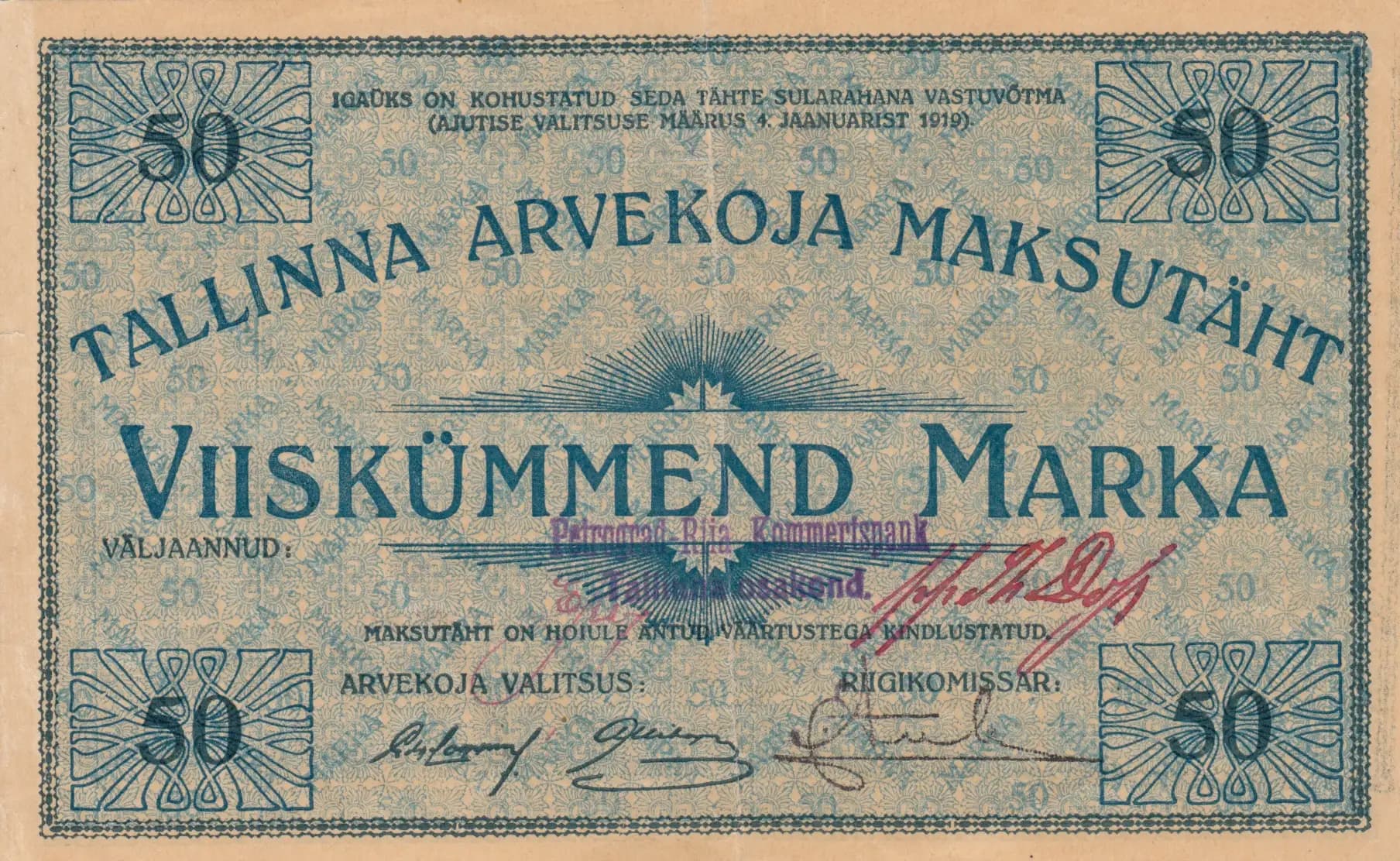
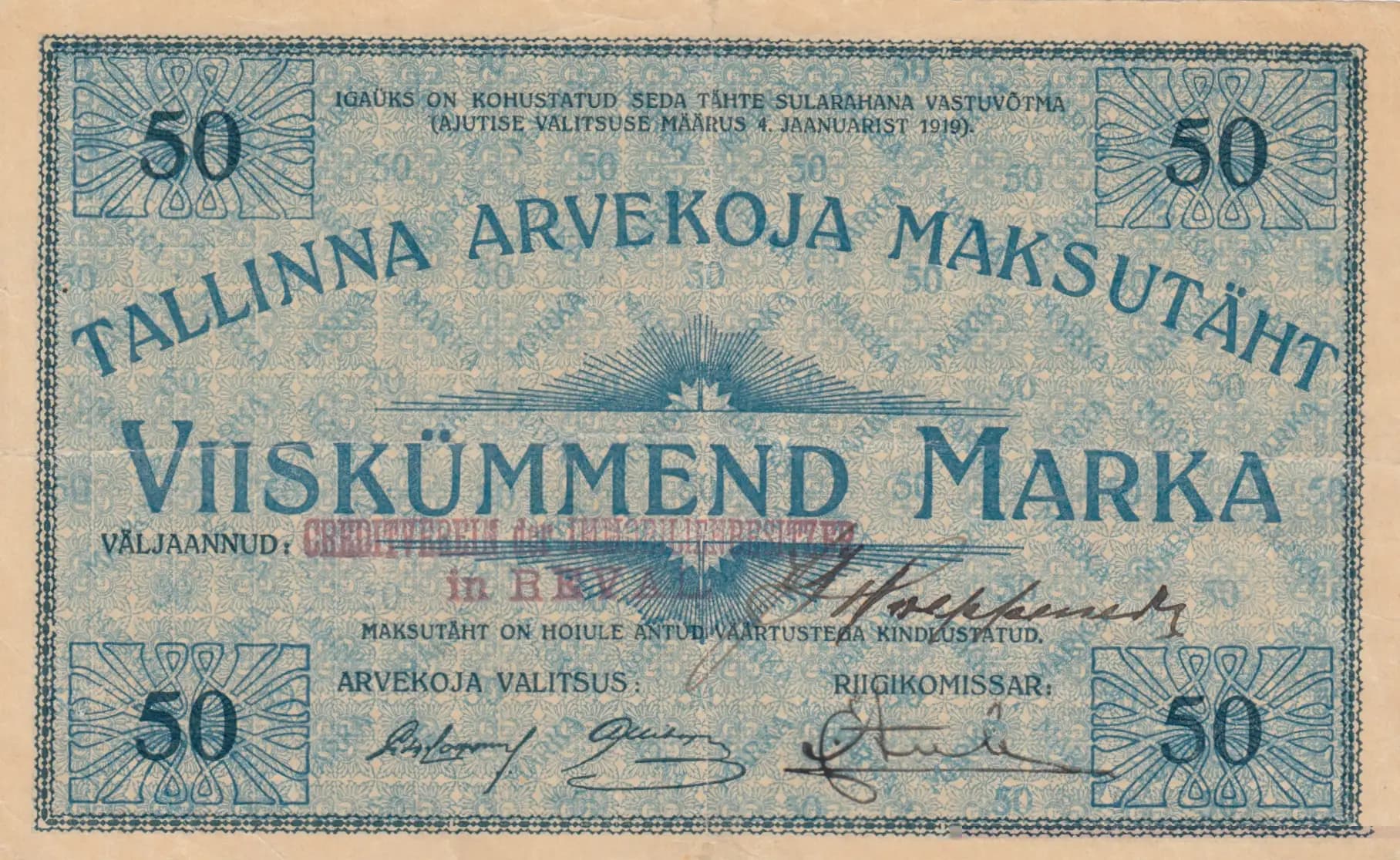
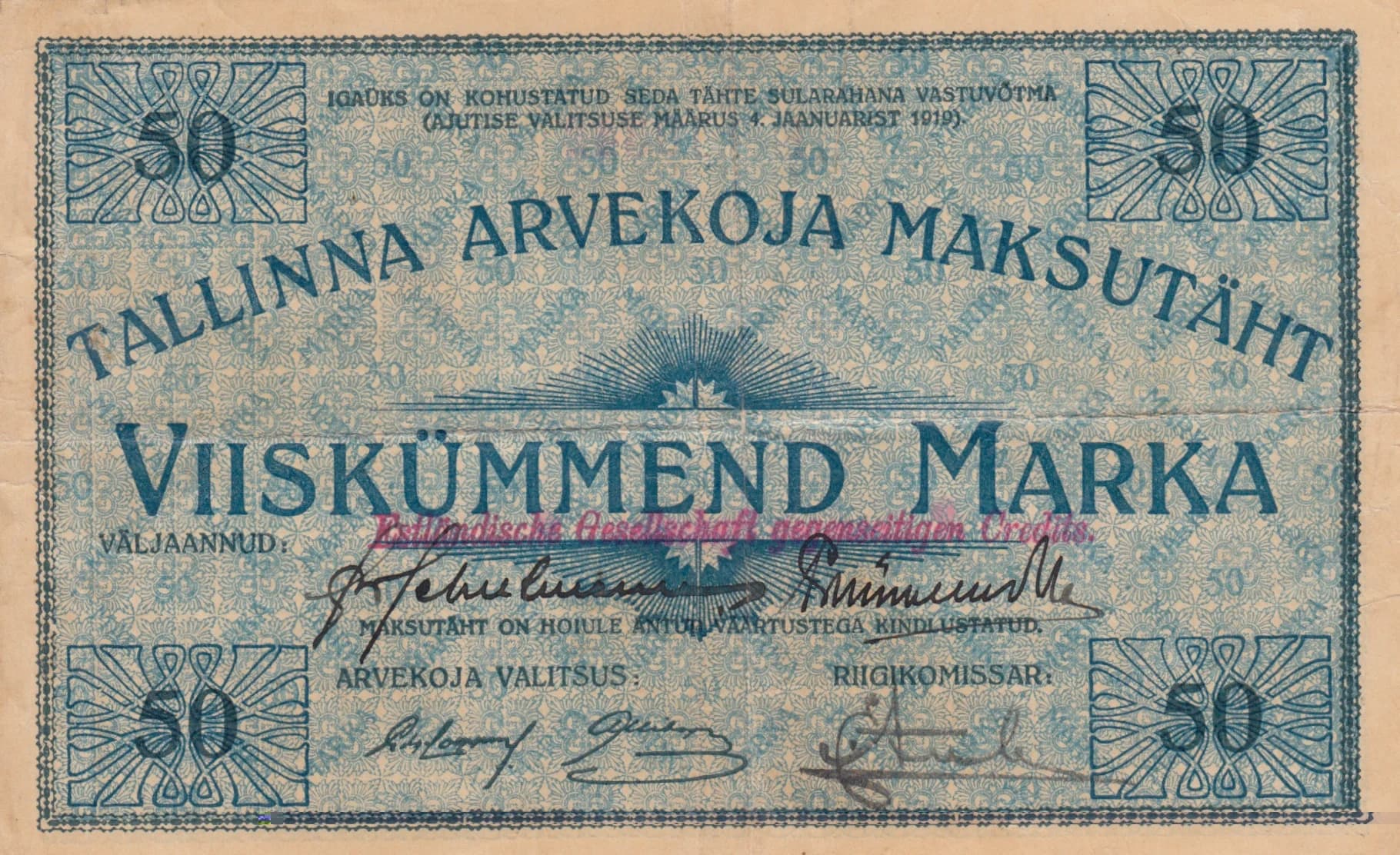
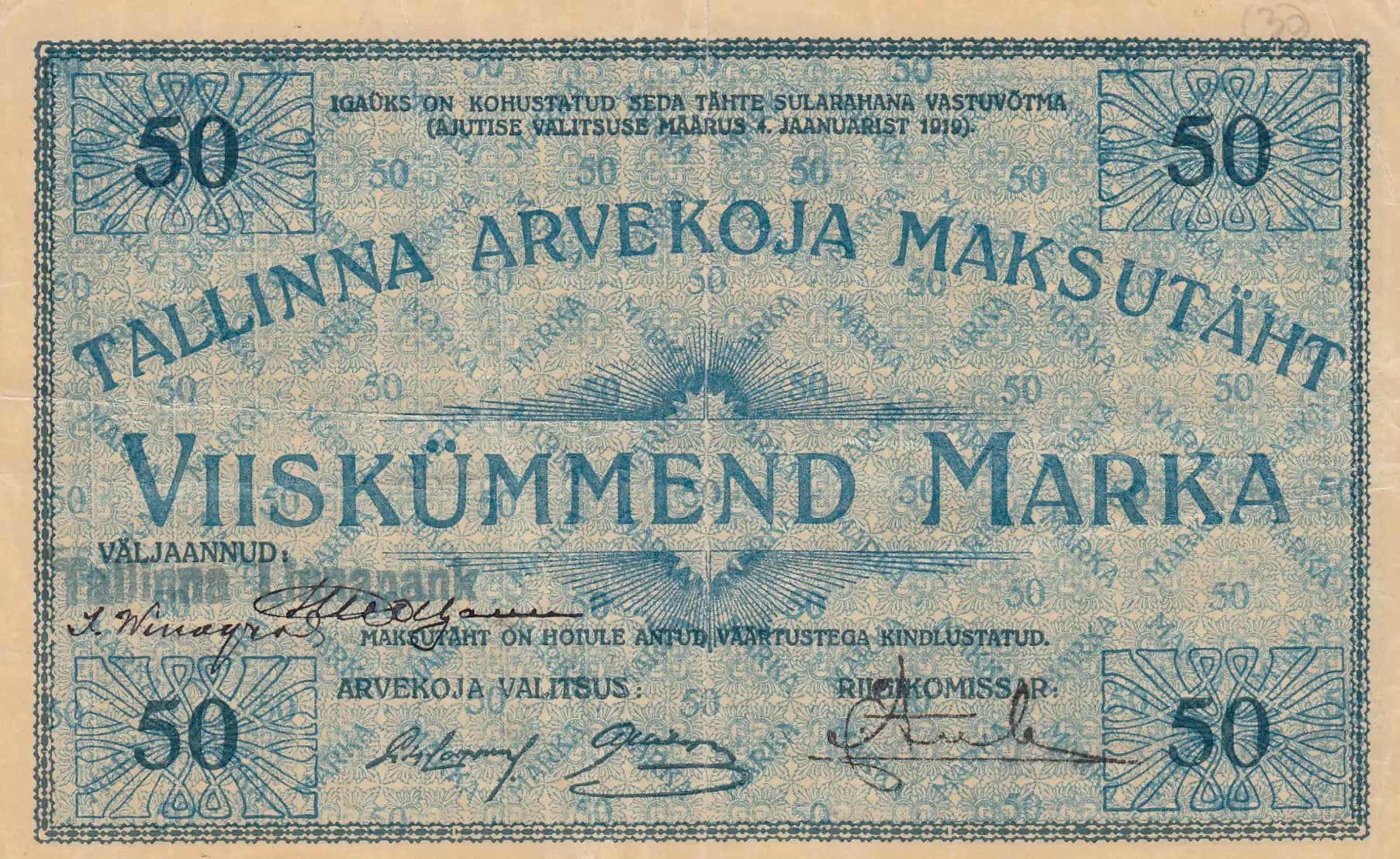
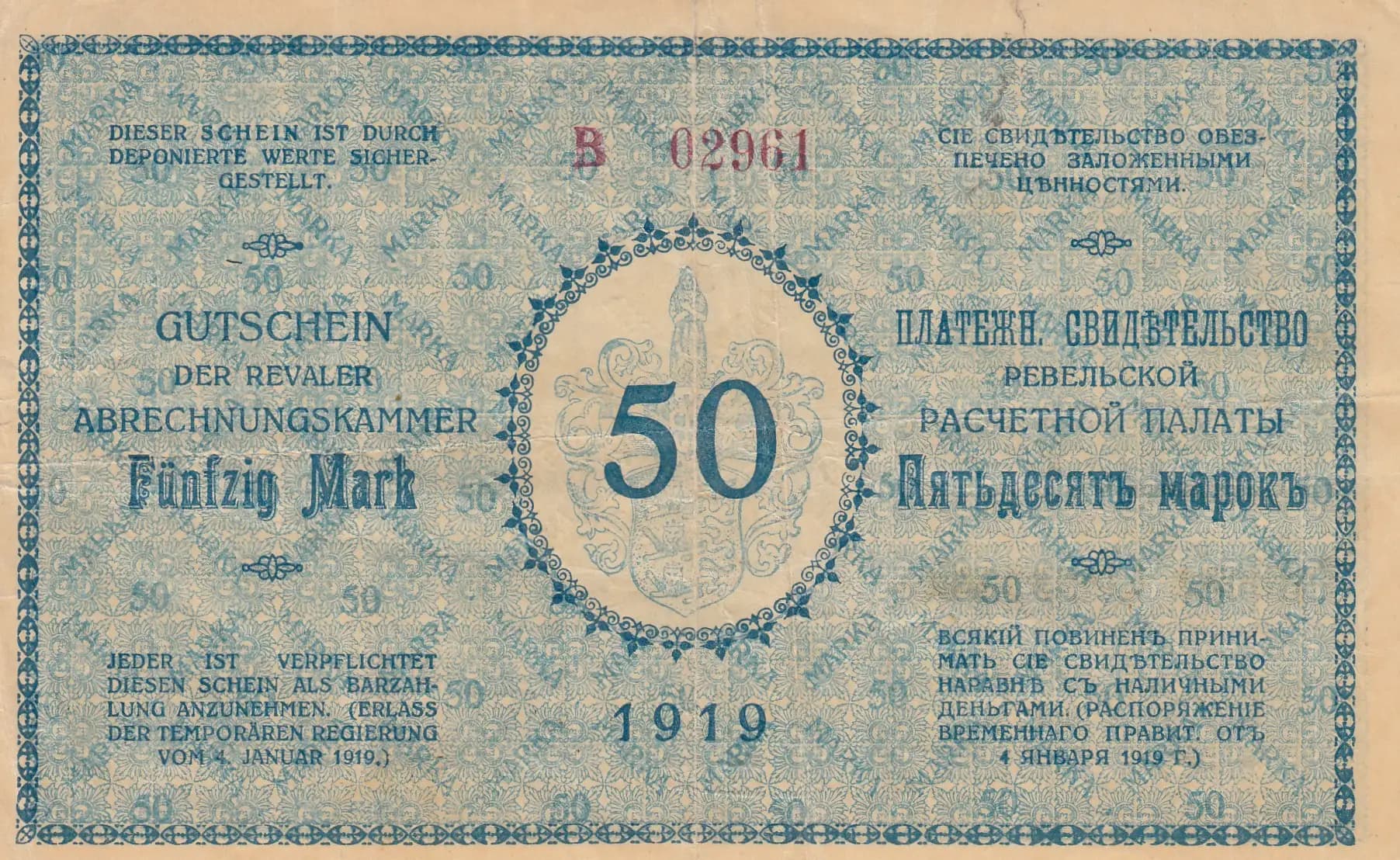
This is an Estonian 50 Marka emergency currency note issued by the Tallinna Arvekoda (Tallinn Chamber of Accounts) in 1919, graded VF. The note features characteristic Art Deco-influenced sunburst designs in corners and center, with text in Estonian, German, and Russian reflecting Estonia's complex linguistic heritage during this transitional period. The specimen shows authentic period wear with creasing and handwritten signatures/overlays in period inks, typical of emergency currency that was actually circulated during Estonia's independence struggle.
Common. While this is an interesting historical emergency issue, the eBay market data provided shows consistent sales in the $45-$180 range for various condition grades, with VF specimens selling around $54.90. This pricing pattern, combined with the relatively straightforward inscription without premium varieties, indicates this is not a scarce note. The Tallinna Arvekoda issued multiple denominations during 1919 as emergency currency, and surviving specimens are encountered regularly in the market. The Pick catalog P-A2b designation suggests this is a documented regular variety rather than a rare printing variant or recalled issue.
This note was issued under the January 4, 1919 decree of Estonia's Temporary Government as emergency currency during the chaotic period immediately following Estonia's declaration of independence from Russia. The trilingual inscriptions (Estonian, German, and Russian) reflect Tallinn's position as a Baltic port city with diverse populations, while the references to the Reval Settlement Chamber (German: Revaler Abrechnungskammer; Russian: Ревельской расчетной палаты) demonstrate the transitional administrative structures. The note's promise that it is 'secured by deposited valuables' was a confidence-building measure during a period when Estonia lacked established banking and currency institutions.
The note features a sophisticated Art Deco design with radiating sunburst patterns in all four corners and prominently in the center. The back side displays what appears to be Alexander Nevsky Cathedral (Aleksander Nevski Katedraal), the most iconic landmark in Tallinn, rendered within an elaborate ornamental oval frame containing the numeral '50'. The architectural vignette serves as both a security element and a patriotic symbol of Estonian identity. The repeating decorative background pattern throughout both sides provides visual continuity. The color scheme employs blue-green and dark teal tones on cream/beige stock, which was typical of emergency wartime currency. The use of three languages (Estonian, German, and Russian) on equal visual prominence reflects the transitional governance and the diverse population of Tallinn during 1919. The ornamental corner designs are consistent across both sides, providing compositional balance.
FRONT SIDE - Estonian: 'TALLINNA ARVEKOJA MAKSUTAHT' (Tallinn Chamber of Accounts Payment Certificate); 'VIISKÜMMEND MARKA' (Fifty Marks); 'VALJAANNUD ARVEKOJA VALIITSUS' (Issued by Chamber Committee); 'RIIGIKOMISSAR' (State Commissioner); 'MAKSUTAHT ON HOIULE ANTUD VAARTUSTEGA KINDLUSTATUD' (The payment certificate is secured by deposited valuables); 'IQADURS ON KOHUSTATUD SEDA TÄHT SULARAHANA VASTUVÕTMA (AJUTISE VALITSUSE MÄÄRUS 4 JAANUARIST 1919)' (The holder is obliged to accept this note as cash - Temporary Government Decree of January 4, 1919). BACK SIDE - German: 'GUTSCHEIN DER REVALER ABRECHNUNGSKAMMER' (Voucher of the Reval Settlement Chamber); 'Fünfzig Mark' (Fifty Marks); 'DIESER SCHEIN IST DURCHS DEPONIERTE WERTE SICHER-GESTELLT' (This note is secured by deposited valuables); 'JEDERZEIT VERPFLICHTET DIESEN SCHEIN ALS BARZAHLUNG (ERLASS DER TEMPORÄREN REGIERUNG VOM 4 JANUAR 1919.)' (At any time obliged to accept this note as cash payment - Decree of the Temporary Government of January 4, 1919). Russian: 'ПЛАТЕЖНОЕ СВИДЕТЕЛЬСТВО РЕВЕЛЬСКОЙ РАСЧЕТНОЙ ПАЛАТЫ' (Payment Certificate of the Revel Settlement Chamber); 'Пятьдесят марок' (Fifty marks); 'СИЕ СВИДЕТЕЛЬСТВО ОБЕСПЕЧЕНО ПЕЧЕНО САХОВАННЫМИ ЦЕННОСТЯМИ' (This certificate is secured by deposited valuables); 'ВСЯКИЙ ПОВИНЕН ПРИНИ-МАТЬ СИЕ СВИДЕТЕЛЬСТВО НАРАВНЕ С НАЛИЧНЫМИ ДЕНЬГАМИ.(РАСПОРЯЖЕНИЕ ВРЕМЕННОГО ПРАВИТ. ОТ 4 ЯНВАРЯ 1919.)' (Everyone is obliged to accept this certificate as equivalent to cash - Decree of the Temporary Government of January 4, 1919). Serial number: B 10342; Date: 1919.
This note was produced using letterpress/typographic printing, evidenced by the crisp, uniform impression of text and the characteristic dot patterns visible in the decorative elements. The printing shows the hallmark clarity of mechanized typographic production from the early 20th century. The red serial number 'B 10342' appears to have been applied separately, possibly via hand stamp or secondary press run. For Pick number P-A2b, this note was printed at a local Estonian facility rather than by an established security printer, which is typical of emergency currency issues from this period. The paper stock appears to be standard commercial bond paper rather than specialized banknote paper, consistent with the expedited production requirements of emergency wartime currency.
This specimen is variety P-A2b with serial number B 10342. The 'B' prefix likely indicates a specific print run or batch designation. Known varieties of this issue include different signature combinations and possible variations in the serial number prefix series. The handwritten signatures and red-inked overlay on the front appear to be period authentication marks rather than catalog variety indicators. No major varieties (such as color variations, overprints, or significant printing errors) are evident in this specimen, though comprehensive variety catalogs specific to Estonian emergency currency from 1919 may document additional details regarding prefix series or signature combinations that distinguish varieties within the P-A2 designation.