50 marka 1919
Market Prices
About This Note
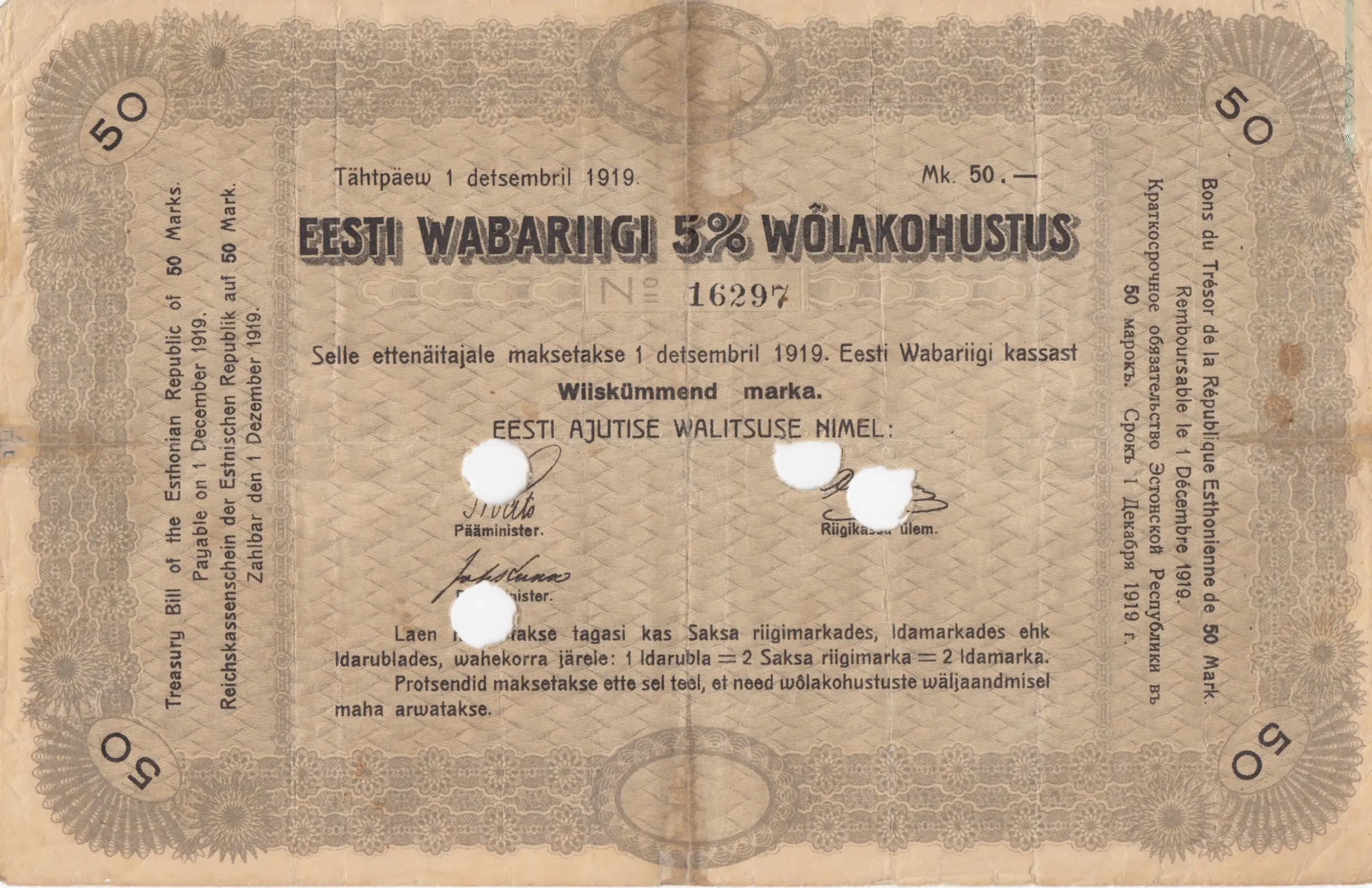
This Estonian 50 Marka Treasury Bill from December 1, 1919, represents an important early monetary instrument of the newly independent Estonian Republic during a period of significant economic and political transition. The note exhibits typical VF condition with four cancellation punch holes, extensive creasing including a prominent center fold, and overall age-related foxing and discoloration—characteristics consistent with its historical use as a war loan bond rather than circulating currency. The ornate decorative design with sunburst patterns and multi-language inscriptions reflects Estonia's complex political situation during the Russian Revolution and Estonian War of Independence.
Common. eBay market data shows consistent pricing for this Pick number in various conditions ranging from $45–$275 USD, with VF-graded examples regularly appearing at $54.90 USD. The broad supply of these notes at relatively modest prices, combined with their status as redeemable Treasury Bills (many examples were cancelled and remain as historical artifacts rather than sought-after collectibles), indicates robust availability in the collector market. The high print run typical of bond issues and the lack of any documented scarcity or recall premium support a common classification.
Issued during Estonia's provisional government phase in 1919, this 5% war loan bond was denominated in marks and denominated for repayment in alternative currencies (German marks, East marks, or East rubles) reflecting the unstable post-WWI Eastern European monetary environment. The note's trilingual inscriptions in Estonian, German, and English, along with references to the State Treasury and Provisional Government leadership, document Estonia's transition from Russian imperial rule to independent statehood during the chaotic period of the Russian Civil War and Estonian War of Independence. The cancellation punch holes indicate this bond was redeemed or deactivated, making it a relic of Estonia's early fiscal policy during nation-building.
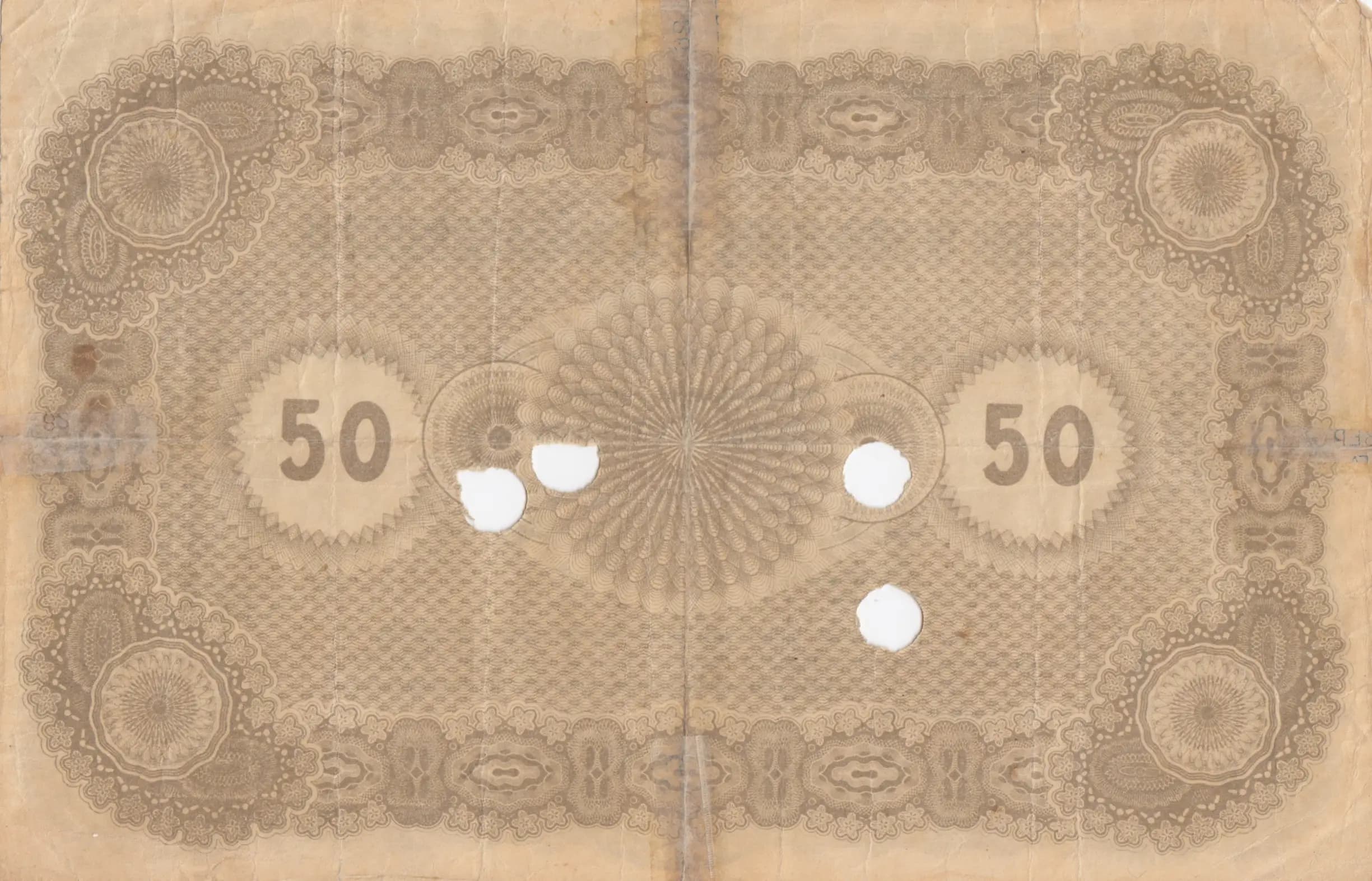
This Treasury Bill features a classical early 20th-century European design aesthetic dominated by intricate ornamental borders with floral and geometric patterns characteristic of Neo-Classical security printing. The front displays a symmetrical layout with the large denominational text ('50 Marks' / 'Wilskümmend marka') prominently positioned, three signature lines for the Prime Minister, Minister, and State Treasury Chief representing the Provisional Government's tripartite authority structure, and detailed terms for loan repayment in multiple currencies. The reverse side showcases a purely decorative composition with large '50' numerals enclosed in ornate circular medallions positioned left and right, and a dominant central sunburst or radiating fan pattern (possibly representing Estonian national symbolism) surrounded by intricate geometric rosette and border designs in all corners. The color scheme employs monochromatic warm tones (beige, tan, brown, gray) typical of early Estonian currency printing. The four circular cancellation punch holes present on both sides, along with the hand-signed authority lines, distinguish this as a redeemed or deactivated bond rather than uncancelled stock.
FRONT SIDE: 'EESTI WABARIIĞI 5% WÖLAKOHUSTUS' (Estonian Republic 5% War Loan Bond); 'Tähtsaew 1 detsembril 1919' (Date 1 December 1919); 'Mk. 50.—' (Marks 50); Serial number '16297'; 'Selle ettenäitajale maksetakse 1 detsembril 1919. Eesti Wabariigi kassast' (To the bearer of this will be paid on 1 December 1919 from the Estonian Republic treasury); 'Wilskümmend marka' (Fifty marks); 'EESTI AJUTISE WALITSUSE NIMEL:' (In the name of the Estonian Provisional Government:); 'Treasury Bill of the Estonian Republic of 50 Marks'; 'Pääminister' (Prime Minister); 'Minister'; 'Riigikassa ülem' (State Treasury Chief); 'Laen maksetakse tagasi kas Saksa riigimärkades, Idamarkades ehk Idarublades, wahekorra järele: 1 Idarubla = 2 Saksa riigimarka = 2 Idamarka. Protsendid maksetakse ette sel teel, ei need wölakohustuste wälijaandmisol maha arwatakse.' (Loan is repaid in German currency marks, East marks or East rubles as applicable: 1 East ruble = 2 German marks = 2 East marks. Interest is paid in advance on that basis and is not deducted from the war bonds at issue). BACK SIDE: Large denomination numeral '50' in circular medallions; minimal textual inscription, primarily ornamental in design.
This note was produced using intaglio printing (engraved steel plate), the standard security printing method for government bonds and treasury bills of the period. The fine line work visible in the ornamental borders, the crisp definition of the large numerals in their medallions, and the detailed geometric patterns characteristic of engraved designs are evident in the visual analysis. The registration of the cancellation punch holes on both sides indicates professional finishing by a specialized security printer. While the specific printer for Estonian 1919 issues is not definitively identified in available references, early Estonian notes were often produced by German or Austro-Hungarian security printers, consistent with the multilingual trilingual design and professional execution.
This specific example bears serial number 16297 and shows evidence of authorized cancellation via four punch holes. No significant varieties have been documented for Pick 25 beyond standard serial number ranges and signature variations representing different signatories (Prime Ministers and Treasury Chiefs of the Estonian Provisional Government in 1919). The visible handwritten signatures appear to be applied during the note's official issuance or authorization phase. The date '01.12.1919' is consistent across all documented examples of this issue.