50 marka 1919
“serie A”
Market Prices
About This Note
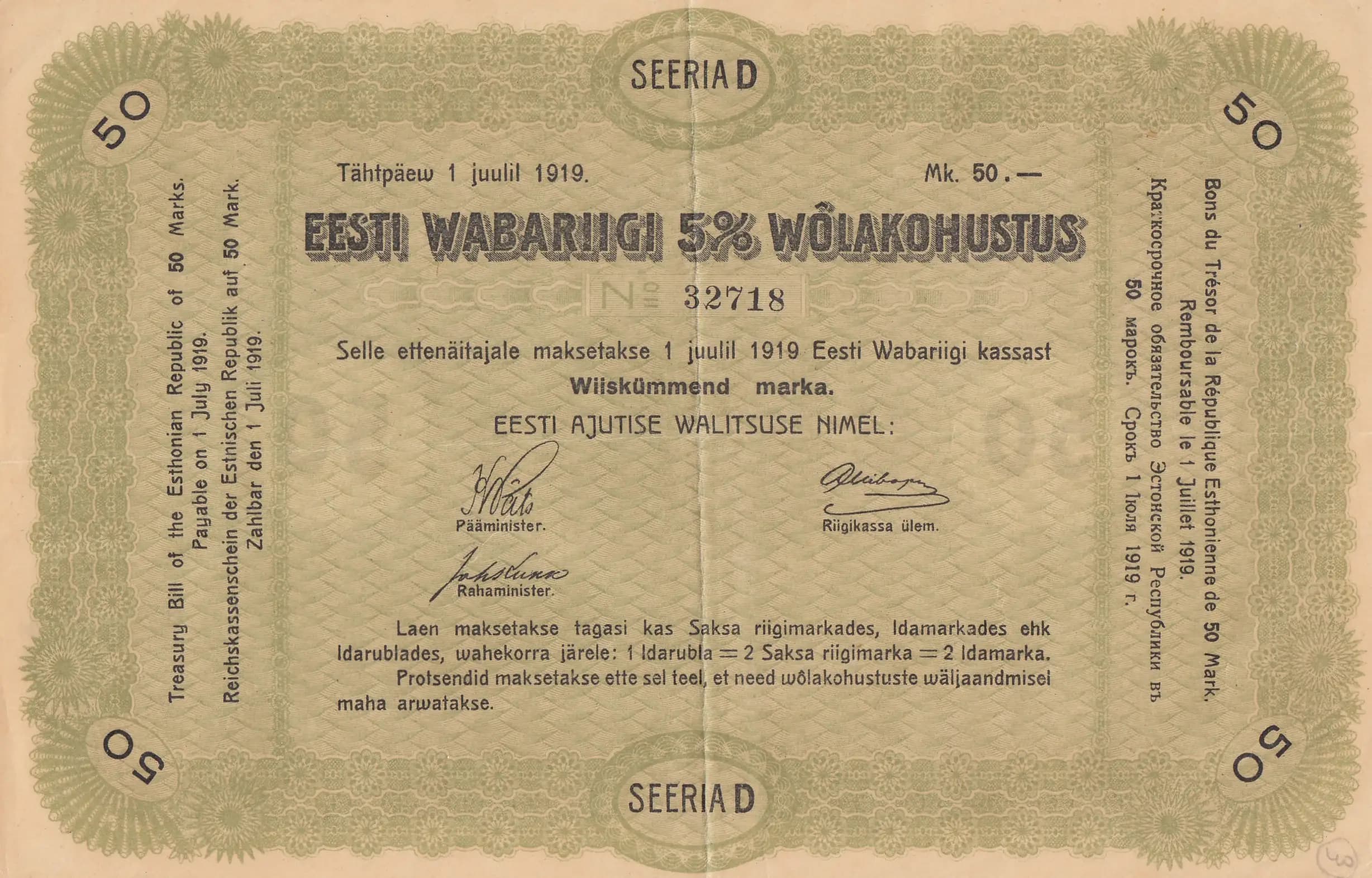
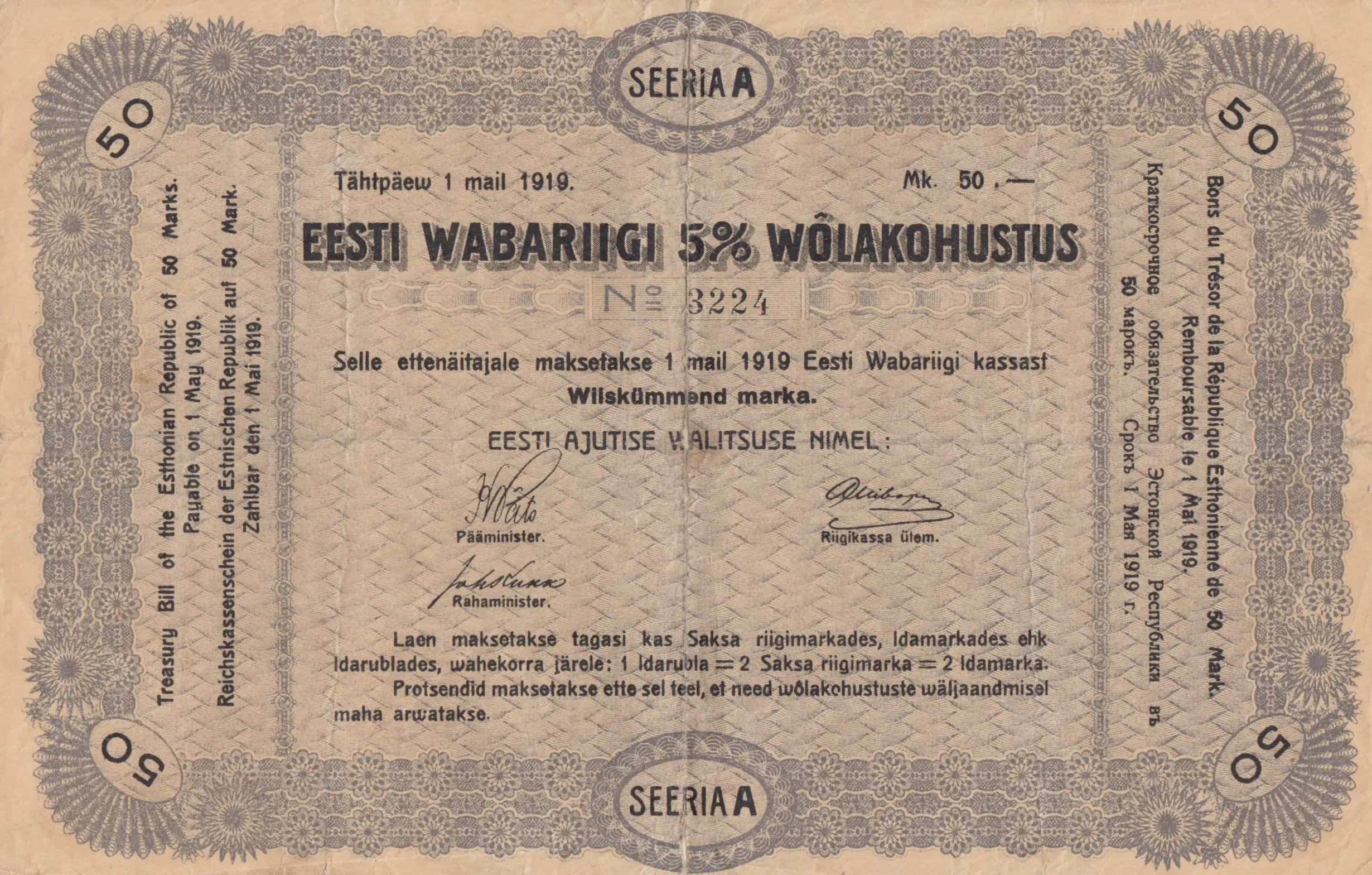
This is Estonia's first banknote, a 50 Marka debt obligation issued by the newly independent Estonian Republic on 1 May 1919. The note displays the characteristic uniface design (printing on front only) of Pick-1, with ornate Art Nouveau-style borders and trilingual text in Estonian, German, and French reflecting the complex geopolitical context of the period. In VF condition with visible center fold and age-appropriate patina, this Series A example represents an important historical artifact from Estonia's critical founding year, with serial number 3224.
Common. The eBay market data shows recent sales of this Pick number in VF condition averaging approximately $54.90 USD, with examples in various conditions ranging from $45 to $180 USD. The 2016 catalogue value for this note in Fine condition is listed at $150. The relatively modest and consistent market pricing across multiple recent sales indicates healthy supply in the collector market. While this is historically significant as Estonia's first banknote issue, the Pick-1 50 Marka denomination appears to have been produced in sufficient quantity to remain readily available to collectors, particularly in VF-XF grades. No evidence suggests restricted print runs or significant recall that would elevate scarcity.
This note was issued during Estonia's declaration of independence from the Russian Empire, representing the new republic's first attempt at establishing sovereign currency. The trilingual inscriptions (Estonian, German, and French) and the explicit mention of repayment in German State Marks or East Rubles demonstrate the transitional economic circumstances of post-WWI Eastern Europe. The 1 May 1919 date coincides with Estonia's formal establishment of the Provisional Government, making this an exceptionally historically significant issue from the nation's founding moment.
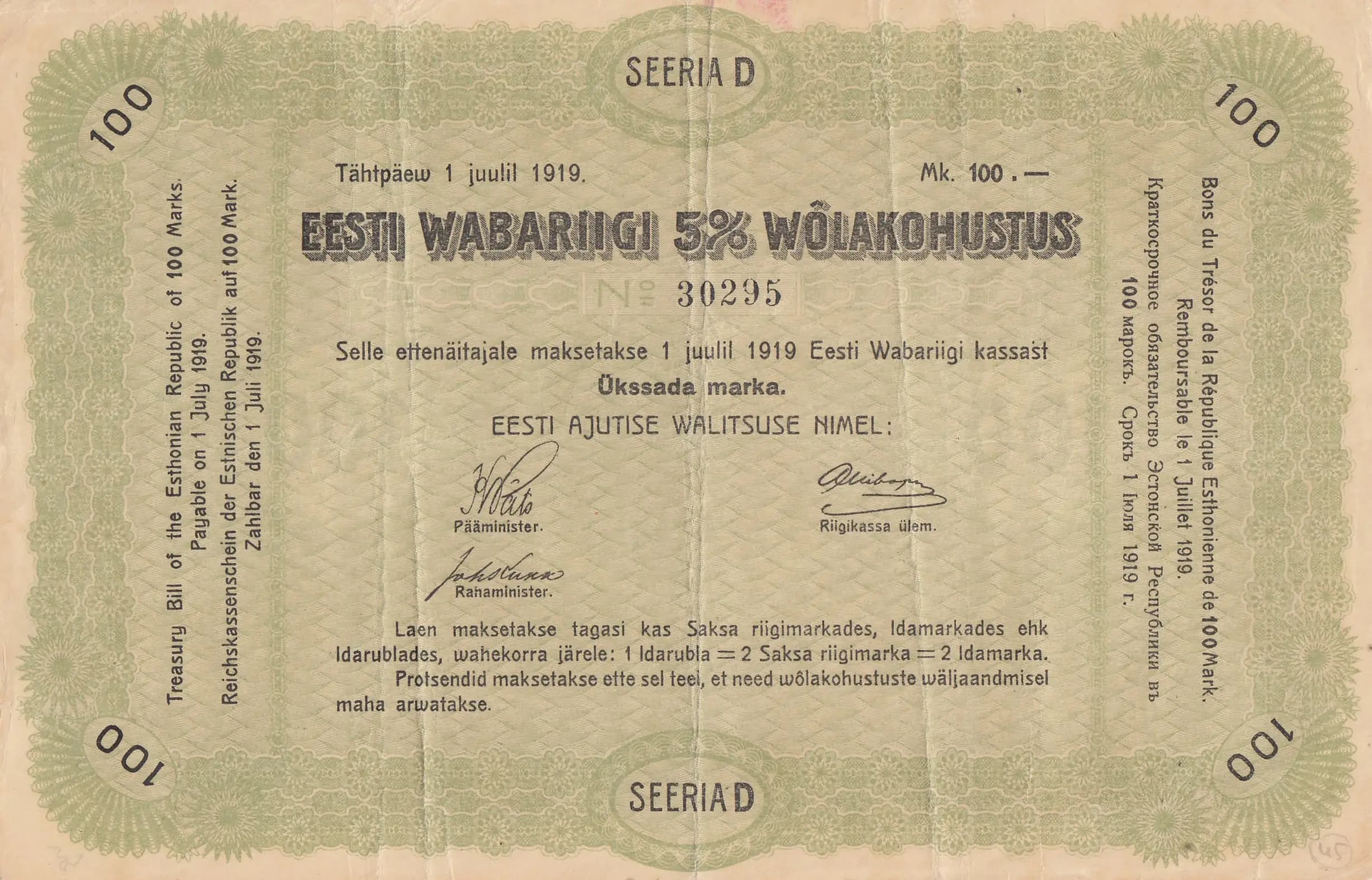
This is a uniface banknote featuring an elaborate ornamental border design typical of early 20th-century debt instruments. The front displays symmetrical Art Nouveau-style geometric and floral patterns with radiating fan-like sunburst motifs positioned in the corners and integrated throughout the border framework. The central design area contains the denomination '50' prominently displayed, with the main text arranged in a formal hierarchical layout characteristic of official government financial documents. The series designation 'SEERIA A' appears twice in oval cartouches—at the top and bottom center—serving both as an identifying mark and likely incorporating watermark-resistant placement. The color scheme is subdued, utilizing primarily black or dark gray printing on a beige/cream paper stock, emphasizing the serious, official nature of the instrument. No portraits or specific landmarks are depicted; rather, the design emphasizes geometric ornamentation and authoritative typography to convey legitimacy and security. The trilingual text (Estonian, German, French) is integrated throughout the design, with each language occupying designated zones, reflecting the document's role in the transitional political economy of post-World War I Estonia.
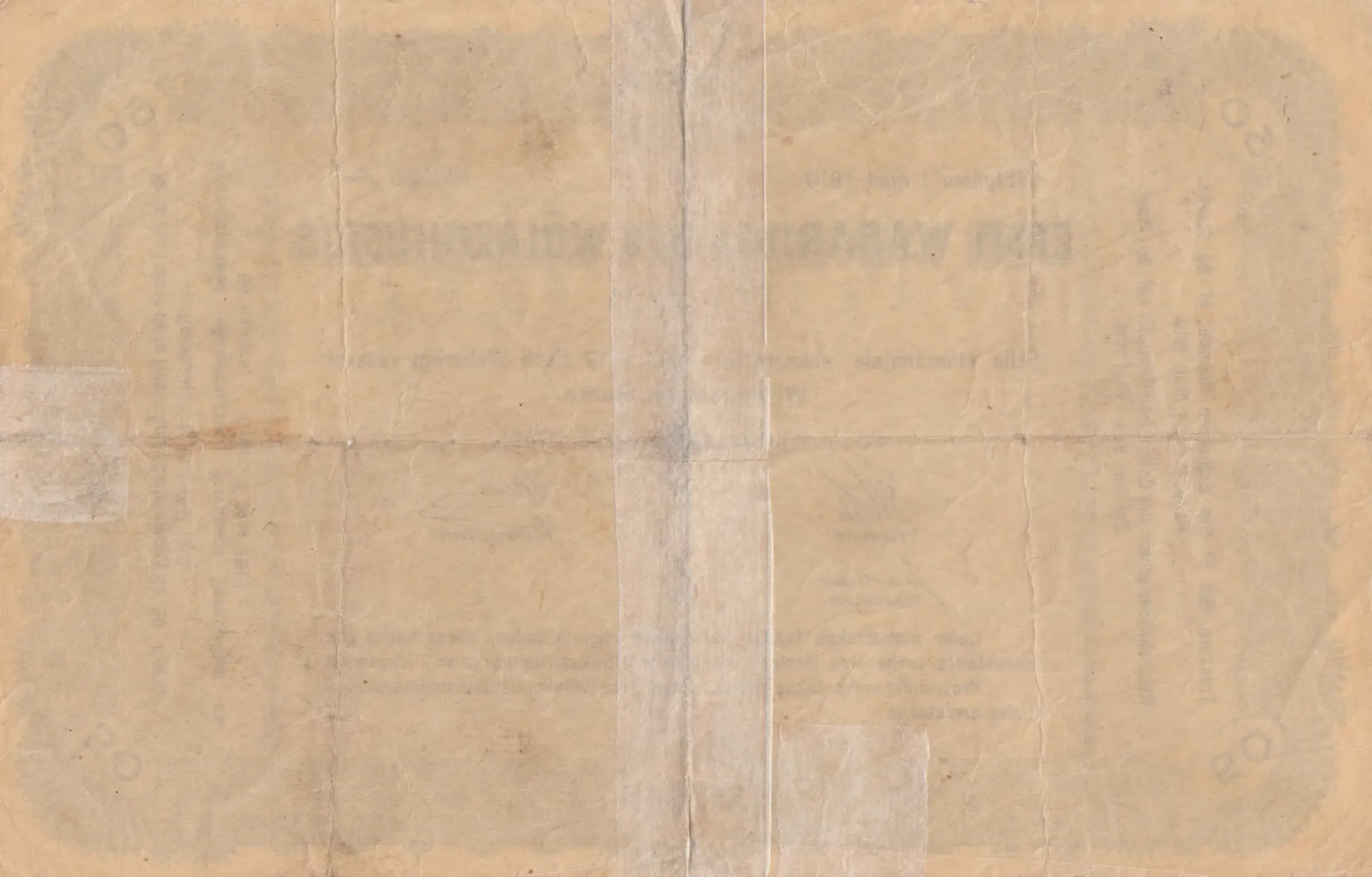
FRONT SIDE: Main title: 'EESTI WABARIIGI 5% WÕLAKOHUSTUS' (Estonian Republic 5% Debt Obligation). Denomination and authority: 'Selle ettenäitajale maksetakse 1 mail 1919 Eesti Wabariigi kassast wilskümmend marka' (This note shall be paid 1 May 1919 from the Estonian Republic treasury fifty marks). Government authorization: 'EESTI AJUTISE V. AJUTSUSE NIMEL: Pääminister. Riigikaasa ülem. Rahaminíster.' (In the name of the Estonian Provisional Government: Prime Minister. State Elder. Finance Minister). Redemption terms in Estonian: 'Laen maksutakse taagasi kas Saksa riigikassast, idamarkadest, eht idarublades, uahekorras järjele: 1 idaruola = 2 Saksa riigimarka = 2 idamarka. Profitsendid maksutakse ettie sel teel, et need wõlakohustuste wäljandmisial maha arwatatakse.' (The loan will be repaid from the German State Treasury, East Marks, or East Rubles in the following order: 1 East Ruble = 2 German State Marks = 2 East Marks. Interest shall be paid in the same manner as deducted from the debt obligation issuance). German text: 'Zahlbar den 1. Mai 1919.' (Payable 1 May 1919). French text: 'Bonds di Tressorinale dei Republique de l'Estonie' (Treasury Bonds of the Republic of Estonia) and 'Remboursable le 1 mai 1919' (Redeemable 1 May 1919). Series designation in oval cartouches: 'SEERIA A' (Series A). Date inscription: 'Tähtpäev 1 mail 1919.' (Valid date 1 May 1919). Serial number: 'N° 3224'. Denomination markings: '50 Marks', 'Mk. 50,—', 'Mk. 50'. BACK SIDE: Blank or negligibly printed (uniface design confirmed).
This note was produced using letterpress or intaglio printing techniques, as evidenced by the crisp, well-defined line work visible in the ornamental borders and the consistent pressure of the typography. The fine details in the geometric and floral border patterns, along with the clear serif typography, suggest a combination of engraving and letterpress work typical of security printing from this era. The uniface design (printing on front only) would have been more economical than double-sided production. The specific security printer for this issue is not definitively documented in readily available numismatic literature, though it is likely to have been contracted to an established European security printer, possibly based in Germany or Scandinavia given Estonia's geographic and economic relationships at the time.
This example is identified as Series A (SEERIA A), the primary variety for the Pick-1 50 Marka issue. The external catalog reference notes that a variant exists as P-1A, which was printed on both sides (while this standard P-1 is uniface). The serial number 3224 falls within the standard numbering sequence for this series. No signatures are visible or documented for this issue, as authorization was indicated by titled positions (Prime Minister, State Elder, Finance Minister) rather than individual signatures. The specimen examined represents the standard uniface variety; collectors should verify whether any examples exist with overprints or emergency modifications, though none are mentioned in major catalogs for this specific denomination.