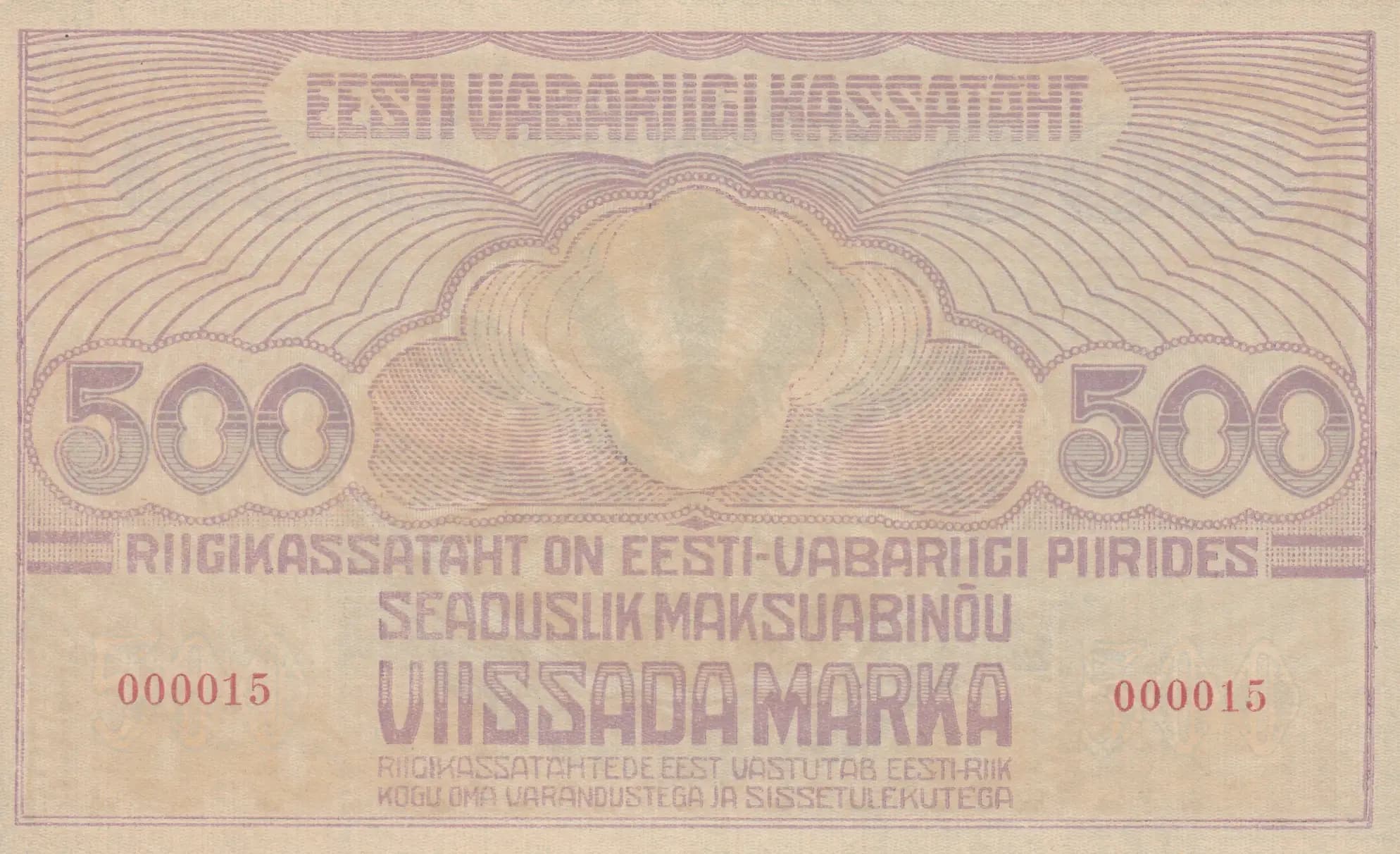
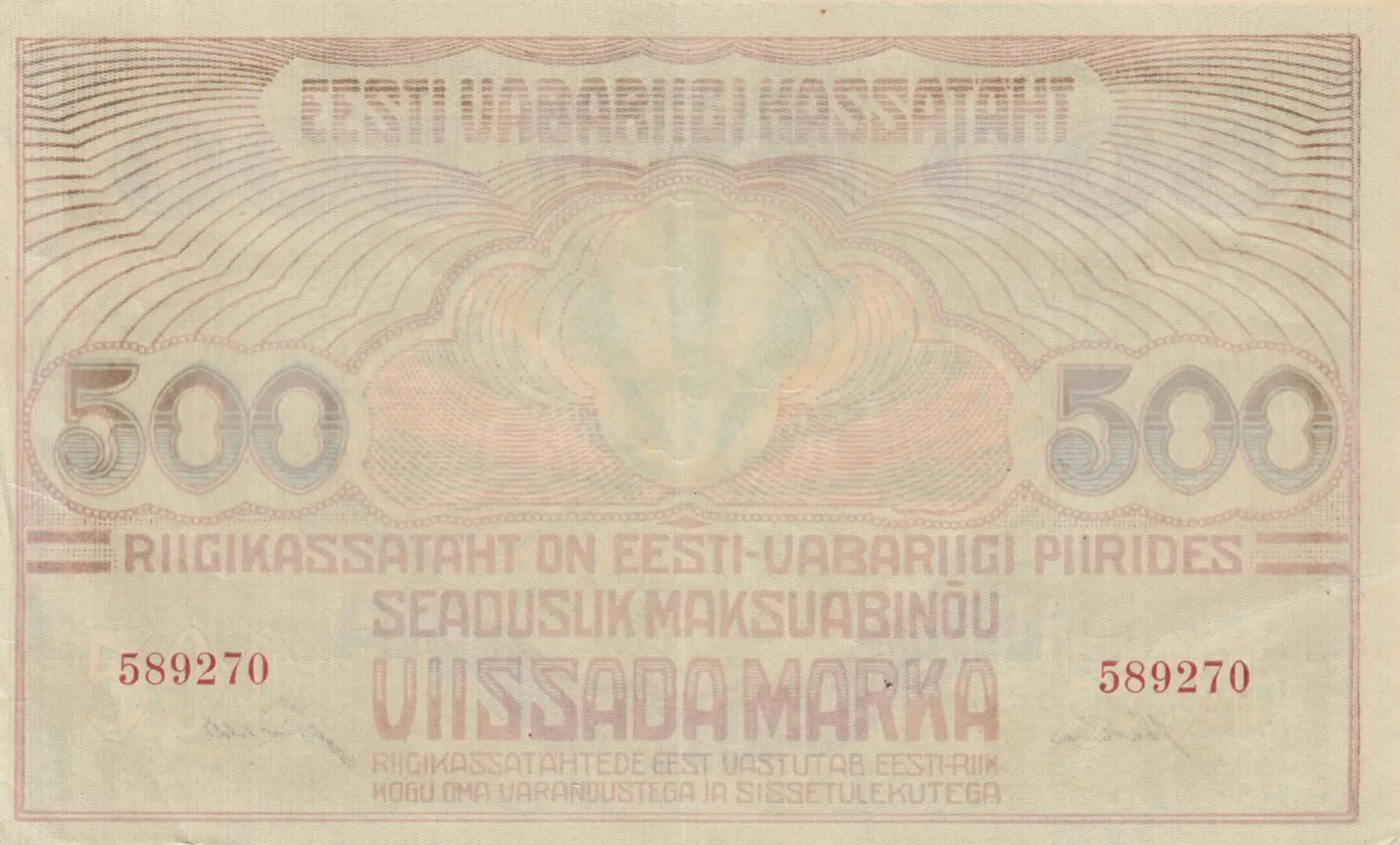
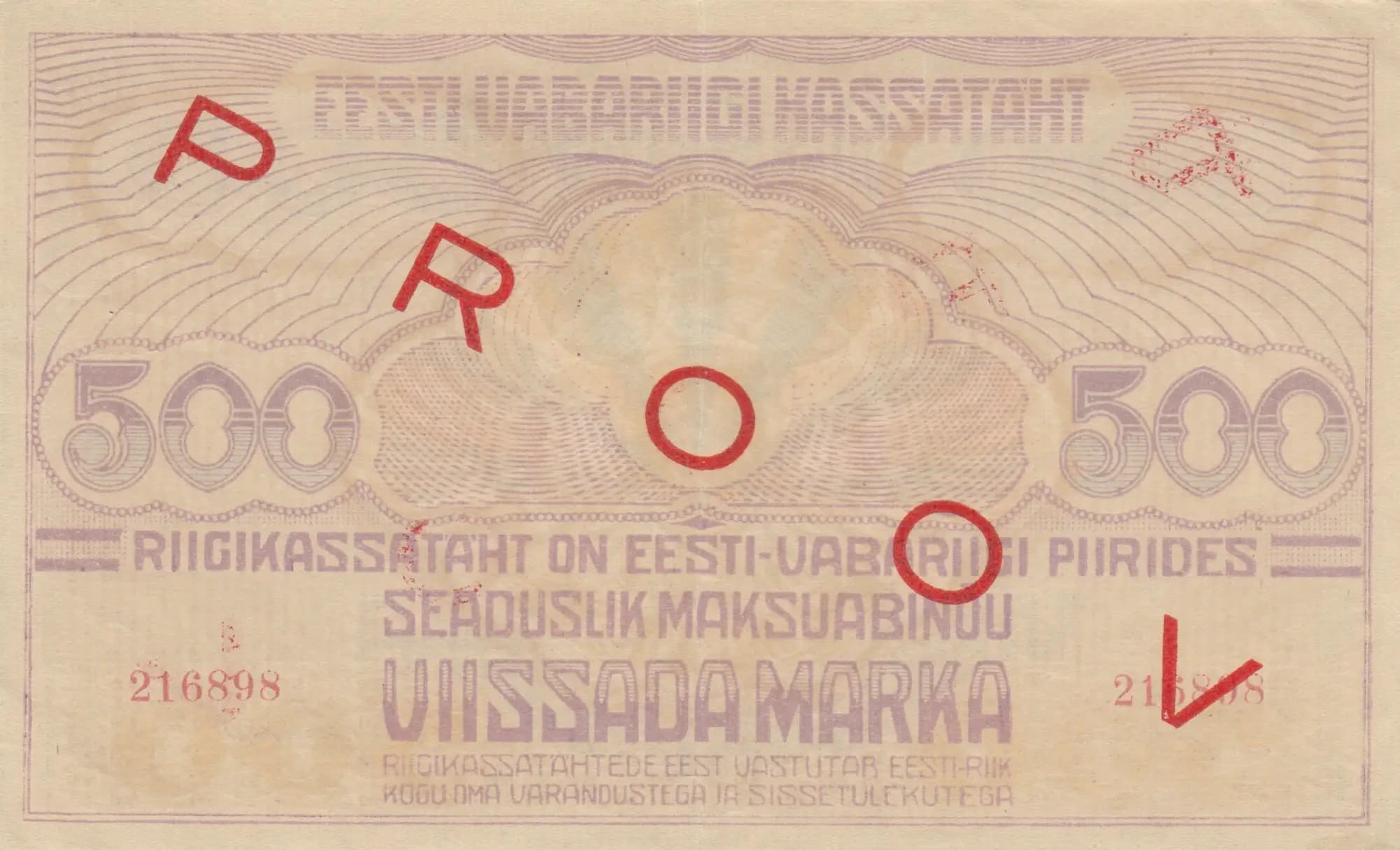
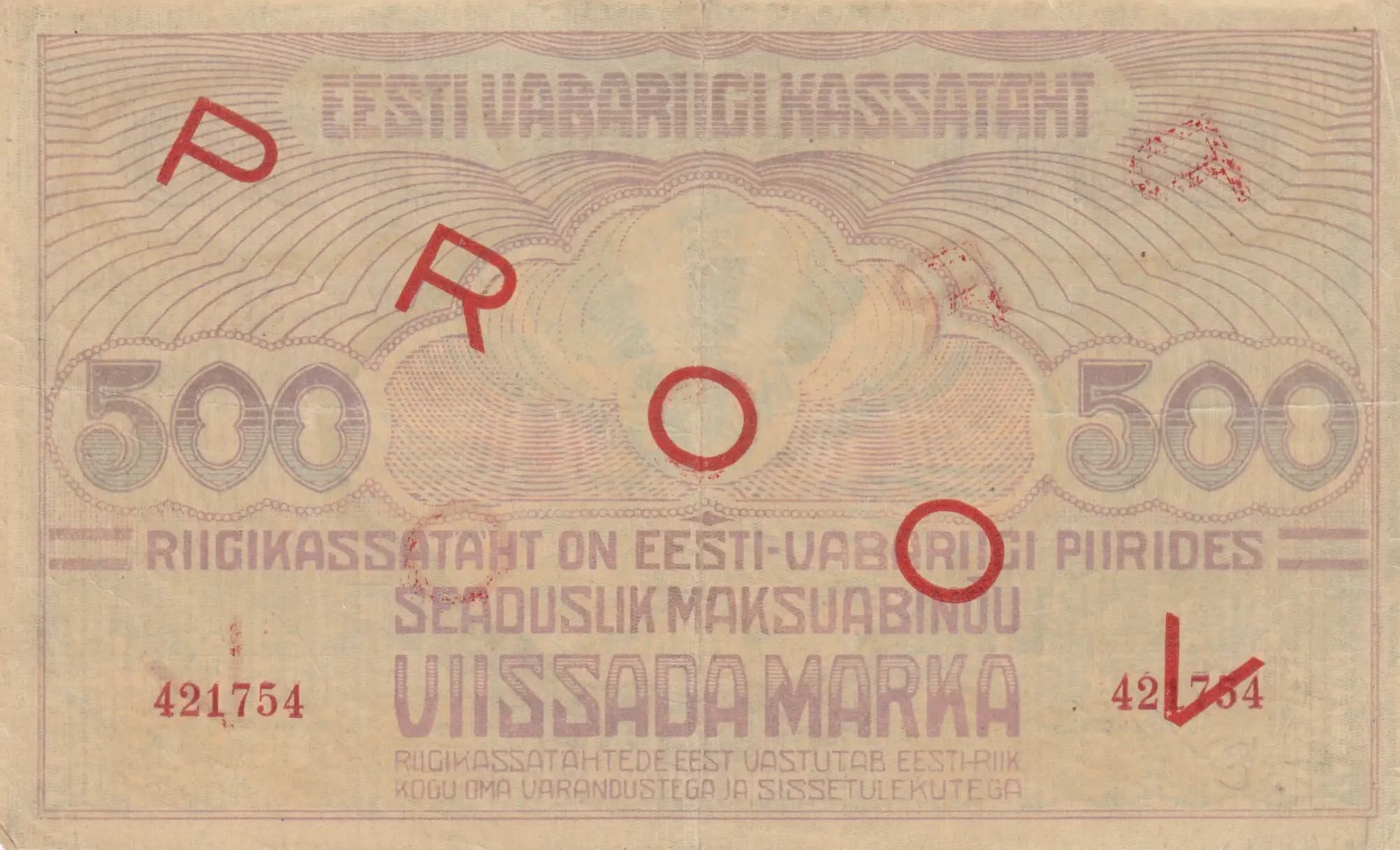
500 marka 1920 specimen
Market Prices
About This Note
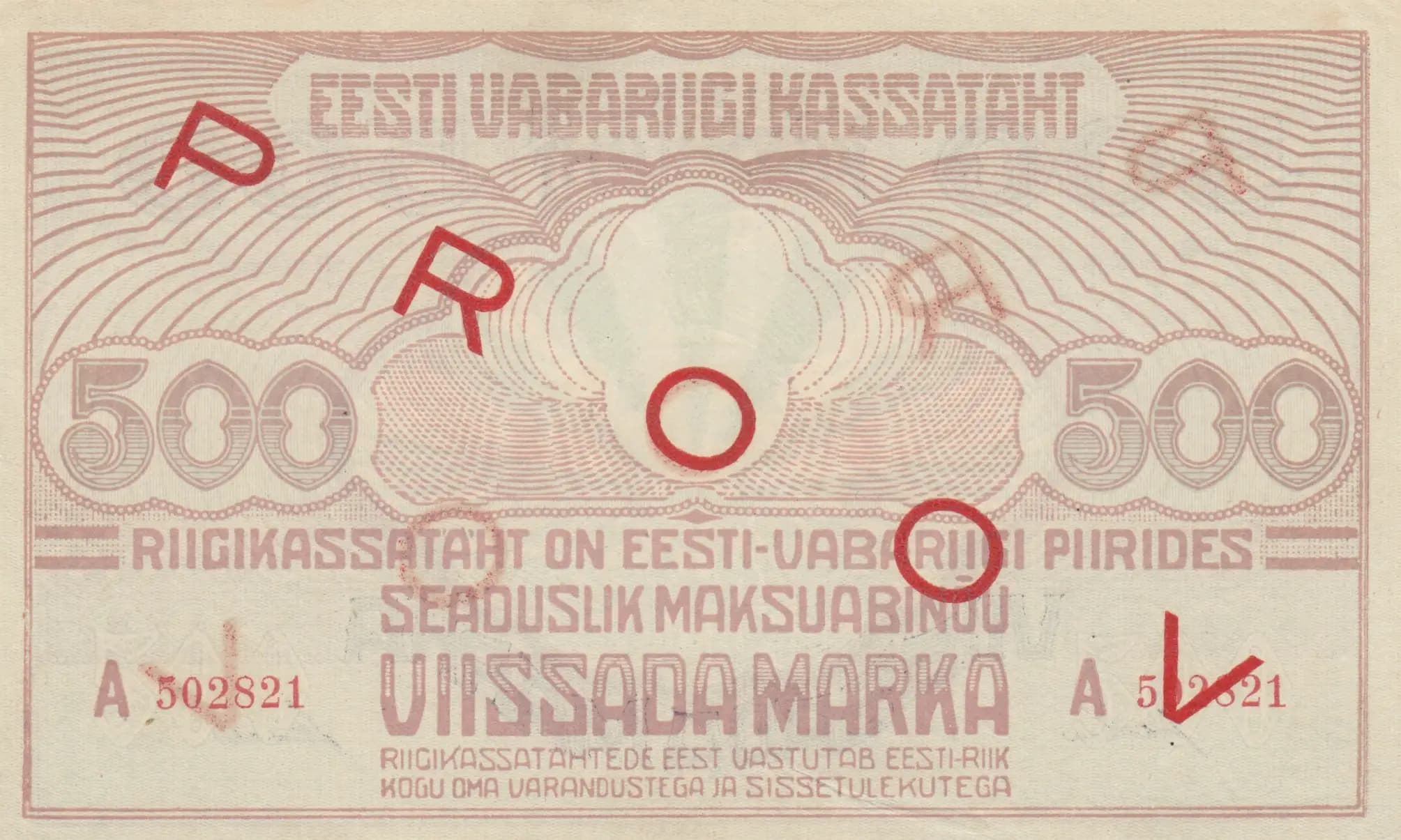
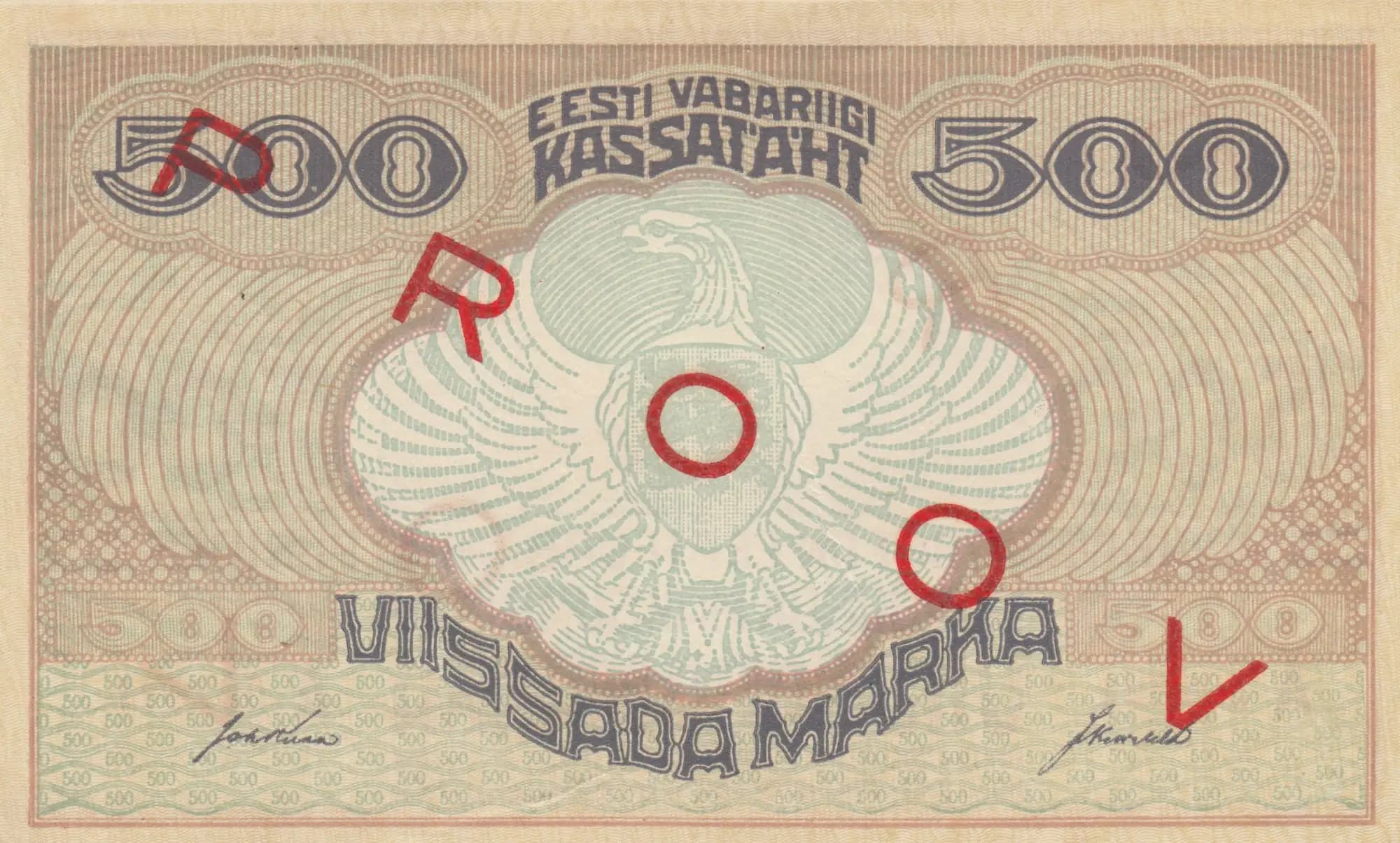
This is a 500 marka specimen banknote from the Estonian Treasury, issued in 1920 during the early years of Estonian independence. The note displays the characteristic ornamental design of the period with a central heraldic emblem featuring a winged coat of arms on the reverse and geometric oval vignettes on the obverse, rendered in pink/mauve and green/blue tones respectively. The multiple red 'PRO' specimen overprints and circular seals confirm its status as a reference/specimen piece rather than circulated currency, and the diagonal red pen stroke and visible aging are consistent with its AU condition grade and archival handling.
Common. The eBay market data shows a wide range of prices (from $15 to $669) across various condition grades, with most graded examples (VF, XF, UNC) selling in the $40–$250 range. The 2016 catalog values (VG $100, VF $250, UNC $500) suggest moderate collectible interest but not scarcity. The existence of multiple variants (P-49b, P-49es) and the apparent availability of multiple examples across different grades indicate that this denomination was printed in sufficient quantities for it to remain available to collectors today. Specimen notes with 'PRO' overprints are typically less common than regular circulated issues, but this does not elevate rarity significantly given the stable market pricing. This note should be classified as common to uncommon in the AU condition grade observed.
The 500 marka denomination was issued by the newly independent Estonian Republic following its declaration of sovereignty in 1918, with this 1920 specimen representing the Treasury's (Eesti Vabariigi Kassataht) effort to establish a stable national currency during the volatile post-WWI period. The reverse features the Estonian state coat of arms with its distinctive winged heraldic design, symbolizing the nation's sovereignty and territorial integrity. The bilingual Estonian inscriptions affirm the Estonian Republic's financial responsibility and the note's status as legal tender within Estonian borders, reflecting the consolidation of Estonian national identity through monetary authority.
The obverse features a symmetrical ornamental design with complex wavy line patterns and fine-line engraving throughout, centered on a decorative oval vignette with radiating geometric lines and an ornamental border frame. The denomination numeral '500' is prominently displayed on both left and right margins. The reverse depicts the Estonian state coat of arms (Eesti Vabariigi Riigivapp) as the central focal point—a heraldic emblem featuring a winged shield design representing Estonian sovereignty and national identity. This heraldic emblem is surrounded by fine-line engraving security patterns and micropattern-like repeating designs. Both sides employ multiple colored inks: the obverse in pink/mauve and cream tones, the reverse in green/teal, blue, brown, and red tones. The design lacks portraits, consistent with the stylized emblematic approach favored by early Estonian currency design.
OBVERSE: 'EESTI VABARIIGI KASSATAHT' (Estonian Republic Banknote); '500' (denomination); 'RIIGIKASSATAHT ON EESTI-VABARIIGI PIIRIDES SEADUSLIK MAKSUABINIU' (State banknote is legal tender within the borders of the Estonian Republic); 'VIISSADA MARKA' (Five hundred marka); 'RIIGIKASSATAHTEDE EEST VASTUTAB EESTI-RIIK KOGU OMA VARANDUSEGA JA SISSETULEKUTEGA' (The Estonian State is responsible for state banknotes with all its property and income); Serial number 'A 502821'. REVERSE: 'EESTI VABARIIGI KASSATAHT' (Estonian Republic Banknote); '500' / 'VIISSADA MARKA' (Five hundred marka); Two handwritten authority signatures (illegible). Additional specimen markings: Multiple 'PRO' overprints (red) indicating specimen/reference status.
This note was produced using intaglio (engraved) printing, evidenced by the fine-line engraving patterns, complex wavy line background security patterns, and the detailed ornamental vignette work visible on both sides. The precision of the micropattern designs and the crisp definition of the heraldic coat of arms indicate high-quality copperplate or steel-plate engraving. The multicolor printing technique (utilizing pink, green, blue, brown, and red inks) was likely executed through sequential passes of the engraved plates, a standard practice for security banknotes of the 1920 period. The printer for P-49 series notes is not definitively documented in standard catalogs, but the technical quality suggests a reputable European security printer contracted by the Estonian Treasury.
This note is cataloged as P-49ds (specimen variety with 'PRO' overprints), distinguishing it from the regular P-49b issue and the P-49es variant with 'EV' watermark noted in the PMG population report. The presence of the three red 'PRO' specimen stamps and the central red circular seal/stamp confirms its classification as a specimen note, which was produced for reference, authentication, and archival purposes by the issuing authority rather than for general circulation. The serial number 'A 502821' (repeated on obverse) and the handwritten authority signatures on the reverse are characteristic of individual specimen specimens. The diagonal red pen stroke marking appears to be archival handling notation rather than a manufacturing feature, typical of notes held in official collections or reference archives.