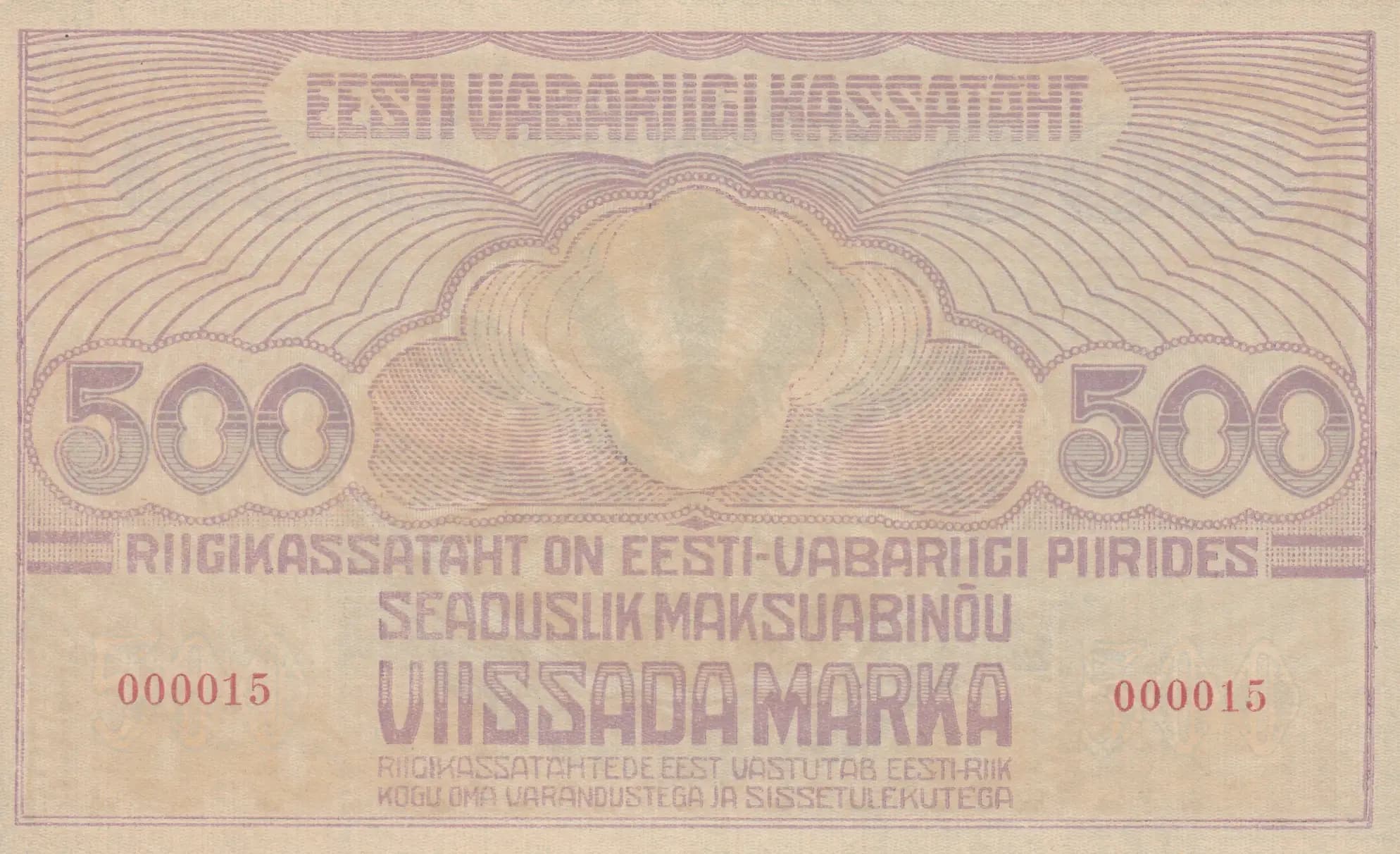
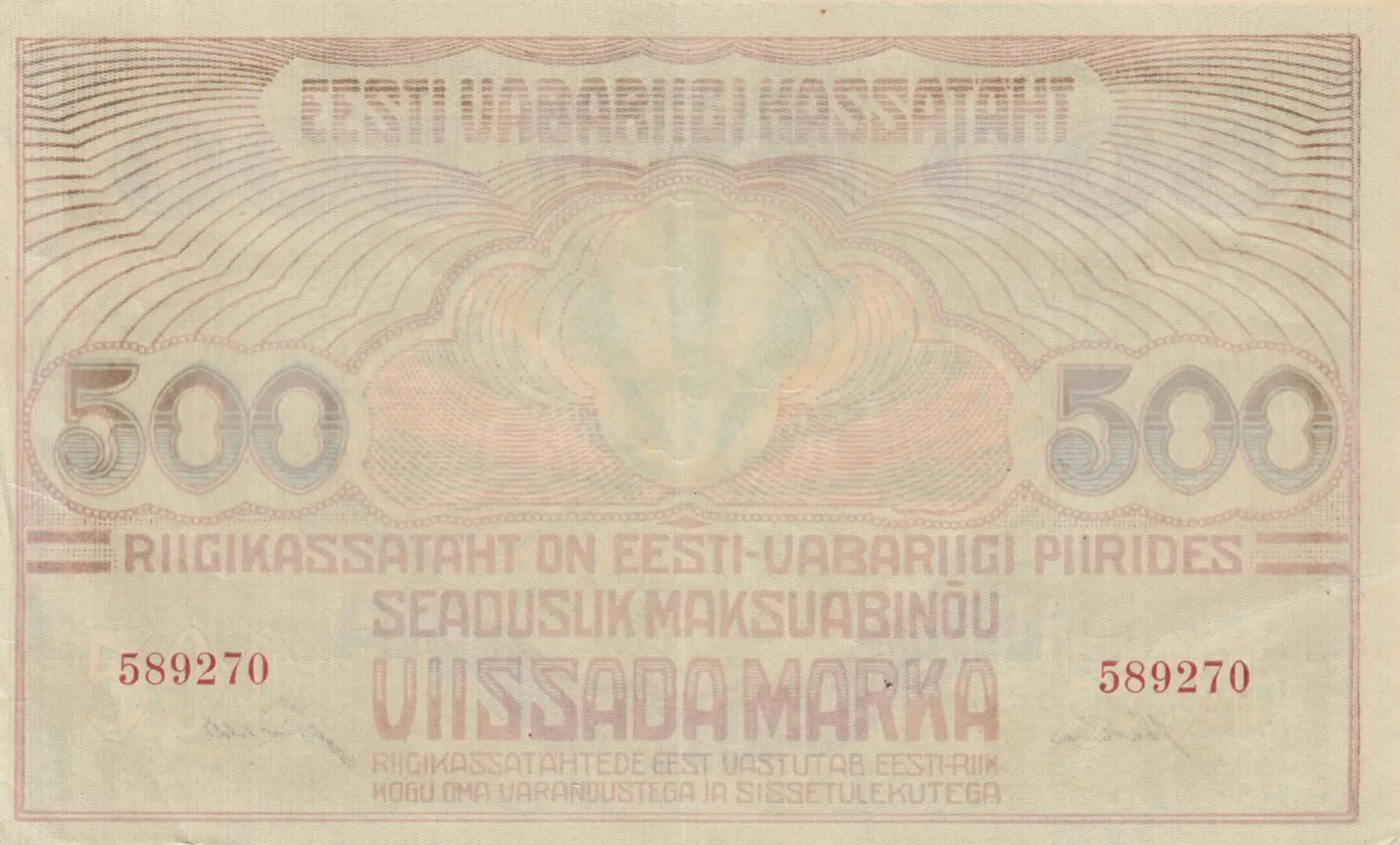
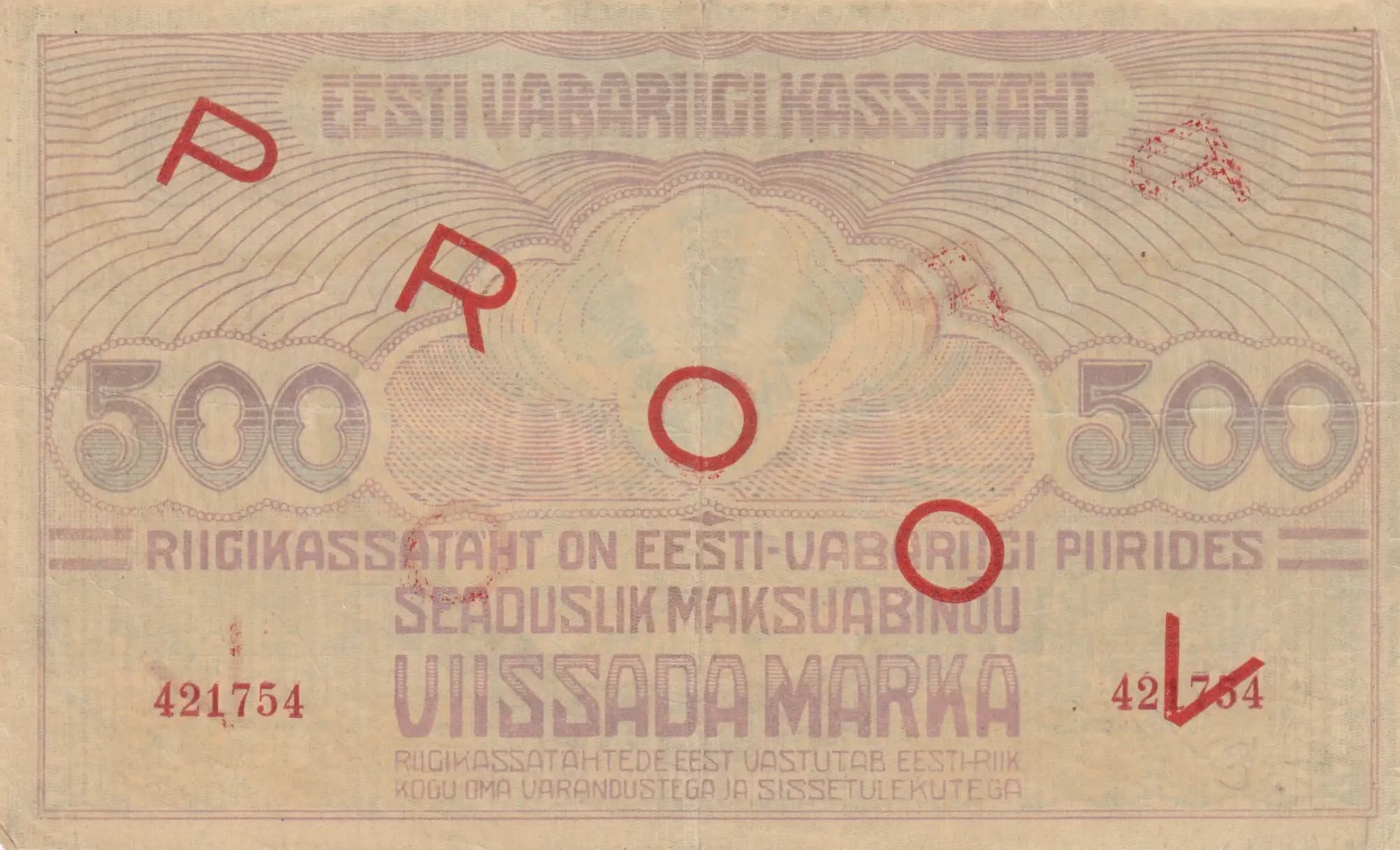
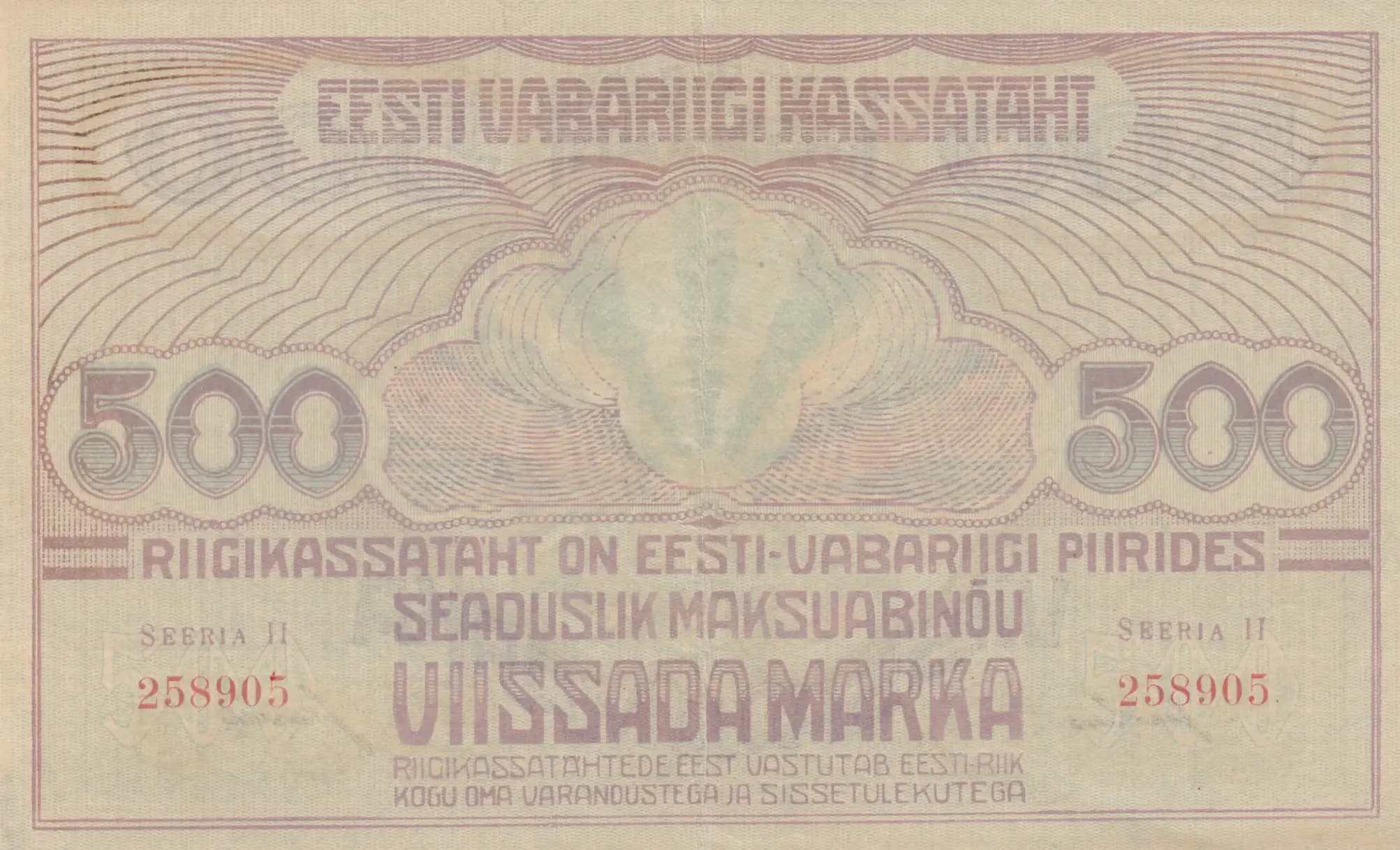
500 marka 1920 specimen
Market Prices
About This Note
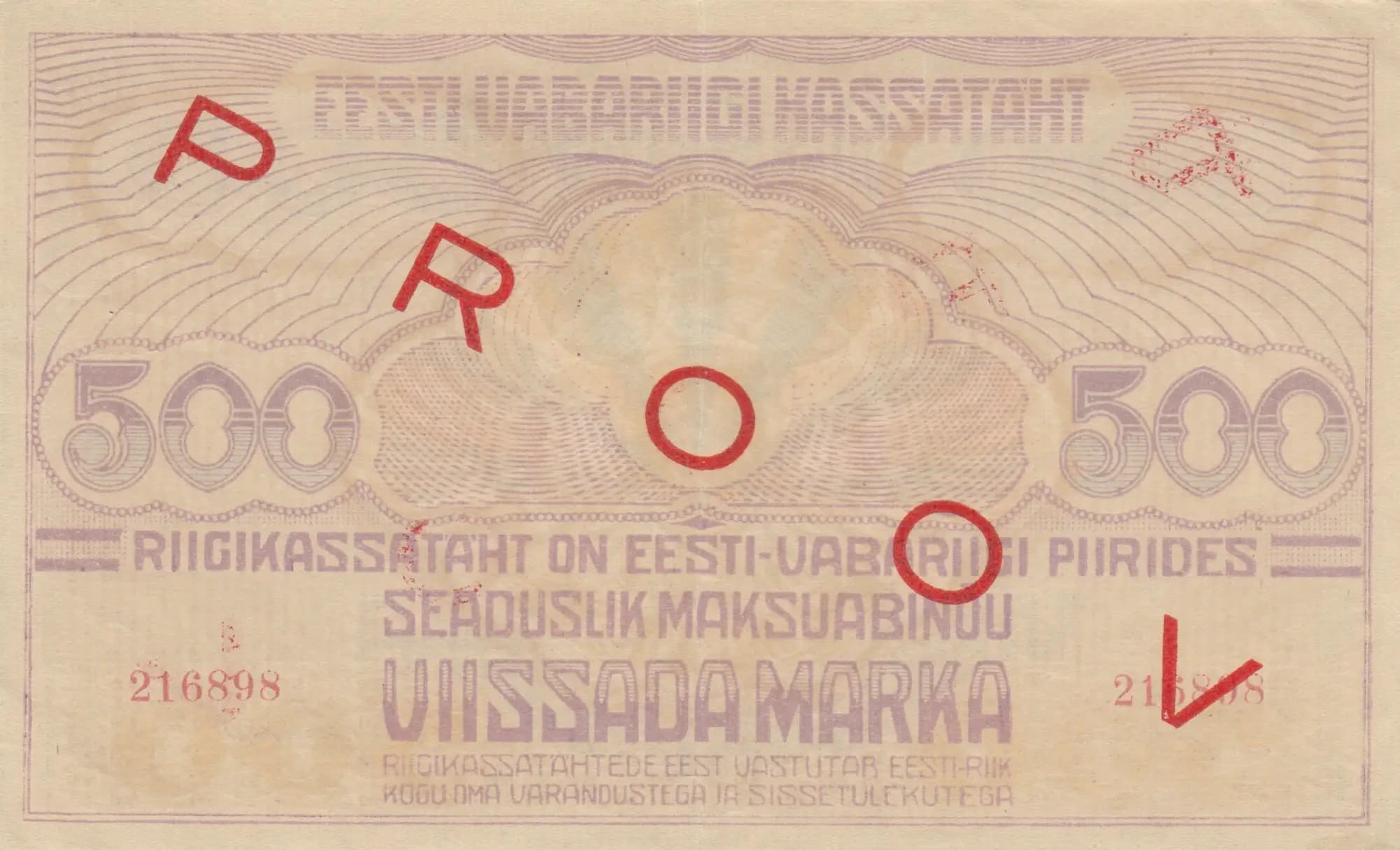
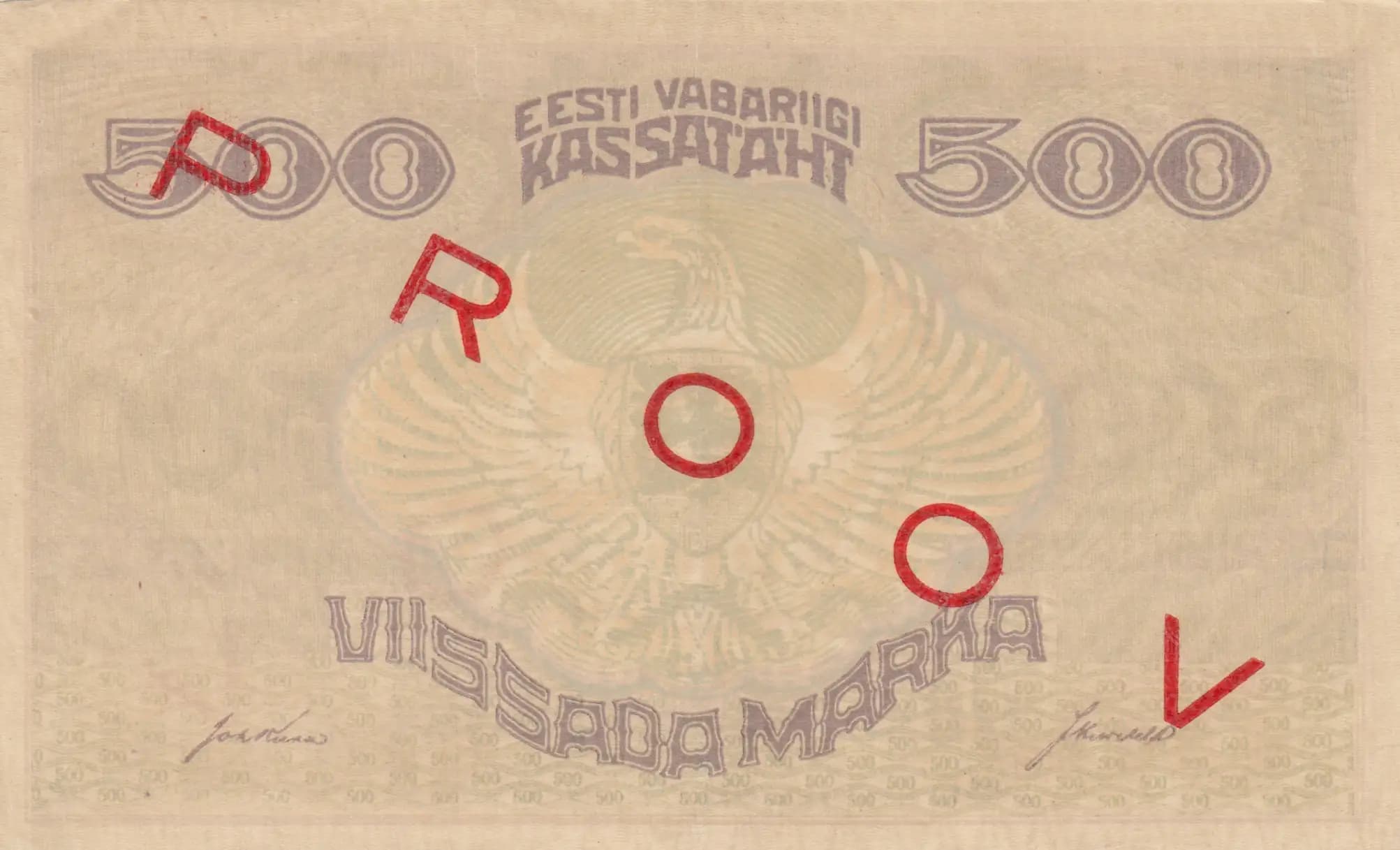
This is a 500 Marka specimen note from Estonia's 1920 Treasury issue, graded EF, distinguished by prominent red 'PROOF' overprints and specimen markings that identify it as a trial or presentation piece rather than circulation currency. The note displays the characteristic cream-colored paper with purple-toned designs typical of early Estonian currency, featuring an ornate shield design on the obverse and a striking double-headed eagle on the reverse. The specimen status, combined with excellent preservation and fine detail work, makes this an important example of Estonia's early numismatic history during the critical 1920-1921 period of national independence.
Common. The eBay market data shows a wide range of prices ($15–$669 USD) across various grades, with the majority of recorded sales in the $40–$250 range for EF to UNC grades, indicating regular availability of this denomination. While specimen and proof notes command premiums over circulated examples, the 500 Marka denomination itself appears in the market with sufficient frequency to be classified as common. The condition grade of EF and the specimen status place this example in a mid-range value tier, but it does not indicate scarcity for the Pick number.
The 500 Marka denomination was issued by the newly independent Estonian Republic's Treasury in 1920, representing the nation's first attempts at establishing sovereign monetary authority following independence from Russia. The double-headed eagle on the reverse reflects heraldic traditions common to Baltic and Northern European states, while the formal Estonian language inscriptions asserting the state's financial responsibility underscore the legitimacy and sovereignty of the fledgling nation. This specimen note exemplifies the technical capabilities and design ambitions of Estonia's early currency production during a period of rapid nation-building and economic stabilization.
The 500 Marka features a sophisticated two-sided design reflecting early 20th-century European currency aesthetics. The obverse displays an ornate oval or shield-shaped central vignette composed of concentric wavy lines forming a geometric pattern, surrounded by decorative border elements and flanked by denomination numerals '500' on both left and right margins. The reverse is dominated by a double-headed heraldic eagle with spread wings in the center, a symbol of sovereignty and authority commonly employed in Baltic and Northern European state heraldry. Both sides feature the same denomination display and are printed in purple-gray tones on cream-colored paper. The red 'PROOF' overprints and circular specimen stamps confirm this as a proof or specimen printing, likely created for approval or presentation purposes before the note entered production circulation.
FRONT SIDE: 'Eesti Vabariigi Kassataht' (Estonian State Treasury Note) / '500' and 'Viissada Marka' (Five Hundred Marks) / 'Riigikassataht on Eesti-Vabariigi piiriiides seaduslik maksuabinõu' (State treasury note is legal tender within the borders of the Estonian Republic) / 'Riigikassatahtede eest vastutab Eesti-Riik kogu oma varandusega ja sissetulevustega' (The Estonian State is responsible for state treasury notes with all its property and income) / '216898' (serial number) / 'PROOF' (specimen marking). BACK SIDE: '500' and 'Viissada Marka' (Five Hundred Marks) / 'Eesti Vabariigi Kassataht' (Estonian Republic State Treasury Note) / 'PROOF' (specimen marking).
The note employs intaglio (engraved) printing, evidenced by the fine line work visible in the heraldic eagle design, the ornate shield pattern, and the precision of the decorative borders. The purple-gray color work and the crisp definition of all text elements are characteristic of intaglio production typical of early 1920s European currency manufacture. The red specimen overprints appear to have been applied as a separate operation, likely via stamp or secondary printing, to designate the note's status as a trial or presentation piece. The security features, while limited by 1920 standards, include the intricate geometric wavy line patterns serving as background anti-counterfeiting design elements.
This note is cataloged as P-49as, indicating it is a specimen variant of the standard P-49 issue. The PMG Population Report identifies P-49b and P-49es (with 'EV' watermark) as known variants for this Pick number. The specimen markings, red 'PROOF' overprints, serial number 216898, and the absence of the 'EV' watermark visible in this image suggest this example may represent a distinct specimen printing. The red overprints and circular stamps are consistent with trial or presentation specimens created during the design approval process. Verification of whether this represents P-49as or another cataloged variant would require comparison with referenced specimens.