500 marka 1919
“1.04.19”
About This Note
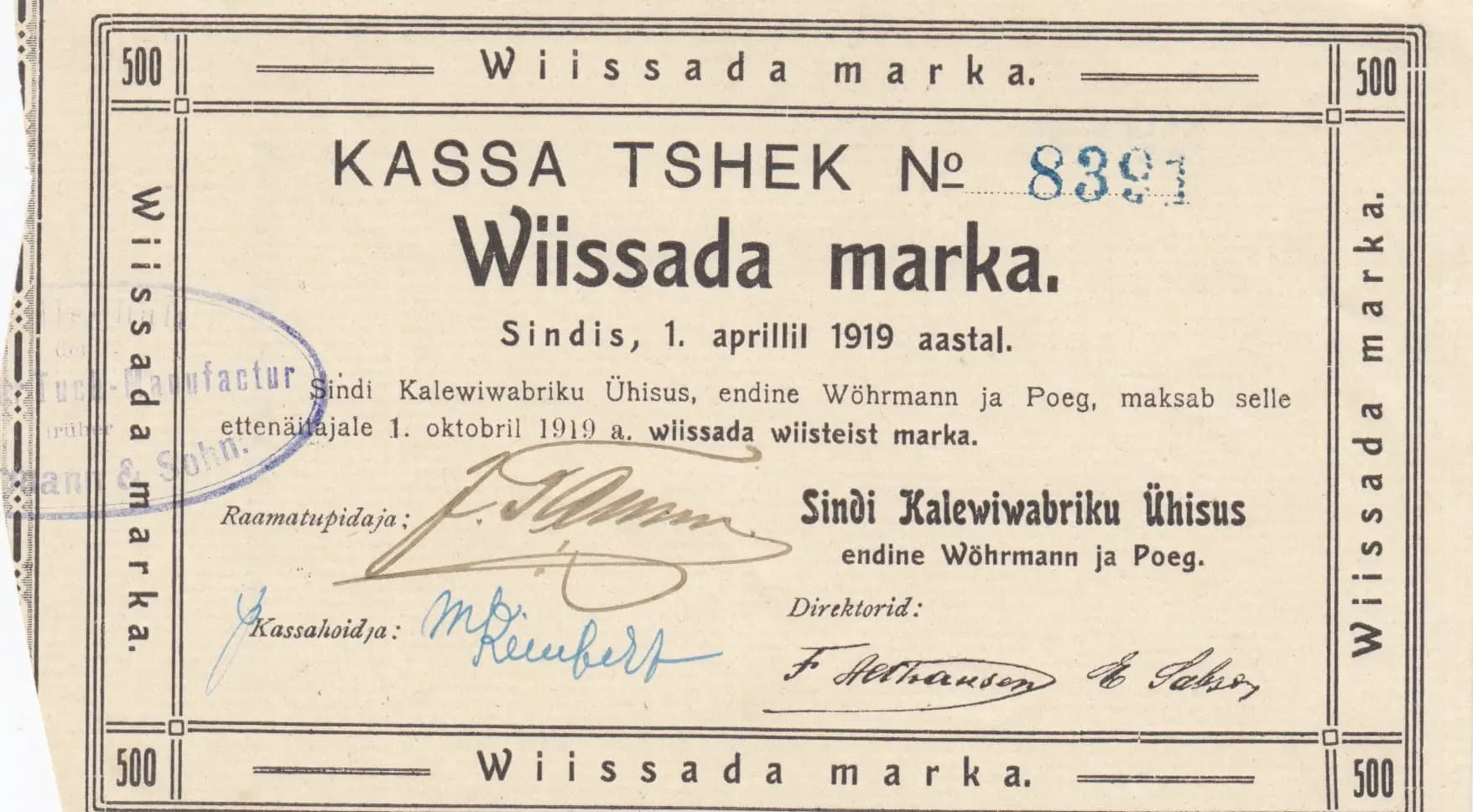
This is a scarce 500 marka cash check issued by Sindi Kalevivabrik (formerly Wöhrmann and Poeg) dated April 1, 1919, during Estonia's critical transition to independence. The document features a formal administrative layout with decorative corner elements and handwritten signatures by company officials (Directors and Cashier), bearing the maturity date of October 1, 1919. The specimen exhibits UNC condition with excellent paper preservation, minimal wear, and original blue ink signatures, making it a well-preserved example of early Estonian corporate financial instruments from the immediate post-independence period.
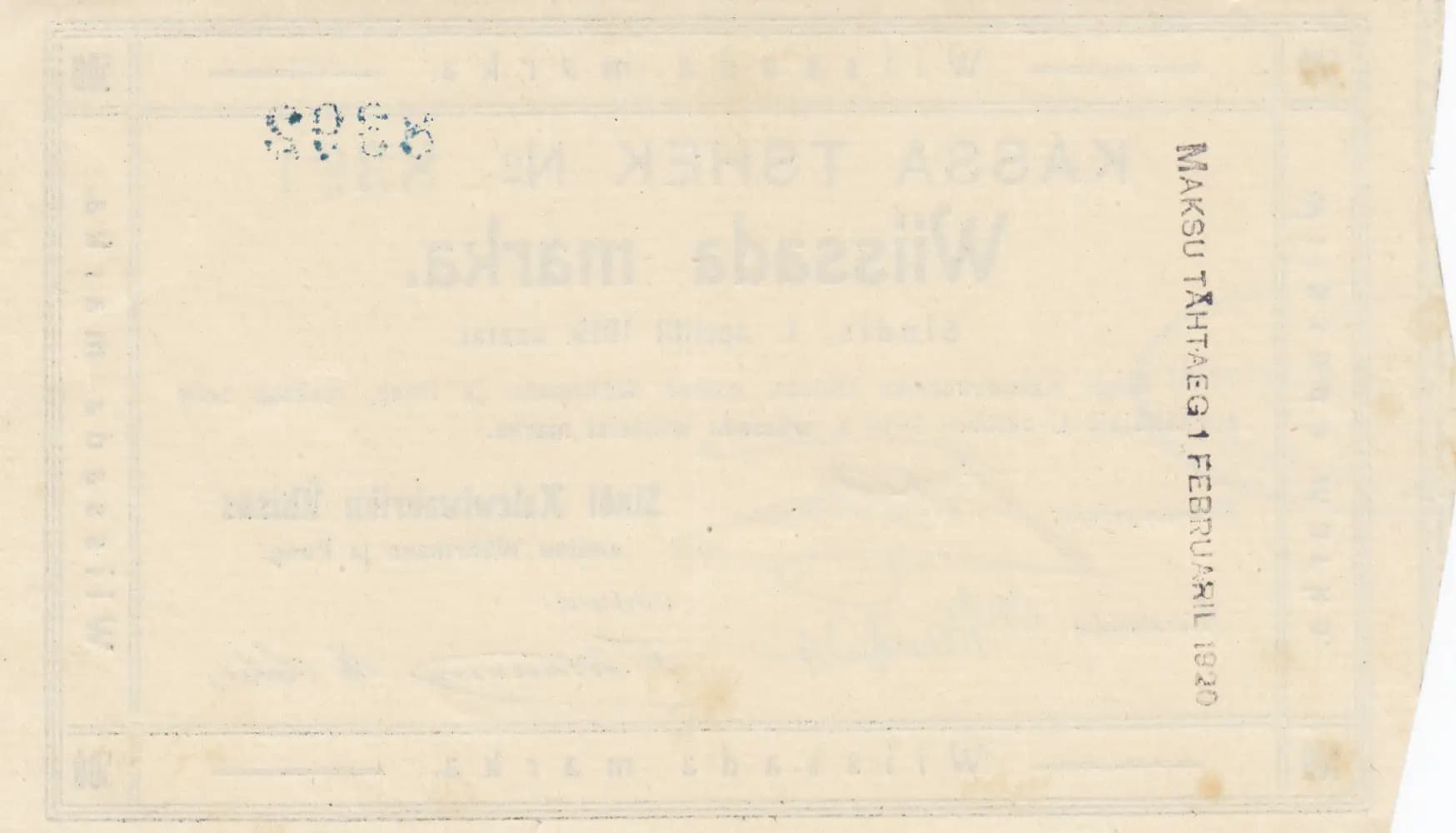
Scarce. While Estonian private industrial notes from 1919-1920 were issued in response to the currency shortage, surviving examples remain relatively uncommon in numismatic commerce. This specific Sindi Kalevivabrik issue is unlisted in the Pick catalog, indicating it falls outside the standard reference works for official Estonian currency. The six-month maturity structure suggests these were intended as temporary credit instruments that would be redeemed and removed from circulation, reducing the likelihood of long-term survival. The back-side notation 'MAKSUTSHEKK FEBRUARIL 1920' (Tax Check February 1920) suggests systematic processing and potentially destruction of fulfilled obligations. UNC specimens with original signatures and minimal handling are particularly uncommon, as most surviving examples show evidence of circulation or storage damage. This combination of factors—unlisted status, industrial origin, time-limited function, and excellent preservation—makes it a desirable research specimen for Estonian numismatic and economic historians.
This note represents a crucial moment in Estonian financial history, issued during the brief window between the declaration of independence (February 24, 1919) and the establishment of the official Estonian currency system. The Sindi Kalevivabrik was a prominent industrial concern that, like many Estonian enterprises, issued its own credit instruments when official government currency was unavailable or in short supply. The bilingual Estonian/Russian terminology and the factory's use of a six-month maturity structure reflect the transitional economic chaos of the early independence period, when private companies filled the monetary vacuum left by Russian imperial withdrawal.
This is a corporate promissory note/cash check rather than a circulating banknote, structured as a formal financial instrument. The front features a simple but dignified decorative border frame with ornamental corner elements, each containing the denomination '500' in stylized typography. The body text is centered in formal administrative layout, printed entirely in Estonian using Gothic/Fraktur typeface characteristic of the period. Three signature lines are provided for the company's financial officers (Accountant, Directors, and Cashier), with visible original handwritten signatures in blue ink. The document includes a circular stamp or seal impression in the upper left area, suggesting official authorization or processing. The back side is predominantly blank except for minimal stamping, indicating this served as a negotiable financial document rather than a decorative or collector piece. The overall aesthetic is utilitarian and businesslike, reflecting the serious economic conditions of 1919 Estonia.
FRONT SIDE: Principal denomination text: 'Wiissada marka' (Five Hundred Marks). Document identification: 'KASSA TSHEK № 8391' (Cash Check No. 8391). Issuing statement and date: 'Sindis, 1. aprillil 1919 aastal' (In Sindis, April 1, 1919). Payment obligation: 'Sindi Kalewiwabrikü Ühisus, endine Wöhrmann ja Poeg, maksab selle ettenaeljale 1. oktoobril 1919 a. wiissada wilsteist marka' (Sindi Kalewiwabrikü Union, formerly Wöhrmann and Poeg, pays this bearer on October 1, 1919, five hundred marks). Signatory designations: 'Raamatupidaja' (Accountant), 'Direktorid' (Directors), 'Kassahoidja' (Cashier). Company name repeated: 'Sindi Kalewiwabrikü Ühisus endine Wöhrmann ja Poeg'. BACK SIDE: 'MAKSUTSHEKK FEBRUARIL 1920' (Tax Check February 1920), numerical reference '2908'.
Letterpress printing (relief printing) for the main text, border frame, and corner ornaments, executed in black ink on cream-colored paper stock. The decorative corner elements with denomination markers show characteristics consistent with engraved or finely-detailed letterpress dies. The three-language inscription elements suggest professional print shop production rather than emergency printing. Blue ink handwritten signatures were applied by authorized company officials after printing, representing the personalization and authorization phase. The circular stamp/seal on the obverse appears to be an inked impression rather than embossed. The printer is not explicitly identified on the note itself, but the professional quality suggests production by an established Estonian or Baltic print shop, likely in Tallinn or Tartu.
Serial number 8391 appears on the obverse under 'KASSA TSHEK №', with back-side reference number 2908 possibly indicating a separate accounting system. The handwritten signatures present on this specimen represent individual authorization by company officials and would vary across the print run. The date combination (April 1, 1919 issuance with October 1, 1919 redemption) is specific to this documented note. The back-side notation 'FEBRUARIL 1920' suggests this particular note may have been processed or verified during a subsequent administrative review in February 1920, possibly indicating a revalidation or delayed redemption. Given the corporate origin and small likely print run, variations in signature combinations, dating, and serial number ranges would constitute distinct collector varieties, though no formal catalog varieties are currently recognized for this unlisted issue.