500 marka 1919
“1.02.19”
About This Note
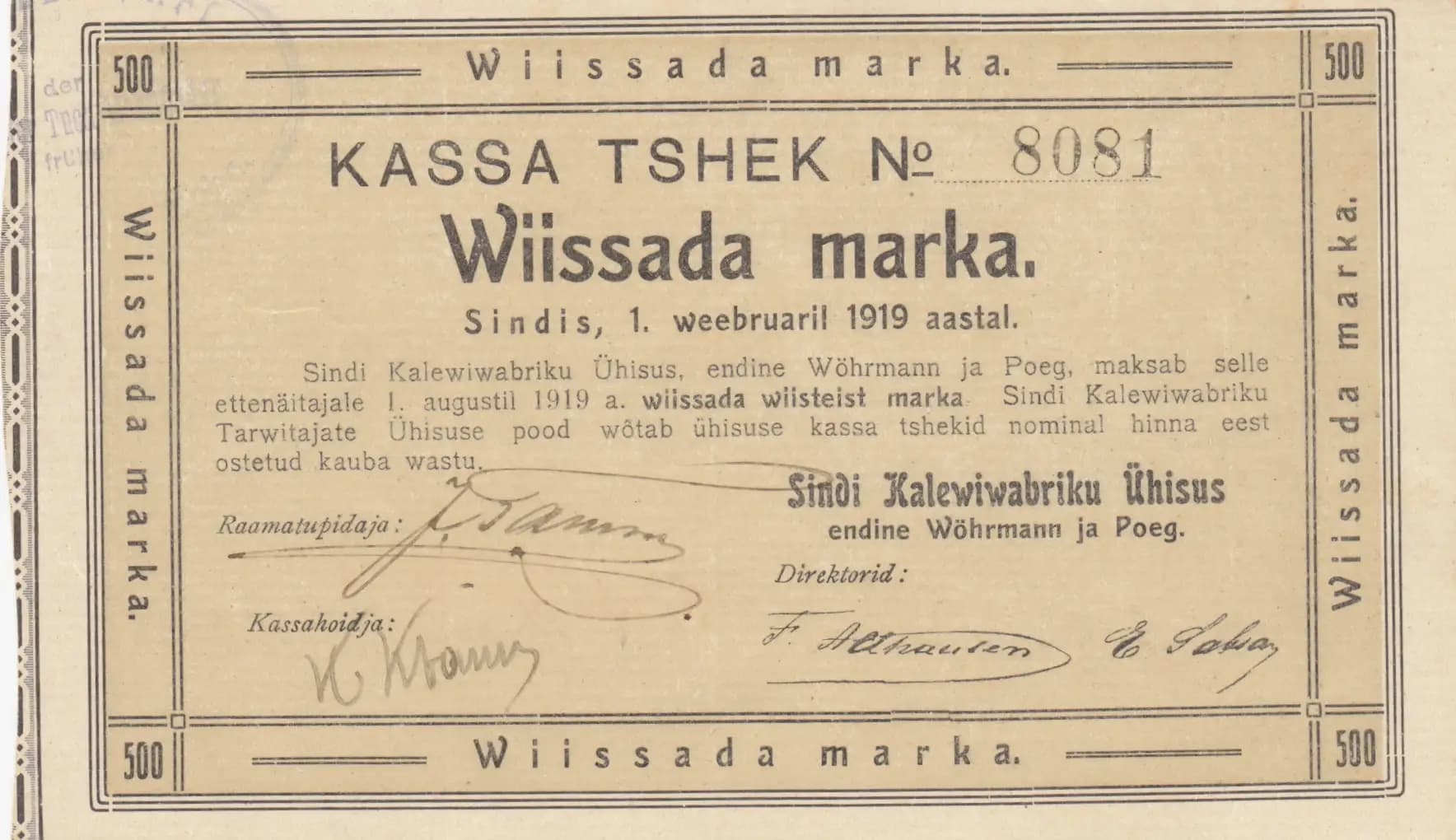
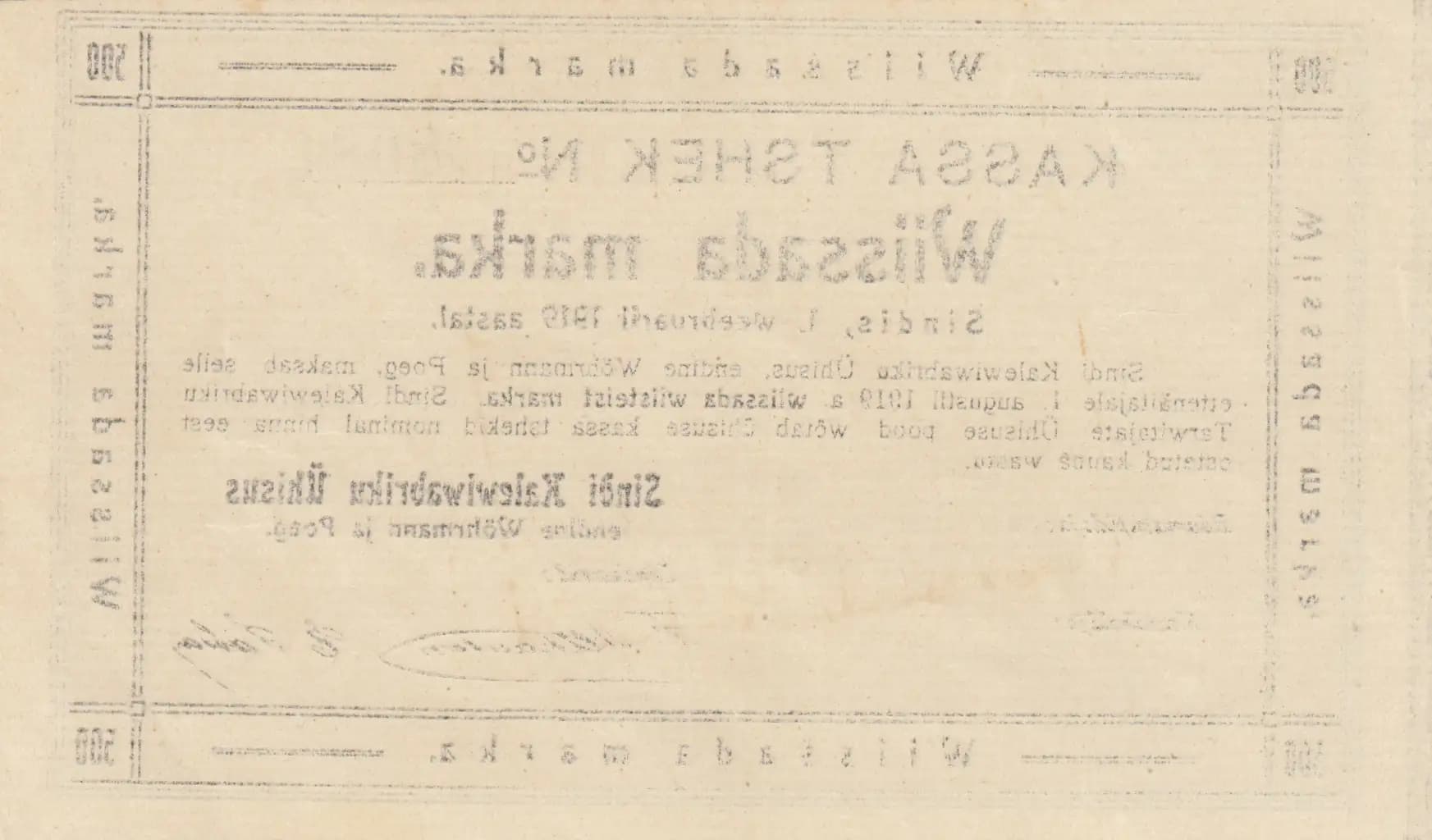
This is a rare emergency currency issued by the Sindi Kalewiwabriku (Sindi Factory Association) on 1 February 1919, redeemable on 1 August 1919 for 500 marks. The note features ornate borders with corner denominations in a cream/beige color scheme with black text and decorative linework, bearing handwritten signatures of company officials including the bookkeeper and directors. The front side is well-preserved in UNC condition with minimal wear, though the reverse side shows severe fading consistent with early 20th-century paper aging, making it an interesting example of Estonian emergency currency from the independence period.
Rare. This note is unlisted in the Pick catalog and represents an emergency issue from a specific industrial cooperative during the critical early independence period of Estonia. Emergency currency from local Estonian institutions in 1919 is scarce, as most have not survived or been widely documented. The specific combination of the Sindi Kalewiwabriku issuer, the 500 mark denomination, the 1 February 1919 date, and the serial number 8081 makes this a specialized collector item. The fact that it is unlisted in Pick suggests limited documentation and circulation among mainstream numismatic catalogs. Very few examples of such local Estonian emergency scrip would be expected to survive in UNC condition.
This emergency cash check was issued during a critical period in Estonian history, just days after Estonia declared independence on 24 February 1918, when the young nation faced severe currency shortages and relied on local institutions to issue scrip. The Sindi Kalewiwabriku Association (formerly Wöhrmann and Poeg), an industrial cooperative in the town of Sindi, issued this note as a substitute for official currency, backed by the promise of redemption in marks and acceptance at the consumer cooperative store. The bilingual inscriptions in Estonian and German reflect the transitional period when Estonian was asserting itself as the primary language while German remained influential from the Baltic German merchant and industrial class.
The note employs a classical design with ornate decorative borders featuring corner denominations and formal linework in black on cream/beige colored paper. The design is centered and symmetrical, typical of commercial cash checks and emergency currency of the period. No portraits, landmarks, or symbolic imagery are present—the note relies entirely on typography and decorative borders for visual appeal. The layout includes three signature lines for official signatories (Raamatupidaja/Bookkeeper, Kassahoida/Cashier, and Direktorid/Directors), with visible handwritten signatures in cursive script, one appearing to read 'Vöhrman' or similar. The note functions as a bearer check, redeemable on a specific future date (1 August 1919), representing a form of post-dated commercial paper rather than currency in the modern sense.
FRONT SIDE: Corner denomination: 'Wiissada marka' (Five hundred marks) and numeric '500'. Title: 'KASSA TSHEK № 8081' (Cash Check No. 8081). Date line: 'Wiissada marka. sindis, 1. weebruarii 1919 aastal.' (Five hundred marks. in Sindi, 1st February 1919). Main text: 'Sindi Kalewiwabriku Ühisus, endine Wöhrmann ja Poeg, maksab selle ettenäitajale 1. augustil 1919 a. wiissada wiisteist marka. Sindi Kalewiwabriku Tarwitajate Ühisuse pood wõtab ühisuse kassa tshekid nominal hinna eest osetud kauba vastu.' (Sindi Kalewiwabriku Association, formerly Wöhrmann and Poeg, pays the bearer on 1st August 1919 five hundred marks. Sindi Kalewiwabriku consumers association store accepts cash checks at nominal price for purchased goods). Company name: 'Sindi Kalewiwabriku Ühisus endine Wöhrmann ja Poeg.' (Sindi Kalewiwabriku Association, formerly Wöhrmann and Poeg). Signature lines: 'Raamatupidaja:' (Bookkeeper:), 'Kassahoida:' (Cashier:), 'Direktorid:' (Directors:). BACK SIDE: Text heavily faded and illegible, appears to contain mirror-image reproduction of front side inscriptions.
The note was produced using letterpress or typographic printing, evidenced by the crisp black text and decorative linework characteristic of early 20th-century commercial printing. The formal typography and uniform impression quality suggest professional printing by a commercial printer, likely Estonian or Baltic German. The severe fading on the reverse side may indicate lighter impression pressure or inferior paper quality on that side, or alternatively, deterioration of inks over time. The handwritten signatures were added post-printing in cursive script using fountain pen or similar implement. The printer/security printer is not identified on the note itself.
Serial number 8081 identifies this as the 8081st check issued in this series. Varieties within the same issue would be determined by: (1) different signature combinations (different bookkeepers, cashiers, or directors signing), (2) different serial numbers within the same design, and (3) condition variations. The visible signatures appear to include 'Vöhrman' or similar for the bookkeeper position, which may distinguish this from other examples. Without access to cataloged varieties, specific variety classification cannot be determined, but this serial number and signature combination constitute the basic variety identifier for this specific example.